On this page
- What is podcast guesting for real estate agents?
- Should you be a guest or start your own podcast?
- What does the full guesting system look like?
- Step 1: What should you be known for as a guest?
- Step 2: What goes on a real estate agent’s podcast one-sheet?
- Step 3: Which shows should you pitch?
- Step 4: How do you pitch a podcast host?
- Step 5: How should you prepare for the interview?
- Step 6: What should you say on the show?
- Step 7: How do you promote the episode?
- Step 8: What follow-up turns one episode into a referral?
- Step 9: How do you track leads from podcast appearances?
- DIY, marketplace, booking agency or network: which booking route fits?
- What are the red flags when hiring a podcast booking agency?
- What compliance rules apply when you speak on a podcast?
- Next step
Podcast guesting for real estate agents means appearing as the expert on other people’s shows so you reach their listeners without producing your own. It works when you run it as a system: pick one angle, build a one-sheet, pitch local and referral-friendly shows, promote every episode to your sphere, and tag each lead in your CRM.
Below: the guest-or-host decision, the nine-step process from first pitch to closed referral, four ways to get booked, and the compliance points that trip agents up on air. Narrower how-tos live on the podcast guesting topic page.
What is podcast guesting for real estate agents?
Podcast guesting is the practice of being interviewed on someone else’s show as a subject expert. The host brings the audience, the editing and the publishing. You bring stories, opinions and one clear reason to contact you.
For an agent, the value isn’t the download count. An episode does three jobs for you:
- It reaches buyers and sellers in your market when the show is local, such as a city business show, a parenting show or a community news podcast.
- It puts you in front of other agents when the show is an industry show. Agents in other markets refer clients who are moving to your area.
- It gives you proof. A recorded conversation you can send to a seller before a listing appointment does more than a line in your bio that says “local expert.”
The trap is treating one appearance as a lottery ticket. One episode rarely produces a deal on air day. Ten episodes, each promoted and tracked, give you a pattern you can act on.
Should you be a guest or start your own podcast?
Start as a guest unless you already have a weekly content habit and a budget for production. Guesting costs you a few hours per appearance. Hosting is a weekly commitment that pays off over months, not weeks. Many agents do both later: guest to test their message, then host once they know what people respond to. Our host vs guest comparison scores the choice on your time, budget and goals.
| Question | Guesting on other shows | Hosting your own show |
|---|---|---|
| Time per month | A few hours per appearance, plus pitching time | Recording, guest booking and promotion every week, unless you hire production |
| Upfront cost | Low: a decent mic, a webcam and your time | Higher: equipment, editing, hosting and cover art, or a production service |
| Audience | Borrowed from the host on day one | Built from zero, starting with your sphere |
| Control | The host picks the questions, the edit and the release date | You control the topics, the guests and the calls to action |
| Lead type | Referrals from other agents, credibility, some local consumers | Referral partners you interview, local consumers, recruits if you run a team |
| Compliance load | Your own words on air | Your words, your guests’ words and every episode description |
| Best fit | Agents testing podcasting, newer agents, agents with little spare time | Agents with a clear niche, a team, or a sphere they want to stay in front of every week |
Leaning toward hosting? The 10-step plan for launching your own real estate podcast lays it out, and the podcast cost and ROI numbers show what a year of production runs.
What does the full guesting system look like?
The guesting system has nine steps in three phases: get ready, get booked, and turn episodes into business. You set up the first phase once and refresh it each quarter. Pitching and interviews run every week. Promotion, follow-up and tracking happen after every single episode, and that’s the phase most agents skip.
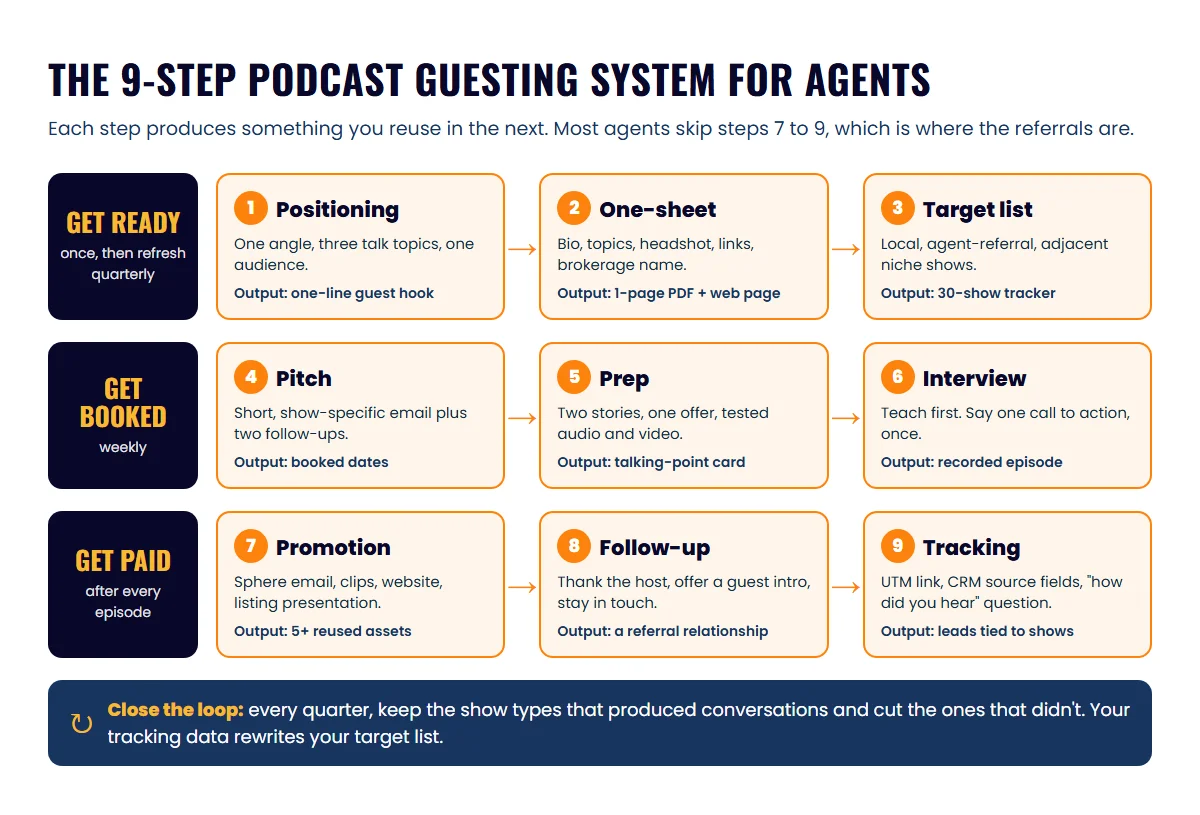
Each section below covers one step, in order.
Step 1: What should you be known for as a guest?
Pick one angle you can talk about for 30 minutes without notes, then write three topics under it. Hosts book a clear angle, not a job title. “Real estate agent in Tampa” is a job title. “The agent who helps families relocate to Tampa for hospital jobs” is an angle.
A useful angle sits where three things meet:
- What you’ve done a lot of. Deals, a niche, a property type, a client group.
- What a show’s listeners need. A first-time buyer show wants down-payment stories. An investor show wants numbers.
- What brings you business. If you want listings, talk about selling. If you want relocation referrals, talk about moving.
Write your angle as one sentence a host could read aloud as your intro. Then list three talk topics, each phrased as a promise to the listener. Your personal brand should match this angle, so the person who looks you up after the episode finds the same story on your website and social profiles. Newer agents can still find an angle; see whether it’s too early to be a podcast guest as a new agent.
Step 2: What goes on a real estate agent’s podcast one-sheet?
A podcast one-sheet is a one-page summary that tells a host who you are, what you’ll talk about and why their listeners will care. Hosts use it to decide whether to book you and to write your intro. Keep it to one page, as a PDF and as a page on your website. Our podcast one-sheet template for agents has annotated examples.
| Section | What to include | Agent-specific tip |
|---|---|---|
| Name and hook | Your name, headshot and your one-sentence angle | Use the same headshot as your website and portal profiles |
| Short bio | 50 to 80 words in the third person | Lead with what you help people do, then your market and experience |
| Talk topics | Three topics, each with a one-line promise | Offer one consumer topic and one agent-to-agent topic |
| Sample questions | Five questions the host can ask you | Hosts are busy, and ready-made questions get you booked faster |
| Proof | Past appearances, speaking, awards you can document | Only list numbers you can back up, and ask your broker before quoting production stats |
| Links | Website, one social profile, a booking or contact link | Point to a page built for listeners, not your general homepage |
| Brokerage | Your brokerage name, as your broker requires | Advertising rules usually require it, so build it in from the start |
Leave off anything that reads like a listing flyer. Hosts want a guest, not an ad.
Step 3: Which shows should you pitch?
Pitch shows whose listeners can hire you or refer you. Build a list of about 30 shows across four tiers, and filter each one by where its listeners live. Search tactics for finding local podcasts to guest on get their own walkthrough; here the question is which shows deserve a pitch.
The four show tiers
- Local consumer shows. City business shows, chamber of commerce podcasts, parenting and school community shows, local food or lifestyle shows. These reach buyers and sellers you can serve directly.
- Agent-to-agent shows. Industry interview shows with agent audiences across the country. These produce referrals into your market.
- Adjacent niche shows. Relocation, personal finance, retirement, divorce, estate planning, military families, small business. These listeners have a reason to move, and few agents pitch them.
- Investor shows. Worth it if you work with investors. If you don’t, the leads won’t fit your business.
The licensed-geography filter
Your license limits who you can serve directly. Before you pitch, ask one question: if a listener calls me tomorrow, can I help them or refer them? A distant show can still pay, and guesting outside your licensed market explains when.
| Where the show’s listeners are | What it can produce for you | Priority |
|---|---|---|
| Inside your licensed market | Direct buyer and seller leads, local credibility | High |
| National, mostly agents | Agent-to-agent referrals into your market | High |
| National, consumers | Relocation clients moving to your area, outbound referrals you can pass on | Medium |
| Another market, consumers | Outbound referral fees at best, if your state and brokerage allow them | Low |
Your tracker columns
Keep the list in a spreadsheet from day one. Columns that earn their place:
- Show name, host name, contact method
- Tier (local, agent, adjacent, investor) and listener geography
- Angle you’ll pitch
- Date pitched, follow-up 1, follow-up 2, outcome
- Record date, air date, episode link
- Leads attributed (filled in at Step 9)
Step 4: How do you pitch a podcast host?
Send a short email that proves you listened, offers one specific topic and makes saying yes easy. Long pitches get skimmed. Generic pitches get deleted. Five to seven sentences is plenty.
Before you write, listen to at least one recent episode. Note one specific moment you can mention. That single line separates you from the mass pitches every host receives.
Plenty of bookings come from the follow-up. Hosts are busy, and inboxes bury things. Wait about a week, then send one short nudge. Wait another week or two and send a final note that offers a different topic. Five copy-paste podcast pitch follow-up emails cover the timing and the usual stalls.
After the second follow-up, stop. Mark the show “no reply” in your tracker and try again in a few months with a fresh angle. If you want ready-made questions to attach to a pitch, the interview question generator gives you a starting list to edit.
Step 5: How should you prepare for the interview?
Prepare two stories, one offer and a working setup, then stop. Over-prepared guests sound scripted. Under-prepared guests ramble.
- Listen to two episodes. Note the host’s style, episode length and how they end the show. The questions hosts ask real estate agents come up on most shows, so draft answers to those too.
- Write two stories from real transactions. Each should have a problem, what you did and the result. Remove anything that identifies a client.
- Write your one offer. A guide, a checklist or a short page built for that show’s listeners. More on this in Step 6.
- Test your setup the day before. USB or XLR mic, wired headphones, a webcam at eye level, light in front of you, notifications off.
- Make a talking-point card. Your angle, the three topics, two stories and your offer on one index card or sticky note.
- Send the host what they need. Headshot, short bio, link to your offer and how to pronounce your name.
Many shows now record on video. If yours does, the episode doubles as source material for clips, so dress and light yourself the way you would for a listing video.
Step 6: What should you say on the show?
Teach the audience something useful, tell stories instead of listing credentials, and mention one call to action once, near the end. Listeners decide whether to trust you in the first few minutes, so lead with substance, not your sales volume.
Stories beat credentials
A credential line, for example “I’ve closed 200 homes,” tells listeners nothing they can use. A story about a seller who almost lost a buyer over a failed inspection, and how you saved the deal, shows them how you think. Keep each story under two minutes.
One offer, said once
Pick one thing for listeners to do, and make it specific to that show. A good offer is free, useful and easy to remember. Our podcast guest call-to-action scripts give you versions for different shows.
The short web address matters. People hear it while driving. A vanity address that redirects to your tracked page (see Step 9) is easier to remember than a long link.
How to not sound salesy
- Answer the question the host actually asked.
- Give away your best tip. Listeners hire the agent who seems to know more than they shared.
- Talk about clients’ problems, not your awards.
- Skip “call me for a free home valuation” on a national show. Nobody outside your market can use it.
Step 7: How do you promote the episode?
Promote every appearance to your own audience, because the host’s listeners are only half the value. The other half is using the episode as proof with people who already know you. Our checklist for after a podcast interview lays out a seven-day release plan.
| Asset | What to do with the episode | Why it works for agents |
|---|---|---|
| Sphere email | Send it to past clients and your database with one line on what you discussed | Gives your sphere a reason to forward you to friends |
| Social clips | Cut two or three 30 to 60 second clips on your best answers | Clips travel further than full-episode links |
| Website | Add a “Featured on” or “Media” page with the episode embedded | Builds trust with people who look you up |
| Listing presentation | Add one slide or a QR code linking to the episode | Sellers hear how you think before you pitch them |
| Google Business Profile | Post the episode as an update with a short summary | Adds fresh, local content to your profile |
| Agent network | Share it in referral groups and with agents in feeder markets | Reminds referral partners what you’re good at |
Tag the host and the show on every social post. Hosts notice guests who help their numbers, and they remember them when another booking slot opens. The content lead generation pillar shows how one episode becomes a week of posts and emails.
Step 8: What follow-up turns one episode into a referral?
Thank the host within 48 hours, offer something useful back, and stay in touch. The host is often more valuable than any single listener, because hosts know other hosts and many of them are agents or referral partners themselves.
A strong post-episode follow-up does three things:
- Thanks the host for something specific in the conversation.
- Gives something back. Introduce a guest you think they’d like, or share their episode with your list and tell them you did.
- Opens the door. Ask if they know another show whose listeners would like the same topic.
Then add the host to your CRM as a referral partner. A short check-in every quarter keeps you on their mind when someone asks them for an agent in your city. If the host is a lender, title rep or inspector, read the ground rules for referral-partner podcast episodes before you discuss any joint marketing.
Step 9: How do you track leads from podcast appearances?
Track podcast leads with three tools working together: a unique tagged link for each episode, source fields in your CRM, and a “how did you hear about me” question in every first conversation. Each method catches leads the others miss, and the six-stage guest lead funnel shows where each lead enters.
1. A tagged link for every episode
UTM parameters are tags you add to the end of a web address so your analytics can tell which campaign sent a visitor. Google’s guidance is to always include three of them: utm_source, utm_medium and utm_campaign (Google Analytics Help).
Use lowercase and the same naming pattern every time, or your reports will split one show into three rows.
2. CRM fields that make attribution possible
Add these fields to your CRM before your first episode airs:
| CRM field | Example value | Why you need it |
|---|---|---|
| Lead source | Podcast guest | Lets you compare podcasting with portals, ads and open houses |
| Source detail | City Business Show, Oct 2026 | Ties the lead to one specific episode |
| How they found the episode | Heard it, sphere email, clip, referral from host | Shows which promotion step works |
| Referring agent or host | Name, if any | Credits referral partners and tracks referral fees |
| First contact date | 2026-10-21 | Measures how long episodes take to produce leads |
| Stage and closed commission | Active buyer / closed, with amount | Turns “it felt good” into a number |
3. The question that catches everything else
Some podcast leads never click a link. They hear the episode, search your name weeks later and call. Ask every new contact the same question and log the answer: “Out of curiosity, how did you first hear about me?” If they say a podcast, ask which one.
To put a dollar figure on it, plug your own average commission and close rate into the podcast ROI calculator.
DIY, marketplace, booking agency or network: which booking route fits?
The right route depends on whether you have more time or more budget. DIY costs only hours. Marketplaces cut search time but you still pitch; our comparison of podcast guest booking platforms shows what each one publishes. Booking agencies and networks do the pitching for a monthly fee; our breakdown of what a podcast booking agency costs prices retainer, per-placement and subscription models per appearance. The table compares the four routes on what matters to an agent.
| DIY pitching | Guest marketplace | Booking agency | Real estate network (e.g. the ICONS Hub) | |
|---|---|---|---|---|
| Who finds shows | You | You, from the platform’s listings | The agency | The network’s team, from a real estate show list |
| Who pitches | You | You, often through the platform | The agency | A coordinator on paid plans |
| Your time | Highest: research, pitches, follow-ups | Medium | Low: prep and the interview | Low on paid plans; you apply yourself on a free plan |
| Cost | Your time only | Usually a subscription; check current pricing | Usually a monthly retainer or per-booking fee; get it in writing | Published plans, listed below |
| Real estate fit | As good as your list | Depends on how many real estate shows are listed | Varies; many agencies focus on business coaches or investors | Built around real estate shows |
| Best for | Agents with spare hours who enjoy outreach | Agents who want leads on shows but will pitch themselves | Agents with budget and no time, who vet the agency carefully | Agents who want real estate shows specifically without pitching |
Here’s how the ICONS Hub plans work, since it’s our own option. The free Icons Lite plan gives you a speaker profile and lets you apply to be a guest on one podcast yourself. Concierge is $87 a month and guarantees 2 podcast bookings every month, with a dedicated human coordinator and a speaker media kit that includes a one-sheet. Momentum is $165 a month and guarantees 4 bookings every two months, with priority matchmaking. Paid plans have a 7-day free trial, and payment details are required for every plan, including Lite. The ICONS podcast network includes 120+ agent podcasts. Details are on the podcast guesting page.
What are the red flags when hiring a podcast booking agency?
The biggest red flags are promises nobody can keep and terms you can’t see. A booking agency controls the shows you appear on and the message that goes out under your name, so vet it like you’d vet a listing photographer who represents your brand. Our full list of podcast booking agency red flags explains each warning sign.
Walk away, or ask hard questions, if you see any of these:
- Guaranteed downloads, leads or closings. An agency can control bookings. It can’t control who listens or who calls you.
- No sample show list. Ask for examples of shows they’ve booked real estate clients on. If they won’t share any, assume the shows are weak.
- Pay-to-play hidden in the fees. Some “bookings” are paid placements. Ask directly whether any fee goes to a show. Paid spots are advertising, which brings disclosure questions for your broker.
- Shows outside your market with no reason. Ten bookings on national consumer shows may look good in a report and produce nothing for a local agent.
- Pitches you never see. You should approve the pitch and one-sheet before they go out under your name.
- Long lock-ins without an exit. Read the term length, renewal and cancellation notice before you sign.
- Reports that stop at the booking. Good partners report on air dates and episode links so you can do your own lead tracking.
- No compliance awareness. If nobody asks about your brokerage name or broker approval, they haven’t worked with many agents.
What compliance rules apply when you speak on a podcast?
Speaking on a podcast as an agent brings the same rules as any other advertising: broker policies, state advertising rules, the NAR Code of Ethics for REALTORS® and fair housing law. This isn’t legal advice. Check with your broker before your first recording, and again if you plan to pay for a placement.
Get broker approval and say your brokerage name
Many brokerages require approval before you appear in media. Ask once, in writing, and keep the reply. If you’re a REALTOR®, Standard of Practice 12-5 says you can’t advertise real estate services in any medium without disclosing your firm’s name in a reasonable and readily apparent way, and Article 12 requires a true picture in your advertising and representations (NAR Code of Ethics). Put your brokerage on your one-sheet and in your on-air intro, and check your state’s rules for anything extra, such as license numbers.
Talk about homes and amenities, not people
The Fair Housing Act prohibits housing discrimination because of race, color, national origin, religion, sex, familial status and disability (HUD). On a podcast, the risk is casual steering: a quick “that area’s great for young families” or comments about who lives in a neighborhood.
Other points to clear with your broker
- Commission talk. Avoid statements that sound like a standard or set commission. Talk about the value you provide instead.
- Lender or title co-marketing. If a lender or title company sponsors the show or pays any of your costs, RESPA questions can come up. Ask your broker first.
- Client stories. Remove names, addresses and anything that identifies a client unless they’ve agreed in writing.
- Market numbers. Quote the source on air (“according to our local MLS data for September”) and keep the numbers current.
Next step
Pick your angle and write your one-sheet this week. Then build a 30-show tracker and send five pitches. If you’d rather hand the pitching off, compare the routes in the table above. Once a few episodes are live, you’ll know whether you want to keep guesting, start your own show with help from a real estate podcast production team, or do both.
Frequently asked questions
Do I have to pay to be a guest on a real estate podcast?
Usually not. Most interview shows book guests for free because guests are their content. If a show charges for a spot, treat it as advertising: ask what the audience looks like, and check with your broker about disclosure before you pay.
How many pitches should I send to land one booking?
There is no reliable industry ratio, so measure your own. Track every pitch in a sheet for the first 30 days, then divide bookings by pitches sent. That number tells you how many pitches a month your goal requires.
Can I guest on shows outside the state where I'm licensed?
Yes, but those listeners can't hire you directly for a transaction there. Use out-of-area shows for agent-to-agent referrals, relocation clients moving into your market and credibility, and check your state's rules on referral fees with your broker.
Is audio-only guesting still worth it, or do I need video?
Audio-only appearances still count, but more shows now record on video. Look at the camera, light your face from the front and use a plain background, because a video episode also gives you clips to post.
Sources
- Housing Discrimination Under the Fair Housing Act — U.S. Department of Housing and Urban Development (accessed October 6, 2026)
- URL builders: Collect campaign data with custom URLs — Google Analytics Help (accessed October 6, 2026)
- 2026 Code of Ethics & Standards of Practice — National Association of REALTORS® (accessed October 6, 2026)
Podcast guesting for agents
Get booked on real estate podcasts
The ICONS Hub connects agents with real estate podcast hosts looking for expert guests.
Guest On The Network
Written by
Co-Founder and Podcast Guru, Icons of Real Estate
Tomás Fonseca co-founded Icons of Real Estate in 2021 and is its Podcast Guru. He has a background in marketing, with stints at companies like Nintendo and Ardor SEO, and is one of the hosts of the Icons of Real Estate Podcast.

How we research, write, fact-check and correct articles: our editorial standards.