On this page
- Can you guest on podcasts outside the market where you’re licensed?
- When does guesting outside your market actually pay?
- How do you find the markets that feed yours?
- How do you score an out-of-market show before you pitch?
- What is an out-of-market listener worth?
- What happens when a listener in another state calls you?
- What should you say on a show outside your market?
- Which compliance issues come up on out-of-market shows?
- How do you track whether out-of-market guesting pays?
- Next step
Guesting on podcasts outside your licensed market pays when the listeners can send you business: agents who refer clients moving to your area, people in markets that feed yours, or investors buying where you work. It rarely pays for outbound referral fees alone. Score each show before you pitch, and route out-of-state listeners through your broker.
New to guesting altogether? The one-sheet, pitch and follow-up basics are in podcast guesting for real estate agents. Everything below is about the shows outside your market.
Can you guest on podcasts outside the market where you’re licensed?
Yes, real estate agents can guest on podcasts anywhere, because a license limits where you can represent clients, not where you can speak. You can talk about real estate on any show in any state.
What changes is what a listener can do with you. A seller in your licensed market can hire you. A seller three states away can’t. You can only refer them to a licensed agent there, through your broker.
That’s why most agents get out-of-market guesting wrong in one of two ways:
- They avoid it completely, and miss the agent-referral and relocation shows that send business into their market.
- They chase any show that says yes, then wonder why a national consumer podcast with a big audience sent nothing.
The fix is to treat outside-market shows as a different tool with different jobs. Local shows produce direct clients. Outside-market shows produce referrals, relocation clients and proof. Shows inside your market are a separate search, covered in how to find local podcasts that want agent guests.
When does guesting outside your market actually pay?
Guesting outside your market pays when the show runs one of five plays for you. If you can’t name the play before you pitch, skip the show.
| Play | Who’s listening | What you get | Payoff speed |
|---|---|---|---|
| 1. Agent-referral show | Agents across the country | Inbound referrals for clients moving to your area | Months, when a client move comes up |
| 2. Feeder-market show | Consumers in a city that sends buyers to yours | Relocation buyers who already plan to move | Months to a year |
| 3. Investor show | Investors who buy out of state | Buyers for rentals or flips in your market | Weeks to months |
| 4. Proof and authority | Anyone; the audience matters less | An episode link for listing presentations and your bio | Every time you send the link |
| 5. Outbound referral | Consumers in other markets | A referral fee when you pass a listener to a local agent | Slow and rare |
Plays 1 to 3 send clients into your market. The money is there. Play 4 is a bonus on top of any appearance. Play 5 is the weakest reason to say yes; treat it as a bonus, not a strategy.
There’s a sixth play for team leaders and brokers: recruiting. An agent-audience show in a nearby state can bring in agents who are thinking about moving or getting licensed in your state. If recruiting is your goal, say so in the pitch.
How do you find the markets that feed yours?
Find your feeder markets from your own closings first, then check them against public migration data. Most moves are short. NAR’s 2025 Profile of Home Buyers and Sellers found a median of 20 miles between buyers’ old and new homes, and 66% of sellers moved within the same state, as Virginia REALTORS reported in its recap of the NAR profile. Out-of-market moves are the minority, so aim at the specific places your movers come from.
- Pull your last two or three years of buyers. Note where each one lived before. Two or three cities or states usually stand out.
- Ask your lender and relocation partners. They see where loan applicants and transferees are coming from.
- Check the public data. The U.S. Census Bureau publishes state-to-state migration flows from the American Community Survey. Look up which states send the most movers to yours.
- Look at your local employers. A hospital, base, university or large company often recruits from the same few regions.
- Write down your top three feeder markets. These are the only consumer audiences outside your state worth pitching.
Then look for shows in those places: city business podcasts, “moving to” shows, local news podcasts and agent shows in that metro. Relocation, money and divorce shows are also worth a look; this list of non-real-estate podcasts that need agent guests shows what each one wants from you. The ICONS Hub podcast directory can be filtered by state and city, which speeds the search up (plans and pricing for ICONS Hub guest booking).
How do you score an out-of-market show before you pitch?
Score it on five questions, 0 to 2 points each. Pitch shows that score 7 or more. Take 4 to 6 only if they invite you. Skip anything at 3 or below.
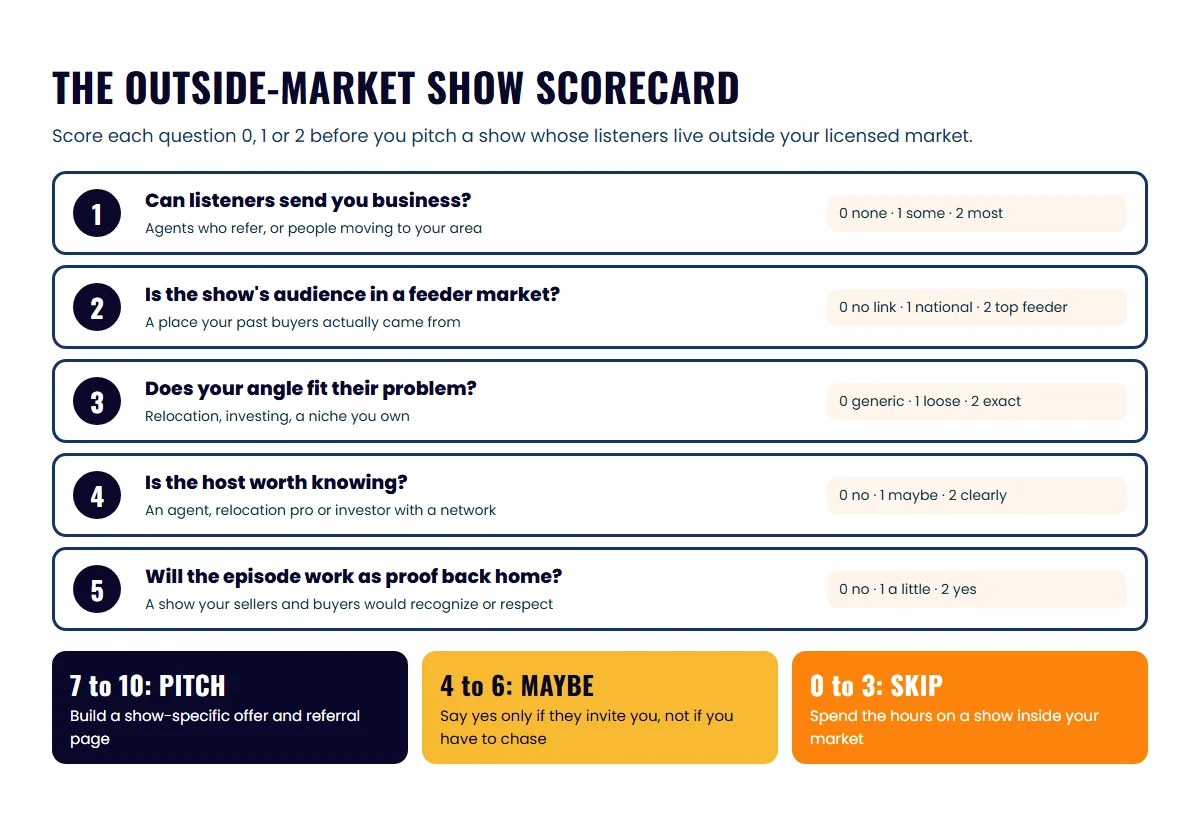
- Can listeners send you business? Agents who refer and people moving to your area score 2. A general consumer audience scores 0.
- Is the audience in a feeder market? One of your top three feeders scores 2. A national show scores 1.
- Does your angle fit their problem? “What it’s really like to move to [your metro] for a hospital job” fits a relocation show exactly.
- Is the host worth knowing? A host who is an agent, relocation consultant or investor has a network that outlasts the episode.
- Will the episode work as proof back home? Sellers in your market should recognize the show, or at least respect it.
A high-scoring show that asks for a fee is a different decision. Check when paying for a podcast guest spot makes sense before you agree.
What is an out-of-market listener worth?
An inbound referral is usually worth several times an outbound one, because you earn the commission instead of a fee on someone else’s. That’s the whole case for building this strategy around clients coming to you, not clients you pass away.
Now add your time. Say one appearance costs three hours to prepare, record and promote. You need far fewer inbound deals than outbound ones to cover a year of guesting. Plug your own commission and hours into the podcast ROI calculator, and compare the cost per conversation with other channels in podcast guesting vs paid ads.
What happens when a listener in another state calls you?
Refer them, don’t advise them on their deal. Treat the call as an outbound referral and run it through your broker.
- Listen and qualify. Find out where they’re buying or selling, when, and their price range. Don’t give advice about their local market or contract.
- Tell them where you’re licensed. “I’m licensed in [your state], so I can’t represent you there, but I can connect you with someone good.”
- Find a licensed agent in their market. Use your brokerage’s referral network or an agent you met on a show.
- Sign a referral agreement first. Your broker and the receiving broker agree in writing on the fee before you hand over the contact.
- Make a warm introduction. One email to both people, with the client’s permission.
- Log it in your CRM. Record the episode, the receiving agent, the fee and the expected close date.
- Check in at closing. Thank the receiving agent. They now know you, and they’re a likely source of inbound referrals later.
Federal rules under RESPA list payments under cooperative brokerage and referral arrangements between real estate agents and brokers as an exception to the kickback ban (12 CFR 1024.14, CFPB). That exception covers agents and brokers. It doesn’t cover paying a podcast host, lender or other non-licensee for sending you a client. State license laws also set their own rules on who can pay and receive referral fees. Ask your broker before you agree to any fee.
What should you say on a show outside your market?
Say where you’re licensed, pick one angle that fits the listeners, and give one next step. Match the line to the play.
Each of these sends people to a page built for that audience. For how to build those pages and tag the links, see how podcast guesting turns into real estate leads.
Which compliance issues come up on out-of-market shows?
Four come up most, and all four belong in a conversation with your broker before you record.
- Name your license and brokerage. Say where you’re licensed and who your brokerage is. On a show outside your state, listeners can easily assume you can help them anywhere. Check what your state requires in advertising.
- Describe places, not people. Relocation talk slides into steering fast. Describe an area by commute times, price ranges, amenities and housing types. Residents, and who would “fit in,” stay off the table. Point listeners to official school data instead of ranking schools yourself.
- Don’t promise referral fees to non-licensees. A host who isn’t licensed can’t receive a fee for sending you a client. Thank them another way, such as promoting their show.
- Keep investor talk general. Share market facts and your process. Don’t predict returns or give tax or legal advice.
A lender or title rep as host adds RESPA questions if the episode leads to joint marketing, so clear that with your broker first.
How do you track whether out-of-market guesting pays?
Track it separately from your local guesting, with four extra CRM fields. Without them, an inbound referral looks like any other agent referral and the show gets no credit.
| Field | Example entry | Why it matters |
|---|---|---|
| Origin market | Feeder city or state | Shows which feeder markets actually send clients |
| Play | Agent-referral, feeder, investor, outbound | Tells you which play to repeat |
| Referring agent | Name and brokerage | Builds your referral partner list |
| Referral fee | Percent and direction (in or out) | Shows what each play is really worth |
Review the fields every six months. If a play has produced no conversations after several appearances, drop it and move those hours to shows that reach your licensed market.
Next step
Pull your last two years of buyers and write down the three places they came from. Then find one agent-referral show and one show in your top feeder market, score both on the five questions, and pitch whichever scores 7 or higher.
Frequently asked questions
Can I say I'm a real estate agent on a podcast in a state where I'm not licensed?
Yes. Talking about real estate on a podcast is not the same as practicing in that state. Say clearly where you're licensed, and don't advise listeners on a specific transaction in a market where you can't legally represent them.
Can I pay the podcast host a referral fee if a listener becomes my client?
Not if the host isn't a licensed agent or broker. Referral fees generally flow between licensed brokers, and paying a non-licensee for a referral can raise state license law and RESPA issues. Ask your broker before you promise anything.
Is a national real estate podcast better than a local one?
Only for referrals and credibility. For direct buyer and seller leads, a local show wins. A national agent-audience show earns its place when listeners can refer clients moving into your market.
What if I'm licensed in two states?
Treat both as your market. Shows that reach either state count as local, and the corridor between them is often your best relocation angle.
Sources
- Key Takeaways from NAR's 2025 Profile of Home Buyers and Sellers — Virginia REALTORS (accessed October 6, 2026)
- § 1024.14 Prohibition against kickbacks and unearned fees — Consumer Financial Protection Bureau (accessed October 6, 2026)
- State-to-State Migration Flows — U.S. Census Bureau (accessed October 6, 2026)
Podcast guesting for agents
Get booked on real estate podcasts
The ICONS Hub connects agents with real estate podcast hosts looking for expert guests.
Guest On The Network
Written by
Co-Founder and Podcast Guru, Icons of Real Estate
Tomás Fonseca co-founded Icons of Real Estate in 2021 and is its Podcast Guru. He has a background in marketing, with stints at companies like Nintendo and Ardor SEO, and is one of the hosts of the Icons of Real Estate Podcast.

How we research, write, fact-check and correct articles: our editorial standards.