On this page
- Is a real estate podcast advertising?
- Which rules apply to a real estate podcast?
- What does a brokerage disclosure sound like on air?
- How does Fair Housing apply to podcast conversations?
- Can you talk about your listings on a podcast?
- What does RESPA mean for lender and title guests?
- When do endorsements and testimonials need a disclosure?
- Do you need consent to record a podcast guest?
- What rules apply to promoting episodes by text and email?
- Can you use any music in your real estate podcast?
- How do you protect client privacy on a podcast?
- Pre-publish master checklist
- Next step
Real estate podcast compliance means treating your show as advertising. Say your brokerage name on air and print it in the show notes. Keep every conversation Fair Housing clean, clear lender money with your broker under RESPA, disclose paid or connected endorsements, get recording consent, follow the rules for follow-up texts and email, license your music and protect client details.
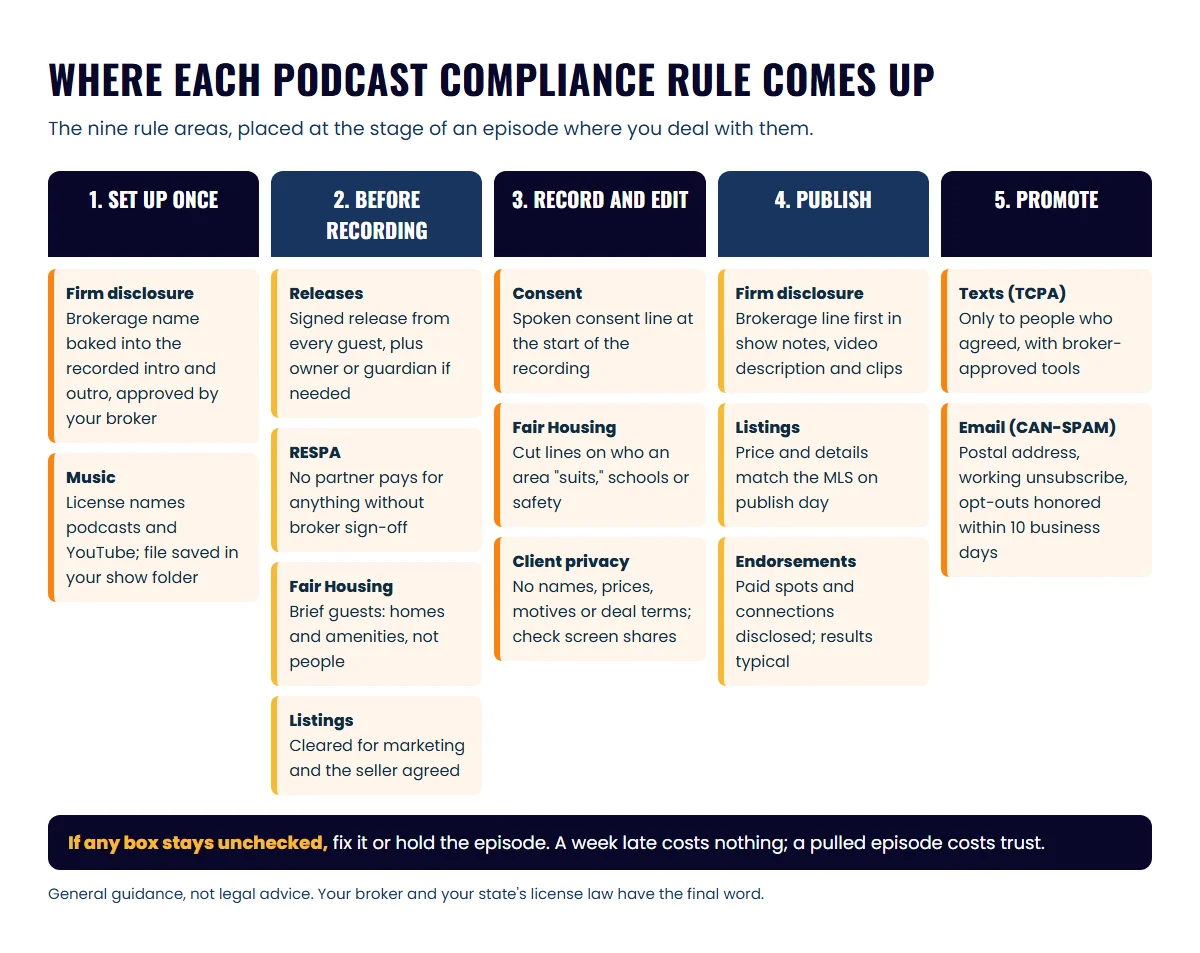
Use this map to set up your show once, then run the master checklist at the bottom before every episode. Your broker and your state’s license law have the final word on all of it.
Is a real estate podcast advertising?
A real estate podcast is advertising in almost every case. A show that introduces you as an agent, mentions your market or invites listeners to call you is promoting your real estate services. That makes it advertising, whether you host or guest, and whether or not money changes hands.
Calling it “just education” doesn’t change that. The test your broker and state regulator apply is simple: does it promote you as a licensee? If yes, every rule that covers a postcard or a Facebook ad covers your episode, your YouTube upload and every clip you cut from it.
That’s why compliance belongs inside your production process, not bolted on afterward. The real estate podcast production workflow builds a compliance listen into post-production for this reason.
Which rules apply to a real estate podcast?
Nine rule areas cover nearly every problem an agent podcaster runs into. The table shows where each one bites and where to go for the detail.
| Rule area | Where it shows up in a podcast | The main risk | Full guide |
|---|---|---|---|
| Firm disclosure and advertising | Intro, outro, show notes, YouTube description, clips | Brokerage name missing, team name used alone | Broker approval for podcasts |
| Fair Housing | Neighborhood talk, guest answers, titles, thumbnails | Steering or describing areas by protected class | Fair Housing podcast checklist |
| MLS and listing rules | Listing episodes, “coming soon” teasers, seller interviews | Marketing a listing before it’s allowed, inaccurate details | Talking about listings on a podcast |
| RESPA | Lender or title co-hosts, sponsors, shared costs | Something of value tied to referrals | Referral partner episodes |
| Endorsements and paid placement | Testimonials, paid guest spots, affiliate links | Undisclosed payment or connection | Paying to be a podcast guest |
| Recording consent and releases | Every recorded guest, home tours, minors | Publishing without permission | Podcast guest release form |
| Follow-up texts and email | Episode promotion to your sphere and leads | Texting or emailing without consent or opt-out | This page |
| Music and copyright | Intro music, background tracks, clips from other shows | Using a song you don’t hold rights to | This page |
| Client privacy | Deal stories, past-client guests, screen shares | Revealing a client’s price, motives or identity | This page |
Rows with a full guide get two or three lines below. Music and privacy get more space because no separate guide covers them yet.
What does a brokerage disclosure sound like on air?
A brokerage disclosure is a short spoken line, plus a printed line, that names the firm you’re licensed with. Under the NAR Code of Ethics, REALTORS® have to disclose the firm name under Standard of Practice 12-5 in a reasonable and readily apparent manner when advertising real estate services or listed property in any medium. Article 12 also asks for a true picture in advertising. Many states add their own rules, for example on license numbers, font size on video, or how team names appear next to the brokerage.
Say it out loud and print it. A listener on a treadmill never sees your show notes, and a viewer scrolling YouTube never hears your intro. Cover both.
Three habits keep this clean:
- Say the brokerage, not just the team. A team name on its own often doesn’t count as the firm disclosure. Say both, in the order your state wants.
- Put it in the template, not your memory. Bake the intro and outro into your recorded open and close so it can’t be skipped on a rushed day.
- Recheck it when anything changes. A new brokerage, team name or license number means updating the intro, the show-note template and the channel’s about page the same week.
What your broker will check, how to ask for approval and what happens to the show if you move firms are all in getting broker approval for a podcast. If the show runs under the brokerage’s own name instead of yours, the approval lanes in producing a brokerage or team podcast apply.
Can a realtor advertise on someone else’s podcast?
Yes, with the same rules. A guest appearance promotes your services, so your firm name should be in your introduction and your bio in the show notes. Hand the host your approved one-line intro so they say it right. If you’re paying for the spot, the payment has to be disclosed too (see endorsements below).
How does Fair Housing apply to podcast conversations?
The Fair Housing Act covers what you say on air, not just what you print. On a podcast the risk is unscripted talk: a guest describing who “fits” a neighborhood, a host answering “is it safe?”, or a title that hints at who lives somewhere. Talk about homes, amenities, prices and commute times, not the people who live there.
Your guests are the bigger risk, because you don’t control their words. Brief them before you record and fix problems in the edit. The Fair Housing podcast checklist has the phrases to avoid, safer swaps and a four-stage host checklist.
Can you talk about your listings on a podcast?
Yes, once the listing can be marketed and the seller agrees. A mention of a specific property is advertising that listing, so MLS rules such as Clear Cooperation, your listing agreement and accuracy rules all apply. Keep details current, because episodes live forever and prices change.
The listings on a podcast guide covers what the seller signs, what never goes on air and how to keep old episodes accurate.
What does RESPA mean for lender and title guests?
RESPA Section 8 restricts payments and other things of value between settlement service providers and the agents who refer business to them. On a podcast, that comes up when a lender co-hosts, sponsors an episode, pays for editing or splits your production bill. A lender as a free guest is usually simple. Money or free services moving between you is not.
Before any partner pays for anything, get it cleared in writing. The RESPA section of the referral partner episode guide summarizes what the CFPB says.
When do endorsements and testimonials need a disclosure?
Endorsements and testimonials need a disclosure whenever there’s a connection your audience wouldn’t expect, such as payment, free services or a family tie. The FTC’s Endorsement Guides FAQ says a connection between an endorser and a marketer should be disclosed if a significant minority of consumers wouldn’t expect it and it would affect how they weigh the endorsement.
On a real estate podcast that covers more than you’d think:
- A paid guest spot. The host should say the segment is paid; weighing a paid guest spot covers the rest.
- A vendor you recommend who pays you, gives you free services or sends you referrals.
- A guest who is your relative or employee, presented as an independent expert
- A past-client testimonial. The FTC page says an endorser’s results must be typical, or the ad has to make clear what people can generally expect. “She sold in three days for $40,000 over asking” needs context if that isn’t normal for your listings.
Also watch the word “free.” NAR Standard of Practice 12-1 limits calling a service free when you’ll be paid from any source. “Free home valuation” in your outro is fine only if your broker agrees it meets that test.
Do you need consent to record a podcast guest?
Yes, get it twice: a signed release before the session and a spoken consent line on tape. Federal law and many states allow recording with one party’s consent, but several states require everyone’s consent. Remote guests may sit in a different state from you, so the strictest rule is the safe default.
The podcast guest release form gives you a template, riders for past clients, lenders, home tours and minors, and the consent line to read before you hit record.
What rules apply to promoting episodes by text and email?
Your promotion is regulated even when the episode isn’t. Two federal laws cover most of it.
- Calls and texts (TCPA). Under 47 U.S.C. § 227, it’s unlawful to call a cell phone using an automatic dialing system or an artificial or prerecorded voice without the called party’s prior express consent. The statute lets people recover up to $500 per violation, and a court can raise that to as much as $1,500 when the violation is willful or knowing. Mass-texting platforms and ringless voicemail are where agents get caught. Ask your broker which tools and consent language the firm approves.
- Email (CAN-SPAM). The FTC’s CAN-SPAM guide says commercial email must include your valid physical postal address and an easy way to opt out, and you must honor opt-outs within 10 business days. Each email in violation can draw penalties of up to $53,088, per the same guide.
A text to a friend with the episode link is fine. Blasting a purchased list is where the trouble starts.
Can you use any music in your real estate podcast?
You can’t use just any music in a real estate podcast: use only tracks licensed for podcast and video use, and keep the license. The U.S. Copyright Office explains that a sound recording and the music and lyrics in it are separate copyrighted works, commonly owned and licensed separately. A song you bought, or one playing in the background at an open house, doesn’t come with podcast rights.
Practical rules:
- Buy a license that names podcasts and YouTube. Read the terms. Some royalty-free libraries cover podcasts but not ads, or end your rights when you cancel.
- Save the license file with the date and the track name in your show folder.
- Mute background music at events and home tours, or cut it in the edit.
- Don’t clip other shows, news segments or TV without permission, even for a “reaction.”
- Make sure the rights are yours. If a producer supplies the intro music, confirm the license transfers to you or covers your show after you part ways.
Video platforms can match music automatically, so an unlicensed track can get flagged months after you publish it.
How do you protect client privacy on a podcast?
Treat a deal story like a listing: you need the client’s permission before it airs. Even when you leave the name out, details like the street, sale price, divorce or a relocation date can identify someone to their neighbors.
Use these rules unless you have the client’s written OK:
- No names, addresses or exact prices tied to a client story.
- No motives. Never mention why someone sold (divorce, death, money trouble, a job loss), even “anonymously.”
- No negotiating details from a deal: what the other side would have accepted, inspection findings, or offer terms.
- Clean your screen before you share it on a video episode. CRM windows, open email and text notifications have all leaked client details on air.
- Change the details, and say so. “I’ve changed a few details to protect the client” keeps a teaching story honest.
Some duties, like confidentiality, can outlast the closing depending on state law and your agency agreement; ask your broker where the line sits.
Pre-publish master checklist
Run this list before every episode goes live. Copy it into your project board or your editor’s brief. Each line links back to a section above.
Disclosure and advertising
- Brokerage name spoken in the intro or outro
- Brokerage line at the top of the show notes and video description
- Team name appears with the brokerage name, never alone
- Clips carry on-screen name and brokerage (plus license number where your state asks for it)
- Any “free” offer cleared with your broker
Fair Housing
- No neighborhood described by who lives there
- Guest answers on schools, safety and “who it’s good for” checked and cut where needed
- Title, thumbnail and clip captions checked too
Listings and clients
- Every listing mentioned is cleared for marketing and the seller agreed
- Price, status and details match the MLS on publish day
- No client names, prices, motives or negotiating details without written permission
- Screen shares checked for CRM windows and notifications
Partners and money
- No lender, title or other settlement partner paid for anything without broker sign-off
- Paid segments, affiliate links and business relationships disclosed on air and in notes
- Testimonials reflect typical results, or the episode says what’s typical
Consent and rights
- Signed release on file for every guest (and property owner or guardian if needed)
- Consent line captured at the start of the recording
- Music license saved; no unlicensed background audio or third-party clips
Promotion
- Texts go only to people who agreed to hear from you, using broker-approved tools
- Promo emails include your postal address and a working unsubscribe link
If any box stays unchecked, fix it or hold the episode. An episode published a week late costs you nothing. One pulled after a complaint costs you the episode and some trust with your broker.
Next step
Set this up once. Write your disclosure lines, get them approved, and record your intro and outro with them baked in. Add the master checklist to your editor’s brief so every episode gets the same five-minute review. Then read the full guide for whichever rule area your show touches most: Fair Housing for neighborhood shows, listings for listing agents, RESPA for partner episodes.
Frequently asked questions
Do I need a disclosure if my podcast never mentions a listing?
Usually yes. If the show promotes you as an agent, it advertises your real estate services even without a listing, so the firm name belongs in the audio and the show notes. Confirm with your broker.
Does the host's show need my brokerage name when I'm the guest?
Your appearance promotes your services, so plan to say your brokerage when you're introduced and ask for it in the show notes. Your broker decides how strict to be about other people's shows.
Does my team name count as a firm disclosure?
Not on its own in many states. Team names usually have to appear with the brokerage name, so say both and check your state's team-advertising rule.
Who is responsible if a guest says something non-compliant?
Treat it as your problem, because it's your show and your license on the feed. Cut it in the edit, or don't publish.
Sources
- 2026 Code of Ethics & Standards of Practice — National Association of REALTORS® (accessed October 6, 2026)
- FTC's Endorsement Guides: What People Are Asking — Federal Trade Commission (accessed October 6, 2026)
- 47 U.S. Code § 227 - Restrictions on use of telephone equipment — Cornell Law School LII (accessed October 6, 2026)
- CAN-SPAM Act: A Compliance Guide for Business — Federal Trade Commission (accessed October 6, 2026)
- Engage: Musicians — U.S. Copyright Office (accessed October 6, 2026)
Done-for-you podcast production
Want a podcast that brings in referrals, not just downloads?
Icons of Real Estate plans, produces and publishes business-growing podcasts for agents. You record. We handle the rest.
Launch Your Podcast
Written by
Co-Founder and Podcast Guru, Icons of Real Estate
Tomás Fonseca co-founded Icons of Real Estate in 2021 and is its Podcast Guru. He has a background in marketing, with stints at companies like Nintendo and Ardor SEO, and is one of the hosts of the Icons of Real Estate Podcast.

How we research, write, fact-check and correct articles: our editorial standards.