On this page
- Why does your broker get a say in your podcast?
- Does guesting on someone else’s podcast need approval too?
- What will your broker actually check?
- How do you ask your broker for podcast approval?
- Template: approval request to host a podcast
- Template: approval request for a guest appearance
- What if your broker says no or doesn’t answer?
- What happens to your podcast if you change brokerages?
- Next step
Does your broker need to approve your podcast? In most cases, yes. If the show promotes you as an agent, it counts as advertising, which falls under your broker’s supervision and your state’s disclosure rules. Guest spots need approval less often, but many brokerages still want notice. Ask in writing before you record, using the templates below.
Rules differ by state and by brokerage, and your broker’s written policy beats anything on this page. Use it to prepare a request your broker can approve in one pass.
Why does your broker get a say in your podcast?
Your license sits under a broker, and that broker answers for how agents in the office advertise. A podcast where you introduce yourself as an agent, talk about the market and invite listeners to call you is advertising, even if it feels like a conversation.
State rules make this explicit. Texas, for example, defines an advertisement to include “radio or television broadcasts” and “all electronic media including email, text messages, social media, the Internet” (22 Tex. Admin. Code § 535.155). The same rule requires the broker’s name in ads at a minimum size relative to the agent’s contact details. Your state’s wording will differ, but a podcast feed, YouTube upload and social clips usually fall inside it.
REALTORS® have a second rule on top. Standard of Practice 12-5 of the Code of Ethics covers advertising “in any medium” and requires the member’s firm to be named “in a reasonable and readily apparent manner.” A show that never names your brokerage is a problem waiting to happen.
So the honest answer isn’t “the broker is being controlling.” The broker carries risk for what you publish, and a podcast publishes a lot: hours of unscripted talk, show notes, clips and thumbnails.
Does guesting on someone else’s podcast need approval too?
Guesting on someone else’s podcast sometimes needs broker approval, but many brokerages only want notice. A guest spot is lower risk because you don’t control the show, the branding or the sponsors. Some brokerages still approve each one, especially when a lender, a vendor or another agent runs the show.
Here’s how the two usually compare:
| Question | Hosting your own show | Guesting on another show |
|---|---|---|
| Is it advertising for you? | Yes, every episode | Usually, if you’re introduced as an agent |
| Typical brokerage ask | Written approval before launch | Notice, or a standing approval |
| Who controls disclosures | You | The host, so you supply your wording |
| Biggest risk | Show name, sponsors, partner money | What you say about clients, rates or neighborhoods |
| What to send your broker | Full concept, branding, disclosure script, partner details | Show name, host, topic, date, link |
If you’re still deciding which path fits you, see the comparison of hosting versus guesting for agents. Once you’re guesting regularly, the podcast guesting guide for agents covers how to pick shows worth your time.
What will your broker actually check?
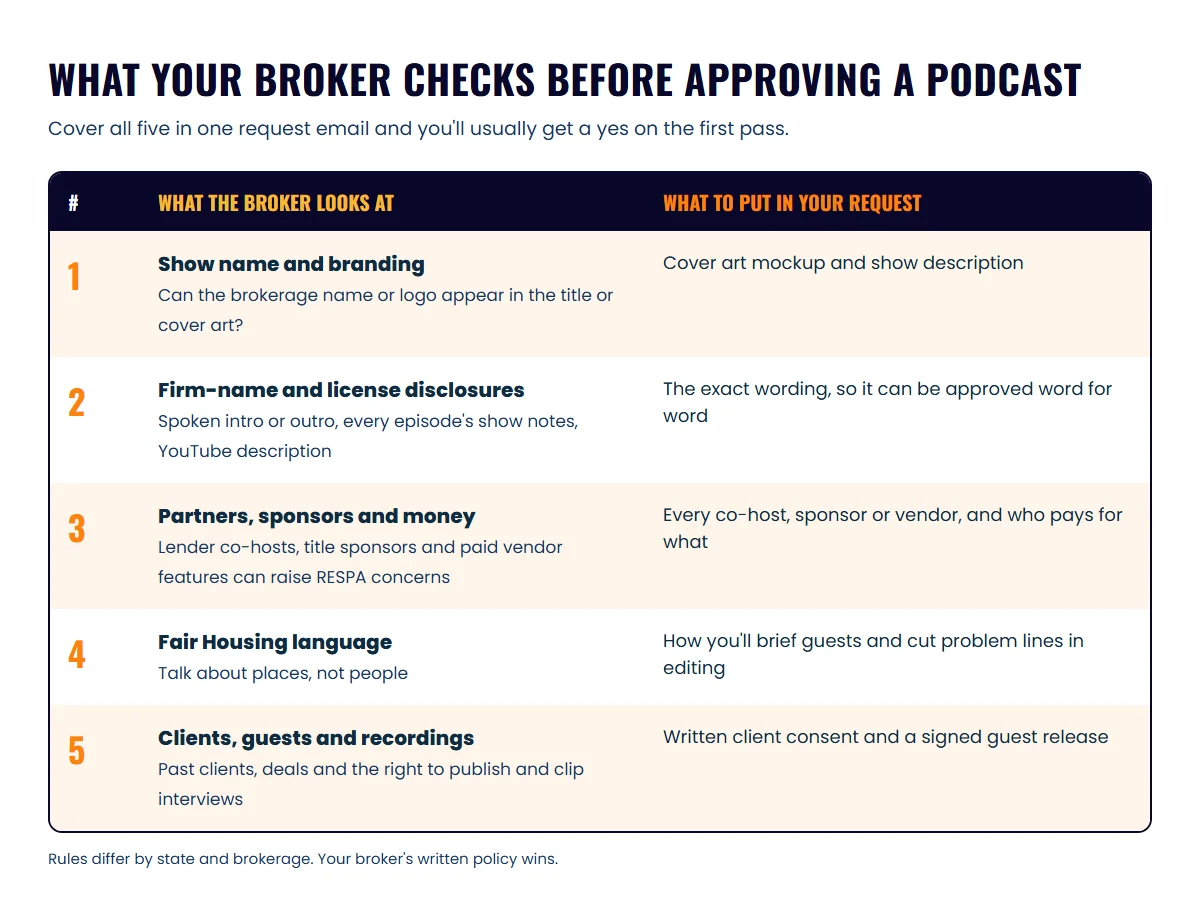
Your broker will mostly check five things: the show name, disclosures, partner money, Fair Housing language and client consent. Cover each one in your request and a first-pass yes is likely.
1. Show name and branding
Can you use the brokerage name or logo in the title or cover art? Some firms want it, some forbid it, and some require exact wording. A show named after you or your town, with the brokerage in the description, is the easiest to approve. Run any title from this list of real estate podcast name ideas past the same check.
2. Firm-name and license disclosures
Where will your brokerage name appear? Plan for three places: a spoken line in the intro or outro, the show notes for every episode, and the YouTube description. Write the exact wording out so your broker can approve it word for word.
3. Partners, sponsors and money
Lender co-hosts, title sponsors and paid vendor features can raise RESPA concerns when money or things of value change hands around referrals. Describe any arrangement plainly, including who pays for what. Your broker or compliance team makes that call. If the partner is a guest rather than a sponsor, running referral-partner episodes safely walks through the guardrails.
4. Fair Housing language
Talk about places, not people. Under the Fair Housing Act, you can’t discriminate on the basis of race, color, national origin, religion, sex, familial status or disability (HUD overview). Unscripted chat about who an area “suits” or which schools are “best” is where agents slip. Tell your broker how you’ll handle it, for example by briefing guests before recording and cutting problem lines in editing.
5. Clients, guests and recordings
Will you mention past clients or deals? Get their written consent first. Will guests sign a release so you can publish and clip their interview? Use a podcast guest release form and say so in your request.
How do you ask your broker for podcast approval?
Ask your broker for podcast approval in one email that holds everything they need to review. A vague “Can I start a podcast?” gets a vague “Let me think about it.” A complete request gets a yes in one reply.
- Find the policy. Check your brokerage’s advertising or social media policy and your independent contractor agreement. Note who approves marketing: the broker, an office manager or a compliance team.
- Draft your disclosures. Write the intro line, outro line and show-notes footer you plan to use.
- Mock up the branding. A rough cover art image and show description are enough.
- List any partners. Name every co-host, sponsor or vendor and describe any payments.
- Send the email below. Attach the mockup and ask for approval in writing.
- Save the reply. Keep it with your show files. If the policy changes or a new manager arrives, you’ll want it.
- Add it to your launch plan. The real estate podcast launch checklist has a slot for this step, and the six-week plan for launching an agent podcast shows where it fits.
Template: approval request to host a podcast
Copy this, fill the brackets, and cut anything that doesn’t apply.
Template: approval request for a guest appearance
For a single guest spot, keep it short. If you expect to guest often, ask for a standing approval instead, so you’re not waiting on a reply before every interview.
The standing approval is the one most agents skip, and it’s the one that saves the most time. Once you’re booked on a steady schedule, through your own outreach or a service like the ICONS Hub for podcast guesting, a fresh sign-off for every interview becomes the bottleneck.
What if your broker says no or doesn’t answer?
When your broker says no, ask what would make it a yes. A “no” is often about one piece, such as the brokerage name in the title or a lender co-host, not the whole idea. Offer to drop or change that piece and resend.
If you get silence, follow up once after a week with a short note: “Following up on my podcast approval request below. I’d like to record on [date]. Is there anything you need from me?” Don’t record and publish on the assumption that no reply means yes. If the answer stays no, guest on other shows within whatever your brokerage allows while you work it out.
What happens to your podcast if you change brokerages?
Your podcast survives a brokerage change if you plan for the move on day one. Keep the hosting account, YouTube channel and domain in your own name, and avoid the brokerage name in the show title unless your broker requires it. Then a move means updating your disclosure lines, show notes template and artwork, not rebranding the show.
Check your independent contractor agreement for anything about marketing materials or content you create while affiliated. After a move, send your new broker the hosting template so the show is approved under the new firm before your next release.
Next step
Pull up your brokerage’s advertising policy, fill in the hosting or guesting template above, and send it today. Approval is usually the shortest step in a podcast launch, as long as you ask with everything your broker needs in one email.
Frequently asked questions
Do I need approval to talk about real estate on a friend's podcast?
If you're introduced as an agent or you talk about buying, selling or your services, treat it as a guest appearance and follow your brokerage's policy. If the topic has nothing to do with real estate and you're not promoted as an agent, it's usually personal, but a quick heads-up costs nothing.
Does my broker need to listen to every episode?
Some brokerages review every episode, but most approve the format, disclosures and branding once and spot-check after that. Ask which applies to you and get the answer in writing.
Can I use my brokerage logo in my podcast cover art?
Only with permission. Many brokerages control how their name and logo appear, and some require specific placement or wording, so include a mockup of your cover art in your approval request.
Is a podcast with a lender co-host allowed?
It can be, but co-hosting or sponsorship with a settlement service provider can raise RESPA questions when money or things of value change hands. Get your broker or compliance team to review the arrangement before you record.
Sources
- 2026 Code of Ethics & Standards of Practice — National Association of REALTORS® (accessed October 6, 2026)
- 22 Tex. Admin. Code § 535.155, Advertisements — Cornell Law Institute (accessed October 6, 2026)
- Fair Housing Act overview — U.S. Department of Housing and Urban Development (accessed October 6, 2026)
Done-for-you podcast production
Want a podcast that brings in referrals, not just downloads?
Icons of Real Estate plans, produces and publishes business-growing podcasts for agents. You record. We handle the rest.
Launch Your Podcast
Written by
Co-Founder and Podcast Guru, Icons of Real Estate
Tomás Fonseca co-founded Icons of Real Estate in 2021 and is its Podcast Guru. He has a background in marketing, with stints at companies like Nintendo and Ardor SEO, and is one of the hosts of the Icons of Real Estate Podcast.
How we research, write, fact-check and correct articles: our editorial standards.