On this page
- What does it mean to own a local market with a podcast?
- Why does a niche podcast beat a general real estate show locally?
- What do published success stories show about niche local podcasts?
- How do you check whether your niche and town are still open?
- Which niche and town combinations work for agents?
- What compliance traps come with a niche local show?
- How long does it take a niche podcast to dominate a local market?
- Next step
A niche local real estate podcast helps an agent dominate a market by being the only show for one group of people in one place. Every guest is a local connector, the episodes answer searches nobody else targets, and the host becomes the name local professionals pass on. The published proof is about relationships, not audience size.
That last point is where most agents get it backwards. They picture “owning” a market as having the biggest audience in town. On a local show, the audience you need is small and specific: the people who refer, list, lend, inspect and build in your area. A niche gets you in front of them faster than a general show can.
What does it mean to own a local market with a podcast?
Owning a local market with a podcast means you’re the first agent people think of for one kind of client in one place. It’s a reputation, not a ranking, and you can see it in three signs.
- Local professionals refer you by name. Lenders, inspectors, attorneys and other agents send people to you for that niche.
- Guests come to you. Business owners and specialists ask to be on the show instead of you chasing them.
- Search points to you. Someone who types your niche plus your town into YouTube, Spotify or Google finds your episodes, because nobody else made them.
None of the three needs a big download number. A show heard by a few hundred of the right local people can do more for your business than one heard by thousands of strangers in other states.
Why does a niche podcast beat a general real estate show locally?
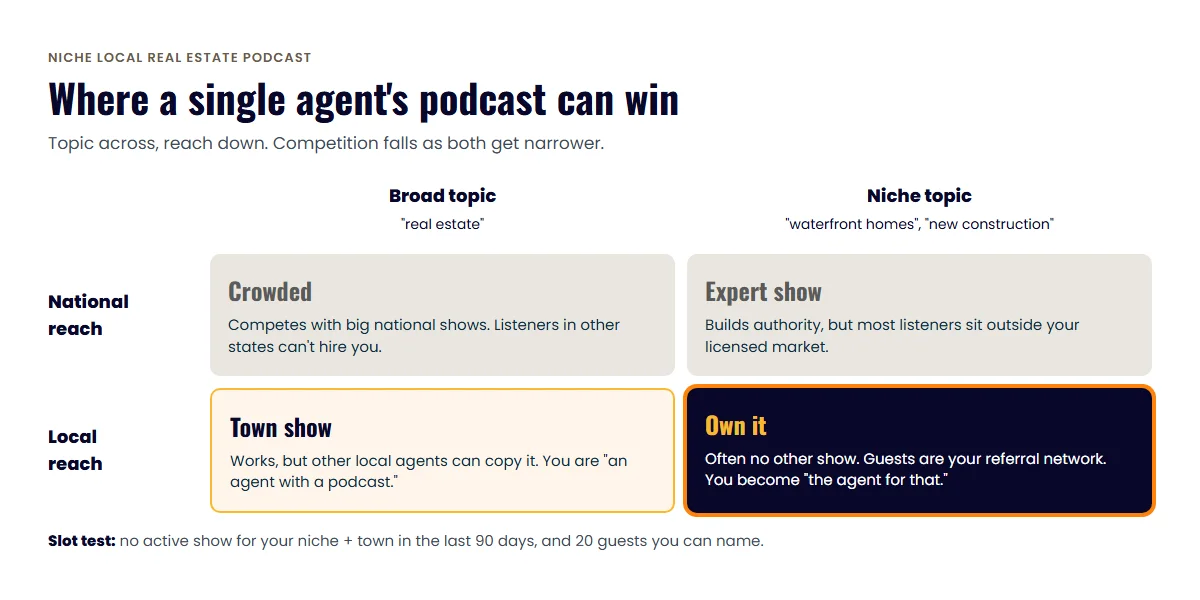
A niche podcast beats a general real estate show locally because it gives you less competition, a tighter guest list and a clearer reason to refer you. “Real estate in Phoenix” competes with every agent and national show. “Horse properties north of Phoenix” may compete with nobody.
The table compares the two on the things that decide whether a show builds a local business.
| General real estate show | Niche local show | |
|---|---|---|
| Competition | National shows, brokerages and every agent with a mic | Often none in your town |
| Guest pool | Anyone, so no one in particular | The specialists your niche clients already use |
| Who refers you | People who can’t say what you’re best at | Professionals who know exactly who to send |
| Search | Broad terms you can’t rank for | Narrow phrases only your episodes answer |
| What listeners remember | “An agent with a podcast” | “The agent for that” |
What do published success stories show about niche local podcasts?
Published Icons client stories show local relationships turning into deals, referrals and sponsors, often within the first few episodes. Each story below comes from its page on the Icons success stories index, and each proves something slightly different.
A niche show that opened a local development deal
Shae Spitz’s story is the clearest case. Her R.E.A.L. Moms Podcast focuses on “mompreneurs in real estate and other industries,” a niche defined by profession. During pre-launch recording she interviewed a real estate agent who, months later, brought her a 70-acre development opportunity with potential for 330 homes. After eight months of negotiations she closed on 75 acres for a development in Columbus, Nebraska: a 330-listing opportunity from one interview.
What it proves: the niche filled her guest list with the right people, and the local deal came from one guest relationship before the show had any audience.
A first episode that made her the go-to name
Renée Ruth’s story is about local reputation. She says that right after her first episode, she was put on the go-to referral list for agents in her area, which is Lynchburg, Virginia.
What it proves: one strong episode can change how local professionals see you. What it doesn’t: the page gives no referral counts.
A city show that local businesses paid to support
Shaune Corbett’s show, Real Estate Success DFW, carries the market in its name. The story says Icons secured four sponsorships for it: Goosehead Insurance, Texas Excel Title, Cherry Creek Mortgage and his home inspector’s company, About The House. All four serve buyers and homeowners in Dallas-Fort Worth.
What it proves: a show tied to one market is worth something to local businesses that want the same clients.
A show that built a professional community
Lisa Parenteau’s story is titled “A Podcast That Built a Cape Cod Community.” Her show, Lifting Others As We Rise, invites real estate professionals to share stories of transformation and success.
What it proves: a niche can be a peer group, not just a client type. The page has no numbers, so treat it as direction rather than a result.
For every published story in one place, with the gaps flagged, see the roundup of verified real estate podcast success stories.
How do you check whether your niche and town are still open?
Check whether a niche and town are open by searching for them the way a client would, then counting the active shows. The whole test takes about 30 minutes.
- Search Apple Podcasts and Spotify for “[town] [niche] podcast” and “[town] real estate podcast.”
- Run the same searches on YouTube and Google.
- For each show you find, check the date of the last episode. Count only shows with an episode in the last 90 days.
- Write down 20 people you could interview in that niche and town. Stall at eight, and the show will stall at episode eight.
- Ask yourself whether listeners can hire or refer you. A niche outside your licensed market builds someone else’s business.
If you find no active show and you can name 20 guests, the slot is open. One active general show still leaves room for a narrower one.
Which niche and town combinations work for agents?
The niche and town combinations that work best match business you already close and guests you can already reach. Pull your last ten closings and look for the biggest group.
For more concepts, the guide to real estate podcast niche ideas matches eight business types to a show. If you’d rather cover a whole town, the hyperlocal real estate podcast guide has formats for business spotlights and community episodes. The free show name generator helps once you’ve picked.
What compliance traps come with a niche local show?
A niche local show has two main compliance traps: Fair Housing, when the niche starts to describe who should live where, and RESPA, when sponsors are settlement-service businesses. Check both with your broker before launch.
Fair Housing. The Fair Housing Act bars housing discrimination because of race, color, national origin, religion, sex, familial status or disability. Define your niche by topic, property type, transaction type or profession. Don’t describe a neighborhood as right for a group of people, and don’t let a guest do it on your show either. Run show descriptions through the free Fair Housing checker before you publish.
RESPA and sponsors. Lenders, title companies and other settlement-service providers are natural sponsors for a local show. RESPA’s Regulation X bans giving or taking anything of value for referrals of settlement-service business on a federally related mortgage loan. Before you sign a lender or title sponsor, have your broker review how the deal is structured, and get the sign-off in writing.
The full list of rules is in the guide to real estate podcast compliance. Treat this section as a starting point for that conversation, not as legal advice.
How long does it take a niche podcast to dominate a local market?
A niche podcast can change how local professionals see you within the first few episodes, as Renée Ruth’s story shows. Being the default show for your niche takes longer: usually a year or more of steady episodes.
What speeds it up is the same thing that builds any local reputation: showing up. Publish on a fixed schedule, follow up with every guest within a week and ask each one who you should interview next. The plan for a real estate podcast’s first 90 days lays out that routine week by week, and the how-to for starting a real estate podcast from scratch covers the setup.
If you’d rather spend your hours on the conversations, the Icons Launchpad setup package handles the logo, cover art, RSS syndication, intro and outro, a landing page and a launch kit, with launch coaching included.
Next step
Do the 30-minute slot test this week. Write your niche and town at the top of a page, run the five searches, then list 20 guests underneath. If both pass, book the first three conversations before you buy a microphone.
Frequently asked questions
Is a niche too small for a podcast?
Rarely, if your guests and clients come from it. A local show isn't trying to win a national audience. It needs enough guests to fill a year and enough listeners in your area to send you business.
Can I change my niche later?
Yes. Keep the show name broad enough to stretch, and shift the guest mix over a season. A full rename usually costs you search history, so try a new segment first.
What if another agent already runs a podcast in my town?
Check whether it's active and what it covers. A general market show leaves room for a narrower one, such as new construction, waterfront homes or local business owners.
Sources
- Housing Discrimination Under the Fair Housing Act — HUD (accessed October 21, 2026)
- § 1024.14 Prohibition against kickbacks and unearned fees — Consumer Financial Protection Bureau (accessed October 21, 2026)
Done-for-you podcast production
Want a podcast that brings in referrals, not just downloads?
Icons of Real Estate plans, produces and publishes business-growing podcasts for agents. You record. We handle the rest.
Launch Your Podcast
Written by
Co-Founder and Podcast Guru, Icons of Real Estate
Tomás Fonseca co-founded Icons of Real Estate in 2021 and is its Podcast Guru. He has a background in marketing, with stints at companies like Nintendo and Ardor SEO, and is one of the hosts of the Icons of Real Estate Podcast.

How we research, write, fact-check and correct articles: our editorial standards.