On this page
- What does the first 90 days of a real estate podcast look like?
- What should you decide in weeks 1 and 2?
- How many episodes should you record before launch?
- What happens in launch week?
- How do you turn your first guests into relationships?
- What should you measure at day 90?
- What goes wrong in a podcast’s first 90 days?
- Should you run the 90-day launch plan yourself?
- Next step
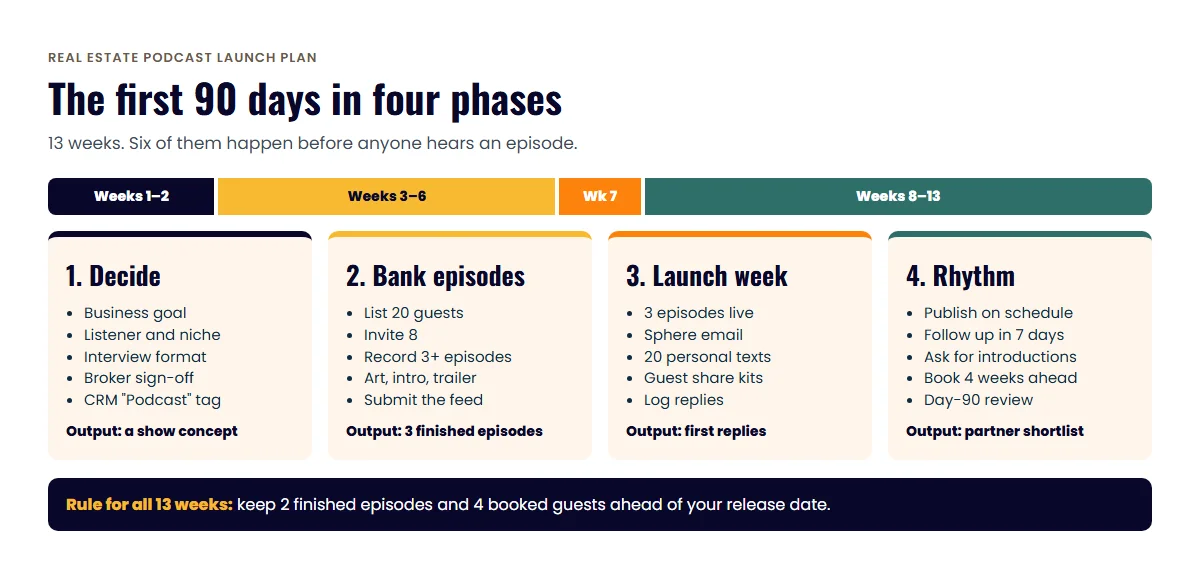
A real estate podcast’s first 90 days need a launch plan in four phases. Spend two weeks deciding the goal, niche and format, then four weeks booking guests and banking three episodes. Launch to your sphere in week seven and publish steadily for six more weeks. Judge day 90 on guest conversations, not downloads.
The 90-day launch plan below runs week by week. It assumes an interview show with local guests, published every week or every other week, because that’s the format where the first 90 days pay off fastest. If you haven’t picked a format yet, read how to start a real estate podcast step by step first and come back.
What does the first 90 days of a real estate podcast look like?
The first 90 days of a real estate podcast are 13 weeks with one job each. Weeks 1–6 happen before anyone hears an episode. Weeks 7–13 are about shipping on time and following up with every guest.
Each row shows the week’s main task and what it produces. Notice that every week after the first two produces a relationship as well as content.
| Week | Main task | Relationship output | Content output |
|---|---|---|---|
| 1 | Pick the business goal, the niche and the format | — | One-paragraph show concept |
| 2 | Broker sign-off, name, CRM “Podcast” tag | Broker knows the plan | Show name and description |
| 3 | List 20 possible guests, invite the first eight | Eight personal invitations | Guest list |
| 4 | Record episodes 1 and 2 | Two guest conversations | Two raw episodes |
| 5 | Record episode 3, cover art, intro and trailer | One more conversation | Trailer and artwork |
| 6 | Submit the feed, edit, write show notes | Follow-up notes to first three guests | Three finished episodes |
| 7 | Launch: three episodes live, sphere email | Replies from your database | Launch email and clips |
| 8 | Guest share kits, personal texts | Guests share with their own people | Social posts |
| 9 | Record and publish on schedule | Coffee with a past guest | One episode |
| 10 | Record and publish, ask guests for names | First introductions | One episode |
| 11 | Record and publish, book four weeks ahead | Next four guests confirmed | One episode |
| 12 | Record and publish, second sphere email | Replies logged in the CRM | One episode and email |
| 13 | Day-90 review | Partner shortlist | Scorecard and next-quarter plan |
What should you decide in weeks 1 and 2?
Decide the goal, the listener and the format in weeks 1 and 2, before you buy anything. Those three choices tell you who to invite, which is the decision that matters most in the next month.
Answer these in writing:
- What should the show do for your business? More listings in one area, more referrals from other agents, a closer relationship with past clients. Pick one.
- Who is the listener? “Homeowners in two school districts” is a listener. “Anyone interested in real estate” isn’t.
- Which format? A guest interview gives you a relationship every episode. A solo show is easier to schedule but builds no network.
- Does your broker need to approve it? Many brokerages have rules on advertising, branding and disclosures. Get the broker approval for your podcast now, not the week before launch.
- How will you track it? Add a “Podcast” lead source to your CRM today, so every contact the show produces is tagged from day one.
If the niche question stalls you, the sibling guide on using a niche podcast to own a local market walks through how narrow to go.
How many episodes should you record before launch?
Record at least three episodes before you launch, and release all three on launch day. The ICONS Podcast Framework launch guide makes the same call: a new listener who likes episode one should find a second and third waiting.
The backlog matters for a second reason. Most podcasts stop early. Steve Goldstein of Amplifi Media counted Apple Podcasts shows in 2021 and found that 26% had a single episode and 44% had three or fewer. Only 36% reached ten. Banked episodes carry you through the week a guest cancels or a closing eats your Tuesday.
Your guest pipeline is the other half of the backlog. Invite eight people in week 3 to land four or five recordings. Start with people who already like you: past clients with a story, a lender you trust, a local business owner. The guide to booking your first 10 podcast guests has invite scripts.
What happens in launch week?
Launch week is when your existing relationships hear the show for the first time. Your sphere, your past guests and your referral partners are the first audience, so the week is mostly personal outreach.
- Three episodes live in the main podcast apps and on YouTube, each with show notes
- One launch email to your whole database: one episode, one sentence on why, one question they can reply to
- Personal texts to 20 people who care about an episode’s topic
- A share kit for each guest: the link, two clips and a ready-made caption
- A podcast line in your email signature and social bios
- Replies logged in the CRM with the “Podcast” tag
Keep the email plain. One link and one question get more replies than a newsletter layout with six buttons. The podcast launch checklist for realtors covers the technical items in more detail, and the free launch checklist tool tracks them for you.
How do you turn your first guests into relationships?
Turn each guest into a relationship by following up within seven days of the recording, then again when the episode goes live. The recording opens the door. The follow-up is where it becomes a referral partner.
A simple rhythm for every guest:
- Recording day: a thank-you note naming one thing they said that stuck with you.
- Within a week: a call or coffee with no agenda beyond getting to know their business.
- Release day: the share kit, plus a note on when the episode drops.
- About a month later: ask who else you should interview. Guests who name someone are already acting like partners.
What should you measure at day 90?
Measure the things a 90-day-old show can actually move: episodes shipped on time, guest follow-ups, introductions and podcast-tagged contacts. Downloads will be small, and that’s normal for a local show.
| Measure | On track at day 90 | Warning sign |
|---|---|---|
| Episodes published on schedule | Every planned release went out | Two or more missed weeks |
| Guests who took a follow-up call | More than half | Guests vanish after recording |
| Introductions from guests | At least one | None, and you haven’t asked |
| Contacts tagged “Podcast” | A handful with real questions | None tagged |
| Apple engaged listeners | Any number, read as a trend | You’re refreshing it daily |
For listening numbers, Apple Podcasts defines an engaged listener as a person who got through 40% of an episode or 20 minutes of it, whichever comes first. Its dashboard stays empty until at least five unique listeners have played your show. A blank dashboard in week 8 isn’t a verdict.
Closings usually come later than day 90. The month-by-month view of how long a real estate podcast takes to generate business shows what to expect next, and the plan to grow a local podcast audience picks up from here.
What goes wrong in a podcast’s first 90 days?
Most problems in a podcast’s first 90 days come from the calendar, not the content. The show stalls because recording slips behind publishing, and nobody notices until the backlog is gone.
Five failure points come up again and again:
- Polishing episode one for a month. Launch on time. Episode 12 will sound better anyway.
- Booking guests one at a time. Keep four booked, always.
- Skipping the follow-up. Without it, you have content but no relationships.
- Judging the show by downloads in week 9. Use the scorecard instead.
- Doing every task yourself. Editing, show notes, clips and uploads take hours that should go to guests and clients.
Should you run the 90-day launch plan yourself?
You can run the 90-day plan yourself if you can protect about half a day a week for recording, editing and publishing. If you can’t, hand off everything except the conversations.
The Icons Launchpad setup package covers the setup side: logo and cover art, RSS syndication, intro and outro video, a podcast landing page, a social media launch kit and launch coaching. Icons says a show takes 4 to 6 weeks to go live, which lines up with weeks 1 to 6 above, and you review and approve everything before it’s published. Your job stays the same either way: invite the guests, have the conversations and follow up.
Next step
Block the next 13 weeks in your calendar today: one line per week from the table above, with recording sessions in weeks 4 and 5 and the day-90 review in week 13. Then write your first eight guest names. If you need questions for those first conversations, the free interview question generator builds a list for each guest.
Frequently asked questions
Should I launch with a trailer or a full episode?
Do both if you can. A short trailer gives Apple and Spotify something to list while you finish the first episodes, but listeners judge the show on the full episodes that go live on launch day.
What if I miss a week in the first 90 days?
Publish the next banked episode on the normal day and don't apologise on air. That's why the plan asks for a backlog before launch: one missed recording shouldn't become a missed release.
Do I need a big audience before I launch?
No. In the first 90 days the value comes from the guests you interview and the sphere you email, and neither needs a big audience.
Sources
- Why there really aren't 2 million podcasts (Steve Goldstein) — RAIN News (accessed October 21, 2026)
- Listener analytics — Apple Podcasts for Creators (accessed October 21, 2026)
Done-for-you podcast production
Want a podcast that brings in referrals, not just downloads?
Icons of Real Estate plans, produces and publishes business-growing podcasts for agents. You record. We handle the rest.
Launch Your Podcast
Written by
Co-Founder and Podcast Guru, Icons of Real Estate
Tomás Fonseca co-founded Icons of Real Estate in 2021 and is its Podcast Guru. He has a background in marketing, with stints at companies like Nintendo and Ardor SEO, and is one of the hosts of the Icons of Real Estate Podcast.

How we research, write, fact-check and correct articles: our editorial standards.