On this page
- What makes an agent’s personal brand defensible?
- Which parts of an agent’s brand can a competitor copy?
- How does a podcast build a brand competitors can’t copy?
- Who should own your podcast, feed and email list?
- How do you audit how defensible your brand is?
- How long does a defensible personal brand take to build?
- Next step
A defensible personal brand is one a competitor can’t copy by outspending you. Real estate agents build one with a podcast by owning what money can’t buy quickly: relationships with the people they’ve interviewed, a back catalog of their own thinking and an audience on channels they control. Logos, ads and follower counts don’t qualify.
Every agent in your market can buy the same headshot photographer, the same designer and the same portal leads. A newer agent with a bigger budget can match your Instagram look in a month. What they can’t match is the slow stuff. This guide is about building more of the slow stuff on purpose.
What makes an agent’s personal brand defensible?
A personal brand is defensible when a better-funded competitor couldn’t recreate it within 90 days. That’s the test: if money and a good designer could copy it in one quarter, it isn’t protecting you.
The test matters because of where agents’ business actually comes from. In NAR’s 2026 Member Profile, the typical REALTOR earned 28% of their 2025 business from repeat clients and 22% from referrals by past clients. That’s half of the business coming from people who already know the agent.
So your real brand isn’t on your business card. It lives in the heads of people who have dealt with you or heard you think. The question is how to add to that group faster than a rival can.
If you haven’t settled your niche, market and point of view yet, start with the personal branding playbook for agents. Defensibility comes after positioning.
Which parts of an agent’s brand can a competitor copy?
Most of what agents spend on branding can be copied or bought within a quarter. The table rates common brand assets on how fast a competitor could match them and who really controls them.
| Brand asset | Could a rival match it in 90 days? | Who controls it | Defensible? |
|---|---|---|---|
| Logo, colors, headshot | Yes, with a designer | You, within broker rules | No |
| Paid ads and portal leads | Yes, with a bigger budget | The ad platform or portal | No |
| Social follower count | Mostly, followers can be bought | The platform | Weak |
| Reviews on third-party sites | Slowly, they take closings | The site | Partly |
| Guest and partner relationships | No, each one takes a conversation | You | Yes |
| Back catalog of episodes | No, it takes months of recording | You, if you own the show | Yes |
| Email list and show subscribers | No, people must opt in | You, if the accounts are yours | Yes |
Notice what the bottom rows have in common. Each one takes time, and each one involves another person choosing you. That’s what makes them hard to copy. It’s also why spending more on design, covered in what realtor branding costs, rarely protects a brand on its own.
How does a podcast build a brand competitors can’t copy?
A podcast builds a defensible brand because every episode adds to the three assets in the bottom rows: a relationship, a piece of content you keep and a reason for people to subscribe. Those stack up over time.
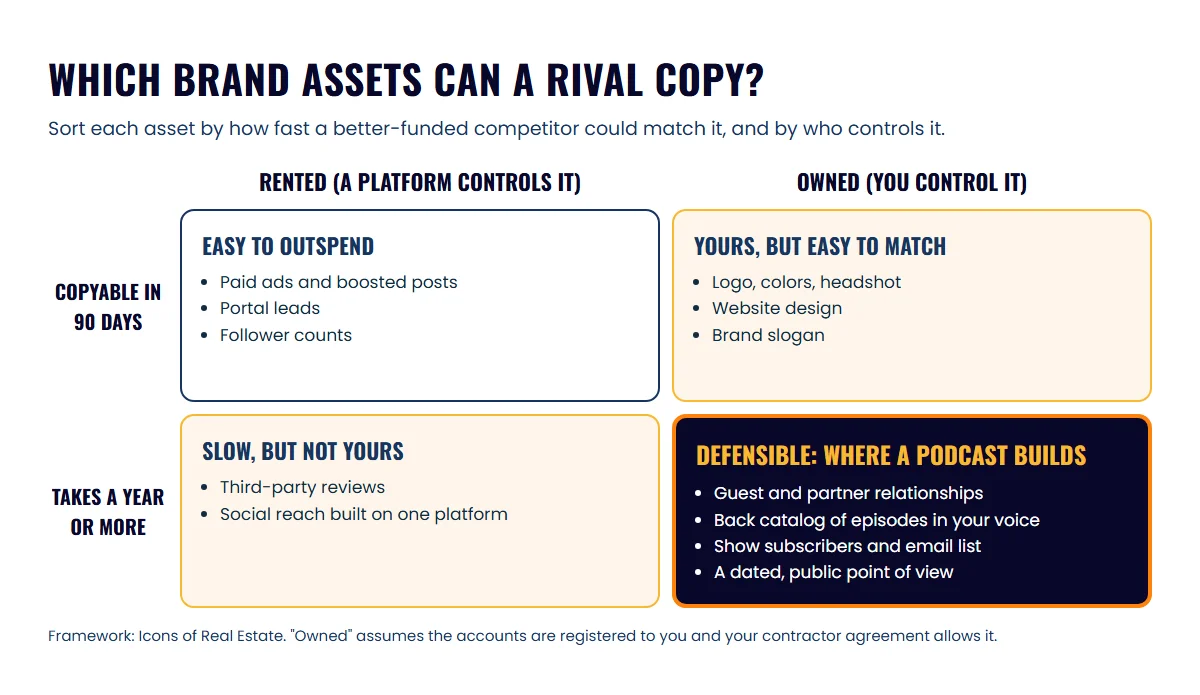
Here are the five parts a show builds that a competitor can’t buy:
- Relationships with guests. Every guest spent 30 to 45 minutes with you and saw how you work. A rival can invite the same people later, but they can’t erase the head start.
- A back catalog in your voice. Two years of weekly episodes is around 100 recordings of you explaining your market. Nobody can produce that next quarter.
- A point of view on record. Your calls on pricing, timing and local quirks are public and dated. When you’re right, the proof is already published.
- An audience you own. Show subscribers and an email list are people who opted in to hear from you. No algorithm sits between you and them.
- Consistency. Most shows stop early. Steve Goldstein’s analysis in RAIN News found that, of the two million podcasts in Apple Podcasts in 2021, 26% had one episode and 44% had three or fewer. Only 36% reached ten.
That last point is the quietest advantage. A competitor can start a show tomorrow. Odds are they won’t still be publishing a year from now.
Real client results look less tidy and take longer, but they point the same way. Renée Ruth, an Icons client, credits her first episode with getting her onto her area’s Go-To Agent referral list. More stories like hers are in real estate podcast success stories.
Who should own your podcast, feed and email list?
You should own your podcast, its feed, your domain and your email list in accounts registered to you, as far as your contractor agreement allows. A brand you don’t control can be switched off or left behind.
This is where many agents’ brands are weaker than they look. Social accounts belong to the platform. Websites and email tools are sometimes in the brokerage’s name. A podcast hosted on someone else’s account can vanish with a contract.
Check these before you build:
- Your independent contractor agreement. It may say who owns content, domains and social accounts. Ask your broker if it’s unclear.
- Your hosting account. The show’s RSS feed should sit in an account under your own email.
- Your production contract. Ask in writing who owns the show, the artwork and the back catalog.
On that last point, Icons’ production page states that the client keeps the show itself, its feed, its listeners and every past episode. If you work with any producer, get the same answer in writing. If you’re planning a brokerage move, read what your brand and podcast keep when you switch brokerages first.
How do you audit how defensible your brand is?
You audit your brand by checking how much of it is owned, slow to copy and growing each month. Run this checklist once a quarter.
- I can name at least ten people I’ve added to my network this quarter through a real conversation
- My best content would still exist if one social platform closed my account tomorrow
- My podcast feed, domain and email list sit in accounts registered to me
- People who refer me can point to something I published, such as an episode or a newsletter
- My last 12 episodes or posts say something a competitor would disagree with
- I have published on schedule for the last three months
- My brokerage has approved my show name and artwork in writing
Five or more ticks means the brand is in good shape. Three or fewer means most of it is rented or copyable, and a podcast is one of the most direct ways to change that.
How long does a defensible personal brand take to build?
A defensible personal brand takes a year or more to build, because the parts that protect you are the ones that need time. Expect the first signs within a few months and the real protection after a year of steady episodes.
Those first signs are usually small: a past client mentioning an episode, or a guest sending a friend your way. The timeline for a podcast to generate business sets out what to expect month by month. If your market is already crowded, pair this with how to stand out in a saturated market with a podcast. For the business case behind all of it, see how top-producing agents build a business beyond the grind.
Next step
List your brand assets in the table above and mark each one owned or rented. If most land in “rented,” plan one owned asset this quarter. For many agents that’s a show they record once or twice a month. If you’d rather only record, look at done-for-you podcast production for agents.
Frequently asked questions
Is a big social following a defensible brand?
Only partly. The following lives on a platform that controls who sees your posts, and followers can be bought. Move the people who care onto an email list or a show feed you own.
Can a competitor copy my podcast idea?
They can copy the name style and format. They can't copy the guests who already trust you, two years of episodes in your voice or the habit your listeners have formed.
Do I need a large audience for the brand to be defensible?
No. A few hundred local listeners who know your name are harder to take from you than thousands of followers scattered across the country.
Sources
- The Feature Sheet: 2026 Member Profile — National Association of REALTORS® (accessed October 21, 2026)
- Steve Goldstein: Why there really aren't 2 million podcasts — RAIN News (accessed October 21, 2026)
Done-for-you podcast production
Want a podcast that brings in referrals, not just downloads?
Icons of Real Estate plans, produces and publishes business-growing podcasts for agents. You record. We handle the rest.
Launch Your Podcast
Written by
Co-Founder and Podcast Guru, Icons of Real Estate
Tomás Fonseca co-founded Icons of Real Estate in 2021 and is its Podcast Guru. He has a background in marketing, with stints at companies like Nintendo and Ardor SEO, and is one of the hosts of the Icons of Real Estate Podcast.
How we research, write, fact-check and correct articles: our editorial standards.