On this page
- What is the minimum age to be a real estate agent?
- Which states require you to be 19 to get a real estate license?
- What else do you need besides being old enough?
- What is the average age of a real estate agent?
- What is the best age to start as a real estate agent?
- How do new agents of any age get known faster?
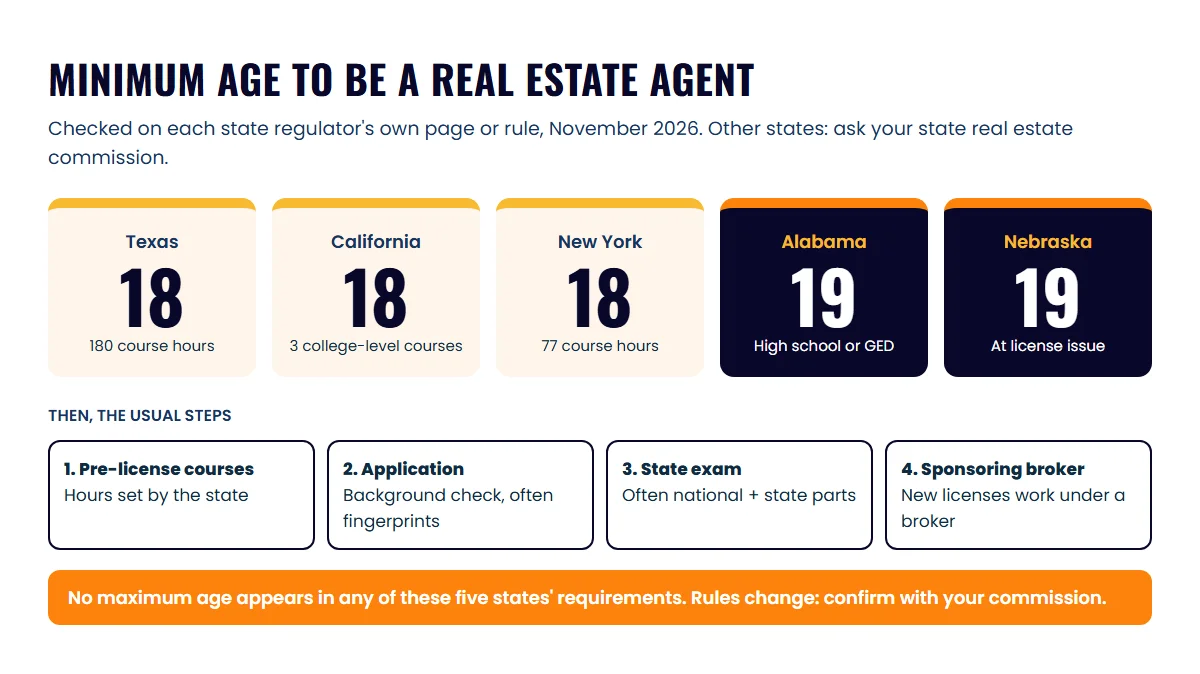
The minimum age to be a real estate agent in most U.S. states is 18. A few states set it at 19: Alabama and Nebraska both do. Age is only the first box. You also need pre-license courses, a passed state exam and usually a sponsoring broker, so confirm the current rules with your state’s real estate commission.
That’s the short answer. Below are the state minimums we checked on official pages in November 2026 and the other requirements that come with age. You’ll also see what NAR’s latest member survey says about the typical agent’s age, and how to think about the best time to start.
What is the minimum age to be a real estate agent?
The minimum age to be a real estate agent is 18 in most states and 19 in a few. Each state sets its own rule, so the commission in the state where you’ll work has the final word.
The table shows the minimum age and the main entry requirements in five states, taken from each regulator’s own page or rule as of November 2026.
| State | Minimum age | Education before the exam | Other requirements named by the regulator |
|---|---|---|---|
| Texas | 18 | 180 classroom hours (six 30-hour courses) | U.S. citizen or lawfully admitted alien, fingerprints with Texas DPS, state and national exam, sponsoring broker |
| California | 18 | Three college-level courses: Real Estate Principles, Real Estate Practice and one elective | Written exam; a criminal conviction may lead to denial |
| New York | 18 | 77 hours of approved qualifying education | State salesperson exam, sponsoring New York broker |
| Alabama | 19 | Proof of high school graduation or equivalent, such as a GED | Proof of lawful presence and state of residence |
| Nebraska | 19, on the day the license is issued | High school diploma, GED or home school completion, plus approved pre-license courses | Fingerprint background check, national and state exam, errors and omissions insurance for an active license |
The Texas row comes from the Texas Real Estate Commission’s sales agent page. It says applicants must be “18 years of age or older”. California’s Department of Real Estate says “You must be 18 years of age or older to be issued a license”. New York’s Department of State lists “Be 18 years old” first among its salesperson requirements.
We left other states out on purpose. A 50-state table copied from course providers goes stale fast, and we only list rows we could check against the regulator. If your state isn’t here, search for “[your state] real estate commission” and look for the salesperson or sales agent license page.
Which states require you to be 19 to get a real estate license?
Alabama and Nebraska both require you to be at least 19 to hold a real estate license. In those states an 18-year-old can’t be licensed, even after passing the exam.
Alabama’s rule is in the commission’s own administrative code. Rule 790-X-2-.01 says “All applicants shall be at least 19 years of age,” shown with a driver’s license, passport, birth certificate or other accepted document.
Nebraska words it differently. Its salesperson application checklist, updated June 2026, says applicants “must be at least 19 years of age to be issued a Nebraska real estate license”. The key word is “issued.” The checklist also says the whole process takes about four to six weeks. If your 19th birthday is close, ask the commission how early you can apply.
You’ll see claims online that some states require 21. We didn’t find an official commission page saying so for a salesperson license. If you read it on a course provider’s site, check it with the state before you plan around it.
What else do you need besides being old enough?
Besides meeting the minimum age, you need pre-license education, a passed exam and a clean enough record to pass the state’s review. Some states, including Alabama and Nebraska, also want proof that you finished high school or an equivalent.
The steps run in roughly the same order everywhere:
- Meet the basic eligibility rules. That means the minimum age and lawful presence in the U.S., plus a high school diploma or GED where the state asks for one.
- Finish the pre-license courses. Hours vary widely, from 77 in New York to 180 in Texas, while California asks for three college-level courses.
- Apply and pass the background check. Fingerprints are required in both Texas and Nebraska, and TREC says you won’t get a license if you fail the check.
- Pass the state exam. In Texas and Nebraska the exam has a national portion and a state portion.
- Join a sponsoring broker. New York requires broker sponsorship, and Texas issues an inactive license until a broker sponsors you.
A criminal record doesn’t automatically rule you out in every state, but it can. Texas suggests requesting a Fitness Determination before you apply. California says a conviction “may result in the denial of a license.” If something in your past worries you, ask the commission first.
Moving states later? A license doesn’t simply transfer. Our guides to Texas real estate license reciprocity and Tennessee real estate license reciprocity show what carries over and what starts again.
What is the average age of a real estate agent?
The typical Realtor was 57 years old in 2026, according to the National Association of REALTORS® (NAR) 2026 Member Profile. Among members with two years or less of experience, the median age was 45.
Those figures come from NAR’s summary of the 2026 Member Profile, published in August 2026. Keep two limits in mind. First, NAR surveys its own members, and not every licensed agent is a Realtor. Second, a median of 45 for new members suggests many people come to real estate after another career, not straight out of school.
The same 2026 profile also found that about three in four Realtors work in real estate as their only occupation, while the rest earn income elsewhere too. Plenty of people start part time while another job pays the bills. If that’s your plan, see how brokerages for part-time agents compare on fees.
What is the best age to start as a real estate agent?
The best age to start as a real estate agent is whenever you can afford a slow first year or two. Income is commission-based, and NAR’s 2026 figures show new agents earn far less than experienced ones.
NAR’s 2026 profile reports a median gross income of $8,000 in 2025 for members with two years or less of experience. Members with 16 or more years had a median of $88,500, and the overall median was $59,200. Age doesn’t change that ramp. Savings, a second income or a part-time path do. If you’re choosing between careers, see which is more profitable, insurance or real estate.
Each stage of life brings different trade-offs. The table below sums up what tends to help and what to plan for at each stage; it’s practical guidance, not survey data.
| Starting point | What tends to help | What to plan for |
|---|---|---|
| Right after high school (18–19) | Time to build a long career, low fixed costs if living at home | A thin network; in Alabama and Nebraska you wait until 19 |
| Mid-career switch | A network from your old job, money saved, life experience clients relate to | Replacing a salary with irregular commissions while you learn |
| After retirement | Patience, a deep local network, possibly a pension or savings | Keeping up with continuing education and the tech your broker uses |
Whatever your age, the agents who grow fastest are the ones local people already know. That’s a reason to start building relationships before your license arrives.
How do new agents of any age get known faster?
New agents of any age get known faster by meeting people in their market regularly and giving them a reason to remember the conversation. Experience is something you can’t rush, but visibility you can build from week one.
Interviews are one way to do that. A guest spot on a local podcast puts you in front of an audience that already trusts the host. Our guide on whether a new agent is ready to be a podcast guest covers what to talk about when you don’t have years of deals behind you. For a bigger picture of standing out in your market, start with personal branding for real estate agents, then see personal branding examples from agents on our podcast.
When you’re ready to be booked, ICONS podcast guest booking pitches you to shows so you only show up for the interview. Before any of that, check the current age and licensing rules with your state commission and ask your broker about your plans.
Frequently asked questions
Can I take real estate classes before I turn 18?
Check with your state commission before you enroll. Several states tie the age rule to when the license is issued, not to when you study. Nebraska, for example, says you must be at least 19 to be issued a license.
Is there a maximum age to get a real estate license?
None of the state pages we checked for Texas, California, New York, Alabama and Nebraska set an upper age limit. They list a minimum age plus education, exam and background requirements.
Do I need a college degree to be a real estate agent?
Not in the states we checked. California asks for three college-level real estate courses, but not a degree. Alabama and Nebraska ask for a high school diploma or equivalent such as a GED.
Is a Realtor the same as a real estate agent?
No. A Realtor is a licensed agent who is also a member of the National Association of REALTORS®. That's why NAR's age figures describe its members, not every licensee in the country.
Sources
- Become a Real Estate Sales Agent — Texas Real Estate Commission (accessed November 10, 2026)
- Requirements for the Salesperson Examination — California Department of Real Estate (accessed November 10, 2026)
- Real Estate Agent licensing requirements — New York Department of State (accessed November 10, 2026)
- Nebraska Resident Salesperson Application Information and Checklist (updated June 2026) — Nebraska Real Estate Commission (accessed November 10, 2026)
- Rule 790-X-2-.01, Documentation Required for License Issuance — Alabama Real Estate Commission (Alabama Administrative Code) (accessed November 10, 2026)
- The Feature Sheet: 2026 Member Profile — National Association of REALTORS® (accessed November 10, 2026)
Done-for-you podcast production
Want a podcast that brings in referrals, not just downloads?
Icons of Real Estate plans, produces and publishes business-growing podcasts for agents. You record. We handle the rest.
Launch Your Podcast
Written by
Co-Founder and Podcast Guru, Icons of Real Estate
Tomás Fonseca co-founded Icons of Real Estate in 2021 and is its Podcast Guru. He has a background in marketing, with stints at companies like Nintendo and Ardor SEO, and is one of the hosts of the Icons of Real Estate Podcast.

How we research, write, fact-check and correct articles: our editorial standards.