On this page
- Is it too early to be a podcast guest as a new agent?
- Why do hosts book guests with no track record?
- What can a new agent talk about credibly?
- What is borrowed credibility, and how do you use it honestly?
- What should a new agent never say on air?
- Which podcasts should a new agent start with?
- How do you pitch a show with no track record?
- How do you answer “How long have you been in real estate?”
- Do you need your broker’s OK first?
- Should you start your own show instead?
- Next step
No, it isn’t too early. A new agent can be a podcast guest in their first months if they pick the right shows and talk only about what they know first-hand: a previous career, their community, their own home purchase or what learning the business is really like. Skip claims about deals you haven’t done.
Below: what to talk about, which shows to pitch first, and how to handle the “how long have you been doing this?” question without flinching. Pitching, prep and follow-up basics live in the complete guesting playbook for agents.
Is it too early to be a podcast guest as a new agent?
A new agent is too early to be a podcast guest only if the plan is to sound like a 20-year veteran. An agent who pretends to have a track record gets caught by the first follow-up question. A new agent who brings a clear angle and real stories from outside real estate makes a good guest.
Three things make your first year a good time to start:
- You need practice more than reach. Your first five appearances will be your weakest. Better to get them done on small shows now than on a big show later.
- You need proof that you exist. A recording people can play beats an empty “About me” page when someone from your sphere looks you up.
- Your beginner’s view is content. Buyers feel lost in the process. You remember feeling lost in it too, and that makes you easier to relate to than an agent who forgot.
There is one real limit. Shows built for agents, where the audience wants tactics from top producers, aren’t a fit yet. You’ll get there. It’s a question of order, not permission.
Why do hosts book guests with no track record?
Hosts book guests who make a good episode. Most interview shows need a new guest every week, so a guest who is clear, prepared and easy to talk to is worth a lot to them. Your sales volume matters far less to a local business show than whether you can tell a story in two minutes.
What a host is really checking when they read your pitch:
- Does this person fit my listeners? A parenting show wants someone who gets family life. A city show wants someone local.
- Can they hold a conversation? A sample clip or a past episode helps, even a short one.
- Will they promote the episode? Hosts love guests who share. A new agent with an active sphere can promise that honestly.
None of those three require closings.
What can a new agent talk about credibly?
You can talk credibly about anything you’ve lived through yourself. Real estate experience is one source of credibility, not the only one. Most new agents have at least two of the six sources below, and the strongest angles combine one of them with real estate.
| Credibility source | Example angle | Why a listener believes you | Shows it fits |
|---|---|---|---|
| Your previous career | “What a nurse’s schedule means for buying your first home” | You did the job for years | Shows for that profession, local business shows |
| Your community | “Moving to [town]: what 15 years of living here taught me” | You know the place from the inside | City, community and relocation shows |
| Your own purchase or sale | “The three surprises in my own first purchase” | It happened to you, recently | First-time buyer and personal finance shows |
| Your beginner’s view | “What I learned in my first 20 showings that buyers never hear” | You’re describing the process as you see it now | New-agent shows, local consumer shows |
| Your mentor or team | “How our team preps a seller, from the new agent’s seat” | You’re reporting what you watch, with credit | Brokerage shows, agent shows later on |
| A group you belong to | “Buying a home as a veteran, from someone who used the benefit” | You share the listener’s situation | Veteran, language or interest-group shows |
Notice how many of those shows aren’t about real estate at all; the non-real-estate podcasts that suit agents are where most new agents get their first yes. Pick one source and turn it into a single sentence a host could read as your intro. “Newly licensed agent” is a job title. “A former middle school teacher who now helps teachers buy their first home” is an angle.
What is borrowed credibility, and how do you use it honestly?
Borrowed credibility means leaning on someone else’s experience, such as your mentor’s, your team’s or your brokerage’s, while making it clear whose experience it is. It’s the fastest way to sound grounded as a new agent. It’s also where new agents most often cross a line.
The NAR Code of Ethics says in Article 12 that REALTORS® must “present a true picture in their advertising, marketing, and other representations.” A podcast appearance is a representation of you. So the test is simple: would a listener walk away with the right idea of how much you’ve done?
Honest ways to borrow credibility
- Credit by name or role. “My team lead has worked this market for years, and the first thing she taught me was…”
- Report what you observed. “I sat in on a listing appointment last month, and the seller’s first question was about timing, not price.”
- Cite public data with its source. Read the number from your local association or MLS report and say where it came from.
- Bring your mentor along. Some shows will book two guests. A joint appearance with an experienced agent lets you handle the beginner questions while they handle the deep ones.
Ways that cross the line
Saying “we’ve sold” about deals your team closed before you joined is the most common slip. Quoting brokerage-wide numbers as your own results is a close second. Watch the labels too: “expert” or “specialist” overstates something you’ve done once. And if a host’s flattering intro overstates your experience, correct it gently on air.
What should a new agent never say on air?
Never say anything you couldn’t defend to your broker the next morning. New agents get into trouble in the same few places, usually because they’re nervous and filling silence.
- Market predictions. “Prices will drop this spring” is a guess. Say what you’re seeing and what clients are asking instead.
- Legal, tax or lending advice. Say “that’s a question for your attorney” or “your lender can run that,” and move on.
- Descriptions of who lives where. The Fair Housing Act bars discrimination because of race, color, national origin, religion, sex, familial status and disability. On air, talk about homes, prices, commutes and amenities, never about the people in a neighborhood.
- Client details. Strip names, addresses and anything that identifies a client from every story.
- Numbers you can’t source. If you don’t know where a statistic came from, leave it out.
- Your production as a selling point. You don’t have much yet, and that’s fine. Talk about how you work, not how much.
Which podcasts should a new agent start with?
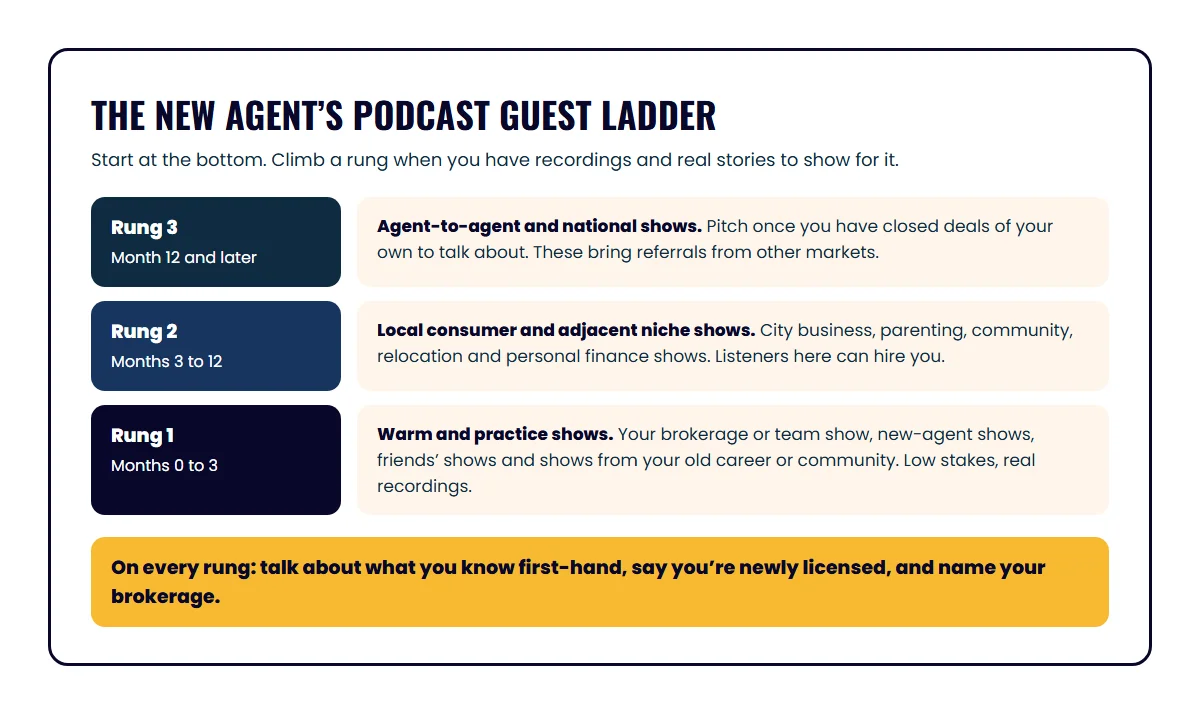
Start with warm and practice shows, move to local consumer shows after a few months, and wait on agent-to-agent shows until you have closings to talk about. Each rung gives you recordings and stories you need for the next one.
| Rung | When | Show types | What you get from it |
|---|---|---|---|
| 1. Warm and practice | Months 0 to 3 | Your brokerage or team show, new-agent and rookie shows, a friend’s show, shows from your old profession or community | Low-pressure practice, your first clips, a link for your website |
| 2. Local and adjacent | Months 3 to 12 | City business, chamber, parenting, school community, relocation, personal finance and first-time buyer shows | Listeners who can actually hire you, local credibility |
| 3. Agent-to-agent | Month 12 and later | Industry interview shows with agent audiences across the country | Referrals from other markets, once you have deals to discuss |
The months are a rough guide, not a rule. Move up when you’ve done a handful of appearances and can tell two or three real stories without notes. To build the rung-two list for your own city, use these search methods for local podcasts.
Shows to skip for now
- Big national shows that book top producers. A rejection there costs you nothing, but the time spent pitching is better used locally.
- Investor shows, unless you invest yourself or come from finance. The audience will ask for numbers you don’t have.
- Shows that charge you to appear. A new agent’s budget is better spent elsewhere. If one asks, check the math on pay-to-play podcast offers before you say yes.
How do you pitch a show with no track record?
Lead with your angle and what the listener gets, and mention that you’re newly licensed in one plain sentence. A pitch from a new agent should look just like a good pitch from anyone else: short, specific and clearly written for that show.
Attach five sample questions so the host has less work to do. Draft them with the podcast interview question generator, then cut anything you can’t answer from experience.
How do you answer “How long have you been in real estate?”
Answer it straight, then bridge to what you do know. Hosts ask this early, and dodging it sounds worse than any honest number. Practice the answer out loud until it takes under 20 seconds.
The script does three jobs. It tells the truth, it names your brokerage, and it moves the conversation to the ground where you’re strongest.
Do you need your broker’s OK first?
Yes, a new agent should get the broker’s OK before recording any podcast appearance, because mentioning your services on air usually counts as advertising. New agents skip this because the show feels small. Send the copy-paste request email from the broker sign-off guide for podcast appearances.
Should you start your own show instead?
Most new agents should guest first and decide about hosting later. A guest spot costs you a few hours. Your own show is a weekly commitment, and you’ll host better after sitting in the guest chair a few times. If hosting still tempts you, the first-year hosting playbook for new agents shows what that commitment looks like month by month.
Next step
Write your one-sentence angle today, using one of the six credibility sources above. Then list five rung-one shows you can pitch this week. If you’d rather apply to a show without pitching cold, the free Icons Lite plan on the ICONS Hub lets you build a speaker profile and apply to one podcast yourself.
Frequently asked questions
Should I tell the host I'm a new agent?
Yes, in the pitch and on air. Hosts find out anyway, and saying it first turns your inexperience into the angle instead of a secret.
Can I use my team's sales numbers when I guest?
Only if you say clearly that they are the team's numbers, not yours, and your broker is fine with it. Presenting team results as your own isn't a true picture of your experience.
How many appearances should a new agent aim for in year one?
There's no standard number. A steady pace you can keep, such as one or two a month, beats a burst of bookings you can't promote or follow up on.
Sources
- 2026 Code of Ethics & Standards of Practice — National Association of REALTORS® (accessed October 6, 2026)
- Housing Discrimination Under the Fair Housing Act — U.S. Department of Housing and Urban Development (accessed October 6, 2026)
Podcast guesting for agents
Get booked on real estate podcasts
The ICONS Hub connects agents with real estate podcast hosts looking for expert guests.
Guest On The Network
Written by
Co-Founder and Podcast Guru, Icons of Real Estate
Tomás Fonseca co-founded Icons of Real Estate in 2021 and is its Podcast Guru. He has a background in marketing, with stints at companies like Nintendo and Ardor SEO, and is one of the hosts of the Icons of Real Estate Podcast.

How we research, write, fact-check and correct articles: our editorial standards.