On this page
- Why do non-real estate podcasts make better targets?
- Which non-real estate podcasts want agent guests?
- The 8 show types, with pitch angles
- Local or national: which version of each show should you pitch?
- How do you find these shows?
- How do you pitch a host who isn’t in real estate?
- What compliance lines matter on these shows?
- Next step
Relocation podcasts are looking for realtor guests, and so are seven other non-real estate show types: personal finance, divorce, estate planning, military family, retirement, small business and parenting. Their listeners face a move, and the host rarely knows housing. Pitch one specific problem their audience has, such as “selling the house in a divorce,” to stand out.
Most agents only pitch real estate shows, where the host’s inbox is full of other agents. The shows below hear from agents rarely, and their listeners are closer to a transaction than most real estate audiences. The one-sheet, pitching, promotion and tracking steps that apply to every show are in the real estate agent’s guesting playbook.
Why do non-real estate podcasts make better targets?
Non-real estate podcasts reach listeners going through the life events that cause moves, and nobody else on the show can explain the housing side. The U.S. Census Bureau’s look at why people move found that in 2022, 41.6% of movers gave a housing-related reason and 26.5% gave a family-related reason. A change in marital status alone was the reason for 6.0% of moves.
Think about what that means for show choice. A divorce podcast, a retirement podcast and a “moving to Denver” podcast are each built around one of those reasons. A real estate show is built around real estate itself, which mostly attracts other agents and investors.
Three more reasons these shows work:
- Less competition. Hosts get pitched by authors and coaches, not by agents. A housing topic is fresh for them.
- A natural expert slot. The host has covered the legal side or the money side. You cover the house.
- Better proof. “As heard on a family law podcast” tells a divorcing seller you’ve handled this before.
Which non-real estate podcasts want agent guests?
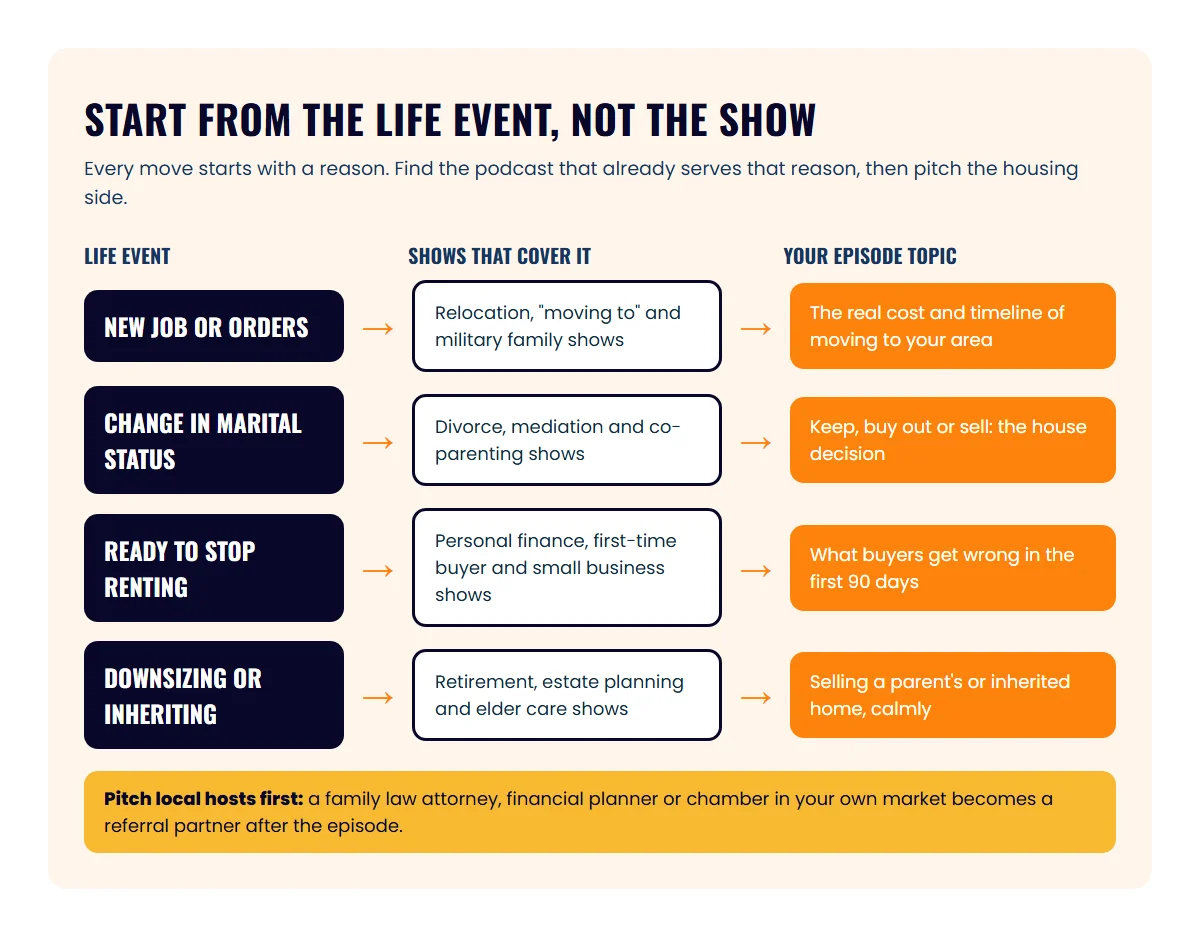
Eight non-real estate podcast types regularly suit agent guests, because their listeners face the life events that cause moves. Each row is a show type, where it sits in podcast apps, why its listeners move and the pitch angle that tends to fit.
| Show type | Where to look in Apple Podcasts | Why listeners move | Strongest pitch angle |
|---|---|---|---|
| Relocation and “moving to [city]” | Society & Culture > Places & Travel | New job, family, cost of living | The real cost and timeline of moving to your area |
| Personal finance and first-time buyer | Business > Investing; Education > Self-Improvement | Ready to stop renting, building wealth | What buyers get wrong in the first 90 days |
| Divorce and co-parenting | Society & Culture > Relationships | Change in marital status | Options for the family home, step by step |
| Estate planning, elder care and probate | Business; Health & Fitness | Inheriting or downsizing a parent’s home | Selling an inherited house without the chaos |
| Military family and PCS | Government; Kids & Family | Orders to a new base | Buy, rent or sell when orders arrive |
| Retirement and second-act | Business > Careers; Education > Self-Improvement | Downsizing, moving closer to family | Downsizing math and timing |
| Small business and entrepreneur | Business > Entrepreneurship | Self-employed buying, buying a building | Buying a home on self-employed income |
| Parenting | Kids & Family > Parenting | Needing more space, school-year timing | Timing a move around the school calendar |
Apple Podcasts has no “personal finance” or “divorce” category, so these shows are spread across Business, Education and Society & Culture. Apple’s own category list shows where each subcategory lives.
The 8 show types, with pitch angles
Each entry gives you three episode ideas and the line you shouldn’t cross. Rewrite the titles in the host’s voice after you’ve heard two of their episodes.
1. Relocation and “moving to” shows
These shows answer one question: what is it really like to live here? Listeners are often months away from a move, which is exactly when they choose an agent. Some are run by relocation consultants, some by locals, some by agents in other cities who want a partner in yours.
- “What $500,000 buys you in [your metro] right now” (an example price; use your own MLS data and say so)
- “Renting first vs buying on arrival: how to decide”
- “Five things transferees regret not asking before they moved here”
Lane: describe homes, prices, commutes and amenities. Never describe areas by who lives there.
2. Personal finance and first-time buyer shows
These shows are where future buyers learn about money. If you want first-time buyer clients, this is the most direct route. Hosts love concrete numbers, so bring them.
- “The full cash-to-close list nobody shows first-time buyers”
- “What to do in the 12 months before you start house hunting”
- “Rent vs buy in [your market]: the honest version” (clearly labelled as your example math)
Lane: you’re not a financial advisor or loan officer. Say “ask your lender” or “ask your tax pro” out loud when questions go there.
3. Divorce and co-parenting shows
These are often hosted by family law attorneys, mediators or divorce coaches. Their listeners face one of the hardest housing decisions there is: keep the house, buy out a spouse, or sell. Most hosts have no one to explain the selling side.
- “Keep, buy out or sell: how the house decision actually plays out”
- “How to sell a home when the owners aren’t speaking”
- “Finding a second home for co-parenting: what to plan for”
Lane: neutral and practical. You never say who should get the house, and the legal questions go back to the attorney host.
4. Estate planning, elder care and probate shows
Estate planning attorneys, elder care advisors and caregiver shows reach adult children who will soon handle a parent’s home. These moves are emotional and paperwork-heavy, and they reward calm, organized guests.
- “Selling an inherited house: the first 30 days”
- “Helping a parent downsize without a family fight”
- “What to clear out, fix or leave before you list a parent’s home”
Lane: no legal or tax advice on probate, titles or inheritance. Name the professional who handles each piece.
5. Military family and PCS shows
Shows for service members and spouses cover permanent change of station (PCS) moves, which come with short timelines. If you live near a base, this is one of the most targeted audiences you can reach.
- “Got orders? Buy, rent or sell, with real timelines”
- “Buying a home sight unseen: how virtual tours really work”
- “Renting out your house when you PCS: questions to ask first”
Lane: send VA loan questions to a lender who handles them.
6. Retirement and second-act shows
Retirement shows reach owners who’ve been in one home for a long time and are thinking about the next one. Many will sell and buy in the same move.
- “Downsizing math: what you net after you sell”
- “Sell first or buy first when you’re downsizing”
- “Moving closer to the grandkids: how to plan a long-distance move”
Lane: pitch the topic, not the age group. Anyone thinking about downsizing is welcome.
7. Small business and entrepreneur shows
Local business shows reach owners who buy homes on self-employed income and sometimes buy their own building. They also make great referral partners.
- “What self-employed buyers need before they apply”
- “How I built a referral business without paid ads” (your own story)
- “Lease or buy your business space: questions to ask”
Lane: commercial deals and tax questions go to the right specialist if they aren’t your field.
8. Parenting shows
Parenting podcasts reach families outgrowing their space or planning a move around the school year.
- “How to time a move around the school calendar”
- “Selling a house with kids and pets at home”
- “Getting kids ready for a move: a checklist for parents”
Lane: point listeners to official sources for school information, and never steer anyone toward or away from an area.
Local or national: which version of each show should you pitch?
Pitch the local version of each show first, because its listeners live where you’re licensed and the host becomes a referral partner for years after the episode. Every niche above has shows hosted by professionals in your own market: a family law attorney’s podcast, a financial planner’s show, a chamber’s business podcast.
National shows still have a place. Use them for proof in your bio and listing presentations, and for relocation clients moving into your area. Here’s the simple rule:
| Show | What it can do for you | Priority |
|---|---|---|
| Local professional’s show in your niche | Direct clients, plus a long-term referral partner | First |
| National show about moving to your city or state | Inbound relocation buyers | Second |
| National show in your niche | Proof for your marketing, outbound referrals | Third |
National audiences raise licensing and referral questions, covered in guesting outside your licensed market. Community and lifestyle shows in your own city get their own worksheet for finding local podcasts.
How do you find these shows?
Search by the problem, not by real estate. Use these four methods:
- Browse the right category. In Apple Podcasts, open the categories from the table above, then search inside them.
- Search with city names. Try “[city] divorce podcast”, “[city] financial planner podcast”, “moving to [city] podcast” and “[state] military spouse podcast” in podcast apps and Google.
- Ask your partners. Attorneys, financial planners and relocation consultants you already know often host shows or know who does.
- Use a directory. The ICONS Hub podcast directory behind the ICONS podcast network can be filtered by theme and area; the plans, including a free tier, are listed on the ICONS Hub guest booking page.
Before you pitch, check three things: a recent episode, a guest format, and listeners you can actually serve or refer.
How do you pitch a host who isn’t in real estate?
Lead with their listener’s problem, then show you can explain it simply. Non-real estate hosts don’t care about your sales volume. They care whether you’ll make their audience smarter in 30 minutes. Keep your bio short and tied to their topic; these guest bio examples for agents show how to rewrite one per niche.
Close the episode with one simple offer, such as a free checklist for the listener’s situation. Wording that doesn’t sound salesy is in how to end a podcast interview with a call to action.
What compliance lines matter on these shows?
Three lines matter most: stay in your advice lane, be careful with lender involvement and keep every comment about places on the right side of Fair Housing.
- Advice lanes. Divorce, estate and finance shows invite legal, tax and investment questions. Answer the housing part and send the rest to the right professional.
- RESPA. Some personal finance shows are hosted or sponsored by lenders. Before you co-market with one, run it past your broker.
- Fair Housing. The Fair Housing Act prohibits housing discrimination based on race, color, national origin, religion, sex, familial status and disability, according to HUD. Parenting and military shows invite “best area for families” questions. Talk about homes, prices, commute times and amenities instead. Your state may add other protected classes. Before the first parenting or military episode, rehearse with the Fair Housing podcast checklist, and clear the appearance with your broker as you would any other.
Next step
Pick the two niches that match clients you’ve already served. Find five shows in each, with local hosts first, and send five tailored pitches this week using the template above. Log every show in the tracker from the guesting pillar so you can see which niche actually sends you business.
Frequently asked questions
Do relocation podcasts actually take realtor guests?
Many do, because a local agent is the person who can answer what a move really costs and how long it takes. Pitch a specific topic about moving to your area rather than a general interview.
Is a national personal finance show worth it if most listeners live elsewhere?
It can be, as proof for your bio and listing presentations and as a source of referrals you pass on. For direct clients, a local financial planner's show usually beats a bigger national one.
Can I talk about mortgage rates on a personal finance podcast?
You can talk about what you see buyers doing, but send rate and loan questions to a licensed loan officer. If a lender co-hosts or sponsors the episode, check RESPA with your broker first.
How many adjacent-niche shows should I pitch?
Pick two niches that match your actual clients and pitch five shows in each. Ten tailored pitches beat fifty generic ones.
Sources
- Apple Podcasts categories — Apple Podcasts for Creators (accessed October 6, 2026)
- Change in Marital Status Became More Common Reason for Moving from 2021 to 2022 — U.S. Census Bureau (accessed October 6, 2026)
- Housing Discrimination Under the Fair Housing Act — U.S. Department of Housing and Urban Development (accessed October 6, 2026)
Podcast guesting for agents
Get booked on real estate podcasts
The ICONS Hub connects agents with real estate podcast hosts looking for expert guests.
Guest On The Network
Written by
Co-Founder and Podcast Guru, Icons of Real Estate
Tomás Fonseca co-founded Icons of Real Estate in 2021 and is its Podcast Guru. He has a background in marketing, with stints at companies like Nintendo and Ardor SEO, and is one of the hosts of the Icons of Real Estate Podcast.

How we research, write, fact-check and correct articles: our editorial standards.