On this page
- What counts as a local podcast for a real estate agent?
- Which local show types reach buyers and sellers?
- How do you find local podcasts in your city?
- How do you check if a local show is worth pitching?
- What goes on your local show worksheet?
- How do you pitch a local podcast host?
- What should you avoid saying on a local show?
- Next step
To find local podcasts to guest on as a realtor, search by your city, county and neighborhood names rather than “real estate.” Most local shows are business, community, school, nonprofit or local news podcasts. Look in podcast apps, Google, local media, the chamber and school groups. Then score each show for listener location, recent episodes and a guest format.
Agents skip the scoring step all the time. A national show with a big audience feels like a win. The show whose listeners live in your farm area is the one that sends you a seller. Finding local shows is one piece of a larger routine; the one-sheet, pitching, promotion and tracking are in the complete podcast guesting system for agents.
What counts as a local podcast for a real estate agent?
A local podcast is any show whose listeners mostly live, work or plan to move inside the area where you’re licensed. The topic doesn’t have to be real estate. In fact, the best local shows for agents usually aren’t.
Think about who listens to a show called “Main Street Makers” about small businesses in your town. Those listeners own homes, rent offices, have parents who are downsizing and coworkers who are relocating. None of them are searching for an agent today. All of them will need one at some point.
Three tests make a show “local” for your purposes:
- The host lives in your market. This is the strongest signal.
- Guests are local. Business owners, coaches, nonprofit leaders, city staff.
- Episodes mention local places. Street names, schools, events, restaurants.
A show only needs to pass one of these to make your list. It needs to pass two to make your shortlist.
Best shows outside your licensed area? That works too, but as a referral play, and guesting on shows outside your market runs on different rules.
Which local show types reach buyers and sellers?
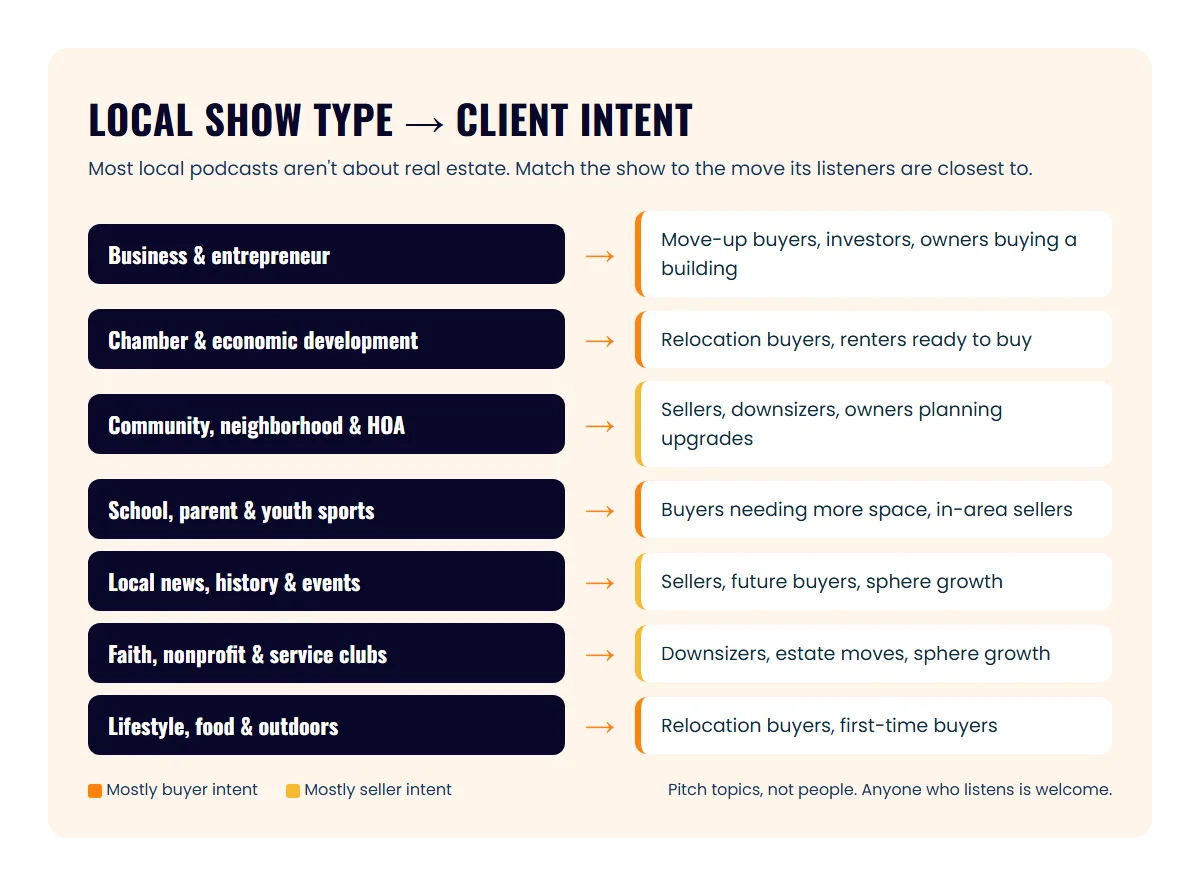
Different local shows reach people at different points in a move. Match the show type to the client intent you want, then pitch a topic that serves that intent.
| Local show type | Who usually listens | Client intent you can reach | Topic that fits |
|---|---|---|---|
| Local business and entrepreneur shows | Owners, managers, self-employed locals | Move-up buyers, investors, owners buying a building | “What business owners should know before buying a home on self-employed income” |
| Chamber of commerce and economic development shows | Business leaders, newcomers’ employers | Relocation buyers, renters ready to buy | “What new hires ask me before they move here” |
| Community, neighborhood and HOA shows | Long-time residents, homeowners | Sellers, downsizers, homeowners planning upgrades | “What to fix and what to leave before you sell” |
| School, parent and youth sports shows | Parents active in local programs | Buyers who need more space, sellers moving within the area | “How to time a move around the school year” |
| Local news, history and events shows | Engaged residents of all ages | Sellers, future buyers, sphere growth | “What this year’s local market numbers mean for owners” |
| Faith, nonprofit and service club shows | Volunteers, members, donors | Downsizers, estate and probate situations, sphere growth | “How families can plan a parent’s move without the stress” |
| Local lifestyle, food and outdoors shows | Residents and people thinking of moving in | Relocation buyers, first-time buyers | “What it actually costs to buy your first home here” |
Keep two notes in mind as you use it.
First, the “who usually listens” column describes what a show is about, not who you want as a client. You pitch topics, and anyone who listens is welcome. Never pick shows to reach or avoid any group of people.
Second, the topic column is a starting point. Rewrite it in the host’s language once you’ve listened to two episodes.
How do you find local podcasts in your city?
Find local podcasts in your city by searching place names, such as your city, county and neighborhoods, not industry words. “Real estate podcast [city]” mostly returns other agents’ shows. Use these seven methods, in this order, and add every show you find to the worksheet.
- Search podcast apps by place name. In Apple Podcasts, Spotify and YouTube, search your city, your county, your neighborhood names, your local nickname (“the Valley,” “the Shore”) and your area code. Then try the city plus “business,” “moms,” “history,” “sports” and “news.”
- Use Google search operators. Google lets you put a phrase inside quotes for an exact match, put
site:before a domain to search only that site and put-before a word to leave it out (Google Search Help). The search strings in the template below use all three. - Check local media. Your local newspaper, TV station, public radio station and city magazine often run podcasts or list them. Look at their “podcasts” or “listen” pages.
- Ask the chamber and business groups. Chambers, downtown associations, Rotary, BNI chapters and small-business centers often host a show or know who does. Ask the membership director directly.
- Look at schools, booster clubs and nonprofits. School foundations, PTAs, youth leagues, libraries and local nonprofits run more podcasts than you’d guess. Check their websites and newsletters.
- Search social by location. On Instagram, Facebook and LinkedIn, search “[city] podcast” and check local hashtags. Many small shows promote on social long before they rank anywhere.
- Ask your sphere. Text 20 people: “Do you listen to any podcasts about our town or by local people?” Past clients will name shows you’d never find by search.
If you’d rather start from a list, the ICONS Hub podcast directory can be filtered by area (US regions, states and cities), and the free podcast match has the concierge team recommend a show for you by email. The plans, including the free Icons Lite tier, are listed on the ICONS Hub guesting plans page.
The 20-minute search sprint
You don’t need a day for this. Set a timer and run one sprint per week until you have 15 to 20 shows on your list.
- First 5 minutes: podcast app searches (method 1).
- Next 7 minutes: the Google search strings above (method 2).
- Then 5 minutes on sites: one local media site and one chamber or school site (methods 3 to 5).
- Last 3 minutes: add every show to your worksheet with its link and a one-line note.
Send the sphere text (method 7) once and let answers trickle in.
How do you check if a local show is worth pitching?
A local show is worth pitching if its listeners live in your market, it is still publishing and it actually has guests. Score each show from 0 to 2 on these five points. Pitch shows that score 7 or more first.
| Check | 0 points | 1 point | 2 points |
|---|---|---|---|
| Listener geography | No local signals | Some local guests or references | Local host, local guests, local topics |
| Still active | No episode in 6+ months | Last episode in 2 to 6 months | Episode in the last 60 days |
| Guest format | Solo show only | Occasional guests | Regular guests |
| Topic fit | No link to homes, money or moving | Could fit with the right angle | Clear fit with your topic |
| Promotion | No social or website | Posts episodes sometimes | Shares every episode, tags guests |
Skip download numbers. Local shows rarely publish them, and a small, loyal audience in your farm area is worth more than reach you can’t serve. Listen to two episodes of every show that scores 7 or more. You’ll learn the host’s style and find a hook for your pitch.
Watch for shows that ask for a fee. Most local hosts don’t charge, but some do. Run any paid offer through the five tests for paid podcast guest spots before you agree.
What goes on your local show worksheet?
Your worksheet is one row per show, with enough detail that you can pitch it in five minutes. Use these columns in a spreadsheet:
- Show name and link
- Show type (from the table above)
- Host name and best contact (email, DM or website form)
- Client intent it reaches
- Score (out of 10)
- Last episode date
- Two episodes you listened to, with one note each
- Your topic for this show
- Pitch date, follow-up date and status
- Lead source tag for your CRM
The last column matters later. When someone calls and says “I heard you on the Main Street show,” you want that tagged, so you know which show types to pitch again.
How do you pitch a local podcast host?
Pitch a local host as a neighbor first and an expert second. Local hosts get fewer pitches than national shows, so a short, specific note often works. Mention a recent episode, offer one topic tied to the show’s listeners and make it easy to say yes.
Promise only what you’ll actually do. If you say you’ll share the episode, plan the posts and the email before you record. No reply after a week? Send one short, polite podcast pitch follow-up, then move on.
What should you avoid saying on a local show?
Avoid describing any area by who lives there. Local shows invite exactly the questions that cause trouble: “What’s the best neighborhood for families?” or “Where should people like us live?” The Fair Housing Act prohibits housing discrimination because of race, color, national origin, religion, sex, familial status and disability (HUD). Talk about homes, prices, commute times, lot sizes and amenities instead, and point listeners to official sources for school information.
Two more checks before you record:
- Clear the appearance with your broker. Many brokerages have rules for advertising, including when and how you name the firm. Ask before the first booking.
- Keep market numbers sourced. Say where a figure comes from (“our local MLS data for last month”), and check it the week you record.
The phrases to cut, for you and the host, are in the podcast Fair Housing checklist.
Next step
Run one 20-minute search sprint this week and score every show you find. If you end up with fewer than five good local shows, your city may have room for a show of its own. See what a hyperlocal real estate podcast of your own involves, or score yourself on the host-or-guest decision worksheet.
Frequently asked questions
What if my town doesn't have any local podcasts?
Widen the circle to your county, the nearest metro and the region your buyers move from. If you still find fewer than five shows, that is a sign the gap is an opening to host your own local show.
How many local podcasts should I pitch at once?
Start with the five highest-scoring shows on your worksheet. Pitch them one at a time with a tailored topic, then add the next show each time you get a yes or a clear no.
Is a small local show with few listeners worth my time?
Often, yes. A show with a modest audience that lives in your farm area can reach more potential clients than a large national show where almost nobody lives near you.
Should I pay to be on a local podcast?
Most local hosts don't charge guests. If one does, treat the spot as advertising: get broker approval and check that the listeners actually live in your market first.
Sources
- Refine Google searches — Google Search Help (accessed October 6, 2026)
- Housing Discrimination Under the Fair Housing Act — U.S. Department of Housing and Urban Development (accessed October 6, 2026)
Podcast guesting for agents
Get booked on real estate podcasts
The ICONS Hub connects agents with real estate podcast hosts looking for expert guests.
Guest On The Network
Written by
Co-Founder and Podcast Guru, Icons of Real Estate
Tomás Fonseca co-founded Icons of Real Estate in 2021 and is its Podcast Guru. He has a background in marketing, with stints at companies like Nintendo and Ardor SEO, and is one of the hosts of the Icons of Real Estate Podcast.

How we research, write, fact-check and correct articles: our editorial standards.