On this page
- Do you have to pay to be a guest on a podcast?
- Do podcast guests get paid?
- What are you actually paying for?
- Why is a paid guest spot different for a licensed agent?
- When is paying to be a podcast guest reasonable?
- How do you run the math on a paid spot?
- What should you ask a show before you pay?
- Paying a show vs paying a booking service
- Next step
Should you pay to be a podcast guest? Usually not: most interview shows book guests free because guests are the content. For a licensed agent, a paid spot is advertising. It needs broker sign-off, your firm name, clear disclosure from the host and listeners in your market. Pay only when all four check out and the math works.
Below: what “paying” can actually mean, why the rules change once you hold a license, and how to judge the specific offer sitting in your inbox. New to guesting altogether? Learn the free route first in the guesting playbook for agents, then come back when a show asks for money.
Do you have to pay to be a guest on a podcast?
No, most interview podcasts don’t charge guests, because they need a steady supply of good guests to make episodes. The host gets an episode, and you get their audience and a recording you can reuse.
Paid offers do exist, and they’re more common than they used to be. Some shows charge every guest. Others are free but sell a faster slot, a bigger promo package or a “featured” episode. A few are really advertising businesses dressed up as interview shows.
The free route should be your default. Pitch shows that book on merit first. If you’re getting turned down everywhere, the fix is usually a sharper angle or a better one-sheet, not a credit card. And if you want an audience you control, compare hosting versus guesting before you pay anyone.
Do podcast guests get paid?
Almost never, and agents shouldn’t expect to be. A podcast guest is usually paid in exposure, a backlink, clips and a warm relationship with the host. Shows that do pay guests tend to be large productions booking well-known names, and that’s not the slot an agent is pitching for.
So how much does a podcast guest get paid? For a real estate agent, the honest answer is zero. Treat any appearance as a marketing activity that costs you time, not a gig that earns a fee. If a host does offer you money, ask your broker how to handle it before you accept.
What are you actually paying for?
“Pay to be on a podcast” covers five different deals, and only some of them are true pay-to-play. Before you judge an offer, name which one it is.
| What you pay for | Who gets the money | Is it pay-to-play? | Question to ask |
|---|---|---|---|
| The interview itself. No fee, no episode. | The show | Yes. This is a paid placement. | “Will the episode say this segment is paid?” |
| Speed. The interview is free, but you can pay to skip the waiting list. | The show | Partly. You buy timing, not access. | “If I don’t pay, will I still be booked, and when?” |
| Assets. The interview is free; you buy clips, raw video or an article. | The show | No, if the booking doesn’t depend on it. | “Can you confirm the booking is the same if I buy nothing?” |
| Booking labor. A service pitches and schedules you. | A booking service | No, unless part of the fee goes to shows. | “Does any of my fee go to a show for a placement?” |
| An ad read or sponsorship. The host promotes you; there’s no interview. | The show | No. It’s a normal, labelled ad. | “Where does the ad run, and who’s the audience?” |
To be transparent about our own show: the guest spot on the ICONS of Real Estate podcast is free. We also sell a $99 priority booking to skip the queue and optional promo kits ($27 and $47) for extra assets like raw footage and an SEO article. Those are rows two and three in the table above. You never need either one to be interviewed. If you want help getting booked on other shows, the ICONS podcast guesting plans list their prices and what each booking includes.
The first row is where agents get hurt. A paid interview looks like independent content, which is exactly why it needs special handling once you hold a license.
Why is a paid guest spot different for a licensed agent?
Once money changes hands for your airtime, the episode is advertising for your real estate services. That puts it under your broker’s policies, your state’s advertising rules, the REALTOR® Code of Ethics if you’re a member, and federal rules on disclosure and kickbacks. Your broker, not this page, makes the call. Show them the offer before you pay, every time.
The host has to say it’s paid
An ad that looks like a neutral interview misleads listeners if nobody says it’s paid. The FTC’s guide to native advertising says promotional messages are deceptive if they suggest they’re independent or impartial, and that audio disclosures need enough volume and cadence for ordinary listeners to hear and understand them. A quick mumble at minute 41 doesn’t count.
Ask the host for a disclosure at the start of your segment, in plain words, such as “This interview is a paid feature.” Then ask for the same line in the show notes and on screen if there’s video. If the host refuses, that tells you how they treat listeners.
Your firm name goes in the ad
Standard of Practice 12-5 requires REALTORS® to show their firm name clearly whenever they advertise real estate services, whatever the medium. Article 12 also requires a true picture in your advertising. Both sit in the NAR Code of Ethics. Say your brokerage in your intro, put it on your one-sheet, and check whether your state wants more, such as a license number.
“A true picture” also covers your claims. A paid spot doesn’t make it fine to say “top agent in the city” unless you can back it up.
Watch who else is paying
This is where co-marketing ideas go wrong. A lender or title rep offers to “split the cost” of a featured episode, or a show’s sponsor covers your fee. Under RESPA, giving or accepting any thing of value in exchange for referring settlement business on a federally related mortgage loan is prohibited, and “thing of value” is defined broadly. See 12 CFR 1024.14 on the CFPB site. Payments for services actually performed are treated differently, which is why the details matter.
Don’t try to work out those details yourself. If anyone in the settlement chain is paying any part of your spot, stop and get a written answer from your broker or compliance officer.
Fair Housing still applies on air
Paid or free, what you say about neighborhoods is advertising. Talk about homes, commute times, parks and schools’ published programs. Don’t describe an area by the people in it or by who would “fit in,” and don’t steer listeners toward or away from places.
When is paying to be a podcast guest reasonable?
Paying is reasonable when the show reaches people who can actually hire you, the disclosure is handled, and one closing covers the fee many times over. It’s a poor deal when you’re paying to feel booked. Run every offer through these five tests in order.
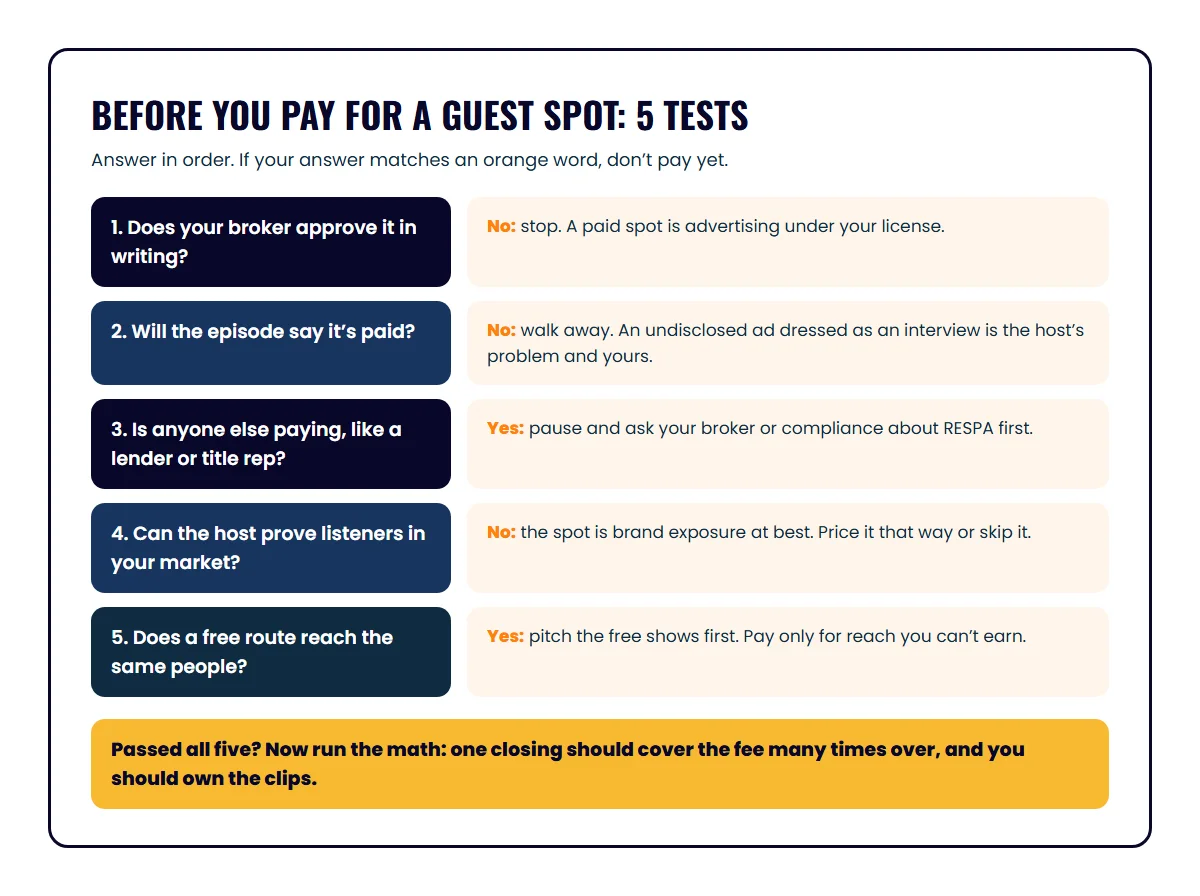
- Broker approval. Get a yes in writing before you pay. If your broker says no, you’re done.
- Disclosure. The host agrees to say the segment is paid, on air and in the show notes.
- No third-party money. Nobody in the settlement chain is covering your fee. If someone is, compliance decides first.
- Listeners you can serve. The host shows you where listeners are. Look for people in the area where you’re licensed, or agents elsewhere who refer clients moving into your market.
- No free equivalent. You’ve tried to reach the same audience by pitching free local shows and couldn’t.
When paying tends to make sense
- Local shows with paid features. Think of a well-run city business podcast or community news show that only offers paid features but has a real local following.
- Useful add-ons. The interview is free, and the paid extra gets you raw video and clips you’d otherwise pay an editor to cut.
- Referral audiences. On a relocation or agent-referral show, one inbound referral can cover years of fees.
When to skip it
- National vanity shows. A “success stories” show that charges every guest and won’t share listener data is selling flattery.
- Promised results. Any offer that promises downloads, leads or closings is promising something no host controls.
- Forced bundles. If you have to buy a stack of add-ons before the host will confirm a date, the interview is the bait.
Several of these overlap with the warning signs of a bad booking agency, which are worth reading before you sign anything.
How do you run the math on a paid spot?
Work out the cost per local listener and the number of closings you need, then compare that to your other channels. Use real numbers from the host’s dashboard, not the download figure on their media kit.
A few habits keep the math honest:
- Track the episode on its own. Give it a unique link and a CRM source so you can see what it produced.
- Count the assets. If the fee includes edited clips and raw video you’d otherwise pay for, subtract that value.
- Compare channels. Line the spot up against Zillow or Facebook spend using cost per conversation for guesting vs paid ads, and let the podcast ROI calculator do the closing math.
What should you ask a show before you pay?
Ask for proof of audience, the disclosure wording and the exact deliverables, in writing, before you send money. Copy this email and fill in the brackets.
A good host answers all six without fuss. Vague answers to questions 2, 3 or 5 are a no.
Paying a show vs paying a booking service
Paying a booking service is a different decision from paying a show. A booking service charges for the labor of finding, pitching and scheduling you. The shows themselves usually stay free. The risk is a service that quietly pays shows for placements and passes the cost to you, so ask directly whether any of your fee goes to a show.
If you’re weighing a service rather than a single paid spot, look at what podcast booking agencies cost and whether a booking agency is worth it for a realtor. Both pages run the numbers against your commission.
Next step
Pitch three free shows that reach your licensed market this week. If a paid offer still looks better afterwards, send the email above, forward the answers to your broker, and run the math before you pay anything.
Frequently asked questions
Is a paid spot on a national show worth it for credibility?
Only if your broker approves and you'll actually use the clip in listing presentations and your bio. A national logo rarely brings local clients, so price it as a marketing asset, not a lead source.
Is a paid podcast spot the same as a sponsorship?
No. A sponsorship buys an ad read or a mention, while a paid guest spot buys an interview that looks like editorial content. That is exactly why it needs a clear disclosure that the segment is paid.
Can my lender partner pay for my guest spot?
Don't agree until your broker or compliance team signs off. If a settlement service provider gives you something of value and there's an understanding that you'll refer business, that can raise RESPA Section 8 issues.
Is it pay-to-play if I buy the show's promo package?
Not if the interview is free and the package only buys extra assets, like raw footage or edited clips. Ask the host to confirm in writing that the booking doesn't depend on buying anything.
Sources
- Native Advertising: A Guide for Businesses — Federal Trade Commission (accessed October 6, 2026)
- 12 CFR 1024.14 Prohibition against kickbacks and unearned fees — Consumer Financial Protection Bureau (accessed October 6, 2026)
- 2026 Code of Ethics & Standards of Practice — National Association of REALTORS® (accessed October 6, 2026)
Podcast guesting for agents
Get booked on real estate podcasts
The ICONS Hub connects agents with real estate podcast hosts looking for expert guests.
Guest On The Network
Written by
Co-Founder and Podcast Guru, Icons of Real Estate
Tomás Fonseca co-founded Icons of Real Estate in 2021 and is its Podcast Guru. He has a background in marketing, with stints at companies like Nintendo and Ardor SEO, and is one of the hosts of the Icons of Real Estate Podcast.

How we research, write, fact-check and correct articles: our editorial standards.