On this page
- What does “worth it” mean for a booking agency?
- How many closings does a booking agency need to pay for itself?
- What can you afford to pay per booking?
- What is your DIY pitching time worth?
- Booking agency, DIY or VA: which fits your hours and budget?
- Should you hire a podcast booking virtual assistant instead?
- When is a booking agency not worth it?
- How do you judge an agency after 90 days?
- Next step
A podcast booking agency is worth it for a realtor when one podcast-sourced closing a year covers the fee, or when it saves hours worth more than it costs. Divide the agency’s yearly fee by the net commission you keep per closing. If the answer is one or two closings, and you won’t pitch yourself, hire help.
Below is the math to check that against your own closing statements, a decision table by hours and budget, and the signs that tell you to keep your money. If you haven’t guested yet, learn the basics in the agent guesting playbook before deciding who does the pitching.
What does “worth it” mean for a booking agency?
A booking agency is worth it if it passes one of two tests: the deal test or the time test. You don’t need both. You do need at least one, written down with your own numbers, before you sign anything.
- The deal test. The bookings it delivers produce enough closings to cover the yearly fee. This is about revenue.
- The time test. The agency costs less than the hours you’d spend pitching, valued at what your time earns you. This is about cost.
Most agency sales pages argue neither test. They talk about reach, authority and download counts. None of those pay your mortgage. A listing appointment does.
There’s a third, honest reason people hire agencies, and it matters more than either test: consistency. Most agents who plan to pitch themselves send a burst of emails, get busy with a closing, and stop. If you know that’s you, the real comparison isn’t agency versus DIY. It’s agency versus zero bookings.
How many closings does a booking agency need to pay for itself?
Divide the agency’s yearly fee by the net commission you keep from one closing, then round up. That number is your break-even closings. If it’s one or two, the decision is easy for most working agents. If it’s five or more, the agency has to deliver unusually good shows.
Break-even closings = (monthly fee × 12) ÷ net commission per closing
Net commission means what you keep after your broker split, franchise fees and transaction fees. Don’t use the sale price or your gross commission. Pull the real figure from last year’s closing statements.
The table below runs the formula across four example fee levels. The $87 row is the published price of our own ICONS Hub Concierge plan, which guarantees 2 bookings a month. The other three rows are round example figures, not quotes from any agency. Real agency price ranges, model by model, are in what podcast booking agencies charge.
| Monthly fee (yearly cost) | Net $4,000 per closing | Net $7,500 per closing | Net $12,000 per closing |
|---|---|---|---|
| $87 ($1,044) | 0.3, so 1 closing | 0.1, so 1 closing | 0.1, so 1 closing |
| $500 ($6,000) example | 1.5, so 2 closings | 0.8, so 1 closing | 0.5, so 1 closing |
| $1,500 ($18,000) example | 4.5, so 5 closings | 2.4, so 3 closings | 1.5, so 2 closings |
| $3,000 ($36,000) example | 9 closings | 4.8, so 5 closings | 3 closings |
Read the example table from the bottom right up. A luxury agent at $12,000 net can justify a premium agency on two or three deals a year. An agent at $4,000 net needs nine podcast-sourced closings to cover the $3,000 row, and that’s not realistic from guesting alone.
What can you afford to pay per booking?
Your maximum price per booking is your net commission per closing divided by the number of bookings it takes you to get one closing. This is the most useful number on this page, because it lets you compare a retainer, a per-placement fee and a subscription on the same scale.
Max price per booking = net commission per closing ÷ bookings per closing
The hard part is “bookings per closing.” Nobody publishes a reliable industry figure, and any agency that quotes one is guessing about your market. So build it from two rates you can measure yourself:
- Conversations per episode. How many episodes does it take before someone reaches out: a listener, a referral from another agent, or the host?
- Closings per conversation. Out of those conversations, how many become a closed deal? Your CRM already knows this rate for your other lead sources.
Now convert any offer into a price per booking. For example, a $1,500 monthly retainer that delivers 4 bookings costs $375 per booking. Under the assumptions above, that’s above the $312 break-even line. It can still work, but only if its shows are clearly better than the ones you’d land yourself. The $87 plan from the table, at 2 bookings a month, works out to $43.50 per booking, well under the line.
The podcast ROI calculator runs the same math with your own commission and close rate, so you can test a few scenarios before a sales call.
What is your DIY pitching time worth?
Your DIY pitching time is worth your real hourly value multiplied by the hours it takes you to land one booking. If that cost per booking is higher than an agency’s price per booking, the agency saves you money before a single deal closes.
Step 1: Find your real hourly value
Divide last year’s net income by the hours you actually worked. Be honest about evenings and weekends. The Bureau of Labor Statistics notes that agents’ schedules “often include evenings and weekends,” and lists a 2025 median pay of $27.59 per hour for real estate brokers and sales agents combined (BLS Occupational Outlook Handbook). Treat that as a floor. If you’re reading a page about hiring help, your number is probably higher.
Step 2: Estimate hours per booking
Count everything the agency would do for you: finding shows, checking each show’s audience, writing a tailored pitch, two follow-ups and the scheduling emails. Leave out the interview and prep, because you do those either way.
Step 3: Multiply
In this example, any offer under $135 per booking beats DIY on time alone. An offer at $375 per booking only wins if its shows produce more conversations than yours would. That’s the question to ask on every agency call: show me the shows.
One caution. Saved hours are only worth money if you spend them on something that earns. If the freed-up six hours go to scrolling, the time test doesn’t apply, and only the deal test counts.
Booking agency, DIY or VA: which fits your hours and budget?
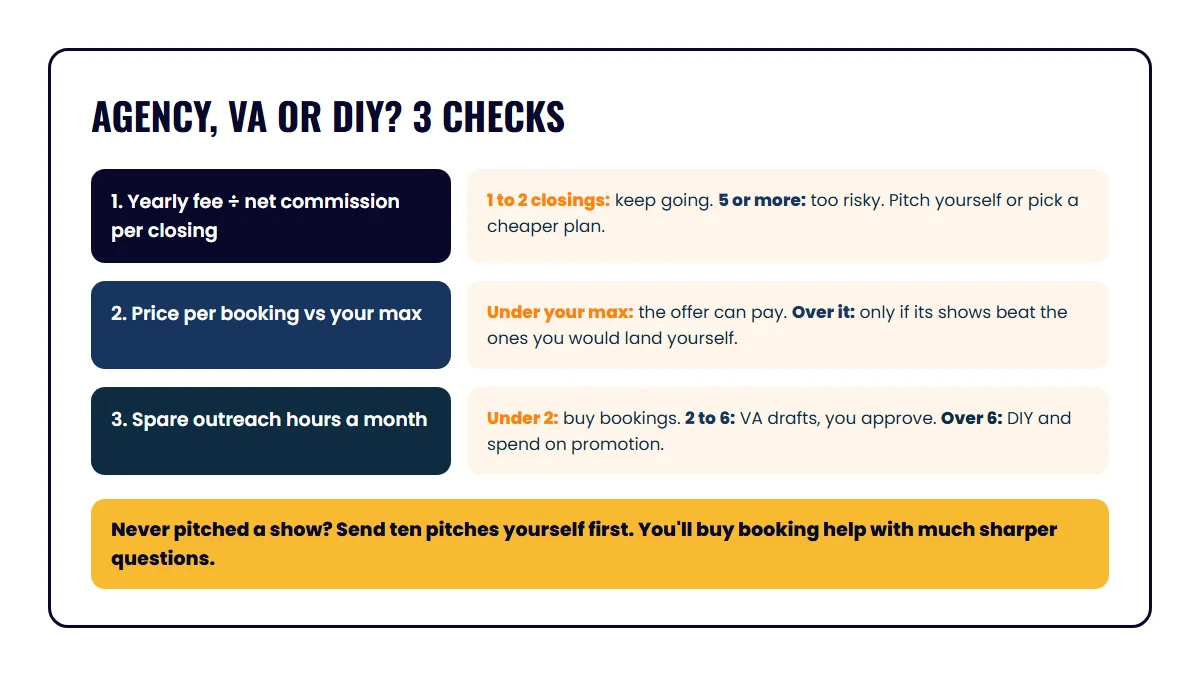
Pick by how many spare hours a month you’ll really give to outreach, then by budget. Agents with under two spare hours should buy bookings. Agents with six or more usually get better shows pitching themselves. The middle band is where a virtual assistant or a low-cost booking plan fits best.
| Spare outreach hours per month | Budget under $100/mo | Budget $100 to $500/mo | Budget over $500/mo |
|---|---|---|---|
| Under 2 hours | Low-cost booking plan with guaranteed bookings. Keep it to 1 or 2 a month so you promote each one. | Booking plan or small agency package. Ask for the show list before you pay. | Full agency, only if your max price per booking clears its fee. |
| 2 to 6 hours | DIY with templates: 4 to 6 pitches a week, tracked in a sheet. | VA does research and drafts; you approve and send. | Agency for national and agent-to-agent shows; you pitch local shows yourself. |
| Over 6 hours | DIY. Your local knowledge is the best pitch asset you have. | DIY plus a VA for show research only. | DIY. Spend the budget on promoting episodes, not booking them. |
Two rules sit on top of the table. First, if your break-even closings from the previous section are five or more, move one column to the left. Second, if you’ve never pitched a single show, do ten yourself first. You’ll learn what hosts respond to, and you’ll be a much sharper buyer of booking help. Self-serve matching sites are one more middle option, so compare what PodMatch, Talks and similar guest platforms offer before you pay anyone.
Should you hire a podcast booking virtual assistant instead?
A podcast booking virtual assistant makes sense when you have a clear angle and a few hours a month but hate the research and follow-up. The assistant handles the repetitive work. You keep control of the pitch and the show list, which an agency usually takes over.
Split the work like this:
| Task | VA does it | You do it |
|---|---|---|
| Find shows by market, niche and audience | Yes | Approve the list |
| Check each show’s recent episodes and guest types | Yes | Spot-check a few |
| Fill the outreach tracker | Yes | Review weekly |
| Write the pitch | Drafts from your template | Add one personal line per show |
| Send pitches and follow-ups | Yes, from a shared inbox or your email with rules | Answer host replies |
| Prep, interview and promotion | No | Yes |
The catch is management. A VA needs your one-sheet, your angle, your pitch template and your no-go list of shows. Budget two or three hours to set that up. After that, a weekly 15-minute review is enough.
When is a booking agency not worth it?
A booking agency isn’t worth it when the bookings can’t turn into business, no matter how many it delivers. Skip it, or wait, if any of these are true:
- You have no follow-up system. If you won’t email the episode to your sphere, post clips or tag leads in your CRM, the bookings decay on air day.
- You don’t have an angle yet. An agency can pitch “experienced agent in Denver.” Hosts rarely book that. Fix your positioning first by picking one of these 50 guest topic angles for agents.
- The shows sit outside your licensed market for no reason. National consumer shows look good in a monthly report. For a local agent they mostly produce nothing.
- Your break-even closings are five or more. That’s a bet on outlier results, not a marketing plan.
- Your broker hasn’t approved media appearances. Clear it in writing before you pay anyone to book you.
- Some “bookings” are paid spots. That’s advertising, with its own disclosure questions; check the rules for paid guest spots before agreeing.
Guaranteed downloads, contract lock-ins and the other warning signs are covered in how to vet a podcast booking agency.
How do you judge an agency after 90 days?
Judge it on show fit, air dates and conversations, not on the number of bookings in its report. Ninety days is long enough for episodes to air and short enough to cut your losses. Set the scorecard before you sign, so the agency knows what you’re measuring.
| Measure | What good looks like | Where to find it |
|---|---|---|
| Bookings delivered vs promised | Matches the contract | Agency report |
| Share of shows you’d have pitched yourself | Most of them | Your own review of the list |
| Local or agent-to-agent shows | The majority, for a local agent | Show list, by listener location |
| Episodes aired with links | Every recorded episode has an air date | Agency report, show feeds |
| Conversations tagged to podcast | At least one, with a source in your CRM | Your CRM |
| Your hours spent | Prep and interviews only | Your calendar |
Then apply three rules:
- Keep if the shows fit and at least one conversation is tagged, even if nothing has closed. Closings lag episodes.
- Fix if the shows fit but there are no conversations. The problem is usually your call to action or your promotion, not the agency.
- Cancel if the shows don’t fit your market. More months won’t change who listens.
Next step
Pull your last five closing statements and work out your net per closing. Run the break-even table and the max-price-per-booking formula with your own numbers. If the answer points to buying bookings, put every quote you get on the same scale, price per booking, and ask each provider for its show list before you sign. To see what a list of established real estate shows looks like, browse the ICONS podcast network.
Frequently asked questions
How many bookings a month should a podcast booking agency get a real estate agent?
Two to four a month is a pace most agents can prep for and promote properly. More than that often means weaker shows or episodes you never promote, which wastes the bookings you paid for.
Can I hire someone to book podcasts for me part time?
Yes. A virtual assistant can research shows, fill your tracker and send pitches from your templates while you approve each one. You still need a clear angle and a one-sheet, because the assistant can't invent your expertise.
Is a booking agency worth it for a new agent?
Usually not at full agency prices. A new agent's net commission per closing is often lower and the pipeline is thin, so the break-even closings climb. Pitch yourself or use a low-cost plan until you know which shows bring you conversations.
Sources
- Real Estate Brokers and Sales Agents: Occupational Outlook Handbook — U.S. Bureau of Labor Statistics (accessed October 6, 2026)
Podcast guesting for agents
Get booked on real estate podcasts
The ICONS Hub connects agents with real estate podcast hosts looking for expert guests.
Guest On The Network
Written by
Co-Founder and Podcast Guru, Icons of Real Estate
Tomás Fonseca co-founded Icons of Real Estate in 2021 and is its Podcast Guru. He has a background in marketing, with stints at companies like Nintendo and Ardor SEO, and is one of the hosts of the Icons of Real Estate Podcast.

How we research, write, fact-check and correct articles: our editorial standards.