On this page
- Should a realtor start a podcast or be a guest?
- How do hosting and guesting compare on cost, time, leads and compliance?
- What does each path cost in a year?
- Which path brings which kind of lead?
- Which path carries more compliance load?
- How do you decide? Score yourself on six questions
- What does the decision look like for real agents?
- Can you guest and host at the same time?
- Next step
Most realtors should be a podcast guest before they start a podcast. Guesting costs a few hours and almost no money, and the host supplies the audience on day one. Start your own show when you can protect weekly recording time, can pay for production or do it yourself, and want referral-partner relationships more than reach.
Four things decide it for your business: cash, hours, the kind of lead you want and how much compliance work you’ll carry. If guesting wins, the podcast guesting playbook for agents covers pitching, prep and follow-up end to end.
Should a realtor start a podcast or be a guest?
Be a guest if you want credibility and exposure quickly with little budget. Host if you want a repeatable reason to meet local business owners, lenders and other referral partners every week, and you’re ready to keep going for a year or more.
Neither path is “better.” They solve different problems:
- Guesting is distribution. You borrow someone else’s listeners and someone else’s production. Each episode is a one-off.
- Hosting is a relationship machine. Your listener count may stay small for a long time. Every recording, though, is a private hour with a guest who knows people in your market.
If you mix those up, you’ll judge the wrong number. Hosts who measure downloads quit too early. Guests who expect one interview to fill a pipeline get disappointed.
How do hosting and guesting compare on cost, time, leads and compliance?
Guesting is cheaper and faster, and it carries less compliance work. Hosting costs more and takes longer. In exchange, you control the message and keep what you build.
| Factor | Being a guest | Hosting your own show |
|---|---|---|
| Cash cost | Close to zero if you pitch yourself; a monthly fee if you use a booking service | Hosting plan and software if DIY; a setup fee plus a monthly retainer if you hire production |
| Your time | Pitching, prep and one recording per booking | Guest booking, recording, review and promotion on a fixed schedule, every cycle |
| Time to first result | Weeks: the audience already exists when the episode airs | Months: you build listeners from your sphere outward |
| Main lead source | The host’s listeners, and the host | Your guests and their networks, then your listeners |
| Message control | Low: the host picks questions, edit and release date | Full: topics, guests, calls to action, show notes |
| Compliance load | Your own statements, and any paid placement | Your statements, your guests’ statements, sponsors and every description |
| What you keep | Episode links and clips you can share | A back catalog, an RSS feed and an audience in your name |
| Cost of quitting | None: you just stop pitching | A dead show with your name on it, if you stop without a plan |
The last row matters more than agents expect. Quitting guesting is invisible. A hosted show that stops at episode 9 sits in podcast apps with your name on it. Decide on a season length before you launch, so stopping looks like a plan.
Most agents underestimate the calendar side. The weekly hours a hosted show really eats are broken down task by task, from booking to promotion.
What does each path cost in a year?
Guesting can cost nothing but time, while hosting has a real cash floor even if you do the work yourself. The bigger cost for most agents, though, is hours, so count both.
| Path | Cash you spend | Hours you spend | Who does the work |
|---|---|---|---|
| DIY guesting | A decent mic and webcam, once | Research, pitches, follow-ups, prep, recording | You |
| Guesting with a booking service | A monthly plan or retainer | Prep and recording only | The service pitches; you show up |
| DIY hosting | Hosting plan, recording and editing software, cover art | Guest booking, recording, editing, publishing, promotion | You, maybe an assistant |
| Hosting with a production team | A setup fee plus a monthly retainer | Recording and approvals | The team handles the rest |
Icons of Real Estate sells both sides, so our published prices make a fair reference point. ICONS Hub guesting plans run from free (Icons Lite, where you apply to one podcast yourself) to $87 a month for Concierge, which books 2 shows a month, and $165 a month for Momentum, which books 4 every two months. Done-for-you production starts with a Launchpad from $497, then $621 a month for ongoing episodes. Plan details sit on the ICONS Hub booking plans page.
Which path brings which kind of lead?
A guest’s leads mostly come from the host’s audience and the host. A host’s leads mostly come from the guests. That one difference should drive your choice more than any download number.
Leads from guesting
- Credibility leads. A seller who hears you on a local business show calls you already trusting you.
- Agent-to-agent referrals. Industry shows put you in front of agents in other markets who need someone in yours.
- Proof for listing appointments. You can send an episode to a seller before you meet.
- The host. Hosts know other hosts, business owners and sometimes buyers. Treat each one as a referral partner.
Leads from hosting
- Guests as referral partners. Interview a lender, an estate attorney, a moving company owner or a builder, and you’ve spent an hour on their business. Many will remember that when a client asks them for an agent.
- Guests’ audiences. Each guest shares the episode with their own customers and followers.
- Sphere touch. A new episode gives you a reason to email your database that isn’t another market report.
- Recruits, for teams. A team leader’s show doubles as a recruiting tool that shows how you think.
How often a guest spot turns into a signed client, and how to track it, is its own question: can podcast guesting generate real estate leads.
Which path carries more compliance load?
Hosting a podcast carries much more compliance load than guesting, because the host answers for the whole episode. A guest answers for their own words. A host answers for what guests say, who pays for what and what the show notes claim. Your broker gets the final word on both.
| Compliance item | Guest | Host |
|---|---|---|
| Broker approval before media appearances | Yes, per your brokerage’s policy | Yes, and usually for the show name, artwork and recurring format too |
| Firm name in your advertising | Say it in your intro and on your one-sheet | On the show page, in descriptions and in the audio |
| Fair Housing in what is said | Your own comments about areas and buyers | Your comments and your guests’, which you can edit out |
| Lender, title or other settlement-service money | Rare | Common: sponsors, co-hosts and shared costs all need a review |
| Guest permissions and releases | Not your job | You need one from every guest |
| Paid placements | Disclosure questions if you pay for a spot | Disclosure questions if you sell sponsor slots |
Two rules explain most of the table. For REALTOR® members, Standard of Practice 12-5 wants the firm name readily apparent in any advertising, whatever the medium (NAR Code of Ethics). A guest mentions the brokerage once in the intro. A host advertises in every episode, so the firm name belongs in the show’s intro, artwork and descriptions.
RESPA is the second. Under its kickback rule, nobody may hand over or take a fee or “thing of value” for referring settlement-service business, and the regulation’s definition of a thing of value includes paying another person’s expenses (CFPB, 12 CFR 1024.14). A lender who covers your production costs or sponsors your show is exactly the case to clear with your managing broker before you sign anything. Guests rarely face this; hosts face it often.
Either way, get sign-off before the first recording. The broker approval steps for a podcast include a request you can adapt.
How do you decide? Score yourself on six questions
Answer six questions, score each one 0, 1 or 2, and add them up. A low total points to guesting, a high one points to hosting, and the middle points to guesting now with a plan to host later.
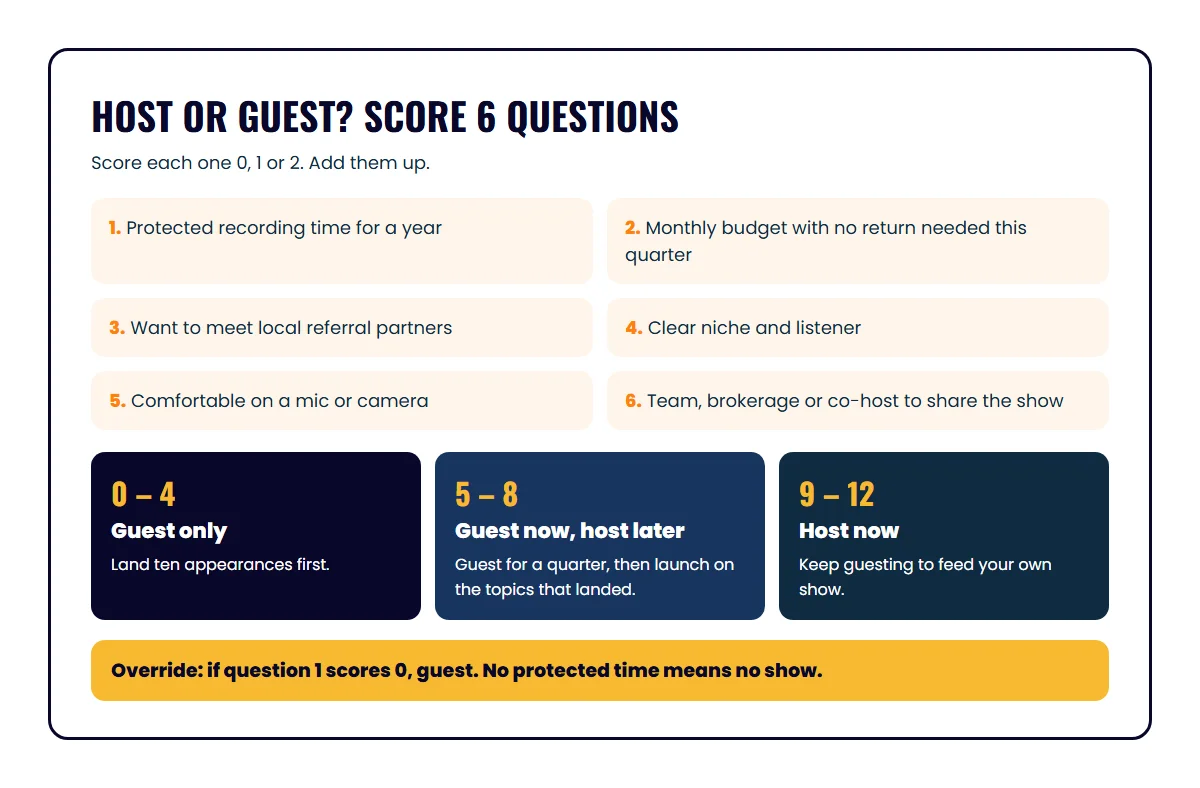
| Question | 0 points | 1 point | 2 points |
|---|---|---|---|
| 1. Can you protect a recording block on your calendar every week or two for a year? | No | Probably, in most months | Yes, it’s already blocked |
| 2. How much can you spend a month without needing a return this quarter? | Nothing | A small monthly plan | A production retainer |
| 3. Who do you most want to meet? | Consumers outside my network | A mix | Local referral partners and business owners |
| 4. How clear is your niche? | Still figuring it out | I have a few ideas | I can describe my listener in one sentence |
| 5. Have you spoken on a mic or camera before? | Never | A few times | Often, and I’m comfortable |
| 6. Do you have a team, brokerage or partner who’d share the show? | No | Maybe | Yes, a co-host or a team that wants it |
How to read your total:
- 0 to 4: guest only. Get ten appearances under your belt before you think about hosting.
- 5 to 8: guest now, host later. Guest for a quarter, note which topics land, then launch a show built on them.
- 9 to 12: host now. You have the time, money and purpose. Guest on the side to bring new listeners to your show.
One rule overrides the score. If question 1 is a 0, guest. A show without protected recording time stalls, no matter how good the other answers are.
What does the decision look like for real agents?
Two example agents show how the score plays out. They’re illustrative roles, not real clients.
Can you guest and host at the same time?
Yes, real estate agents can guest and host at the same time, and once a show is running, most hosts should. The usual order is guest first, then host, then keep guesting.
- Guest for 60 to 90 days. Record at least five appearances. Write down which stories got follow-up questions.
- Pick your show’s angle from those notes. The topics hosts asked you about are the topics your listeners will want.
- Ask the hosts you met to be your first guests. They already know you, and they’ll share the episode.
- Keep guesting at a lower pace. One or two appearances a month send new listeners to your show.
There are two cases where hosting first makes sense. One is a team or brokerage show built for recruiting, where the audience is agents you already know. The other is a referral-partner show, where the guests matter more than the listeners from day one. Either way, the launch sequence is the same one in the step-by-step podcast launch plan for agents.
Next step
Score yourself on the six questions above. If you land in guest territory, write a one-page podcast one-sheet and send five pitches this week. If you land in host territory, block your recording time on the calendar for the next three months before you spend a dollar. Either way, get broker approval in writing first.
Frequently asked questions
Can a new agent host a podcast?
Yes, if it's an interview show with local business owners or referral partners. The guests carry the content and the audience, so you don't need a big name. You do need a guest list and time you can protect.
Does guesting hurt my chances of starting my own show later?
No. Guest spots give you practice on a mic, a list of hosts who may return the favor, and a clear idea of which topics people respond to.
Is it worth guesting if I already host a show?
Usually yes. Guesting puts you in front of new listeners, and inviting those hosts onto your show is an easy way to trade audiences.
Sources
- 2026 Code of Ethics & Standards of Practice — National Association of REALTORS® (accessed October 6, 2026)
- § 1024.14 Prohibition against kickbacks and unearned fees — Consumer Financial Protection Bureau (accessed October 6, 2026)
Podcast guesting for agents
Get booked on real estate podcasts
The ICONS Hub connects agents with real estate podcast hosts looking for expert guests.
Guest On The Network
Written by
Co-Founder and Podcast Guru, Icons of Real Estate
Tomás Fonseca co-founded Icons of Real Estate in 2021 and is its Podcast Guru. He has a background in marketing, with stints at companies like Nintendo and Ardor SEO, and is one of the hosts of the Icons of Real Estate Podcast.

How we research, write, fact-check and correct articles: our editorial standards.