On this page
- Does being a podcast guest actually bring in real estate business?
- What is trust transfer, and why does it work for agents?
- What does the podcast guest lead funnel look like?
- Which lead paths does one appearance open?
- How long does a guest appearance take to produce a lead?
- What call to action should you use on a podcast?
- Why do most guest appearances produce zero leads?
- How many appearances should you do before judging results?
- Next step
Yes, podcast guesting can generate real estate leads, but rarely on the day the episode airs. Most business comes through three slower paths: the host becomes a referral partner, listeners look you up weeks later, and the episode becomes proof that wins listing appointments. Plan for months, not days, and track every step.
What follows is how that lead flow works and where it breaks. Booking the shows in the first place (one-sheet, pitch, follow-up) is covered in the podcast guesting system for agents.
Does being a podcast guest actually bring in real estate business?
Being a podcast guest brings in real estate business when the show fits your market and you build a path from the episode to a conversation. Most guest spots that “didn’t work” never had that path. The agent showed up, talked well and went home, with no offer, no promotion and no follow-up.
Each appearance can feed three kinds of business:
- The host. A person who spent an hour learning how you think. Hosts of local business shows know business owners. Hosts of agent shows know agents in other markets.
- The listeners. A small share will act. Some will be local buyers and sellers. On industry shows, some will be agents with clients moving to your area.
- Your own people. Past clients and your sphere hear you as the expert in a format they rarely see. That’s what makes them mention you when a friend asks for an agent.
Most agents only count the second group. That’s why so many conclude guesting doesn’t work.
What is trust transfer, and why does it work for agents?
Trust transfer is the credibility a host lends you by inviting you on. Listeners already trust the host, so an hour-long interview works like a long, public introduction from someone they rely on. That’s close to how most clients already choose an agent.
Referrals still dominate agent selection. In NAR’s 2025 Profile of Home Buyers and Sellers, 43% of buyers used an agent they found through a referral, and 66% of sellers found their agent through a referral or used one they’d worked with before, according to a Virginia REALTORS summary of the report. A guest spot is a referral at scale: one trusted voice vouching for you in front of many people at once.
The audience is large, too. Edison Research’s Infinite Dial 2026 reports that 58% of Americans age 12 and older consumed a podcast in the last month, and 45% in the last week. Your future clients are listening to something every week. Some of it can be you.
Trust transfer has a limit. It works best when the host’s audience can actually use you. A glowing introduction to listeners three states away, with no referral angle, transfers trust you can’t spend. A distant show can still pay off through agent referrals, and guesting outside your licensed market explains how to tell which ones will.
What does the podcast guest lead funnel look like?
The guest lead funnel has six stages: the booking, the recording, the promotion, the listener’s action, the conversation, and the tagged client or referral. Each stage loses people. Your job is to plug the leaks you control.
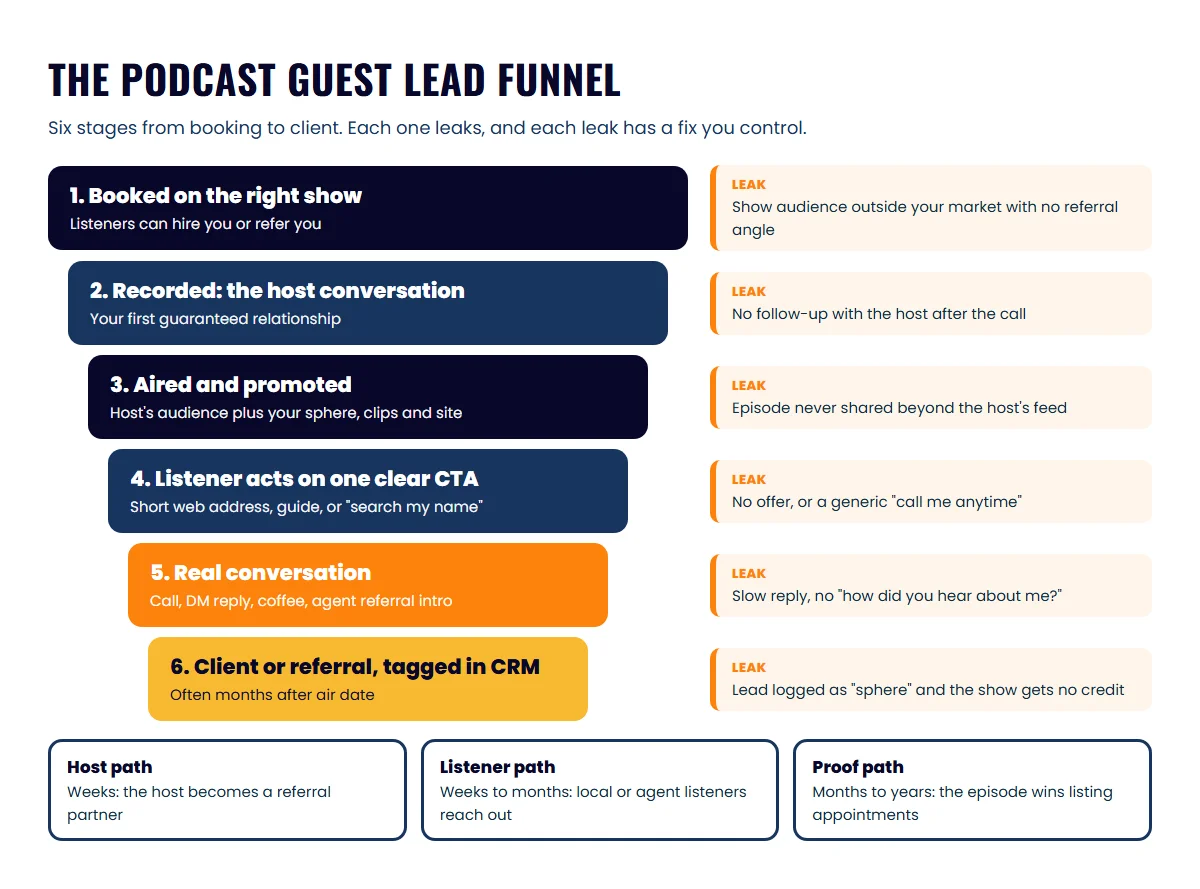
| Stage | What should happen | Where it usually leaks | The fix |
|---|---|---|---|
| 1. Booking | You land on a show whose listeners can hire or refer you | National consumer shows with no link to your market | Filter shows by listener geography before you pitch |
| 2. Recording | The host gets to know you as a peer | You hang up and never speak to the host again | Ask for a 15-minute follow-up call before the episode ends |
| 3. Air and promotion | The episode reaches the host’s feed and your own audience | It lives only in the host’s feed | Email your sphere, post clips, add it to your website |
| 4. Listener action | A listener does one specific thing | No offer, or “reach out anytime” | One short web address with a guide built for that show |
| 5. Conversation | A call, a DM reply or a coffee | Slow replies, no source question | Reply the same day and ask how they heard about you |
| 6. Client or referral | The deal is credited to the episode | Logged as “sphere,” so the show gets no credit | A CRM source field with the show name and air date |
Stages 2 and 3 are where agents lose the most, and they cost nothing to fix. The host thank-you and the sphere email are both scripted in this 7-day plan for after a podcast interview.
Which lead paths does one appearance open?
One appearance opens up to five lead paths, and each runs on its own clock. The host path is fast and almost certain. Listener paths are slower and smaller. The proof path is the slowest and often the most valuable.
| Lead path | Who it reaches | What the lead looks like | Typical speed |
|---|---|---|---|
| Host | One person who now knows your work | Referral intros, a return booking, a joint event | Within weeks, if you follow up |
| Local listeners | Buyers and sellers in your licensed market | A guide download, a DM, a call | Weeks to months after air |
| Agent listeners | Agents in other markets | A referral for a client moving to your area | Months, often when a client move comes up |
| Your sphere | Past clients and contacts who hear the episode | “My friend is thinking of selling” | Whenever a friend asks for an agent |
| Proof | Sellers and buyers comparing agents | A won listing appointment | Months to years, every time you send the link |
The speeds in this table are planning assumptions, not measured data. Use them to set expectations and then replace them with your own tracked numbers.
How long does a guest appearance take to produce a lead?
Expect a host conversation within a couple of weeks, listener inquiries over the following months, and closings later still, because buyers and sellers act on their own timeline, not the episode’s. Ask the host for the expected air date when you record, since many shows publish weeks after the interview.
Here is a planning timeline for one appearance. It’s a model to plan around, not industry data:
- Recording day. Ask the host for a follow-up call and the expected air date.
- Air date. Send your sphere email and post your first clip the same day.
- First two weeks after air. Host follow-up call. Most click-through traffic from show notes arrives now.
- Months one to three. Listeners who saved the episode, or heard a clip, search your name. Agent referrals start when a client move comes up.
- Months three to twelve. Conversations turn into signed agreements and closings. The episode keeps working as proof in listing presentations, especially if you repurpose the guest appearance into clips and a page on your site.
What call to action should you use on a podcast?
Use one call to action, matched to the show’s listeners, said once near the end and repeated in the show notes. A local show gets a local guide. An agent show gets a referral line. A niche show gets a checklist for the life event its listeners are facing.
The address should be short enough to remember while driving. Point it at a page built for that show, with your brokerage name, a phone number and one form. The pillar guide explains how to tag each link so you can track the show.
What should be on the landing page?
- A headline that repeats what you promised on air
- The guide or checklist, available without a long form
- Your photo, name, brokerage and how to reach you
- A link to the episode, so visitors can hear you again
- One question on any form: “Where did you hear about me?”
What to avoid saying
- “Call me anytime.” Nobody acts on an invitation that vague.
- “Free home valuation” on a national show. Most listeners can’t use it.
- Three offers in one episode. Listeners remember one.
- Your phone number as the only CTA. It can’t be tracked, and few people write it down while driving.
Why do most guest appearances produce zero leads?
Most appearances produce zero leads because of choices made before and after the interview, not the interview itself. Five failures cover nearly every case.
- Wrong show. The listeners can’t hire you, and the show offers no referral angle.
- No offer. You gave great answers and no next step.
- No promotion. The only people who heard the episode were the host’s listeners, and only on air day.
- No host follow-up. You let the one relationship an appearance almost always gives you go cold.
- No tracking. The lead came in, but it was logged as a referral or sphere contact, so you never knew the show caused it.
Fix these and the same interview performs very differently. Still deciding between guesting and starting your own show? Weigh them with this host vs guest decision framework.
How many appearances should you do before judging results?
Commit to a fixed number of tracked appearances over at least two quarters before you decide. One episode is a sample of one. Closings lag months behind air dates, so early judgment is mostly noise.
Judge in two passes:
- At 90 days, judge conversations. Count host follow-up calls, listener inquiries and referral introductions. If you’ve had real conversations, the funnel is working and closings will lag behind.
- At 12 months, judge closings. Divide your total cost, including your time, by the closings your CRM traces to guesting.
If pitching is the part you keep putting off, a booking service removes it. On the ICONS Hub, the Concierge plan is $87 a month for 2 guaranteed bookings every month; details are on the podcast guesting page. To compare guesting with ads on cost per conversation, see podcast guesting vs paid ads.
Next step
Before your next interview, set up three things: a show-specific short web address, a CRM source field for podcast guest appearances, and a calendar reminder to call the host within two weeks of air. Those three steps plug the biggest leaks in the funnel, and they take less than an hour.
Frequently asked questions
Has anyone actually gotten clients from being on a podcast?
Agents do report it, but no published study measures how often guest spots turn into closings. The reliable answer is your own: tag every appearance in your CRM and ask every new contact how they heard about you.
Should I give my phone number on air?
Usually not. A short web address is easier to remember while driving and lets you track the visit. Put your phone number on the page it leads to.
Do national shows produce leads for a local agent?
Consumer listeners outside your market rarely can hire you. National agent-audience shows are different, because listeners can refer clients who are moving into your area.
Is one podcast appearance enough to judge whether guesting works?
No. One episode is a sample of one. Commit to a set number of tracked appearances over at least two quarters, then compare conversations against the time and money you spent.
Sources
- Key Takeaways from NAR's 2025 Profile of Home Buyers and Sellers — Virginia REALTORS (accessed October 6, 2026)
- The Infinite Dial 2026 — Edison Research at SSRS (accessed October 6, 2026)
Podcast guesting for agents
Get booked on real estate podcasts
The ICONS Hub connects agents with real estate podcast hosts looking for expert guests.
Guest On The Network
Written by
Co-Founder and Podcast Guru, Icons of Real Estate
Tomás Fonseca co-founded Icons of Real Estate in 2021 and is its Podcast Guru. He has a background in marketing, with stints at companies like Nintendo and Ardor SEO, and is one of the hosts of the Icons of Real Estate Podcast.

How we research, write, fact-check and correct articles: our editorial standards.