On this page
- What are the biggest red flags in a podcast booking agency?
- Is a “guaranteed booking” a red flag?
- How do you check the shows an agency books?
- What should a podcast booking contract include?
- How do you spot hidden pay-to-play?
- What do podcast booking scams look like?
- How should you read agency reviews and Reddit threads?
- What should you ask before you sign?
- Next step
The biggest podcast booking agency red flags are guaranteed downloads or leads, no list of real shows, fees that quietly pay shows for your spot, and long contracts you can’t exit. A good agency guarantees only what it controls, names recent shows, puts the term, renewal and cancellation rules in writing, and lets you approve pitches before they go out.
Use this page as a pre-signing checklist. Not sure you want outside help at all? The guesting playbook for real estate agents compares DIY, marketplaces, agencies and networks.
What are the biggest red flags in a podcast booking agency?
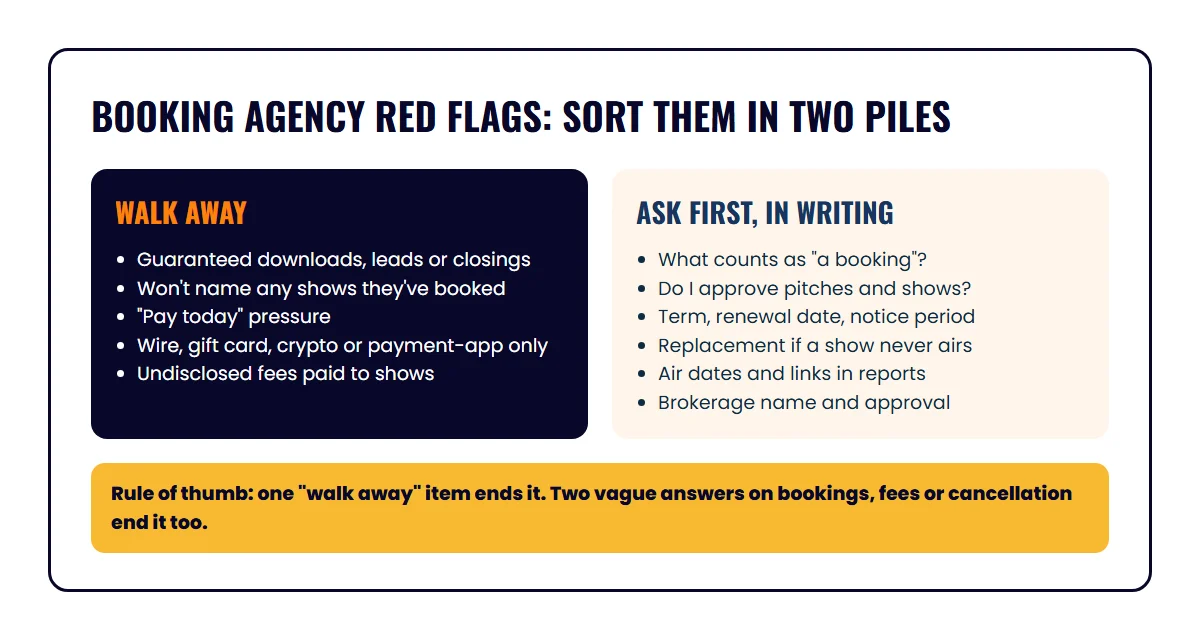
The worst red flags are promises about outcomes and secrecy about shows and fees. Some flags mean you should walk away. Others just mean you need a clear answer in writing before you sign.
| Red flag | Why it matters for an agent | Verdict |
|---|---|---|
| Guarantees downloads, leads or closings | No agency controls who listens or who calls you | Walk away |
| Won’t name any shows it has booked | You can’t check fit or quality, so assume the shows are weak | Walk away |
| Pressure to pay today, or payment by wire, gift card or crypto | These are classic scam signs | Walk away |
| Part of your fee goes to the shows, and they don’t say so | You’re buying ads without knowing it, which is a disclosure problem | Walk away unless they disclose it fully |
| You never see the pitch or one-sheet | Strangers pitch under your name and brokerage | Ask: require approval before anything goes out |
| No definition of “a booking” | A booking could mean a dead show or an episode that never airs | Ask: get the definition in the contract |
| Long term with auto-renewal and a short notice window | You can end up paying months after you want out | Ask: know the exact notice date |
| Reports end at “booked” | You can’t track leads without air dates and episode links | Ask: require links when episodes publish |
| Mostly national shows with no local or referral angle | Big numbers, few listeners who can hire you | Ask: how they match shows to your market |
| No questions about your brokerage or broker approval | They haven’t worked with many licensed agents | Ask: how they handle compliance |
Is a “guaranteed booking” a red flag?
A guaranteed booking isn’t a red flag by itself. A guaranteed result is. An agency can control how many shows it pitches and books. It can’t control downloads, reviews, leads or closings.
The question is what counts as a booking. Push for a definition like this one in the contract:
- The show has published an episode in the last 60 days.
- It is listed on Apple Podcasts or Spotify, or posts full episodes on YouTube.
- The interview is recorded, not just “scheduled.”
- You get the episode link when it publishes.
- If a show cancels or never publishes, the booking is replaced.
If an agency guarantees a number of bookings but won’t agree to anything like that, the guarantee is soft. Ten interviews on shows that stopped publishing last year do nothing for you.
How do you check the shows an agency books?
Ask for five to ten shows the agency booked for clients in the last 90 days, then audit them yourself. It takes about ten minutes and tells you more than any sales call.
- Find each show on Apple Podcasts or Spotify by name. If you can’t find it, cross it off.
- Check the date of the latest episode. A show that hasn’t published in months may never air your interview.
- Scroll the past guests. Do they look like you, or like coaches and software founders? A real estate agent on a crypto show is a stretch, while relocation, money and divorce shows are often a good fit (see non-real-estate podcasts that need agent guests).
- Listen to five minutes of one episode. Is the audio clean? Does the host prepare, or read questions from a list?
- Look for a listener geography clue. Local shows mention neighborhoods, local businesses and events. Industry shows mention agents and brokers. Either can work, for different reasons.
- Check for a “sponsored” or “featured guest” fee on the show’s own website or guest application page.
- Write down the fit for each show: local consumers, agent referrals, or neither.
If more than half of the list lands in “neither,” the agency isn’t a fit for a licensed agent, however good the price looks.
What should a podcast booking contract include?
A good booking contract states the deliverable, the term, how you leave and who owns the materials. Most of these are normal business terms. The red flag is when one is missing or vague.
| Clause | What you should see | The red-flag version |
|---|---|---|
| Deliverable | A number of bookings per period, with a written definition of a booking | “Up to” a number, or “opportunities” instead of bookings |
| Show approval | You can reject a show before the agency confirms it | The agency books whatever accepts |
| Pitch approval | You approve the one-sheet and pitch before outreach starts | No mention of approval |
| Term and renewal | Clear start date, minimum term and renewal rule | Auto-renewal buried in the terms with no date |
| Cancellation | A written notice period you can actually meet | Notice longer than the term, or “at our discretion” |
| Refunds and replacements | What happens if a show cancels or never publishes | “All bookings final” with no replacement |
| Third-party fees | A statement that no fee goes to shows, or a full list of fees that do | Silence |
| Reporting | Air dates and episode links, monthly | “Performance reports” with no detail |
| Materials | You keep your one-sheet, bio and headshots | The agency owns your media kit |
Minimum terms and up-front billing are common in service contracts and aren’t scams. Just know the dates, and put the cancellation notice deadline in your calendar the day you sign.
Keep your media kit portable too. If your one-sheet comes from your own podcast one-sheet template, switching agencies never means starting over.
For what fair pricing looks like across retainers, per-placement fees and subscriptions, see how much a podcast booking agency costs.
How do you spot hidden pay-to-play?
Ask one direct question in writing: “Does any part of my fee go to the podcasts you book me on?” A clear yes or no is fine. A vague answer is the red flag.
Paying for a spot isn’t always wrong. Some shows sell featured interviews openly. The problem is when you don’t know. A paid appearance is advertising, and it changes what you and the host may need to disclose. The FTC says that when a marketer has a link to an endorser that consumers wouldn’t expect, it “should be disclosed clearly and conspicuously,” and that a spoken claim needs a spoken disclosure (FTC Endorsement Guides FAQ).
For an agent, a paid spot also falls under your brokerage’s advertising rules, and a lender or title company offering to “cover” the fee raises RESPA questions. Send your broker the show name, the fee and who receives it, and keep the reply. When paying can make sense is covered in the agent’s guide to paid guest spots.
What do podcast booking scams look like?
Most podcast booking scams follow the same pattern as other scams: a flattering surprise, urgency and an odd way to pay. The FTC lists four signs: scammers pretend to be from an organization you know, claim there’s a problem or a prize, pressure you to act now, and tell you to pay in a specific way (FTC: How To Avoid a Scam).
Here’s how those signs show up in podcast outreach:
- The surprise invitation. “Our producers selected you as a featured guest.” Then a “production fee” appears after you say yes.
- The borrowed name. An email claims to come from a well-known show or network, but the sender’s domain doesn’t match the show’s website.
- The deadline. “Only two guest slots left this quarter, pay by Friday.”
- The payment ask. Wire transfer, gift cards, crypto or a payment app instead of an invoice or card checkout.
The FTC puts it plainly: “Honest businesses will give you time to make a decision.” To check an invitation, find the show yourself, go to its official website, and contact the host through the details listed there. Never use the contact details in the email you’re checking.
How should you read agency reviews and Reddit threads?
Read podcast booking agency reviews and Reddit threads for repeated patterns, not star ratings. One angry review means little. The same complaint from several clients, months apart, means a lot.
Look for these patterns in reviews, Reddit threads and forum posts:
- Shows never aired. Complaints like “the host ghosted me” point to weak or inactive shows.
- Couldn’t cancel. If clients say the charges kept coming, read the contract twice.
- Every show felt the same. Comments about tiny shows nobody hears mean the agency sold volume over fit.
- Replies from the agency. A calm, specific reply that fixes the problem is a good sign. Silence or an attack on the reviewer isn’t.
Discount reviews from people in very different niches. A software founder who wanted national exposure will judge an agency differently from a listing agent who wants local sellers. Most important, ask the agency for one or two current clients in real estate you can talk to. If they can’t name any, that tells you who they usually serve.
What should you ask before you sign?
Ask your questions by email, not just on a call, so the answers are in writing. Copy and adjust this one.
Score the replies. Any walk-away answer from the table at the top ends the conversation. Two or more vague answers to questions 1, 3 or 5 should end it too.
Next step
Run the audit on the next proposal you get, before the sales call, not after. If you’d rather compare against an option with published terms, the ICONS Hub lists its plans openly: a free Icons Lite profile, Concierge at $87 a month with 2 guaranteed bookings a month, and Momentum at $165 a month with 4 bookings every two months, on a booking platform built for real estate pros. Hold it to the same checklist on the podcast guesting page.
Frequently asked questions
Are podcast booking agencies a scam?
Most are real businesses, but quality varies a lot. The bad ones sell volume on weak or inactive shows, hide paid placements, or promise results they can't control. Use the checklist on this page before you sign anything.
Is it normal for a booking agency to ask for payment up front?
Yes, many charge a setup fee or the first month in advance. What isn't normal is pressure to pay today, or a demand to pay by wire transfer, gift card, crypto or a payment app.
How many bookings should an agency get me per month?
There is no industry standard, so compare the number in the contract with what the agency will show you as proof. A smaller number of active, relevant shows is worth more to an agent than a long list of shows nobody in your market hears.
Can I cancel a podcast booking agency contract early?
Only if the contract says so. Check the minimum term, the auto-renewal date and the written notice period before signing, and put a calendar reminder on the date notice is due.
Sources
- How To Avoid a Scam — Federal Trade Commission (Consumer Advice) (accessed October 6, 2026)
- FTC's Endorsement Guides: What People Are Asking — Federal Trade Commission (accessed October 6, 2026)
Podcast guesting for agents
Get booked on real estate podcasts
The ICONS Hub connects agents with real estate podcast hosts looking for expert guests.
Guest On The Network
Written by
Co-Founder and Podcast Guru, Icons of Real Estate
Tomás Fonseca co-founded Icons of Real Estate in 2021 and is its Podcast Guru. He has a background in marketing, with stints at companies like Nintendo and Ardor SEO, and is one of the hosts of the Icons of Real Estate Podcast.

How we research, write, fact-check and correct articles: our editorial standards.