On this page
- What makes a real estate agent’s podcast guest bio work?
- How long should a podcast guest bio be?
- Podcast guest bio examples for real estate agents
- Fill-in-the-blank podcast guest bio template
- How do you introduce yourself on a podcast as a guest?
- What headshot do podcast hosts need from you?
- What should you leave out of your podcast bio?
- Do you have to write your own bio?
- Next step
A strong podcast guest bio for a real estate agent runs 50 to 80 words, written in the third person. It says who you help and where, gives one piece of proof you can document, adds one human detail and names your brokerage. Start from an example for a new, team-lead, luxury or investor-friendly agent, then add your own facts.
You’ll also get a one-line version, a longer version, a spoken intro for when the host hands you the mic, and a headshot checklist. Everything here is about the bio. Pitching, booking and follow-up are covered in the full guesting playbook for agents.
What makes a real estate agent’s podcast guest bio work?
A bio works when a host can read it aloud in 20 seconds and a listener knows exactly who you help. Most agent bios fail because they open with a license date and a list of designations. Listeners don’t care when you got licensed. They care whether you serve someone like them, in a place they live.
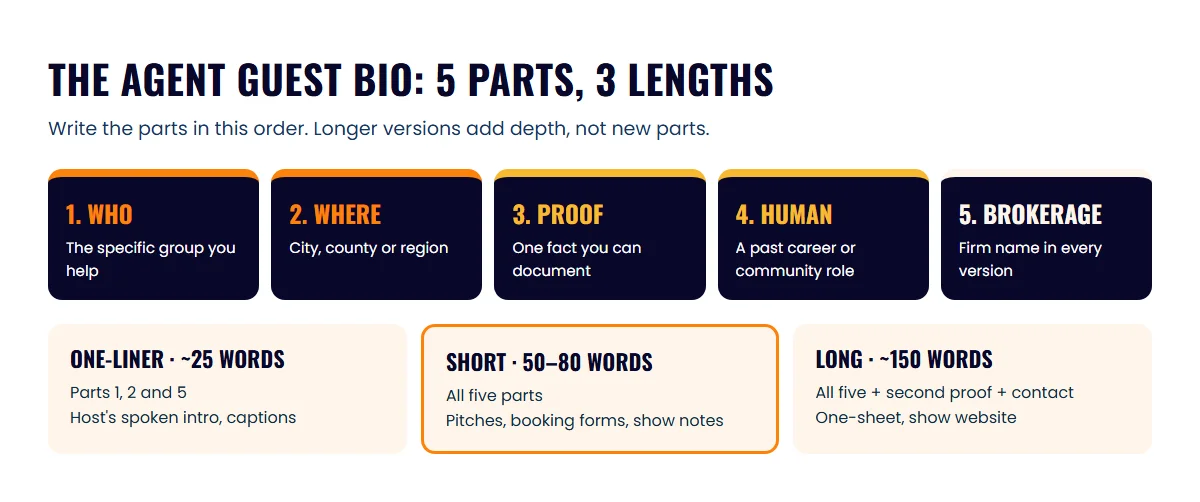
Build every version from these five parts, in this order:
| Part | What it answers | Weak version | Strong version |
|---|---|---|---|
| 1. Who you help | “Is this person for me?” | “A full-service agent” | “Helps nurses and hospital staff buy their first home” |
| 2. Where | “Can they work with me?” | “Serving the greater area” | “In Fort Wayne and the surrounding county” |
| 3. One piece of proof | “Why trust them?” | “Top producer, award-winning” | “Has helped [number] first-time buyers since [year]” (a number you can document) |
| 4. One human detail | “Would I like them?” | “Loves spending time with family” | “Spent 11 years as an ER nurse before real estate” |
| 5. Brokerage | Your advertising duty | Missing | “With [Brokerage Name]” |
The human detail does more work than you’d expect. It gives the host an easy first question, and it’s what listeners remember.
How long should a podcast guest bio be?
Keep three lengths ready, because hosts ask for different things. A short bio of 50 to 80 words covers most requests. Save each version in one document so you can paste the right one in seconds.
| Version | Length | Where it’s used | What to include |
|---|---|---|---|
| One-liner | About 25 words | The host’s spoken intro, social captions, guest lists | Parts 1, 2 and 5 |
| Short bio | 50 to 80 words | Pitch emails, booking forms, show notes | All five parts |
| Long bio | About 150 words | One-sheet, show website, event programs | All five parts plus a second proof point and how to reach you |
Write all three in the third person. Hosts paste your bio straight into show notes, and “I” looks odd there. Your first-person version is the spoken intro, covered further down.
Podcast guest bio examples for real estate agents
Each example below is a template. Replace every bracket with your own facts, and delete any line you can’t back up. The numbers are placeholders, not suggestions.
Bio for a new agent
New agents should lead with a prior career or a community tie, not a track record they don’t have yet. Not sure you’re ready to guest yet? Read whether a brand-new agent should be on podcasts first.
Bio for a team lead
Team leads have two audiences: consumers and agents. Write the consumer version first. For agent-to-agent shows, swap the proof line for something about how you build or train the team. Credit team results to the team.
Bio for a luxury agent
Luxury bios slip into hype fast. Describe the property type and what you do for those sellers, not the people who live there. “Waterfront and equestrian properties” is specific and safe. Describing an area by who its residents are is a Fair Housing problem.
Bio for an investor-friendly agent
Investor audiences want to know you understand numbers, but you’re not their CPA or attorney. Say what you do (find and analyze deals, work with their lender and tax advisor), not what you advise on.
Fill-in-the-blank podcast guest bio template
If none of the four examples fits you, use this template. Fill in each blank, read it aloud, and cut any word that doesn’t help a listener decide if you’re their agent.
Two quick tests before you send it:
- The stranger test. Could someone who has never met you say who you help after one listen? If not, sharpen part 1.
- The proof test. If your broker asked where each number came from, could you show them? If not, take it out.
The optional last line is where most guests over-sell. Keep it to one free resource, and borrow wording from these on-air plug scripts for guests.
How do you introduce yourself on a podcast as a guest?
When the host says “Tell us a bit about yourself,” answer in about 20 seconds, in the first person, and end by handing the conversation back. The host has already read your bio. Don’t repeat it word for word. Add the “why” behind your niche instead.
Use this three-beat structure:
- Who you help, in plain words. “I help teachers here in Fort Wayne buy their first home.”
- Why you do it. One sentence with a real reason.
- The handoff. A line that sets up the host’s next question.
Spoken intro examples
Say your brokerage name at some point in the episode, ideally in the intro. Some hosts also ask you to give your full name and company at the top. Have it ready so you don’t stumble.
What headshot do podcast hosts need from you?
Send one recent, high-resolution headshot in both a square and a horizontal crop, on a plain background. Hosts use your photo on episode artwork, YouTube thumbnails and social posts, and each needs a different shape. If the host gives you specs, follow theirs.
Use this checklist before you send it:
- Recent. Taken in the last two years and looks like you on camera today.
- Same photo as your website. Listeners who look you up should recognize you instantly.
- Two crops. One square, one horizontal with space beside you for text.
- Plain or blurred background. Busy backgrounds disappear behind episode titles.
- Full resolution file. Send the original, not a screenshot from social media.
- Clear file name. For example,
firstname-lastname-headshot.jpg, so the host can find it later. - No logos on the photo. Let the host add their own branding.
Put the headshot, all three bio lengths and a pronunciation note for your name in one shared folder. Send the link once and you’ll never resend attachments. If you want hosts to share the episode widely afterward, the post-interview follow-up plan shows what to send them next.
What should you leave out of your podcast bio?
Leave out anything you can’t prove, anything that bends advertising rules and anything that describes people rather than property. Your bio is advertising, so it carries the same duties as your website.
Article 12 of the NAR Code of Ethics holds REALTOR® marketing to a “true picture” standard, and a bio read on air is marketing. Its Standard of Practice 12-5 adds that your firm’s name has to appear in any advertising medium.
| Leave out | Why | Use instead |
|---|---|---|
| “Top REALTOR®”, “#1 REALTOR®” | NAR’s trademark rules prohibit descriptive words with the REALTOR® mark | “[Name] is a REALTOR® with [Brokerage Name]” |
| “REALTOR” used as a job title for any agent | The mark identifies NAR members only and isn’t a synonym for “agent” | “real estate agent” unless you’re a member |
| Team or office numbers presented as yours | Not a true picture of your own experience | “The team closed [number] transactions in [year]” |
| Awards or rankings you can’t document | Hosts and listeners may check | A specialty or a program you built |
| Your bio with no brokerage name | Advertising rules usually require it | “with [Brokerage Name]” in every version |
| Describing an area by who lives there | Fair Housing risk | Describe property types and features |
| Tax, legal or lending promises | Outside your license | “works alongside clients’ tax advisors and lenders” |
The NAR Membership Marks Manual says the mark should be capitalized and that members can’t use descriptive words with it. The Fair Housing Act protects people based on race, color, national origin, religion, sex, familial status and disability (HUD), so a line saying an area suits a certain kind of household doesn’t belong in a bio. Before you record, run through the Fair Housing phrase list for podcast guests.
State rules and brokerage policies vary, so get your broker’s OK before the bio goes anywhere; this broker approval request template makes that a two-minute email.
Do you have to write your own bio?
You don’t have to write your own podcast guest bio, but you do have to approve every claim in it. Some guests hire a copywriter or a booking service to write their bio and one-sheet. That’s fine, as long as you check every claim before it goes out under your name. Your long bio also anchors your podcast one-sheet, so write it once and reuse it there.
If you’d rather hand off the whole process, the paid plans on our podcast guesting service include a speaker media kit with an optimized profile and a one-sheet, and the booking team sharpens your bio before pitching.
Next step
Open a blank document today and write your short bio from the template above. Then cut it down to a one-liner and expand it to a long version. Record your 20-second spoken intro on your phone, play it back once, and fix whatever made you wince. Send all three to your broker, and you’re ready to pitch.
Frequently asked questions
Should a podcast guest bio be in the first or third person?
Third person for anything you send the host, because they read it aloud or paste it into show notes. Keep a first-person version only for your spoken intro on air.
Should I put my sales volume in my podcast bio?
Only if you can document it, it's yours rather than the team's, and your broker is fine with you publishing it. A specific niche usually earns more interest than a volume figure.
How often should I update my guest bio?
Check it every quarter and any time you change brokerage, team or niche. An old bio in a host's show notes keeps advertising the old details.
Can I use the same bio for every show?
Keep the core the same, but swap the proof and the human detail to fit each audience. An investor show and a parenting show care about different things.
Sources
- 2026 Code of Ethics & Standards of Practice — National Association of REALTORS® (accessed October 6, 2026)
- Membership Marks Manual — National Association of REALTORS® (accessed October 6, 2026)
- Using NAR Trademarks in Usernames — National Association of REALTORS® (accessed October 6, 2026)
- Housing Discrimination Under the Fair Housing Act — U.S. Department of Housing and Urban Development (accessed October 6, 2026)
Podcast guesting for agents
Get booked on real estate podcasts
The ICONS Hub connects agents with real estate podcast hosts looking for expert guests.
Guest On The Network
Written by
Co-Founder and Podcast Guru, Icons of Real Estate
Tomás Fonseca co-founded Icons of Real Estate in 2021 and is its Podcast Guru. He has a background in marketing, with stints at companies like Nintendo and Ardor SEO, and is one of the hosts of the Icons of Real Estate Podcast.
How we research, write, fact-check and correct articles: our editorial standards.