On this page
- What should you do right after a podcast interview ends?
- What should a podcast guest thank-you email to the host say?
- What should you do while you wait for the episode to come out?
- What is the 7-day follow-up plan once the episode goes live?
- How do you tell your sphere about a podcast appearance?
- How do you add a podcast appearance to your realtor website?
- What should the second note to the host say?
- What compliance checks apply to post-episode promotion?
- What should you do on day 30 and day 90?
- Next step
After a podcast interview, a guest should send the host a specific thank-you within 24 hours and ask for the release date. When the episode goes live, run a seven-day plan: share it, add it to your website, email your sphere, text a few people personally, post a clip, tell referral partners, then follow up with the host again.
Most agents do the interview, post the link once, and move on. The episode is proof of how you think. Your sphere, your referral partners and the sellers you’ll meet next spring all want that proof. Everything here starts after you hang up; picking an angle and pitching shows live in the full podcast guesting playbook for agents.
What should you do right after a podcast interview ends?
Right after a podcast interview, do four things while the conversation is fresh. They take about 30 minutes and set up release week.
- Ask two questions before you hang up. “When do you expect this to go live?” and “Will you send me the link or any clips?” Hosts often record weeks ahead of release, so the date tells you when your seven-day plan starts.
- Write down your three best moments. Jot the questions where you gave your strongest answers. You’ll use them to pick clips and to write your sphere email.
- Send the thank-you email. Use the template below. Specific beats long.
- Log the host in your CRM. Tag them as a referral partner, add the show name and recording date, and set a reminder for the release date.
If you said something on air you’d rather not publish, such as a client detail or a careless line about a neighborhood, ask the host to cut it now. It’s much easier before the edit than after release.
What should a podcast guest thank-you email to the host say?
A good podcast guest thank-you email names one specific moment from the conversation and offers the host something back. Keep it short; under 150 words is plenty. Hosts get stacks of “thanks for having me” notes. The guest they remember is the one who sent a headshot, links and a guest introduction in the same email.
Swap the guest introduction for something else useful if you don’t have a good fit: a local data source they asked about, or a show you think they should guest on. The point is that you give before you ask.
What should you do while you wait for the episode to come out?
While you wait for the episode, prepare your release-week assets so launch week is copy and paste. Do the slow work now.
- Draft the sphere email and the text message from the templates below, leaving the link blank.
- Set up your media page on your website if you don’t have one yet, so you only add an entry on day 2. Template 5 below shows what each entry needs.
- Pick your clip moments from your notes. If the host sends clips, great. If not, you’ll ask for permission in the release-week note.
- Prep your next pitch. One recorded episode is your best credential for the next booking. Pull a new angle from this list of podcast pitch topics for realtors, or run the interview question generator to see what a host might ask about it.
What is the 7-day follow-up plan once the episode goes live?
The 7-day follow-up plan gives each day after release one main job. That keeps it to 20 to 45 minutes a day, and you don’t post everything at once and then go quiet.
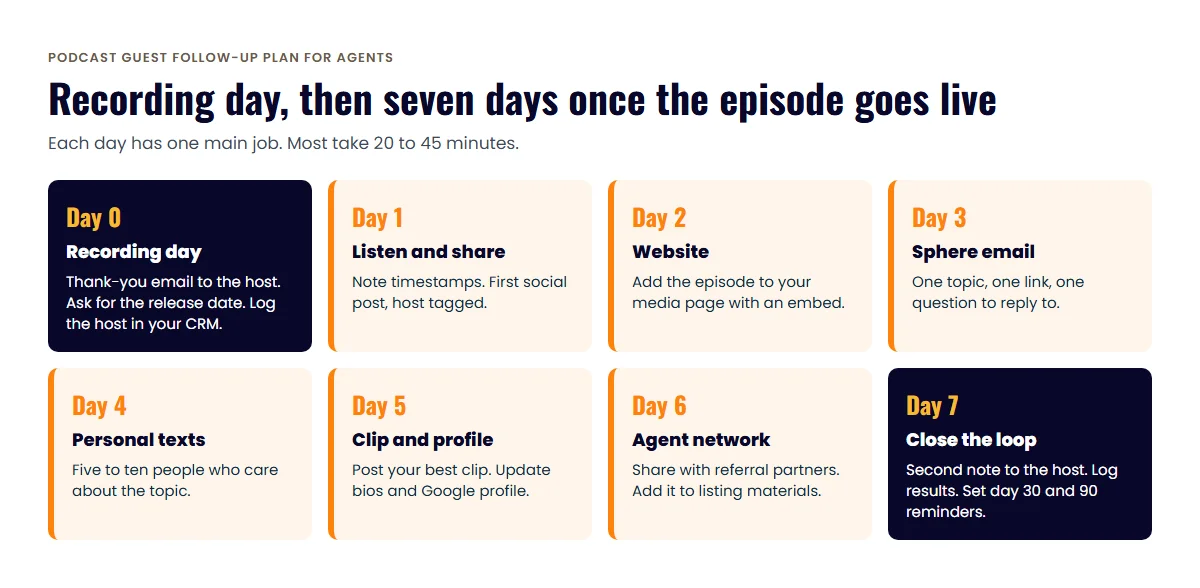
| Day | Main job | Template | Done when |
|---|---|---|---|
| 1 | Listen to the episode, note timestamps, post the link on social | Template 4 | Host and show tagged on your main platform |
| 2 | Add the episode to your website media page | Template 5 | Page live with embed and summary |
| 3 | Send your sphere email | Template 2 | Email sent with opt-out and postal address |
| 4 | Text five to ten people personally | Template 3 | Each text written to one person, not a group |
| 5 | Post your best clip, update your bios and profiles | Template 4 | Clip live; “As heard on” line in your bios |
| 6 | Share with referral partners and add it to listing materials | Template 3 | Sent to your agent network; slide or QR code added |
| 7 | Send the host a second note and log your results | Template 6 | Results logged; day 30 and 90 reminders set |
Day 1: Listen, take notes, share
Listen to the full episode before you share it. You’ll catch anything awkward, and you’ll get exact timestamps for your best answers. Then post the link on the platform where your clients spend time. Tag the host and the show. Hosts notice guests who help their numbers.
Day 2: Put it on your website
A link on social disappears in a day. A page on your website keeps working for years. See the website section below for exactly what to add.
Day 3: Email your sphere
Send one email to your database with one topic and one link. Don’t paste the full show notes. Write it like a note to a past client, and end with a question people can answer by hitting reply.
Day 4: Text people one at a time
Pick five to ten people who would care about this specific topic. A past client who asked you about the same issue. A friend thinking about selling. An investor you’ve worked with. A personal text gets read. A group text gets muted.
Day 5: Post a clip and update your profiles
Post your strongest 30 to 60 second answer as a captioned clip. Then add an “As heard on [Show name]” line to your social bios, email signature and Google Business Profile description. Shows that record on camera give you better clips; how agents use video podcasts explains why.
Day 6: Tell your agent network and update listing materials
Share the episode with agents who send you referrals, especially in markets your clients move from. Then add a slide or QR code to your listing presentation. A seller who hears how you think before the appointment walks in half-sold. If you host your own show, a seller interview episode can do the same job for a specific listing.
Day 7: Close the loop with the host
Send a short second note to the host (Template 6). Tell them where you shared it and what reaction you got. Then log the episode in your tracker: release date, where you shared it, replies and any conversations it started. Set reminders for day 30 and day 90.
How do you tell your sphere about a podcast appearance?
Tell your sphere about a podcast appearance with one short email and a handful of personal texts. Lead with the problem you talked about. “I was on a show” is about you. “Why some homes sit” is about them.
How do you add a podcast appearance to your realtor website?
Add each podcast appearance to one “Media” or “As heard on” page on your website, with an embedded player, a short summary and a link to the show. A page that grows with every episode beats scattered blog posts. Sellers who look you up after a listing appointment will find it.
To embed a YouTube version of the episode, click Share, then Embed, copy the HTML code and paste it into your page, as described in YouTube’s embed help. Video owners can turn embedding off, so if the option is missing, link to the episode instead. For an audio-only show, check the show’s website or episode page for an embed player, or ask the host for one.
If your site has a blog, write a longer post that expands one answer from the episode and embeds it. A one-off appearance becomes a page that can rank for a local question. Planning those posts is covered in turning content into real estate leads.
What should the second note to the host say?
The second note to the host should thank them for publishing, show you kept your promise to share, and ask for one small thing. Send it on day 7, when you have something to report.
What compliance checks apply to post-episode promotion?
Post-episode promotion counts as advertising your real estate services, so your broker’s rules and your state’s ad rules apply to every post, page and email. When a rule below is unclear for your state, your broker decides.
- Show your brokerage name. REALTORS® who promote their services anywhere, a podcast caption included, must show their firm’s name clearly under Standard of Practice 12-5 of the NAR Code of Ethics. That includes captions, your media page and your email signature. Your state may also require a license number.
- Treat the sphere email as commercial email. Under the FTC’s CAN-SPAM rules for business email, commercial messages must include a valid physical postal address and a clear way to opt out. You must honor opt-outs within 10 business days, and there’s no exception for business-to-business email.
- Check your clips for Fair Housing problems. Don’t post a clip that describes an area by the people in it or says who it’s “good for.” Describe homes, amenities and facts instead.
- Protect client details. Don’t post a clip that names a client or an address unless they’ve agreed in writing.
- Watch co-marketing. When the show belongs to a mortgage lender or title company, or one of them sponsors it, ask your broker before any joint promotion of the episode.
What should you do on day 30 and day 90?
On day 30, check whether the episode started any conversations and send the host a useful note. On day 90, reuse the episode once more and decide whether this show deserves a second appearance.
- Day 30: Check your tracker for replies and calls that mention the episode. Send the host something useful: an article, an intro, or a congratulations on a milestone. Don’t ask for anything.
- Day 90: Post a second clip or quote, or link the episode in a market update email. If the episode drew replies, pitch the host a follow-up topic. If the host is a local business owner, ask about coffee. Many of the best referrals come from the host, not the listeners.
If you’d rather spend your time on these follow-up steps than on pitching, the ICONS Hub booking plans hand the pitching and scheduling to a coordinator. The thank-you note and the sphere email should still come from you.
Next step
Copy Templates 1 and 2 into your notes app today, so they’re ready the next time you hang up from an interview. Then put the next release date in your calendar with “Day 1” in the title. The plan only works if day 1 is already booked.
Frequently asked questions
How soon should I send a thank-you email after a podcast interview?
Within 24 hours of recording. The conversation is still fresh for both of you, and a specific note stands out in a host's inbox. Send a second, shorter note after the episode goes live.
Should I send a handwritten card to the podcast host?
It's a nice extra, not a replacement. Send the email first so the host has your links and details in writing, then add a card if that's already part of how you treat referral partners.
What if the host never sends me the episode link?
Check the show's feed on Apple Podcasts, Spotify or YouTube around the release date. If it still isn't out two weeks after the date you were given, send one polite note asking whether the date has moved.
Can I download the episode and re-upload it to my own channels?
Only with the host's permission. Ask for clips or the file in your thank-you email. Without permission, share the host's link or use the embed code they make available.
Sources
- CAN-SPAM Act: A Compliance Guide for Business — Federal Trade Commission (accessed October 6, 2026)
- 2026 Code of Ethics & Standards of Practice — National Association of REALTORS® (accessed October 6, 2026)
- Embed videos & playlists — YouTube Help (accessed October 6, 2026)
Podcast guesting for agents
Get booked on real estate podcasts
The ICONS Hub connects agents with real estate podcast hosts looking for expert guests.
Guest On The Network
Written by
Co-Founder and Podcast Guru, Icons of Real Estate
Tomás Fonseca co-founded Icons of Real Estate in 2021 and is its Podcast Guru. He has a background in marketing, with stints at companies like Nintendo and Ardor SEO, and is one of the hosts of the Icons of Real Estate Podcast.

How we research, write, fact-check and correct articles: our editorial standards.