On this page
- What questions do podcast hosts ask real estate agents?
- How should you structure an answer on a podcast?
- How do you answer the opening questions?
- How do you talk about the housing market without making predictions?
- Which podcast questions are traps for real estate agents?
- What gets a real estate agent invited back on a podcast?
- How do you prepare answers without sounding scripted?
- Next step
Questions real estate agents get asked on podcasts follow a pattern: your origin story, what makes you different, the housing market, a hard deal you saved, advice for buyers or sellers, and where listeners can find you. Answer each with one direct sentence, one specific story and one takeaway the listener can use the same day.
Hosts aren’t trying to trip you up. They want a guest who makes the episode easy to listen to. Know the questions and have a shape for your answers, and you’ll sound like the expert in the room. Pitching, booking and follow-up are covered in podcast guesting for real estate agents.
What questions do podcast hosts ask real estate agents?
Podcast hosts ask real estate agents about 20 questions that fall into five groups: openers, expertise, market, story and wrap-up. The wording changes from show to show, but the intent behind each question rarely does.
The table lists the questions, what the host is really after, and the move that answers it well.
| Stage | Question you’ll hear | What the host wants | Your answer move |
|---|---|---|---|
| Opener | “Tell us a bit about yourself.” | A 30-second reason to keep listening | Who you help, where, and one surprising detail |
| Opener | “How did you get into real estate?” | A human moment | The turning point, not your résumé |
| Opener | “How long have you been in the business?” | Context for your advice | A straight number, then your angle |
| Opener | “What makes you different from other agents?” | A clear position | One niche or method, with proof |
| Expertise | “What’s the biggest mistake buyers make?” | A tip listeners can repeat | One mistake, one fix, one example |
| Expertise | “What should sellers do before listing?” | A practical checklist | Three steps, in order |
| Expertise | “How do you find clients?” | Business insight for agent audiences | Your actual lead source and why it works |
| Expertise | “What do you wish people knew about your job?” | Something counterintuitive | A myth and the reality |
| Expertise | “What’s one tool or habit you can’t work without?” | A quick, quotable answer | One item and the result it gives you |
| Market | “What’s happening in the market right now?” | A grounded read on conditions | Source, range, listener’s situation |
| Market | “Is now a good time to buy?” | A yes or no | “It depends on three things,” then name them |
| Market | “Where are prices heading?” | A prediction | Scenarios, not a forecast |
| Market | “Will rates come down?” | A prediction | What you watch, and what to do either way |
| Story | “Tell us about a deal that almost fell apart.” | Drama with a lesson | Problem, what you did, result |
| Story | “What’s the strangest thing you’ve seen in a showing?” | Entertainment | A short, client-safe anecdote |
| Story | “What’s a failure that taught you something?” | Honesty | A real mistake and what changed after |
| Wrap-up | “What advice would you give your younger self?” | A memorable closer | One sentence you’d put on a sticky note |
| Wrap-up | “Who should listen to this and reach out?” | Your ideal client, defined | A situation, not a demographic |
| Wrap-up | “Where can people find you?” | Your call to action | One offer and one short web address |
| Wrap-up | “Anything I didn’t ask that I should have?” | A bonus insight | Your strongest unused talking point |
Agent-to-agent shows lean hard on the expertise questions about lead sources and systems. Consumer shows spend more time on market and advice questions. Check two recent episodes of each show to see which mix you’ll get.
How should you structure an answer on a podcast?
A strong podcast answer has three parts: a one-sentence answer, a specific story that proves it, and a takeaway the listener can act on. Call it answer, story, takeaway. The structure keeps you from rambling and gives the editor clean clips.
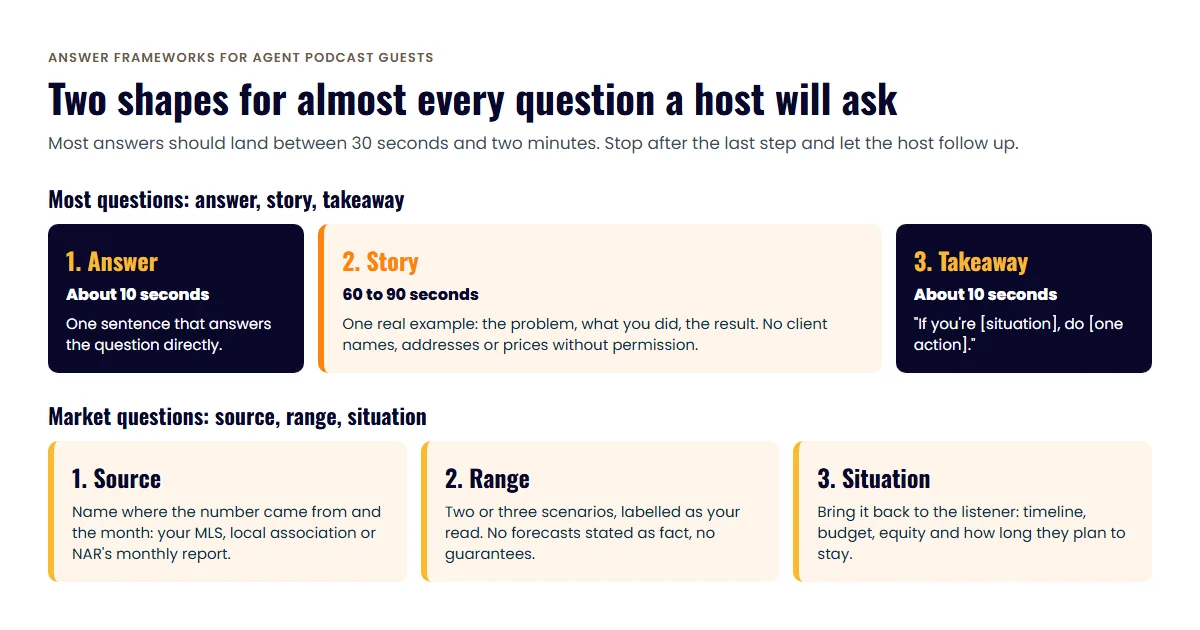
- Answer (about 10 seconds). Say the answer first, in one sentence. “The biggest mistake I see is buyers shopping for homes before they know their monthly number.”
- Story (60 to 90 seconds). Give one real example with a problem, what you did and the result. Strip anything that identifies a client.
- Takeaway (about 10 seconds). Tell the listener what to do with it. “So before you open a listing app, get your payment range in writing.”
Then stop. Silence is the host’s cue to follow up, and a follow-up question makes better audio than a five-minute monologue.
Not every question needs a story. Quick-fire questions like “favorite tool?” want a quick-fire answer. Save stories for the questions where the host has given you room.
How do you answer the opening questions?
Opening questions decide whether listeners stay, so answer them in under a minute and lead with who you help rather than your title. Nobody needs your brokerage history in the first two minutes.
“Tell us a bit about yourself”
Use a three-beat answer: who you help, where you help them, and one detail that makes you memorable.
The script names your brokerage in passing. Most brokerages expect that whenever you promote your services, and NAR’s Standard of Practice 12-5 in the Code of Ethics requires the firm name in advertising. Ask your broker how they apply it to podcasts.
“How did you get into real estate?”
Hosts want the turning point, not a timeline. Pick the moment you decided, the reason, and what it taught you about clients. If you’re newer, there’s a script in podcast guesting as a new agent for the “how long have you been doing this?” follow-up.
“What makes you different?”
Answer with one specific method or niche, then prove it with a number you can document or a short example. “I’m a hard worker who cares” is what every agent says. “I sell homes that have been on the market more than 90 days, and here’s the first thing I change” is a position.
How do you talk about the housing market without making predictions?
Talking about the housing market safely means naming your source and time period, describing a range of outcomes instead of a forecast, and bringing it back to the listener’s own situation. Call it source, range, situation.
The reason is both practical and ethical. Episodes stay online for years, so a confident forecast ages badly. NAR’s Code of Ethics also asks members to “avoid exaggeration” (Article 2), and Article 12 holds their advertising to a true-picture standard. A guest appearance promoting your business is marketing.
- Source. Say where the number came from and when. For your area, that’s usually your MLS or local association report. For national context, NAR publishes a monthly Existing-Home Sales report with sales and price data by region.
- Range. Describe what could happen in two or three scenarios, and say it’s your read, not a promise.
- Situation. Turn the market back to the listener: their timeline, budget or equity matters more than the headline.
“Is now a good time to buy?”
“Where are prices heading?”
“Will rates come down?”
Give the honest answer: you don’t set rates and you can’t know. Then say what a listener should do either way, such as getting quotes from more than one lender and knowing their payment ceiling. Don’t recommend a specific lender on air; see the trap questions below.
Phrases to retire
The table shows market phrases that sound confident but create risk, with safer versions.
| Risky phrase | Why it’s a problem | Say this instead |
|---|---|---|
| “Prices will go up 10% next year.” | A forecast stated as fact | “Based on [source], I’d expect prices to stay [range], but that’s my opinion.” |
| “You can’t lose money on real estate here.” | A guarantee nobody can give | “Over long holding periods this area has [fact from source], but markets do drop.” |
| “Rates are about to fall, so buy now.” | Rate prediction plus pressure | “Buy when the payment works today. A lower rate later is a bonus, not a plan.” |
| “It’s a buyer’s market everywhere.” | Too broad to be true | “In [area], [specific fact] for [month] favors buyers a bit.” |
| “This is the bottom.” | Unknowable and dated the day it airs | “Here’s what would tell me conditions are changing.” |
| “Homes here always sell in a weekend.” | An absolute that is easy to disprove | “Well-priced homes in [area] have been selling in [days on market from source].” |
Which podcast questions are traps for real estate agents?
Trap questions are friendly questions that lead you toward Fair Housing, RESPA, advertising or privacy problems if you answer them casually. Hosts usually don’t mean any harm. The table shows the common ones and a redirect for each.
| Trap question | The risk | Redirect |
|---|---|---|
| “Which neighborhoods are safe?” | Steering and subjective crime talk | Point to official crime data and invite listeners to look for themselves. |
| “Where are the good schools?” | Steering through school talk | Name the official school ratings site and suggest visiting schools. |
| “Which area is best for young families?” | Describing areas by familial status | Talk about homes, lot sizes, parks and commute times instead. |
| “Who’s your go-to lender?” | RESPA and referral arrangements | “I tell clients to compare at least two or three lenders.” Check with your broker before naming anyone. |
| “What do agents get paid now?” | Commission talk that sounds like a standard rate | Explain that compensation is negotiable and set out in a written agreement. |
| “What’s your best deal ever?” | Client privacy and unverifiable claims | Tell the story without names, addresses or sale prices unless the client agreed. |
| “Are you the top agent in town?” | Claims you’d need to prove | Describe what you do well; skip rankings unless you can source them. |
NAR’s FAQs on steering, crime and schools advise “remaining objective and factual, and avoiding subjective commentary, personal opinions, or hearsay.” For more on-air redirect lines, keep the on-air Fair Housing checklist open while you prep. Your broker has the final word on what you can say.
What gets a real estate agent invited back on a podcast?
Real estate agents get invited back when they make the host’s job easier: tight answers, clean audio, stories with stakes, no hard selling, and real effort promoting the episode. Hosts remember guests who made a good episode with little editing.
From a producer’s chair, these are the habits that turn one appearance into a second booking or a referral to another show:
- Joined on time, with a tested mic and headphones, in a quiet room
- Kept most answers under two minutes and let the host steer
- Told at least one story with a problem, a decision and a result
- Gave away a genuinely useful tip instead of hinting at it
- Said the call to action once, when asked (see these call-to-action lines for podcast guests)
- Avoided predictions, guarantees and neighborhood talk the host would have to cut
- Shared the episode and tagged the host in the first week
- Sent a thank-you note with one specific moment they enjoyed
- Suggested a follow-up topic the audience would want
The last item on the list matters most. Hosts need episodes every week, and a guest who arrives with the next episode already shaped is solving their problem. Pitch it in your thank-you note, not on air.
Short on follow-up ideas? The pitch topics for agent guests are sorted by audience.
How do you prepare answers without sounding scripted?
Prepare by picking the six questions you’re most likely to get, writing bullet notes for each, and saying the answers out loud two or three times. Bullets keep you on track; full scripts make you sound like you’re reading.
- Predict the questions. Use the bank above and two recent episodes of the show. You can also run your own profile through the podcast interview question generator to see questions from a host’s side.
- Write bullets, not paragraphs. For each question: the one-sentence answer, the story in three words, the action for the listener.
- Pull your market facts the day before. Note the source and month next to each number so you can cite them on air.
- Rehearse out loud. Record yourself on your phone answering three questions. Cut anything that runs past two minutes.
- Pick your redirects. Decide in advance what you’ll say if the host asks about safe areas, schools or lenders.
If your bottleneck is getting booked rather than preparing, compare the podcast guest booking platforms agents use. ICONS Hub’s guest booking plans are one option, with a dedicated coordinator handling the pitching and scheduling.
Next step
Pick the five questions from the bank you’d least like to be asked. Write an answer-story-takeaway set for each, and a source-range-situation answer for “What’s the market doing?” Say them out loud once a week before each recording. After the interview, send the thank-you note with your rebook pitch the same day.
Frequently asked questions
Should I ask the host for the questions in advance?
Yes. Most hosts will share a rough outline or the topics they plan to cover. Ask for themes rather than an exact script, so your answers stay natural and the host keeps room to follow up.
What if the host asks a question I can't answer?
Say so plainly, then answer the nearest question you can. "I don't know the numbers for that county, but here's what I'm seeing in the neighborhoods I work" sounds more credible than a guess.
How long should a podcast answer be?
Most answers should run 30 seconds to two minutes. Lead with a one-sentence answer, add a story only when it earns its place, and stop so the host can steer the conversation.
Can I mention my own listings when a host asks what I'm working on?
Only with your seller's permission and within your broker's rules, and remember the episode stays online after the home sells. Talking about the type of problem you're solving is usually safer and ages better.
Sources
- 2026 Code of Ethics & Standards of Practice — National Association of REALTORS® (accessed October 6, 2026)
- FAQs on Steering, Crime and Schools — National Association of REALTORS® (accessed October 6, 2026)
- Existing-Home Sales — National Association of REALTORS® (accessed October 6, 2026)
Podcast guesting for agents
Get booked on real estate podcasts
The ICONS Hub connects agents with real estate podcast hosts looking for expert guests.
Guest On The Network
Written by
Co-Founder and Podcast Guru, Icons of Real Estate
Tomás Fonseca co-founded Icons of Real Estate in 2021 and is its Podcast Guru. He has a background in marketing, with stints at companies like Nintendo and Ardor SEO, and is one of the hosts of the Icons of Real Estate Podcast.

How we research, write, fact-check and correct articles: our editorial standards.