On this page
- What does a month of content from one podcast episode look like?
- Why stretch one episode over a month instead of a week?
- Week 1: how do you release the episode?
- Week 2: how do you put the guest to work?
- Week 3: which pieces bring search and email traffic?
- Week 4: how do you turn the episode into conversations?
- How much of your time does a one-episode month take?
- What makes a one-episode month fall flat?
- Next step
You can turn one podcast episode into a month of real estate content by giving each week one job. Release the episode and first clips in week one. Work the guest in week two. Turn it into an article and newsletter in week three, then use it for one-to-one conversations in week four.
That plan suits an agent who records one 45-minute conversation a month, or two at most. If you have a team and want every possible asset, the 30-asset podcast repurposing checklist covers the full production sheet on a two-week calendar. This page is the lighter version, built for a busy solo agent who wants the conversation to keep working until the next one is recorded.
What does a month of content from one podcast episode look like?
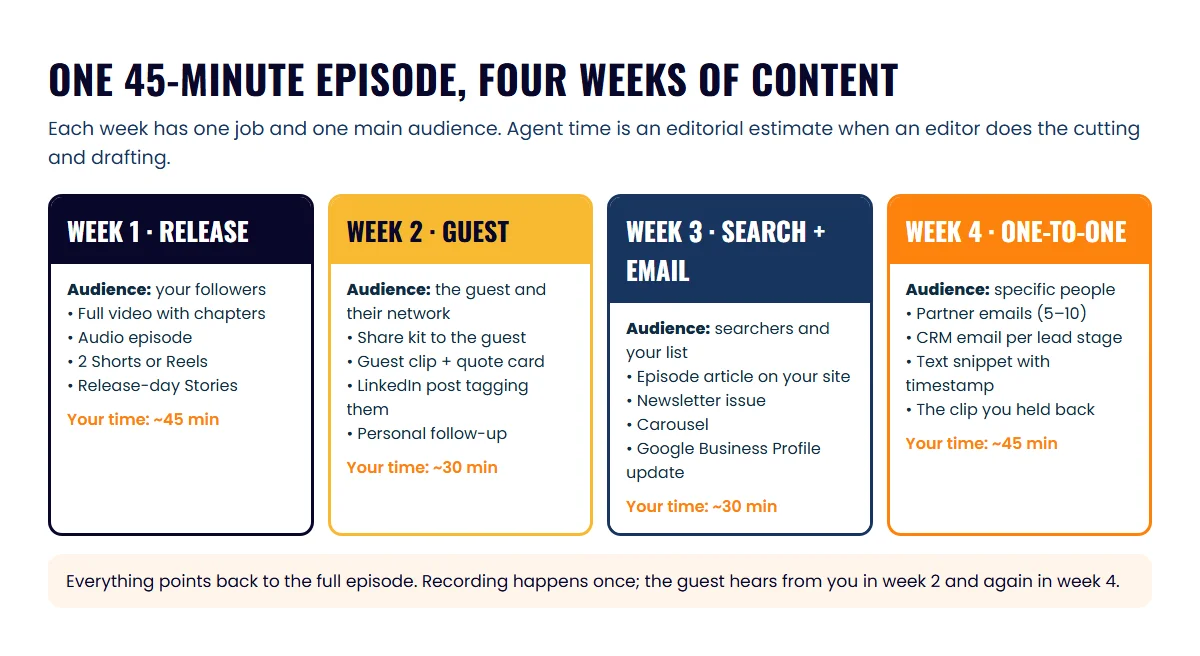
A month of content from one podcast episode is about 15 to 20 posts and messages spread over four weeks. Each week aims at a different audience: your followers, the guest’s audience, search and email readers, and finally the handful of people you want to talk to directly.
The table shows what goes out each week and roughly how much of your own time it takes when someone else does the editing and drafting.
| Week | Job | What goes out | Your time |
|---|---|---|---|
| 1 | Release | Full video episode, audio episode, 2 Shorts or Reels, release-day Stories | 45 min |
| 2 | Guest | Guest clip, guest quote card, a LinkedIn post tagging the guest, the share kit sent to the guest | 30 min |
| 3 | Search and email | Episode article on your site, newsletter issue, carousel, Google Business Profile update | 30 min |
| 4 | One-to-one | Partner emails, CRM email by lead stage, text snippet, one last clip | 45 min |
Times are our editorial estimates for an agent who approves work rather than makes it. They aren’t benchmarks. Track your own for two months and adjust.
Why stretch one episode over a month instead of a week?
Stretching one episode over a month matches how often a busy agent can actually record. A steady rhythm you can keep beats a weekly schedule you drop, and for a solo agent that rhythm is often one or two recordings a month. The guide to how often a real estate podcast should publish walks through that choice.
There is a second reason. A podcast gives you two things from each conversation: a relationship with the guest and a stack of content. Posting everything in three days wastes both. Here’s how. The guest gets one tag and forgets the episode, and your audience sees the same face five times in a row, then nothing for three weeks.
A month-long plan keeps the guest in your feed, gives you a reason to contact them again, and fills the gap until the next recording.
Week 1: how do you release the episode?
Release week puts the full episode on every channel you own and adds the two strongest clips. The goal is to make the long version easy to find, because everything later in the month points back to it.
- Publish the full video on YouTube with chapters. Per YouTube’s chapters help page, chapters need three or more timestamps listed in order from 00:00, and each chapter has to run 10 seconds or longer. Name chapters after the questions a buyer or seller would ask.
- Publish the audio episode through your podcast host the same day.
- Post two Shorts or Reels on different days. YouTube lets you create Shorts from your own videos, selecting up to 60 seconds, and those Shorts link back to the original video.
- Run release-day Stories with a poll or question sticker and the episode link.
Pick the two clips with the moment types in which podcast clips get DMs. Save the rest. You’ll need them.
Week 2: how do you put the guest to work?
Guest week is where the relationship side of the podcast pays off. Send the guest a short share kit, then post the pieces that make them look good, tagged, a few days after release when they’ve had time to listen.
- Send the share kit on Monday: the episode link, one clip of their best answer, one quote card and two ready-to-paste captions.
- Post the guest clip and quote card mid-week, tagging the guest. By then they’ve had time to listen.
- Write one LinkedIn post that retells the conversation for partners: what the guest said, why it matters to other professionals, and a question at the end. The one-clip workflow for Shorts, LinkedIn posts and newsletter notes has a template for this.
- Follow up personally. A two-line message to the guest asking how the episode landed with their clients does more for the relationship than another tag.
Guests of an ICONS show get help with this week from ICONS Social. It drafts roughly 10 posts from the episode in the guest’s own words. Once the guest approves them, it publishes them to the guest’s own accounts.
Week 3: which pieces bring search and email traffic?
Week three turns the conversation into written content that keeps working after social posts fade. The core piece is an episode article on your own site that answers the one question the guest handled best, with the video embedded.
- Episode article: one question, answered in your words, with the episode embedded. The guide to embedding a podcast on a real estate website covers the setup.
- Newsletter issue: three takeaways from the conversation and your own view, then the episode link. Keep it short enough to read on a phone.
- Carousel: six to eight slides, one tip per slide, pulled from the article.
- Google Business Profile update: a short summary and a button to the article.
On YouTube, add the full episode as the related video on each Short. The link shows below your channel handle, although the feature needs advanced feature access, so check your channel settings first.
Week 4: how do you turn the episode into conversations?
Week four uses the episode to start one-to-one conversations, which is where real estate business usually comes from. Instead of posting to everyone, send specific parts of the episode to specific people.
- Partner emails: a personal note to five to ten lenders, agents or past guests who would find the episode useful.
- CRM email: one short email per lead stage with a timestamp link to the answer that fits that stage. A buyer six months out and a seller ready to list need different moments.
- Text snippet: one line plus a timestamp link, saved as a template for when the topic comes up in a call.
- One last clip: the moment you held back, posted at the end of the month so the feed doesn’t go quiet before the next episode.
Lender guests raise RESPA questions when promotion is shared or costs are split, so clear joint marketing with your broker first.
How much of your time does a one-episode month take?
A one-episode month takes about two to three hours of your own time on top of the recording, if someone else edits and drafts. Your jobs are picking moments right after the call, approving each week’s batch and writing the personal messages in weeks two and four.
Doing it all yourself is a different number. Cutting clips, writing an article and designing a carousel can easily take a full working day per episode. Few agents can keep that up next to a full calendar of showings and closings. Three ways to cut your hours:
| Option | What it handles | Your role |
|---|---|---|
| Repurposing software | Transcript, clip suggestions, caption drafts | Choose clips, rewrite captions, schedule |
| ICONS Social | Drafts roughly 10 posts from an ICONS episode and publishes them once you approve | Edit and approve |
| A production service | Editing, clips, graphics, articles and publishing | Record and approve |
The podcast repurposing tools comparison covers the software route. ICONS Social costs nothing if you’ve guested on one of the ICONS shows or you run your own show in ICONS DIY Podcast. For your own show, our podcast production service includes social repurposing (reels, carousels and thumbnails made for each episode) plus episode articles on your site.
What makes a one-episode month fall flat?
A one-episode month falls flat when the conversation has too few moments that stand on their own. Before you plan four weeks around a recording, list its quotable moments. Four or more strong ones will carry a month; with only one or two, run a two-week plan instead.
Three other problems come up often:
- Repeating the same words everywhere. Use the same moment, but rewrite the text for each audience.
- Skipping week four. It feels like admin, yet it’s the week most likely to produce a call.
- Forgetting compliance in short pieces. A 30-second clip or quote card can lose the context that made a line safe. Check captions for Fair Housing words to avoid and ask your broker whether clips need your brokerage name.
For the case for filming your show at all, read the video podcast playbook for real estate agents.
Next step
Take your most recent episode and list every moment that stands alone. If you have four, put them into the four-week table above and assign an owner to each line before Monday.
Frequently asked questions
Can a 20-minute episode fill a month?
Sometimes. Length matters less than the number of moments that stand alone. A tight 20-minute interview with four strong answers can fill a month; a rambling hour with one good story can't.
What if I publish two episodes a month?
Run two shorter plans that overlap. Give each episode its own release and guest week, and share one search and email week between them so your newsletter covers both.
Should I post the same clip on every platform?
Post the same moment, but rewrite the words around it for each audience. A Short speaks to local buyers and sellers, while a LinkedIn post speaks to lenders, agents and other partners.
Sources
- Video Chapters — YouTube Help (accessed October 21, 2026)
- Create YouTube Shorts from your videos — YouTube Help (accessed October 21, 2026)
- Add a related video to your YouTube Shorts — YouTube Help (accessed October 21, 2026)
Done-for-you podcast production
Want a podcast that brings in referrals, not just downloads?
Icons of Real Estate plans, produces and publishes business-growing podcasts for agents. You record. We handle the rest.
Launch Your Podcast
Written by
Co-Founder and Podcast Guru, Icons of Real Estate
Tomás Fonseca co-founded Icons of Real Estate in 2021 and is its Podcast Guru. He has a background in marketing, with stints at companies like Nintendo and Ardor SEO, and is one of the hosts of the Icons of Real Estate Podcast.

How we research, write, fact-check and correct articles: our editorial standards.