On this page
- What does the Fair Housing Act say about advertising words?
- Is there an official list of fair housing words to avoid?
- Fair housing words to avoid, by protected class
- Which words are fine, even though agents worry about them?
- When is a caution word a problem?
- Do fair housing rules cover social posts and podcast episodes?
- How do you check a listing or caption before you post?
- Next step
Fair housing words to avoid are words in a listing, ad or social post that favor or exclude buyers or renters by protected class. The federal classes are race, color, national origin, religion, sex, disability and familial status. Describe the property, not the people: “four bedrooms and a fenced yard,” not “perfect for families.”
You can paste a listing description or caption into the free Fair Housing Ad Checker to flag risky phrases before you post. The rest of this page explains where those flags come from, so you can judge each one yourself and talk it through with your broker.
What does the Fair Housing Act say about advertising words?
The Fair Housing Act bars any housing “notice, statement, or advertisement” that “indicates any preference, limitation, or discrimination” based on a protected class (42 U.S.C. § 3604(c)). HUD lists the federal classes as race, color, national origin, religion, sex, familial status and disability.
HUD’s rule adds two details that matter for agents (24 CFR § 100.75):
- It covers “all written or oral notices or statements” by a person in the business of selling or renting homes. Flyers, signs and brochures are named; your captions and videos follow the same logic.
- It covers “words, phrases, photographs, illustrations, symbols or forms” that convey a home is or isn’t available to a particular group.
Familial status means households with children under 18, and it also protects anyone who is pregnant. That one class is behind most of the friendly-sounding phrases that get agents in trouble.
Is there an official list of fair housing words to avoid?
No current official HUD list of fair housing words exists. What agents use instead are older HUD documents and word lists published by MLSs, Realtor associations and fair housing groups.
The two HUD documents behind most lists:
- HUD’s advertising guidelines (former 24 CFR part 109). These named example words by class, plus “catch words” such as restricted, exclusive, private and integrated. HUD removed part 109 from its regulations effective May 1, 1996, in a final rule published at 61 FR 14378.
- HUD’s January 9, 1995 memo by Roberta Achtenberg, “Guidance Regarding Advertisements Under §804(c) of the Fair Housing Act.” It said which words create liability and which don’t. It also limited complaints against publishers to ads whose preference is “readily apparent to an ordinary reader” (memo copy hosted by RESO).
According to Oregon REALTORS in April 2026, HUD has since taken the 1995 memo off its website without replacing it, and the article treats the memo as still the clearest explanation available (Oregon REALTORS). The law itself, § 3604(c), hasn’t changed. Treat any word list, including ours, as a guide to the law, not the law.
Fair housing words to avoid, by protected class
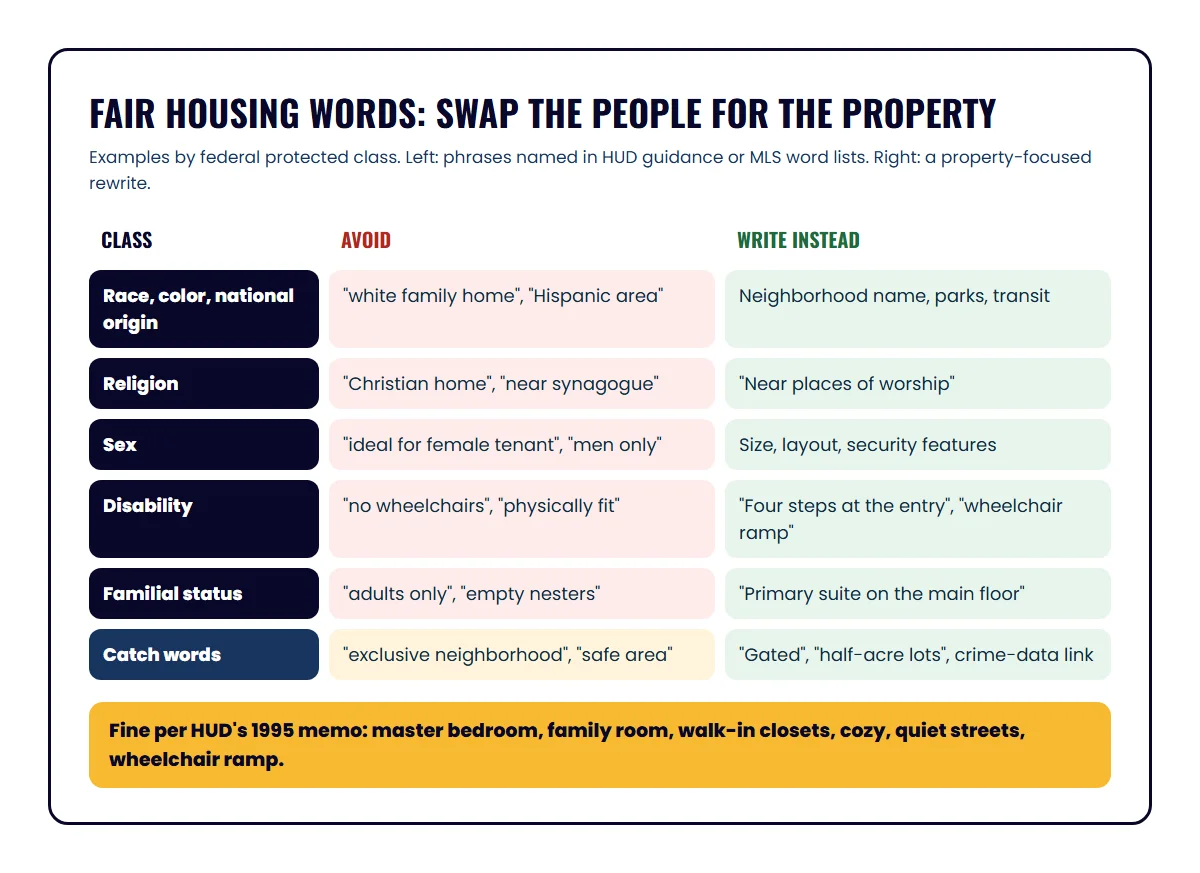
The words that cause trouble describe who lives somewhere or who should buy. The table below gives examples for each federal class, where the example comes from, and a property-first rewrite.
| Protected class | Examples to avoid | Where it comes from | Write this instead |
|---|---|---|---|
| Race, color, national origin | “white family home,” “no Irish,” “Hispanic area” | HUD 1995 memo; Newark, Ohio fair housing manual | The neighborhood name, parks, transit, commute times |
| Religion | “Christian home,” “no Jews,” “near synagogue” | HUD 1995 memo; ArkansasONE MLS list | “Near places of worship” |
| Sex | “men only,” “ideal for female tenant” | Newark manual; Lexington-Fayette fair housing guide | Size, layout, security features |
| Disability | “no wheelchairs,” “physically fit,” “healthy only” | HUD 1995 memo; former HUD list; ArkansasONE | “Four steps at the entry,” “bedrooms upstairs” |
| Familial status | “adults only,” “no children,” “couples only,” “empty nesters” | HUD 1995 memo; ArkansasONE; NAR | “Primary suite on the main floor,” “fenced yard” |
| Catch words | “exclusive neighborhood,” “restricted community,” “safe neighborhood” | Former HUD list; ArkansasONE | “Gated,” “half-acre lots,” a link to official crime data |
The phrases that sound friendly
Most agents never write “adults only.” The risk sits in warm, casual phrases that describe a buyer:
- “Perfect for empty nesters” or “ideal for newlyweds” (both on the ArkansasONE MLS unacceptable list)
- “Great for young families” or “kid-friendly street” (a preference based on familial status)
- “Perfect for young professionals” (ArkansasONE suggests “close to downtown” or “near transit”)
- “Active adult community” (the Newark, Ohio manual warns that even qualifying 55+ housing can’t seek “active” older persons)
NAR’s legal team gives the same test: phrases like “ideal for empty nesters” or “perfect for students” imply a preference for one group, while “easy walk to train” describes the property (NAR).
Which words are fine, even though agents worry about them?
HUD’s 1995 memo cleared a long list of common property words. Ads that describe the property, its services or the neighborhood are not violations, even if the words sound like they relate to a class.
According to the memo, these do not violate the Act:
- Master bedroom, rare find, desirable neighborhood. The memo calls them facially neutral.
- Mother-in-law suite, bachelor apartment. Common physical descriptions.
- Great view, fourth-floor walk-up, walk-in closets, jogging trails, walk to bus stop. Property and neighborhood descriptions, not disability limits.
- Wheelchair ramp and other accessibility features. Lawful to advertise.
- Non-smoking, sober. Rules about conduct, not status.
- Two bedroom, cozy, family room, quiet streets. Not facially discriminatory.
- Apartment complex with chapel, kosher meals available, Merry Christmas, Happy Easter. Facilities, services and secular holiday greetings.
One caveat: some MLSs now ask for “primary bedroom” and “ADU” instead of “master bedroom” and “mother-in-law suite.” That’s a house style, not a federal rule, but your MLS can still enforce it.
When is a caution word a problem?
A caution word is a problem when it describes who lives there or who belongs, rather than the property. The old HUD list called these catch words: “restricted, exclusive, private, integrated, traditional, board approval or membership approval,” to be avoided when “used in a discriminatory context.”
Context decides. “Exclusive listing” is an industry term. “Exclusive neighborhood” describes who gets in. “Deed restricted” describes land use. “Restricted community” hints at people. “Private driveway” is a feature. “Private community” can read as a gate on residents.
The steering rule raises the same issue from another angle. HUD’s steering rule names telling a buyer they “would not be comfortable or compatible with existing residents” as unlawful steering. So “you’ll fit right in” or “like-minded neighbors” in a caption deserves a second look.
Do fair housing rules cover social posts and podcast episodes?
Fair housing advertising rules cover social posts and podcast episodes, because they apply to written and oral statements alike. That reaches Instagram captions, Reels, YouTube titles, episode titles and show notes, not just MLS remarks.
Three places agents forget:
- Social captions and on-screen text. A neighborhood tour Reel with “perfect for young families!” on screen is an ad. If you schedule posts in batches, check them at the batching step, before they sit in your social media scheduling tool for real estate.
- Podcast titles, descriptions and clips. An episode called “Why Families Love Elm Street” has the same problem as a listing that says it. Our on-air fair housing checklist for hosts and guests covers what you say on air; the written packaging needs the same word check. If you feature a property, the MLS and ad rules for featuring your listings on a show add seller consent on top.
- Ad targeting. HUD’s rule also covers “selecting media or locations for advertising” that deny groups information about housing. The ArkansasONE list reminds agents to use the special housing ad category on Meta and Google, and not to target or exclude by age, zip code or other traits tied to protected classes.
For the wider picture of brokerage disclosure, recording consent and other rules that touch an agent’s show, see real estate podcast compliance. And if content is part of how you win clients, the content-to-leads guide for real estate agents shows where a clean caption fits in the system.
How do you check a listing or caption before you post?
Check it in four steps, with the description in front of you and your broker’s rules nearby. It takes about two minutes per listing once it’s a habit.
- Run the text through a checker. Paste it into the Fair Housing Ad Checker. It flags avoid and caution phrases, explains why, and suggests a property-focused swap.
- Read every “who” sentence. Any sentence about who would love the home, who lives nearby or who it’s perfect for gets rewritten as a feature.
- Check the caution flags in context. “Exclusive listing” stays. “Exclusive neighborhood” goes.
- Check your state and MLS lists. Federal law sets the floor. Your state, city and MLS may protect more classes and ban more words.
When something is borderline and you can’t rewrite it as a plain property fact, leave it out or ask your broker.
Next step
Paste your current active listing remarks and your last five captions into the free fair housing checker, fix what it flags, and save the swap table above where you write.
This page is general information, not legal advice. It covers federal law only; state and local laws add protected classes and rules, so check with your broker or a lawyer before you publish anything you’re unsure about.
Frequently asked questions
Is master bedroom a fair housing violation?
HUD's 1995 advertising memo says the term master bedroom does not violate the sex or race provisions. Some MLSs now prefer primary bedroom or primary suite, so follow your MLS rules.
Can I advertise a 55+ community?
Yes, if the community qualifies as housing for older persons under federal law, for example 55+ housing where at least 80% of occupied units have a resident 55 or older. Confirm with the HOA or developer before you advertise it.
Does an Equal Housing Opportunity logo make an ad compliant?
No. The logo or statement is good practice, but an ad can still break the law if its words or images show a preference. Fix the wording first.
Can I say I speak Spanish in my ads?
NAR's guidance says agents may promote their language fluency or a specialty area, as long as they describe their services and don't state a preference for who they serve.
Sources
- 42 U.S. Code § 3604, Discrimination in the sale or rental of housing — Cornell Legal Information Institute (accessed October 21, 2026)
- 24 CFR § 100.75, Discriminatory advertisements, statements and notices — Cornell Legal Information Institute (accessed October 21, 2026)
- 24 CFR § 100.70, Other prohibited sale and rental conduct — Cornell Legal Information Institute (accessed October 21, 2026)
- 42 U.S. Code § 3607, Religious organization or private club exemption (housing for older persons) — Cornell Legal Information Institute (accessed October 21, 2026)
- Housing Discrimination Under the Fair Housing Act — U.S. Department of Housing and Urban Development (accessed October 21, 2026)
- Guidance Regarding Advertisements Under §804(c) of the Fair Housing Act, HUD memo by Roberta Achtenberg, January 9, 1995 (copy hosted by RESO) (accessed October 21, 2026)
- Fair Housing Amendments Act regulations, final rule removing 24 CFR part 109, 61 FR 14378 — Federal Register via GovInfo (accessed October 21, 2026)
- A Publisher's Guide to Fair Housing Advertising (includes former 24 CFR 109.20) — Lexington-Fayette Urban County Human Rights Commission (accessed October 21, 2026)
- Fair Housing Compliance After the Guidance Reset — Oregon REALTORS (accessed October 21, 2026)
- Avoid Fair Housing Violations in Advertising — National Association of REALTORS (accessed October 21, 2026)
- Fair Housing Advertising Word and Phrase List (revised March 2026) — ArkansasONE MLS (accessed October 21, 2026)
- Fair Housing Advertising Manual — City of Newark, Ohio (accessed October 21, 2026)
Done-for-you podcast production
Want a podcast that brings in referrals, not just downloads?
Icons of Real Estate plans, produces and publishes business-growing podcasts for agents. You record. We handle the rest.
Launch Your Podcast
Written by
Co-Founder and Podcast Guru, Icons of Real Estate
Tomás Fonseca co-founded Icons of Real Estate in 2021 and is its Podcast Guru. He has a background in marketing, with stints at companies like Nintendo and Ardor SEO, and is one of the hosts of the Icons of Real Estate Podcast.

How we research, write, fact-check and correct articles: our editorial standards.