On this page
- Do Fair Housing rules apply to what you say on a podcast?
- Which protected classes do you have to keep in mind?
- What does steering sound like in a conversation?
- What should you say instead?
- How do you handle schools, crime and “is it safe?” questions?
- Host checklist: what to check before you publish
- Guest checklist: what to do when you’re on someone else’s show
- Templates: guest briefing note and on-air redirects
- What if a problem episode is already live?
- Next step
Fair Housing rules apply when realtors speak on a podcast, as hosts or as guests. Federal rules cover oral statements about housing, not just written ads, so an episode, clip or show note that signals a preference for or against a protected class is a problem. Describe homes, prices and amenities, never who lives there or who belongs there.
What follows is a producer’s working checklist, not legal advice; your broker and your state’s rules settle the details, so hand them a copy. Fair Housing isn’t the only on-air risk, either. Talking about commissions after the NAR settlement has its own rules.
Do Fair Housing rules apply to what you say on a podcast?
Fair Housing rules apply to spoken podcast content as well as to written ads. The Fair Housing Act makes it unlawful to make or publish any “notice, statement, or advertisement” about the sale or rental of a dwelling that shows a preference, limitation or discrimination based on a protected class (42 U.S.C. § 3604). HUD’s rule spells out that this covers “all written or oral notices or statements” by people in the business of selling or renting homes (24 CFR § 100.75).
An episode is oral. Your show notes, episode titles, thumbnails, captions and transcripts are written. A podcast hits both categories at once, and it stays online for years.
Podcasts also create a risk that print ads don’t: unscripted talk. Nobody writes “great area for young couples” in a listing. Plenty of people say it while chatting with a host. That’s why a podcast needs its own checklist instead of your brokerage’s ad-copy rules alone.
Which protected classes do you have to keep in mind?
According to HUD, federal law protects seven classes: race, color, national origin, religion, sex, familial status and disability. If you’re a REALTOR®, Article 10 of the NAR Code of Ethics adds sexual orientation and gender identity, and Standard of Practice 10-3 bars advertising that shows a preference on any of those bases (NAR Code of Ethics). State and local laws can add more. Ask your broker for your local list and keep it next to your mic.
Two classes trip up podcasters most often:
- Familial status. This one hides inside friendly phrases: “family neighborhood,” “perfect for empty nesters,” “lots of young kids on the street.”
- Disability. Watch for “not for someone in a wheelchair” or comments about group homes nearby. Describing the feature is fine: “single-level, no steps at the entry.”
What does steering sound like in a conversation?
Steering means trying to restrict a buyer’s or renter’s choices because of a protected class. HUD’s steering rule includes discouraging someone from a home or area, exaggerating drawbacks, and telling a buyer they “would not be comfortable or compatible” with existing residents (24 CFR § 100.70).
On a podcast, steering rarely sounds like a policy. It sounds like a tip. Listen for these four patterns:
- “Who lives there” descriptions. “It’s mostly young professionals.” “Lots of retirees.” “A big [nationality] community.”
- “Good for” and “perfect for” labels. Any phrase that assigns a neighborhood to a type of person.
- “Fit in” language. “You’d feel at home there.” “It might not be your crowd.”
- Code words. “Up-and-coming,” “transitional,” “a changing area,” “safe” and “good schools” can carry meaning about who lives somewhere, even when you don’t intend it.
NAR’s Standard of Practice 10-1 adds a member-specific line: in residential sales, don’t volunteer information about a neighborhood’s racial, religious or ethnic makeup. If a host asks, you can decline politely. A script for that is further down.
What should you say instead?
Instead of describing people, say place facts: prices, commute times, parks, home features and links to official data. Facts are more useful to listeners anyway, because they’re specific and they help a buyer decide. Use this table as your on-air cheat sheet.
| Risky on air | Why it’s risky | Say this instead |
|---|---|---|
| “It’s a great area for families.” | Preference based on familial status | “Three parks within a mile, and most homes have 3+ bedrooms.” |
| “Lots of young professionals live there.” | Describes residents, implies who belongs | “It’s a 15-minute train ride downtown, with restaurants open late.” |
| “Perfect for retirees.” | Preference based on age or family status | “Lots of single-level homes and a senior center on Main Street.” |
| “It’s a really safe neighborhood.” | Subjective, often used as code | “You can look up local crime data on the police department’s site.” |
| “The schools are great there.” | Often used as code for who attends | “It’s in the [District Name] district. Check the state report card for the numbers.” |
| “It’s a big [religion] community.” | Religion; volunteers demographic makeup | “There’s a [house of worship] on Oak Street, two blocks from the listing.” |
| “You’d fit right in there.” | Suggests compatibility with residents | “Tour it and see if the commute and price range work for you.” |
| “It’s not wheelchair-friendly.” | Discourages based on disability | “The entry has four steps and the bedrooms are upstairs.” |
| “That area’s changing.” | Code for resident demographics | “Median prices rose this year, and two new shops opened on Elm.” |
Notice the pattern in the right column: numbers, distances, named places, features and links to official data. If you can’t measure it or point to it, don’t say it.
How do you handle schools, crime and “is it safe?” questions?
Point to the official source and stop there. These three questions come up in almost every neighborhood episode, and they’re where agents slip most.
Schools
You can say which district or attendance zone a home sits in and tell listeners where the official data lives, such as the state education department’s report cards. Avoid rankings, adjectives (“great,” “rough”) and anything about who attends. Districts and zones also change, so add “confirm boundaries with the district” in the show notes.
Crime and safety
“Safe” is an opinion, and it’s one of the most common code words in real estate talk. Tell listeners where to look up crime data themselves and let them judge. Don’t name streets or blocks as places to avoid.
Demographics
If a listener question or host asks about the people who live in an area, decline and offer place facts. In residential sales, Standard of Practice 10-1 tells REALTORS® not to volunteer racial, religious or ethnic makeup at all.
Host checklist: what to check before you publish
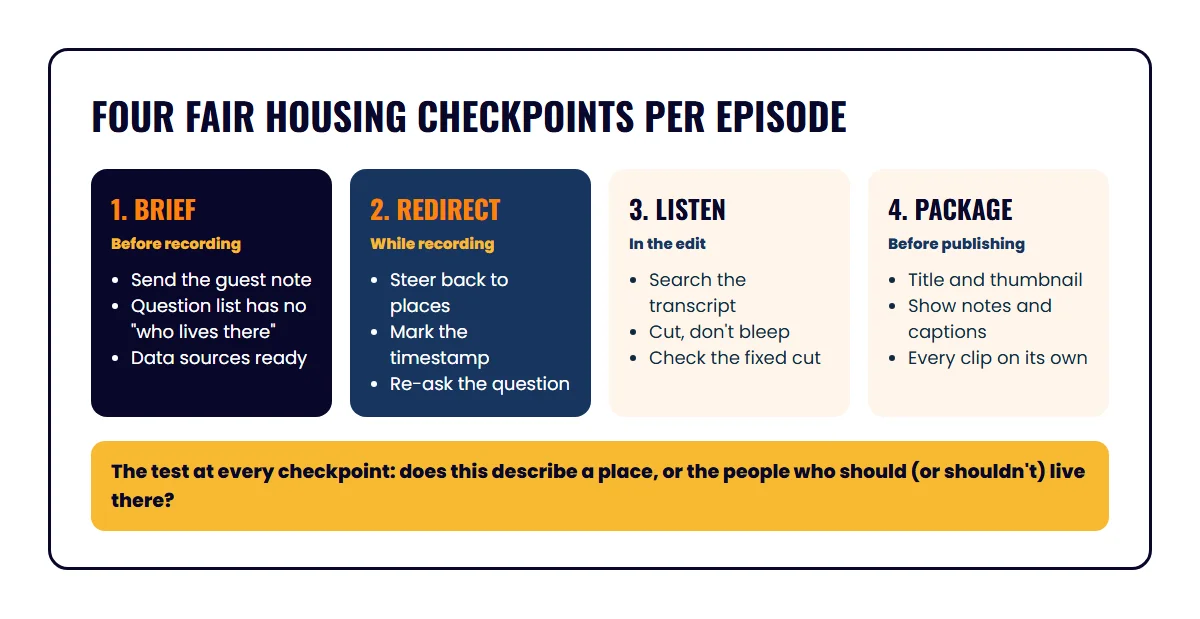
Run this checklist on every episode. It fits into the normal steps of real estate podcast production, so it adds a short listen, not a new process. Add it to your podcast launch checklist so it’s built in from episode one.
Before recording
- Send the guest briefing note (template below) with the calendar invite.
- Read your question list. Remove any question that asks who lives somewhere or who an area suits.
- Have your data sources ready: MLS stats, district names, commute times, official crime and school links.
- Get your broker’s sign-off on your show format and disclosure wording, using the broker approval request for a podcast if you haven’t yet.
While recording
- Redirect any slip right away with a place fact.
- Note the timestamp of anything you’ll need to cut.
- Re-ask the question if the first answer went off track, so the editor has a clean take.
In the edit
- Search the transcript for flag words: family, kids, young, older, retire, church, mosque, temple, safe, crime, schools, changing, fit in, crowd, community, wheelchair.
- Listen to every flagged moment in context.
- Cut the full statement. Don’t bleep it; a bleep draws attention and leaves the meaning.
- Listen to the edited section again to make sure the cut doesn’t change what someone else meant.
Before publishing
- Check the episode title, description and thumbnail text.
- Check show notes, captions and the auto-generated transcript.
- Review every short clip on its own. A clip pulled out of context can sound worse than the full episode.
- Check listing mentions separately. The rules for talking about listings on a podcast add seller consent and disclosure on top of Fair Housing.
If someone else produces your show, give them this list and ask them to flag, not fix, anything borderline. An outside editor, including Icons’ done-for-you production team, can work from a list like this. You and your broker still make the call on what airs.
Guest checklist: what to do when you’re on someone else’s show
Your words are yours, even on another agent’s podcast. The host may never edit anything out. Use this shorter list before each appearance.
- Read the host’s last two episodes’ titles and notes. If they lean on “best areas for families” content, prepare your redirects
- Prepare three place facts for each area you might discuss
- Know your district names and the official data sites for schools and crime
- Plan your decline line for “who lives there?” questions
- Ask the host before recording: “If I misspeak on a Fair Housing point, can we cut it?”
- Ask to see clips before they post, or at least the titles
- Use your brokerage name as your broker requires
Templates: guest briefing note and on-air redirects
Copy these, adjust the wording, and run them past your broker once.
What if a problem episode is already live?
If a problem episode is already live, fix the audio, clips and written parts quickly, tell your broker, and keep a record. A slip you catch after release is easier to deal with than one a listener reports.
- Unpublish or replace the audio. Many hosting platforms let you swap in a new audio file on the same episode; check yours. Do the same for the YouTube version.
- Pull the clips. Delete any short clips with the statement, on every platform.
- Fix the written parts. Update titles, show notes and transcripts.
- Tell your broker. Say what happened and what you changed. They may want a record or a different fix.
- Update your checklist. Add the phrase that slipped through to your transcript search list.
Old copies may live on in apps that already downloaded the file. That’s why the pre-publish checklist matters more than the cleanup.
Next step
Print the swap table, add the four checkpoints to your podcast production workflow, and send the guest briefing note with your next invite. Then ask your broker for any extra protected classes in your state so your list is complete.
Frequently asked questions
Can I say a home is near a church or temple?
Naming a building as a landmark or giving a distance is a place fact. Saying the area suits people of a certain faith is a preference. Keep it to the landmark and let listeners decide.
Is it fine to call a home 'great for families'?
Familial status is a protected class, so avoid it. Describe the features instead: four bedrooms, a fenced yard, a park two blocks away.
Do I need a Fair Housing disclaimer in my show notes?
Some brokerages want one, and it does no harm, but a disclaimer does not fix a problem statement in the audio. Ask your broker what wording they prefer.
What if the host keeps asking about who lives in an area?
Redirect once or twice with place facts. If it keeps happening, ask the host to cut that section, and think twice before going back on that show.
Sources
- 42 U.S. Code § 3604, Discrimination in the sale or rental of housing — Cornell Legal Information Institute (accessed October 6, 2026)
- 24 CFR § 100.75, Discriminatory advertisements, statements and notices — Cornell Legal Information Institute (accessed October 6, 2026)
- 24 CFR § 100.70, Other prohibited sale and rental conduct — Cornell Legal Information Institute (accessed October 6, 2026)
- 2026 Code of Ethics & Standards of Practice — National Association of REALTORS® (accessed October 6, 2026)
- Housing Discrimination Under the Fair Housing Act — U.S. Department of Housing and Urban Development (accessed October 6, 2026)
Done-for-you podcast production
Want a podcast that brings in referrals, not just downloads?
Icons of Real Estate plans, produces and publishes business-growing podcasts for agents. You record. We handle the rest.
Launch Your Podcast
Written by
Co-Founder and Podcast Guru, Icons of Real Estate
Tomás Fonseca co-founded Icons of Real Estate in 2021 and is its Podcast Guru. He has a background in marketing, with stints at companies like Nintendo and Ardor SEO, and is one of the hosts of the Icons of Real Estate Podcast.

How we research, write, fact-check and correct articles: our editorial standards.