On this page
- What is a brokerage or team podcast actually for?
- Who should own the show: the brokerage, the team or the host?
- How do you run a show with several hosts?
- Which episodes help you recruit agents?
- How should approvals work when several agents speak for the firm?
- How do you measure whether the podcast recruits agents?
- What does production look like for a team show?
- Next step
Brokerage podcast production means running a show whose main job is recruiting and keeping agents. It needs four things a solo agent’s show doesn’t: written ownership of the feed, one anchor host with a rotating bench of agents, an approval workflow for everyone who speaks for the firm, and a way to trace new recruits back to episodes.
Team leaders, broker-owners and recruiting leads are the readers here. Recording, editing and publishing work the same as for any agent show and are covered in real estate podcast production from start to finish. What follows is only what changes when the show belongs to a team or a firm.
What is a brokerage or team podcast actually for?
A brokerage or team podcast is a recruiting and culture asset built for listeners who are agents, not consumers. That agent might be licensed elsewhere in your market, newly licensed, or already on your roster. Everything else follows from that choice: the guests, the topics, the call to action and how you measure it.
A recruiting show earns its keep in three ways:
- Agents hear how you think before they interview. A candidate who has heard three episodes walks in knowing your systems, your tone and your leaders.
- The guest seat opens doors. Inviting a strong agent from another firm to talk about their craft is a low-pressure first conversation.
- Your current agents stay. Episodes that feature their wins and their systems give them something to share and a reason to feel seen.
It is not a consumer lead show. If you also want buyers and sellers, run a separate feed. Compare the team recruiting concept with the consumer ones in these real estate podcast concepts by niche to see how the audience, segments and guest pipeline differ.
Who should own the show: the brokerage, the team or the host?
The party that pays for the show and holds the hosting account should own it, and that has to be written down before episode one. Disputes start when a co-host leaves and asks for “their” episodes, or when a team moves firms and the brokerage name is baked into the show title.
| Model | Who holds the feed and accounts | Best fit | Watch for |
|---|---|---|---|
| Brokerage-owned | The brokerage | A firm recruiting across several offices | Hosts are talent; agree what happens to their episodes if they leave |
| Team-owned | The team leader’s business | A team inside a larger brokerage | The brokerage must approve the name and disclosures; plan for a future move |
| Host-owned with co-hosts | The lead agent personally | A small team built around one agent’s brand | Co-hosts have no claim on the show; say so in writing |
If you lead a team and might switch firms one day, check what your brand and podcast take with you when you switch brokerages. A neutral show name with the brokerage disclosure in the intro and show notes moves more easily than a name built around the firm.
How do you run a show with several hosts?
Use one anchor host on every episode and rotate a small bench of agents around them. An anchor gives listeners a consistent voice and keeps the show’s purpose steady. Meanwhile, the bench gives candidates a look at several people they might work beside.
Most teams make the team leader or recruiting lead the anchor. Pick two to four agents for the bench. Choose people who explain things clearly and who want to be there. A reluctant agent on a mic recruits nobody.
A monthly rotation calendar
For a four-episode month, record all four in one half-day session. One plan that works:
| Week | On the mic | Episode type | Recruiting job |
|---|---|---|---|
| 1 | Anchor + bench agent A | “One system”: a process your team uses, step by step | Shows how you support agents |
| 2 | Anchor + agent from another firm or market | Craft conversation with a peer | Opens a relationship, builds referral ties |
| 3 | Anchor + bench agent B | Career story: how they built their business here | Lets candidates picture themselves on the team |
| 4 | Anchor + staff member or leader solo | Questions agents ask before joining, answered plainly | Handles objections before the interview |
At two episodes a month, alternate weeks 1 and 3 with weeks 2 and 4.
The host hand-off kit
Give every bench agent the same one-page kit before their first recording:
- A one-sentence show promise.
- Your intro line and brokerage disclosure line, word for word.
- Topics that stay off air (see the next section).
- The call to action the anchor will read, so they don’t invent a different one.
- How they’ll review their episode, and by when.
Which episodes help you recruit agents?
The episodes that recruit are the ones that would still help an agent who never joins. A candidate can smell a sales pitch. A useful episode about how your agents run listing appointments sells the team without saying so.
| Episode type | Why it recruits | Keep it safe |
|---|---|---|
| “One system” walkthrough | Shows the support a new agent gets | No client names or deal details without permission |
| Agent career story | Candidates hear someone like them succeed | Get the agent’s written OK on any numbers they share |
| Peer from another firm | Builds a warm relationship with a possible recruit | Talk craft, not offers, on air |
| Staff spotlight (TC, marketing, ops) | Makes back-office support concrete | Describe what they do, not promises of results |
| “Before you join” Q&A | Answers the questions candidates ask anyway | Have compensation answers reviewed first |
What stays off air
- Commission rates charged to clients, or anything that sounds like agents agreeing on what to charge. Talking about commissions on a podcast after the NAR settlement explains the risk and what to say instead.
- Income promises. “Our agents make six figures in year one” is a claim, not a story. If an agent shares their own numbers, frame them as one person’s results and run them past your broker.
- Your split or fee plan, unless your broker has approved exactly how it will be described.
- Other firms by name, in a negative way. It sounds petty and invites trouble.
How should approvals work when several agents speak for the firm?
Run approvals in four lanes, in a fixed order, each with one owner and a deadline. A solo agent approves their own episode. A team show has several people whose words, numbers and reputations are on the record, so one person can’t approve it alone.
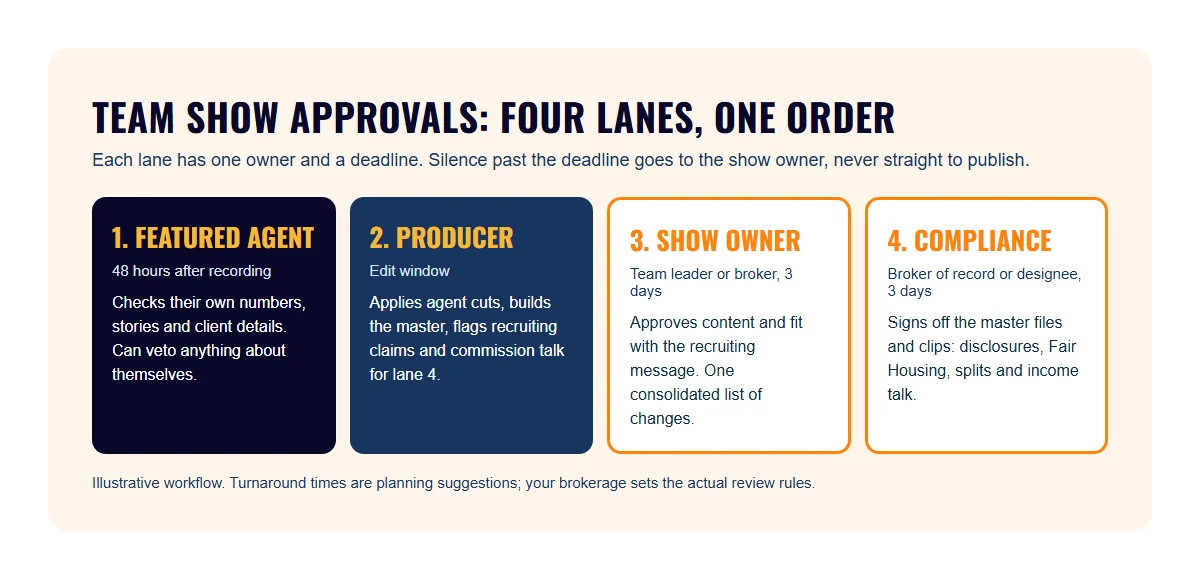
- Featured agent. Within 48 hours of recording, each agent who spoke flags anything about themselves to cut: a number, a client detail, a joke that won’t age well.
- Producer. Makes those cuts, builds the master and flags anything about recruiting claims, compensation or income for lane 4.
- Show owner. The team leader or broker approves the content and sends one consolidated list of changes.
- Compliance. The broker of record or their designee signs off the master files and every clip, because clips travel without context.
Silence is not approval. If a lane misses its deadline, the episode goes back to the show owner, who decides whether to wait or swap in a backup episode. For the single-show gates, file naming and T-minus schedule this plugs into, use the podcast production workflow SOP.
Disclosures when your agents share episodes
Your agents will post clips on their own accounts. That’s the point, but it also makes them endorsers of the team. The FTC’s endorsement guidance says employees who mention their company’s products on social media should disclose the relationship, and that listing your employer on your profile page isn’t enough. Many agents are independent contractors rather than employees, but a listener should still know the person praising the team is on it. Ask your broker how they want those posts labeled.
How do you measure whether the podcast recruits agents?
You measure it by counting recruits who name the show, not downloads. A recruiting show with a few hundred agent listeners in your market can outperform a show with thousands of listeners who will never join. You need three things: a source field, an interview question and a simple cost formula.
1. Add podcast options to your applicant source field
Whatever holds your recruiting pipeline, whether it’s a recruiting CRM, your main CRM or a spreadsheet, needs a required source field with fixed values. Suggested values:
- Podcast: listened before first contact
- Podcast: was a guest on the show
- Referral from a current agent
- Event or class
- Social media
- Job board or license list
- Other (with a note)
Add two more fields: “Episodes mentioned” (free text) and “Podcast role” with three values: Sourced, Influenced or None. “Sourced” means the show started the relationship. “Influenced” means the candidate came another way but the show helped them decide.
2. Ask an open question in every first interview
Ask before you mention the podcast, so you don’t lead the answer:
“Before we talked today, had you seen or heard anything from our team? What was it?”
If they mention the show, follow up: “Which episode or person stuck with you?” Write the answer in “Episodes mentioned.” After a few months, that field tells you which episode types recruit.
For tracking links, put a dedicated recruiting call to action in show notes, such as a short “talk to us about joining” page with its own tracking parameters. The UTM and vanity URL conventions for tagging podcast leads in a CRM work for recruits too. Just use a separate campaign value so recruits don’t mix with consumer leads.
3. Work out cost per recruited agent
Divide the show’s full yearly cost by the agents it sourced, then run it again counting influenced recruits as half.
Two cautions. First, keep consumer business from the show on a separate line; it’s a bonus, not part of this number. Second, don’t judge the show on the first quarter. Candidates often listen for months before they reach out.
What does production look like for a team show?
Team show production is a normal agent podcast plus a shared recording day, clear account roles and one budget owner.
- One recording day a month. Book a half-day, in an office podcast studio or remotely, and run every guest and bench agent through it. Agents show up for a fixed date. They don’t show up for “sometime this week.”
- Account roles, not shared passwords. Apple Podcasts Connect lets you assign roles to each user, and Apple says each person should use their own Apple Account. A sensible split: the show owner as Admin, the producer as Show Manager, and the recruiting lead as Analyst, who can view analytics. Set up the same pattern in your hosting platform and on YouTube.
- One budget owner. The team or the brokerage pays, not individual agents. Shared costs make ownership messy later.
You’ll also choose who does the production work. If you’re comparing outside help, score each vendor with this checklist for real estate podcast production companies, including how they handle several hosts and broker review. Icons’ done-for-you podcast production team notes that team and brokerage shows work well for recruiting, and one of its published success stories is headlined “How Kyle’s Podcast Led to New Agent Recruitment and More Closings.”
Next step
Before you book a single guest, write one page that answers four questions: who owns the show, who anchors it, who approves each lane, and which applicant source values you’ll track. Share it with your broker. Then plan your first recording day around the four-week rotation above.
Frequently asked questions
Should a brokerage podcast talk to consumers or agents?
Pick one. A recruiting show talks to agents. If you also want a consumer show, run it as a second feed with its own name, because mixing the two makes both weaker.
How many hosts should a team podcast have?
One anchor on every episode plus a bench of two to four rotating co-hosts works for most teams. More than that and listeners can't learn the voices.
Can we invite agents from other brokerages on the show?
Yes, and it is one of the most useful episode types. Keep the conversation about their craft, not a pitch to join you, and follow up privately afterward.
How long before a team podcast helps recruiting?
Expect it to show up first as candidates who mention an episode in interviews, usually after you have a back catalog worth sending. Track it from day one so you can see the trend instead of guessing.
Sources
- FTC's Endorsement Guides: What People Are Asking — Federal Trade Commission (accessed October 6, 2026)
- Users and access — Apple Podcasts for Creators (accessed October 6, 2026)
Done-for-you podcast production
Want a podcast that brings in referrals, not just downloads?
Icons of Real Estate plans, produces and publishes business-growing podcasts for agents. You record. We handle the rest.
Launch Your Podcast
Written by
Co-Founder and Podcast Guru, Icons of Real Estate
Tomás Fonseca co-founded Icons of Real Estate in 2021 and is its Podcast Guru. He has a background in marketing, with stints at companies like Nintendo and Ardor SEO, and is one of the hosts of the Icons of Real Estate Podcast.

How we research, write, fact-check and correct articles: our editorial standards.