On this page
- What has producing 2,000+ episodes taught ICONS about agent podcasts?
- Why should an agent’s podcast start from business goals?
- How much of an agent’s time should a podcast take?
- Why do agent podcasts need a backlog before launch?
- What makes a good guest for an agent’s show?
- Which hosting habits matter most once the microphone is on?
- What happens to an episode after the recording?
- Who should own the show when someone else produces it?
- Next step
The main lessons from producing real estate agent podcasts are practical. Start from business goals, keep the agent’s job to one conversation a week, launch with a backlog, choose guests on purpose and plan the follow-up. ICONS has produced 2,000+ episodes across 120+ agent podcasts, and its ICONS Podcast Framework writes those rules down.
What follows is the short version of those rules, each with what it means for your show. None of them needs a big budget. Most of them are habits you can copy this month, whether ICONS produces your show or you do it yourself.
What has producing 2,000+ episodes taught ICONS about agent podcasts?
Producing 2,000+ episodes has taught ICONS that agent podcasts succeed or stall on a handful of production habits, not on gear or downloads. The table sums up the lessons covered below and what each one asks of you.
| Lesson | How ICONS applies it | What it means for you |
|---|---|---|
| Start from business goals | Shows are built around goals and market, “not around a content calendar” | Decide whose call you want before you pick a show name |
| Protect the agent’s time | About an hour a week from the agent | Your job is the conversation; hand off the rest or batch it |
| Launch with a backlog | Three episodes on day one, ten ready by launch | A bad week never becomes a missed week |
| Choose guests on purpose | Four guest categories, four signals | Every booking should build a relationship you want |
| Host with simple rules | The 5 rules and a 40-minute session | Guests relax, and you get better tape |
| Follow up after the episode | 13 follow-up touchpoints | The deal comes from the relationship, not the upload |
Why should an agent’s podcast start from business goals?
An agent’s podcast should start from business goals because the show’s real return comes from the people it puts you in a room with. ICONS’ production page says it builds each show “around your business goals and your market, not around a content calendar.” The home page is blunter: “We don’t build podcasts for vanity!”
In practice, that means the first planning question is who you want to know, not what you want to talk about. A listing agent chasing move-up sellers needs a different guest list from a team leader who wants recruits. Topics follow from the guests.
Shae Spitz is the clearest proof among the ICONS client stories. During pre-launch production, before her show was public, she interviewed an agent who later became central to a development deal. Her story calls it a 330-listing opportunity. Audience size played no part.
For you: write down the three kinds of people you most want a reason to call. That’s your show’s brief.
How much of an agent’s time should a podcast take?
An agent’s podcast should take about one hour a week, and most of that hour is the conversation itself. ICONS’ production page sets the client’s time at about an hour a week, and calls that plenty. The framework describes the agent’s part as one 25-minute conversation a week, with everything else handled by the team.
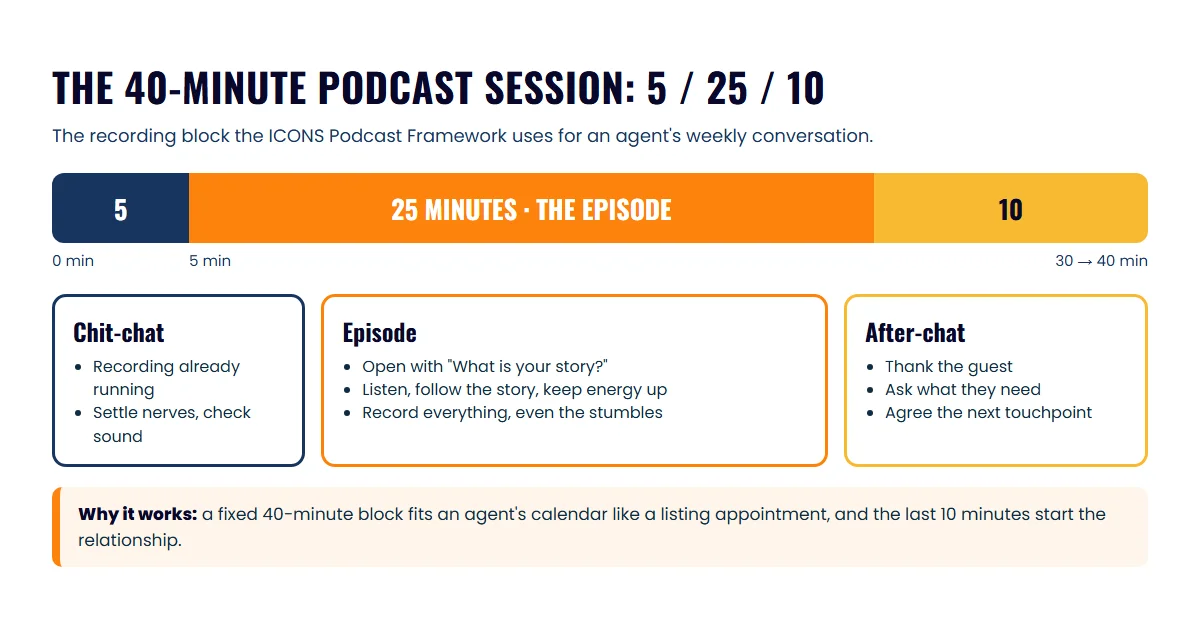
That budget holds because the session has a fixed shape. The framework calls it 5/25/10: five minutes of chit-chat, a 25-minute episode, then ten minutes of after-chat. That’s a 40-minute block you can put in your calendar like a listing appointment.
For you: block one 40-minute slot a week and treat it as fixed. If production tasks are eating more than that, the weekly time budget for a real estate podcast shows where the hours go.
Why do agent podcasts need a backlog before launch?
Agent podcasts need a backlog because most podcasts stop early, and a busy month is the usual cause. In Amplifi Media’s 2021 count, 26% of podcasts in Apple’s directory had one episode and 44% had three or fewer. Only 36% had reached ten.
The framework answers that with two rules. Release at least three episodes on launch day, so new listeners have something to binge. Have at least ten episodes ready by the launch date, so a closing-heavy month doesn’t create a gap. On the production side, podcast materials are ready two weeks before each episode airs.
Consistency is what clients notice. Michael McDonald’s show is the example on ICONS’ production page: once the team took over production, “his show has shipped reliably every Thursday since.”
For you: don’t announce a launch date until you have ten recordings. If your show has already stalled, the guide to why podcasts fail early covers the warning signs. The plan for relaunching a stalled real estate podcast covers the restart. ICONS’ production page notes that taking over an existing show “is a common start.”
What makes a good guest for an agent’s show?
A good guest for an agent’s show is someone who knows something your listeners need, can say it clearly and serves the households you serve. The framework sorts guests into four categories: industry experts, community heroes, successful clients and adjacent pros.
Before booking, it checks four signals: substance, articulation, alignment and commitment. Commitment is the easy one to skip. A guest who won’t share the episode or show up on time costs you a recording slot.
For you: keep a scored list instead of booking whoever answers first. The podcast guest list every agent should build turns the four signals into a 0–2 scoring sheet.
Which hosting habits matter most once the microphone is on?
Good hosting comes down to simple habits: be on time, record everything and open with a question that gets the guest talking. Five rules in the framework are ones you don’t break:
- Record everything.
- Be on time.
- Always have the talk.
- Don’t give up on a no-show.
- Have fun.
It pairs them with five host skills: active listening, empathy, storytelling, energy and tone, and audience engagement. For the first question, it recommends one that “unlocks everything”: “What is your story?”
The most common fix our editors make on a new host’s first recordings is length. Several first sessions ran far too long. Plan for 45 minutes to an hour and tell the guest that up front.
Our account managers and editors add a short checklist for the first few recordings:
- Set expectations before you hit record. Phones off or on silent, 45 minutes to an hour, and stay on after the interview until the Riverside upload reaches 100%. Clients who say this at the start see fewer technical problems and incomplete uploads.
- Do a 30-second test recording before the guest joins. Audio can sound fine live and still come out distorted or missing in the file.
- Don’t fear the pause. Silence, a stumble or “let me rephrase that” is easy to cut. Keep going.
- Use artificial light. Daylight changes mid-recording, and a window behind you leaves your face in shadow.
- Speak straight into the mic. No headphones? Keep the speaker volume low so your mic doesn’t pick up the guest as an echo.
- Look at the camera, not the screen. Eye contact is the one thing the editors can’t fix later.
What happens to an episode after the recording?
After the recording, an episode has two jobs: become content, and keep the relationship moving. Both take planning, and both are where many agent shows leave value on the table.
On the content side, the framework counts one episode as 7+ pieces of content, from clips to post graphics to an article. ICONS clients review and approve everything before it’s published. The guide to repurposing a real estate podcast episode shows what to make from one recording.
On the relationship side, the framework sets 13 follow-up touchpoints. The number matters less than the habit: the guest should hear from you well after the episode goes live. Start with a thank-you and the episode link the day it goes live, then plan the next reason to talk.
For you: put the guest’s next touchpoint in your CRM before you close the recording window.
Who should own the show when someone else produces it?
The agent should own the show outright, even when a producer runs it. On ICONS’ production page, the rule is that the client keeps the show, its name and artwork, the back catalog, the audience and the RSS feed: “We run it, you own it.”
Ownership matters because a podcast compounds. Episodes keep getting found in search and in podcast apps long after they’re published. If a producer holds the feed or the account, you can lose that back catalog the day you change vendors.
For you: before you sign with any producer, ask who owns the feed, the hosting account and the artwork files. The answer should be you. The questions to ask a podcast production company cover the rest of that conversation.
Next step
Pick one lesson and apply it this month: block the weekly 40-minute session, build a ten-episode backlog or score your next five guests. The full set of rules is in the free ICONS Podcast Framework. For the whole workflow, see the real estate podcast production guide. If you’d rather hand most of it off, read what a done-for-you podcast includes for agents, or see what ICONS podcast production covers.
Frequently asked questions
Is the ICONS Podcast Framework free?
Yes. The five frameworks are a free download from the ICONS Podcast Framework page, and they cover guests, hosting, launching and distribution.
Can I use these rules if I produce my own show?
Yes. Most of them are habits, not tools: a backlog before launch, a fixed session shape, scored guests and planned follow-up all work for a do-it-yourself show.
Does ICONS take over podcasts that already exist?
Yes. The production page says taking over an existing show is a common start, and the show, name, artwork, feed and audience stay yours.
Sources
- Steve Goldstein: Why there really aren't 2 million podcasts — RAIN News (accessed October 21, 2026)
Done-for-you podcast production
Want a podcast that brings in referrals, not just downloads?
Icons of Real Estate plans, produces and publishes business-growing podcasts for agents. You record. We handle the rest.
Launch Your Podcast
Written by
Co-Founder and Podcast Guru, Icons of Real Estate
Tomás Fonseca co-founded Icons of Real Estate in 2021 and is its Podcast Guru. He has a background in marketing, with stints at companies like Nintendo and Ardor SEO, and is one of the hosts of the Icons of Real Estate Podcast.
How we research, write, fact-check and correct articles: our editorial standards.