A done-for-you podcast for real estate agents is a service where a production team plans, edits, publishes and promotes your show, and you mainly record. Expect launch assets, edited episodes, clips and show notes. Your part is about one hour a week, launch takes roughly four to six weeks, and the feed should stay in your name.
Search the phrase today and you mostly get podcasts made for agents. Services that make a show with you are harder to pin down. Below: what you should receive, which jobs stay on your plate, how the launch weeks run and how to keep the show if you leave. The production workflow behind all of it lives in the real estate podcast production pillar.
What is a done-for-you podcast?
A done-for-you podcast is a show you host while a hired team handles everything around the recording. That includes strategy, branding, guest coordination, editing, publishing and promotion. You supply the voice, the local knowledge and the relationships.
It sits at the top of three service levels you’ll see on the market:
| Service level | What they do | What’s left for you |
|---|---|---|
| Editing only | Clean up the audio (sometimes video) you send them | Concept, art, guests, publishing, clips, promotion |
| Editing plus publishing | Edit, write show notes, upload to your host and YouTube | Concept, guests, clips, promotion |
| Done-for-you | Concept, art, feed setup, guest coordination, editing, publishing, clips, articles | Recording, approvals, guest follow-up, turning listeners into clients |
A lot of vendors use “done-for-you” loosely. Some mean the third row. Others mean the second row with a nicer website. The only way to know is to see the deliverables list, which is the next section.
What do you get with a done-for-you podcast service?
You get two bundles: one-time launch assets that make the show exist, and recurring per-episode work that keeps it running. Ask for both lists in writing before you pay anything.
Launch deliverables (one time)
- Show concept. A format and angle built around your market and the clients you want, not a generic interview show.
- Name and cover art. Square artwork that meets Apple and Spotify specs and still reads on a phone screen.
- Intro and outro. Audio, and video versions if you’re on YouTube. Your brokerage line belongs here.
- Hosting and RSS feed setup. The account that publishes your episodes to every app.
- Directory submission. Apple Podcasts, Spotify, YouTube and others.
- Launch kit. A trailer or first-episode clips, plus graphics for announcing the show to your sphere.
- Episode page or landing page on your own website, if the package includes it.
Per-episode deliverables (ongoing)
| Deliverable | What “good” looks like for an agent | Ask whether it’s included |
|---|---|---|
| Guest booking | Guests chosen for your farm area or referral network, not random “experts” | Who finds guests: them, you, or both? |
| Audio and video edit | Tight pacing, no dead air, levels matched between you and the guest | How many revision rounds per month? |
| Title and show notes | Local place names and the topic a buyer or seller would search | Who writes them, and do you approve? |
| Publishing | Released on schedule to your host, YouTube and your site | What is the turnaround from recording to release? |
| Short clips | Vertical clips with captions, ready to post | How many per episode? |
| Episode article | A written version for your website that can rank locally | Is it on your site or theirs? |
| Guest share kit | Clips and a link the guest can post to their own audience | Is it sent to the guest for you? |
Read the “ask” column twice. Two quotes at the same monthly price can differ by half their deliverables. The breakdown of what each monthly retainer tier should include helps you compare them line by line. To score competing quotes side by side, use the worksheet for comparing podcast production companies. For contract wording, work through the vetting questions for production companies.
What do you still do each week?
You still record, approve, and follow up with guests, and that adds up to about one hour a week for a show that releases twice a month. Nobody else can do those jobs, because they depend on your voice, your judgment and your relationships.
Here’s how that hour breaks down over a typical two-episode month. These are planning estimates, not survey data.
| Your task | Time per month | Why it can’t be handed off |
|---|---|---|
| Review the guest list and episode topics | 20 to 30 min | Only you know which relationships you want to build |
| Skim the prep notes before recording | 15 to 20 min | A prepared host makes a shorter edit and a better episode |
| Batch-record two episodes | 90 min to 2 hours | It’s your show and your voice |
| Approve edits, titles and show notes | 30 to 45 min | You’re accountable for what goes out under your name and brokerage |
| Follow up with each guest after release | 20 to 30 min | The referral relationship is where the business starts |
| Post clips and log leads in your CRM | 20 to 30 min | Your accounts, your sphere, your pipeline |
| Approx. total | 3.5 to 5 hours a month | About 1 hour a week |
The approval step is the one that slips
When a done-for-you show stalls, the team rarely misses a deadline. Far more often, an approval sits in the agent’s inbox for nine days during a busy closing week. Block a recurring 30-minute slot for approvals the same way you block a listing appointment. Icons clients approve each edit by share link in ICONS Review, with comments pinned to the exact moment, so the slot rarely needs more than the 30 minutes.
Compliance stays with you
A team can flag risky lines, but you and your broker decide what’s acceptable. Ask your broker what firm-name disclosure the show, clips and show notes need. Listen for guest comments that describe neighborhoods by who lives there. A lender offering to cover part of the production bill is a RESPA question, so get your broker’s answer before you accept.
How long does a done-for-you podcast take to launch?
Most done-for-you launches take four to six weeks from signing to the first public episode. The team’s work is predictable. What usually stretches the timeline is waiting on the agent for decisions, recordings and approvals.
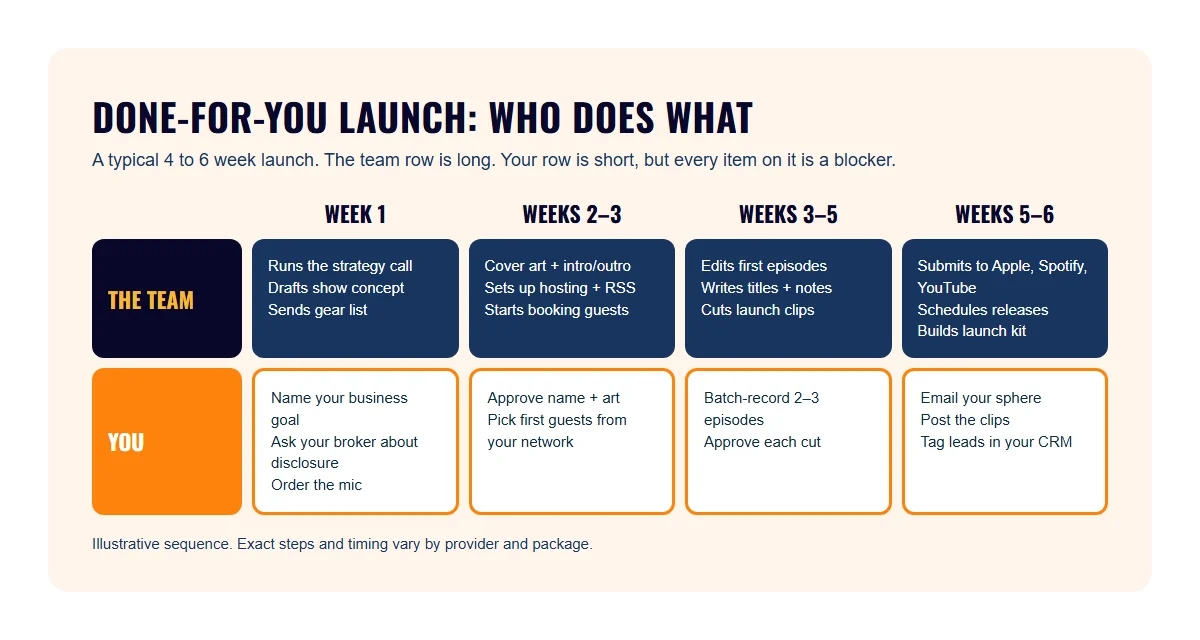
A typical sequence looks like this:
- Week 1: strategy. A discovery or strategy call sets the show’s goal, audience and format. You leave with a gear list. Ask your broker about disclosure wording this week, not the night before launch.
- Weeks 2 to 3: branding and setup. The team designs the name, cover art and intro, and sets up hosting and the RSS feed. You approve the art and suggest your first guests.
- Weeks 3 to 5: first recordings. You batch-record two or three episodes. The team edits, writes titles and show notes, and cuts clips.
- Weeks 5 to 6: publishing and launch. The show goes to Apple, Spotify and YouTube. You announce it to your sphere and start tagging replies in your CRM.
Launching with two or three episodes live gives new listeners something to binge and gives you a buffer for busy weeks. The free podcast launch checklist lists every launch step if you want to track progress against your provider’s plan.
Who owns the podcast feed in a done-for-you setup?
As the host, the real estate agent should own the podcast feed, not the production company. The RSS feed is the address every podcast app uses to find your episodes, so whoever controls the podcast hosting account controls your show. Get the show name, artwork, back catalog and feed in your name from day one.
This matters most when you leave a provider. To move a show without losing followers, Apple’s guidance on changing an RSS feed URL says to add an <itunes:new-feed-url> tag to the new feed and set a 301 redirect from the old feed. Both need to stay live for a minimum of four weeks, per Apple. That redirect has to be set up on the old hosting account. If the account belongs to your old producer, you depend on their cooperation to keep your audience.
Ownership checklist
Confirm each of these in writing before you sign:
| Item | What to confirm |
|---|---|
| Hosting account | Registered to you or your business, with your email as the owner login |
| Directory and channel logins | Your own access to Apple Podcasts Connect, Spotify and the YouTube channel |
| Brand assets | You own the show name, cover art, intro, outro and music licenses, or the licenses transfer to you |
| Files | Raw recordings and final files are delivered to you or stored where you can download them |
| Exit terms | If you cancel, the provider sets up the feed redirect and hands over all accounts within a stated time |
| Published content | Clear ownership of clips and articles already posted on your site and social accounts |
A provider who answers yes to all three without hesitating is a good sign. Hedging on any of them is a reason to keep looking.
Is a done-for-you podcast right for you?
A done-for-you podcast fits agents whose time is worth more in front of clients than in an editing app, and who will show up to record every couple of weeks. It doesn’t fit an agent who can’t commit one hour a week, because no team can produce a show its host won’t record.
Good fit:
- Producing agents and team leads whose calendars are already full
- Agents who want a consistent show for six months or more, not a one-time experiment
- Anyone with a referral network (lenders, inspectors, local businesses) to invite as guests
- Agents who would rather pay for consistency than risk a show that dies in a busy month
Probably not a fit yet:
- Agents who want to test podcasting cheaply first (try guesting or a short DIY run)
- Hobby editors who enjoy the work and have the hours for it
- Anyone who can’t name a business goal for the show yet
If you’re still weighing it up, should a realtor hire a podcast producer or DIY walks through the time-versus-fee math in detail.
For reference, Icons of Real Estate’s podcast production is built on this model: “You record. We handle everything else.” Icons quotes 4 to 6 weeks to go live and puts the client’s share of the work at about an hour a week. The same page also states that the show, name, artwork, back catalog, audience and RSS feed belong to the client. Pricing on that page: $497 one time for the Launchpad, and $621 a month to start for Ongoing Production.
Next step
Before you talk to any provider, write down three things: the business goal for your show, the first five guests from your own network, and the one-hour weekly slot you’ll protect for recording and approvals. Then ask every provider for their deliverables list and their answer to the ownership email above.
Frequently asked questions
Do I need to buy equipment for a done-for-you podcast?
Usually just a decent microphone, headphones and a quiet room. A good service will send you a specific gear list during onboarding rather than leaving you to guess.
Can a done-for-you service take over a podcast I already started?
Many can. Expect them to review your existing feed, artwork and back catalog first, and confirm the hosting account stays in your name during the handover.
Will a done-for-you podcast get me leads on its own?
No. The service makes and publishes the show. Leads come from the guests you choose, the follow-up you do and how you share episodes with your sphere.
Do I still need my broker's approval?
Ask your broker before launch. Most brokerages have advertising rules, such as a firm-name disclosure, that apply to the show, its clips and its show notes.
Sources
- Change the RSS Feed URL — Apple Podcasts for Creators (accessed October 6, 2026)
Done-for-you podcast production
Want a podcast that brings in referrals, not just downloads?
Icons of Real Estate plans, produces and publishes business-growing podcasts for agents. You record. We handle the rest.
Launch Your Podcast
Written by
Co-Founder and Podcast Guru, Icons of Real Estate
Tomás Fonseca co-founded Icons of Real Estate in 2021 and is its Podcast Guru. He has a background in marketing, with stints at companies like Nintendo and Ardor SEO, and is one of the hosts of the Icons of Real Estate Podcast.

How we research, write, fact-check and correct articles: our editorial standards.