On this page
- What is a podcast pre-interview, and does every guest need one?
- What should a realtor host research before the pre-interview call?
- What should you ask on a pre-interview call?
- How do you find the stories worth recording?
- Which compliance points belong in the pre-interview?
- When should you not book the guest?
- The full pre-interview checklist for realtor hosts
A podcast pre-interview checklist for realtor hosts covers three jobs before you record. Research the guest for 15 minutes. Hold a 20-minute pre interview call to find their best stories and agree the angle. Then decide whether to book them at all. Hosts who skip it record polite, forgettable episodes.
The pre-interview sits between the yes and the logistics. Sending the brief, the calendar invite and the reminders is covered in how to prepare a podcast guest before recording. This page is the conversation that tells you what to put in that brief.
What is a podcast pre-interview, and does every guest need one?
A podcast pre-interview is a short call, usually 15 to 20 minutes, held a week or two before recording. You check that the guest can tell a story, find the two or three stories worth recording and agree what the episode is about.
Not every guest needs a call. A past client or a lender you have known for years can go straight to the brief. Book a pre-interview when any of these is true:
- A new voice. You have never heard the guest speak, on a podcast, a video or a stage.
- A future partner. The guest could become a referral partner, so the relationship matters more than the episode.
- A sensitive topic. It touches money, lending, neighbourhoods or anything else your broker would want to see.
- A booking you didn’t make. Someone else found and booked the guest for you.
What should a realtor host research before the pre-interview call?
Research a guest for about 15 minutes before the pre-interview call. You are looking for a story to ask about, a reason they fit your listeners, and anything that would embarrass either of you on air.
- Their website and bio. What they do, who they serve, and the words they use for it.
- Their reviews. Google reviews often name the problem clients hire them for. That problem is usually your episode.
- Past interviews. Search their name with “podcast” or “interview.” Note the stories they have told before so you can ask for a new one.
- Their social feeds. Skim the last month. Look for a recent win or opinion you can open with.
- Client overlap. Ask yourself who they serve that you also want to meet: sellers, first-time buyers, relocations, estates.
- Red flags. Public complaints, licence issues or a habit of talking about neighbourhoods by who lives there.
Write what you find as three lines in your notes: one story to ask about, one listener problem they solve, one question you still have. That’s the call plan.
What should you ask on a pre-interview call?
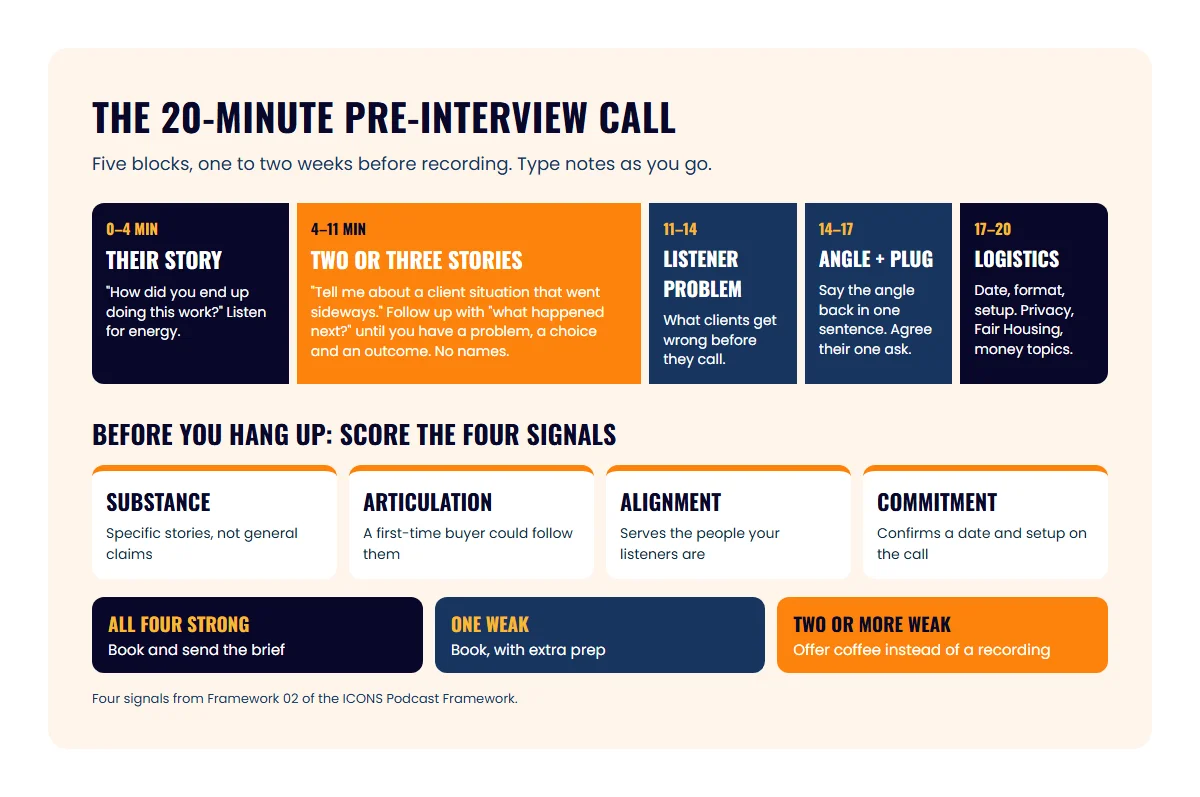
Ask questions on a pre-interview call that pull out stories with details, then agree the angle and logistics. A 20-minute call has room for five parts if you keep the small talk short.
- Their story (4 minutes). “How did you end up doing this work?” Let them talk. You’re listening for energy and a clear beginning, middle and end.
- Two or three stories (7 minutes). “Tell me about a client situation that went sideways and how you fixed it.” Ask for the details: what happened, what it cost, what they did next.
- The listener problem (3 minutes). “What do your clients get wrong before they call you?” This becomes the episode’s promise.
- The angle and the plug (3 minutes). Say the angle back in one sentence and ask if it’s right. Agree the one thing they want listeners to do.
- Logistics and no-go topics (3 minutes). Recording date, video or audio, and anything they would rather not discuss.
The interview question generator builds a question list from the guest’s role and your market. Use it after the call, once you know which stories you’re chasing.
How do you find the stories worth recording?
The stories worth recording are specific, have a turn in the middle and end with something a listener can use. You find them on the pre-interview by asking a follow-up every time the guest says something general.
General answers sound like “we always put the client first.” So follow up with a question about a real moment, such as when that promise last cost them something. Keep asking “what happened next?” until you have a name-free, date-free story with a problem, a choice and an outcome.
Follow-ups also make the guest like you more. A 2017 study summarised by the Association for Psychological Science found that people who asked more questions were better liked, and that follow-up questions were particularly likely to increase liking. That’s useful when the guest is a future referral partner.
Write down the best two stories in the guest’s own words. On recording day, ask for them by name: “Tell the story about the inspection on the farmhouse.” Guests relax when they know a good answer is coming.
Which compliance points belong in the pre-interview?
Compliance points belong in the pre-interview because a guest who hears them on the call has a week to think about them. Covering them five minutes before recording is too late for most guests to change how they tell a story.
Brief three things in plain words:
- Client privacy. No client names, addresses or details that identify a family. The stories still work without them.
- Fair Housing. Talk about homes, streets, parks and commutes. Leave residents out of it. The Fair Housing Act protects race, color, national origin, religion, sex, familial status and disability, as HUD’s overview lists them. “Great for young families” describes familial status.
- Money and lending. Lenders keep rates and terms general. Anyone who wants to pay you, sponsor the show or swap referrals gets referred to your broker first.
The Fair Housing rules for realtors on a podcast include wording you can paste into the brief. You can also run your notes or a draft description through the Fair Housing checker. Neither replaces your broker’s review, and this page isn’t legal advice.
When should you not book the guest?
Don’t book a guest when the pre-interview shows two or more weak signals. Framework 02 of the ICONS Podcast Framework names four signals to confirm before a guest is booked: substance, articulation, alignment and commitment.
Here is how each signal shows up on a pre-interview call:
| Signal | What a strong guest does on the call | What a weak signal sounds like |
|---|---|---|
| Substance | Tells a specific story with a problem, a choice and an outcome | Only general claims, no examples even after a follow-up |
| Articulation | Explains their work so a first-time buyer would follow it | Jargon, long pauses, or answers that never land |
| Alignment | Serves people your listeners are, or will be | Serves a market your clients never touch |
| Commitment | Confirms a date and the tech on the call | “Let me check and get back to you” on every point |
One weak signal is fixable. A quiet guest with great stories needs more prep, not a cancellation. Two weak signals usually mean a flat episode. Thank them, keep the relationship, and offer a coffee instead of a recording. The agent-to-agent referral episode guide has extra vetting steps for agents in other markets.
The full pre-interview checklist for realtor hosts
The full pre-interview checklist below runs from the moment a guest says yes to the brief you send afterwards. Copy it into your notes app or project tool and reuse it for every guest.
Before the call
- Book a 20-minute call one to two weeks before recording
- Read their website, bio and Google reviews
- Find one past interview and note the stories they already told
- Note the clients you share and one red flag check
- Write three lines: a story to ask about, the listener problem, one open question
On the call
- Ask for their story and listen for energy
- Get two or three stories with details, using follow-ups
- Name the listener problem in their words
- Say the angle back in one sentence and agree it
- Agree their plug and any topics to avoid
- Brief client privacy, Fair Housing and money topics
- Confirm the date, the format and their setup
After the call
- Score the four signals and decide: book, prep more, or coffee instead
- Write the two best stories in the guest’s words
- Send the brief and invite, using the guest prep templates
Once the call is done, the episode is half built. The three questions every real estate podcast host should ask cover the recording itself. And because the guest will judge the whole experience, see what podcast guests want in return for an interview.
If you’d rather spend your hour on the conversation and hand off the rest, ICONS podcast production includes guest booking and scheduling. The real estate podcast production guide shows where the pre-interview fits in the full workflow.
Frequently asked questions
Should I record the pre-interview call?
Only with the guest's permission, and only for your notes. Never publish it. Most hosts just type notes during the call, which is enough to write the angle and the first three questions.
Can an assistant or producer run the pre-interview?
Yes, as long as they hand you the notes before you record. You still need the stories, the angle and any no-go topics in front of you on the day.
How long before recording should the pre-interview happen?
One to two weeks before works well. The stories are still fresh for the guest, and you have time to send a brief built from what you heard.
Sources
- Housing Discrimination Under the Fair Housing Act — U.S. Department of Housing and Urban Development (accessed October 21, 2026)
- Asking Questions Increases Likability — Association for Psychological Science (accessed October 21, 2026)
Done-for-you podcast production
Want a podcast that brings in referrals, not just downloads?
Icons of Real Estate plans, produces and publishes business-growing podcasts for agents. You record. We handle the rest.
Launch Your Podcast
Written by
Co-Founder and Podcast Guru, Icons of Real Estate
Tomás Fonseca co-founded Icons of Real Estate in 2021 and is its Podcast Guru. He has a background in marketing, with stints at companies like Nintendo and Ardor SEO, and is one of the hosts of the Icons of Real Estate Podcast.

How we research, write, fact-check and correct articles: our editorial standards.