On this page
- What should you ask a guest when they say yes?
- How do you write a podcast guest brief?
- Which reminders reduce no-shows?
- What should you tell a real estate guest not to say?
- What happens in the first five minutes of the recording?
- What do you do when a guest cancels or doesn’t show?
- The guest preparation timeline
Prepare a podcast guest in three moves: collect their details and topics when they say yes, send a one-page brief a week before recording that covers the angle, three questions and the tech checklist, and send a calendar invite plus an email reminder the day before. Guests who know what is coming show up on time and talk well.
Everything here sits between two other jobs. Getting the yes is covered in how to book your first ten guests, and what to ask on air is in the interview questions by guest type. This page is the week in between.
What should you ask a guest when they say yes?
Ask a guest for seven things the moment they agree, while they’re still enthusiastic and the email thread is open. Chasing the same details the night before recording is how intros get fumbled and headshots arrive as tiny, blurry crops.
- Name as it should appear on screen and in show notes, with pronunciation if there’s any doubt
- Title and company, written the way they want it said
- A headshot (any phone photo against a plain wall will do) and a two-sentence bio
- Website and one social profile for the show notes
- Two topics they’d like to cover and one they’d rather avoid
- How they’d like to be introduced, and what they’d like listeners to do afterwards
- A signed release, using the podcast guest release form
Put the seven questions in a form or a single email. One message, one reply. A guest who hasn’t answered a week before recording is your first sign they may not turn up, so nudge once rather than hope.
How do you write a podcast guest brief?
A podcast guest brief is a one-page document that tells a guest what the episode is about, how it will run, what you’ll ask first and what they need on their side. Write it once as a template, then change five lines per guest.
Keep it to six parts, in this order:
- The show in one line. Who listens and what the show does for them, so a home inspector knows he’s talking to first-time buyers, not other inspectors.
- The episode angle. One sentence: “We’ll talk about what buyers miss on inspection day, and what a seller should fix before listing.”
- Format and timing. Recorded on video, 25 minutes, lightly edited, released in roughly three weeks. Say whether they can ask for cuts.
- Three questions you’ll open with. Enough to spark stories, not enough to rehearse.
- What to keep out. The compliance lines in the next section, written plainly.
- Tech and logistics. Join link, time with time zone, the five-point tech checklist, and a line about what happens after the episode goes live.
The tech lines are a compressed version of the five-point recording checklist.
Which reminders reduce no-shows?
The reminders that reduce no-shows are a calendar invite sent at booking, an email with the brief a week before, and a short personal email the day before with the join link at the top. Three touches, all from you, no extra tools.
Don’t rely on the calendar invite alone. In Google Calendar, event notifications are a personal setting for each account: your own reminders don’t change what your guest receives, and a busy professional may have them switched off. The invite holds the slot; the emails do the reminding.
- At booking: send a calendar invite for the recording slot with the join link in the location field and the description. Ask for an accept.
- Seven days before: email the guest brief. Ask one question that needs a reply, such as “Is this angle right?” A reply confirms they’ve read it.
- One day before: a three-line email. Time with time zone, join link, “reply if anything’s changed.” Add a line asking them to join a test meeting if your platform offers one, so a mic problem shows up today rather than tomorrow.
- On the day: nothing new. Be in the room ten minutes early with the link open, and resend it if they’re five minutes late.
Pick one weekday for recordings and hold it. Guests remember “I record on Thursdays at 10” better than a floating slot.
What should you tell a real estate guest not to say?
Tell every real estate guest, in writing, to keep three things out of the recording: client names and addresses, descriptions of who lives in a neighbourhood, and specific lending terms. Most guests have no idea these matter, and the ones who do appreciate being told.
The second one is Fair Housing. The Fair Housing Act prohibits discrimination in housing because of race, color, national origin, religion, sex, familial status or disability, as HUD’s overview lists them. An unscripted guest who says a neighbourhood is “great for young families” or “where the retirees are” has just described residents by familial status or age on your show. Brief them to talk about parks, commute times and housing stock instead, and tell them you’ll cut anything that strays. The Fair Housing checklist for podcast episodes gives you the wording to send.
For lenders and other settlement-service guests, keep the conversation educational and check any co-marketing or payment arrangement with your broker before you book. This page isn’t legal advice; your broker’s policy and a compliance review come first.
What happens in the first five minutes of the recording?
The first five minutes of a recording are a sound check and a settling-in chat, not the interview. Join early, greet the guest, and run through four things before you press record.
- Confirm the name, title and pronunciation. Say it back to them.
- Check their audio and video against the checklist: mic close, window in front, camera at eye level. Fix what you can in a minute and let the rest go.
- Tell them the first question again and that you’ll edit, so a stumble costs nothing.
- Remind them of the three things to keep out. One sentence, lightly: “Places, not people, and no client names.”
Then start recording while the small talk is still warm.
What do you do when a guest cancels or doesn’t show?
When a guest cancels or doesn’t show, offer one reschedule and record something else in the slot. The slot is already blocked on your calendar, and the release date is already promised to your listeners.
Keep a solo episode planned for exactly this: a market update, a listener question or a listing story. The solo versus interview format comparison has formats that take 20 minutes to record without a guest. If a guest no-shows twice, thank them and move on; your launch plan for a real estate podcast depends on a schedule, not on any one guest.
Hosts who run their own show can keep the intake answers, brief and release in one place. ICONS DIY, the do-it-yourself podcast workspace from ICONS, has five team roles (Owner, Co-host, Editor, Assistant and Reviewer), so an assistant who handles guest prep works from their own sign-in rather than yours.
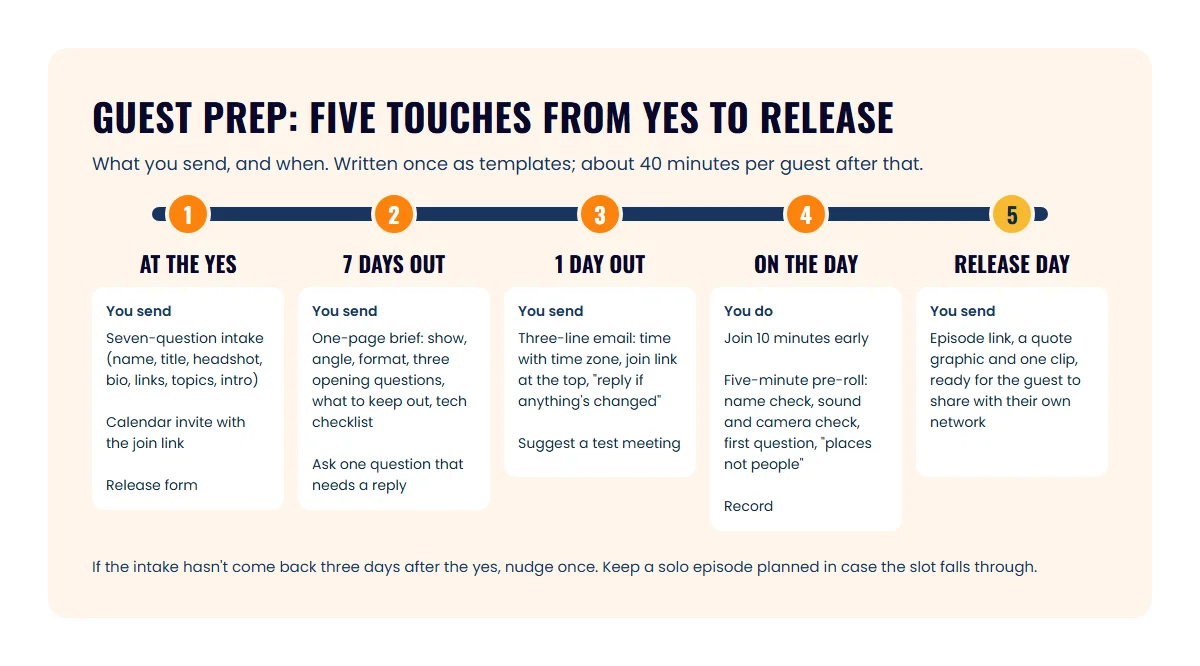
The guest preparation timeline
The whole process takes about 40 minutes of your time per guest once the templates exist, spread across three weeks.
- At the yes: send the seven-question intake and the calendar invite with the join link. Send the release form.
- Within three days: check the intake came back. Nudge once if not.
- Seven days before: send the brief, with one question that needs a reply.
- One day before: send the three-line reminder with the link at the top.
- On the day: join ten minutes early, run the five-minute pre-roll, record.
- The day it goes live: send the guest the link, a quote graphic and a clip to share with their own network.
Write the intake, brief and reminder once this week, save them as templates, and the next guest takes a quarter of the time.
Frequently asked questions
Should I send guests the questions in advance?
Send three, not the full list. Three questions let a guest think about stories without rehearsing answers, which keeps the conversation natural. Keep the rest for the recording.
Do I need a pre-interview call?
Not for most local guests. A one-page brief and a five-minute chat before you hit record cover the same ground. Book a 15-minute call only for a nervous guest or a sensitive topic.
How far ahead should I book a guest?
Two to four weeks works for busy local professionals. Closer than a week and the brief and reminders have no room to do their job; further than six weeks and people forget they agreed.
What if a guest wants to promote their business?
Agree the plug in advance: one mention of their business and how to reach them, placed near the end. Put it in the brief so there's no negotiation on the day.
Sources
- Change your event notifications — Google Calendar Help (accessed October 9, 2026)
- Join Meeting Test — Zoom (accessed October 9, 2026)
- Housing Discrimination Under the Fair Housing Act — U.S. Department of Housing and Urban Development (accessed October 9, 2026)
Done-for-you podcast production
Want a podcast that brings in referrals, not just downloads?
Icons of Real Estate plans, produces and publishes business-growing podcasts for agents. You record. We handle the rest.
Launch Your Podcast
Written by
Co-Founder and Podcast Guru, Icons of Real Estate
Tomás Fonseca co-founded Icons of Real Estate in 2021 and is its Podcast Guru. He has a background in marketing, with stints at companies like Nintendo and Ardor SEO, and is one of the hosts of the Icons of Real Estate Podcast.

How we research, write, fact-check and correct articles: our editorial standards.