On this page
- What changed about commissions in August 2024?
- Can you legally talk about commissions on a podcast?
- Which commission topics are safe, and which aren’t?
- Why is an agent roundtable about rates the riskiest episode?
- What should you say instead?
- What if a guest says something risky about commissions?
- How do clips, captions and show notes change the risk?
- Pre-publish checklist for commission episodes
- Next step
Yes, real estate agents can talk about commissions on a podcast. Since the NAR practice changes took effect on August 17, 2024, explaining how agent pay works is low-risk content. The trouble starts when you call a rate “standard,” agree on rates with other agents on air, call your service “free,” or describe your own fees without your broker’s sign-off.
Buyers and sellers are confused about who pays whom, and a clear episode on it can do more for your reputation than another market update. You can make that episode without creating a problem for yourself or your brokerage. Treat what follows as a producer’s working rules, not legal advice; your broker, your state and your MLS get the final say.
What changed about commissions in August 2024?
Two practice changes from NAR’s settlement took effect on August 17, 2024, and they’re the facts your episode should rest on. According to the NAR settlement FAQs:
- No offers of compensation in the MLS. Listing brokers can no longer post offers to pay buyer brokers in the MLS. Offers can still be made off-MLS, and sellers can still offer buyer concessions in the MLS, for example toward closing costs.
- Written buyer agreements before touring. MLS participants working with buyers must have a written agreement with the buyer before touring a home.
NAR’s consumer guide to written buyer agreements adds the detail buyers care about most. The agreement’s compensation “must be clearly defined (e.g., $0, X flat fee, X percent, X hourly rate)” and not open-ended or a range. The FAQ also says a buyer’s broker can’t receive more from any source than the amount or rate agreed in that buyer agreement.
One line runs through all of it. Listing agreements, buyer agreements and related disclosure forms must state that broker commissions are not set by law and are fully negotiable. That sentence is your safest talking point, because it’s the official position and it’s true everywhere.
Can you legally talk about commissions on a podcast?
Yes, real estate agents can legally talk about commissions on a podcast, because no rule stops an agent from discussing commissions in public. NAR’s FAQ goes further: asked whether a broker can tell a potential buyer the amount of broker commissions and who is paying, the answer is “Yes. In fact, REALTORS® must provide this information to potential buyers under NAR’s Code of Ethics.”
On a podcast, the risk comes from three other places:
- Antitrust law. Talk among competing agents that sounds like setting or holding rates together.
- Honesty rules. Statements that are misleading, like “free” service or claims about other agents’ fees.
- Advertising rules. Your episode is marketing, so your brokerage’s advertising policy and your state’s rules apply to anything you say about your own pricing.
If you host, your show should already be approved by your broker. If not, start with the guide to getting broker approval for a podcast, and mention that you plan to cover commissions.
Which commission topics are safe, and which aren’t?
Explaining the commission rules on air is safe, your own terms need a broker check first, and talk about what agents in general charge, or should charge, belongs off air.
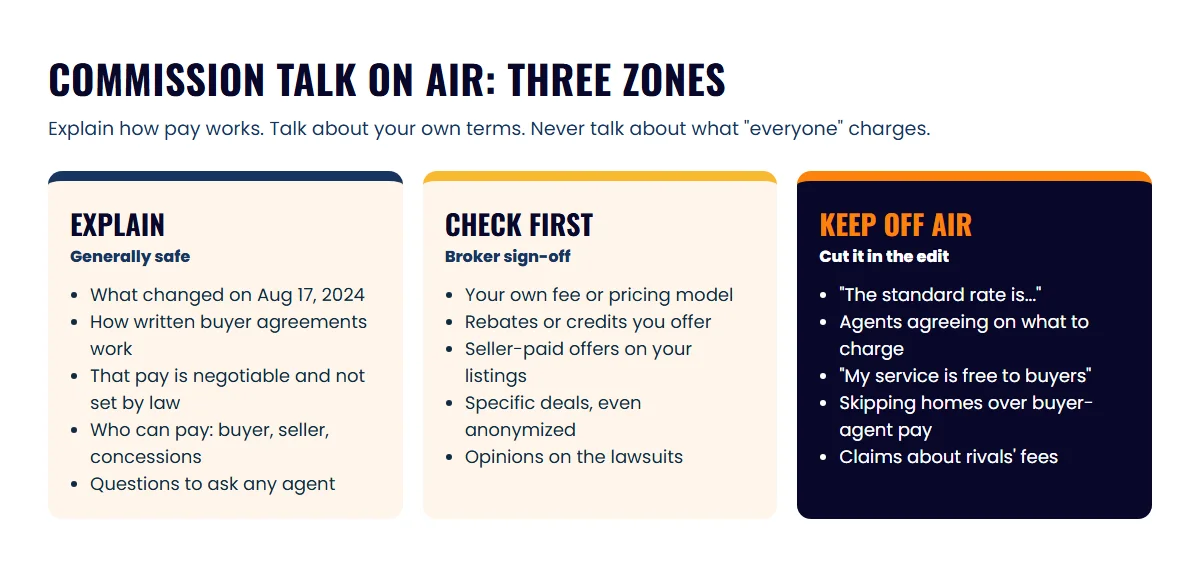
| Topic | Zone | Why | Safer way to say it |
|---|---|---|---|
| What changed on August 17, 2024 | Explain | Public facts with an official source | “Here’s what changed, straight from NAR’s FAQ.” |
| How a written buyer agreement works | Explain | Helps buyers ask better questions | “The agreement has to spell out the amount or rate. Read that line.” |
| Who can pay the buyer’s agent | Explain | Buyer, seller or concessions are all on the table | “You can ask the seller to cover some or all of it as part of your offer.” |
| Your own fee or pricing model | Check first | It’s advertising; it must be accurate and approved | “My fee is in my buyer agreement, and it’s negotiable.” |
| Rebates or credits you offer | Check first | Rules on inducements vary, and your broker must sign off | Clear it with your broker before you mention it at all. |
| “The standard commission is X%” | Keep off air | There’s no standard rate, and it can sound like price signaling | “Fees vary by agent and by deal. Ask each agent you interview.” |
| Agents agreeing on what to charge | Keep off air | Competitors discussing rates is antitrust territory | Stick to how the rules work, not what anyone should charge. |
| “My service is free to buyers” | Keep off air | Misleading if you’re paid from any source | “The seller may pay my fee, but it’s set out in our agreement.” |
| “We skip homes that don’t pay agents” | Keep off air | Steering based on pay is prohibited under the Code | “I show you every home that fits what you want.” |
Why is an agent roundtable about rates the riskiest episode?
An agent roundtable about rates is the riskiest episode because it puts competitors in a room talking about prices, the exact situation antitrust law watches. The FTC describes price fixing as an agreement among competitors to raise, lower, maintain or stabilize prices, and says it can be “written, verbal, or inferred from conduct” (FTC on price fixing).
No one on your panel has to sign anything. The FTC lists present or future prices, pricing policies and discounts as topics that can draw scrutiny when competitors discuss them. It also warns that a public invitation to coordinate, such as one competitor announcing it will raise prices if rivals do the same, can raise concerns. A recorded, published conversation is about the worst place to sound like that.
Lines that drift into this zone tend to sound harmless in the moment:
- “None of us should be going below X.”
- “If we all held the line, buyers would just have to accept it.”
- “Agents in this town are all at about the same rate anyway.”
Keep panels to how the rules work and how you each explain them to clients. Brief every agent guest beforehand, and if one of these lines slips through, cut it.
What should you say instead?
Swap opinions about what agents charge for explanations of how pay works and how to negotiate it. The rewrites below keep the useful part and drop the risk.
| Instead of this | Say this |
|---|---|
| “The normal commission around here is X%.” | “There’s no set rate. Fees are negotiable and vary by agent and by deal.” |
| “Buyers don’t pay anything, the seller covers it.” | “The seller may agree to pay your agent, but your agreement says what your agent gets, and you’re responsible for anything not covered.” |
| “My services are free for buyers.” | “Let’s walk through exactly how I get paid and who pays it.” |
| “Discount agents give you worse service.” | “Ask every agent what’s included for their fee and compare.” |
| “Listings that don’t offer compensation are a waste of time.” | “If a seller isn’t offering to pay your agent, you can ask for it in your offer.” |
That “free” line matters more than it sounds. Standard of Practice 12-1 of the REALTOR® Code of Ethics says members must not say their brokerage services are free “unless the REALTOR® will receive no financial compensation from any source for those services.” If the seller pays you at closing, your service isn’t free.
Row four matters too. Article 15 bars knowingly or recklessly making false or misleading statements about other real estate professionals and their business practices. Comparing models is fine. Running down a named competitor’s fees isn’t.
Here’s a segment you can read nearly word for word. Fill the brackets and run it past your broker once, then reuse it.
Note what the script leaves out: no percentages, no “most agents charge,” no claim about what’s typical in your market. If you want a worked number, use one that’s clearly a made-up example: “Say an agreement sets a flat fee of $8,000. That’s the most the agent can receive, whoever pays it.”
What if a guest says something risky about commissions?
Cut a risky guest line about commissions in the edit, because you’re the publisher and what goes out on your feed is on you. Standard of Practice 15-2 says the duty to avoid false or misleading statements about other professionals includes not knowingly or recklessly republishing statements made by others. Airing a guest’s claim about a rival’s fees counts.
Prevention is easier than editing:
- Brief the guest. Send a short note before recording: “We’ll explain how commissions work. Please don’t quote typical rates or talk about what other agents charge.”
- Steer live. If a guest heads that way, redirect: “Let’s keep it to how buyers can negotiate.” It’s easier to cut a clean redirect than a long tangent.
- Review the transcript. Search it for “standard,” “normal,” “free,” “everyone charges” and “percent” before you publish.
- Get edit rights in writing. Your podcast guest release form should give you the right to edit the interview.
This habit also protects you on Fair Housing. The Fair Housing checklist for podcast hosts uses a similar brief-steer-review routine for neighborhood talk.
How do clips, captions and show notes change the risk?
Clips strip out context, so each one needs to stand on its own. A 30-second cut of “the seller pays my fee” without the next sentence about the agreement can read as misleading. A clip is marketing, and Article 12 of the Code holds REALTOR® marketing to a “true picture” standard.
- Check each clip alone. If it only makes sense with the sentence before or after, recut it or skip it.
- Date-stamp commission episodes. Say the recording month in the audio and put it in the show notes. Rules and your own fees can change; the audio won’t.
- Put numbers in show notes, not audio. If you mention your own fee, keep the current figure in text you can update.
- Watch titles and thumbnails. “Buyers pay nothing!” is a headline that fails the true-picture test on its own.
If you mention a specific listing’s seller-paid offer, that’s listing advertising too. The guide to talking about listings on a podcast covers seller consent and accuracy.
Pre-publish checklist for commission episodes
Run this list on any episode, clip or show note that touches commissions. It slots into the review step of a full real estate podcast production process.
- Broker has approved any mention of your own fees, rebates or credits.
- Every fact about the 2024 changes matches NAR’s FAQ or consumer guide.
- Neither you nor a guest states a “standard,” “normal” or “typical” rate.
- No agents discuss what they or others should charge.
- Nothing calls your services “free” if you’re paid from any source.
- Claims about named competitors’ fees or service are cut.
- Nothing suggests that you’d skip homes based on what the seller pays agents.
- The recording month is said on air and shown in the show notes.
- Each clip makes sense on its own, without the surrounding context.
- Firm name and the “general information, not legal advice” line are in the audio and the notes.
- Any lender or partner talk about concessions has been reviewed for RESPA by your broker or compliance team.
Working with an outside team? Hand them this list along with your brief, and ask about it when you compare production companies. A good editor catches the “everyone charges” line in the first pass. That’s part of what done-for-you podcast production for agents should include.
Next step
Record the 90-second explainer above as a standalone episode or a recurring segment, then run it through the checklist. It answers the question buyers ask you most, it’s built on NAR’s own wording, and it shows listeners you’ll explain your pay plainly. For more episode ideas around buyer questions, try the free interview question generator.
Frequently asked questions
Can I say what I charge on my podcast?
Usually yes, if your broker approves it and the number is accurate. Say it as your own fee, note that it's negotiable, and keep the current figure in your show notes rather than baking it into evergreen audio.
Can I interview a real estate attorney about the settlement?
Yes, and it's often the cleanest way to cover the legal side. Ask the attorney to explain the rules in general terms and to avoid advising listeners on their own situations.
Should I delete old episodes that mention offers of compensation in the MLS?
Review them. If an episode describes the old system as current practice, add a dated note to the show notes or pull the segment. Ask your broker how they want older marketing handled.
Can a lender guest talk about seller concessions on my show?
General explanations of how concessions work are fine. Anything that looks like a joint offer, referral arrangement or paid feature with a lender should go past your broker or compliance team first because of RESPA.
Sources
- NAR Settlement FAQs — National Association of REALTORS® (accessed October 6, 2026)
- Consumer Guide: Written Buyer Agreements — National Association of REALTORS® (accessed October 6, 2026)
- 2026 Code of Ethics & Standards of Practice — National Association of REALTORS® (accessed October 6, 2026)
- Price Fixing — Federal Trade Commission (accessed October 6, 2026)
Done-for-you podcast production
Want a podcast that brings in referrals, not just downloads?
Icons of Real Estate plans, produces and publishes business-growing podcasts for agents. You record. We handle the rest.
Launch Your Podcast
Written by
Co-Founder and Podcast Guru, Icons of Real Estate
Tomás Fonseca co-founded Icons of Real Estate in 2021 and is its Podcast Guru. He has a background in marketing, with stints at companies like Nintendo and Ardor SEO, and is one of the hosts of the Icons of Real Estate Podcast.

How we research, write, fact-check and correct articles: our editorial standards.