On this page
- Why does a podcast mention count as advertising the listing?
- Does mentioning a listing on a podcast trigger Clear Cooperation?
- Which property mentions are safe, and which need care?
- What do you need from the seller before the episode?
- How do you keep a listing episode accurate after it publishes?
- What Fair Housing rules apply to describing a listing out loud?
- What about a guest who pitches their own listing?
- Pre-publish checklist for listing episodes
- Next step
Yes, you can talk about your listings on a podcast, but every mention counts as advertising that property. You need the seller’s written permission, a price that matches the listing agreement, your firm name, and property-only language. If the home isn’t in the MLS yet, keep it off air: a public episode can trigger your MLS’s Clear Cooperation deadline.
Generic podcast advice skips this because it’s written for business owners, not licensees. A listing mention brings four sets of rules into the studio at once: your seller’s authority, your MLS, your duty of confidentiality and Fair Housing. Each one applies to audio and video a little differently. Where your broker, MLS or state rules say otherwise, they win.
Why does a podcast mention count as advertising the listing?
A podcast mention counts as advertising because you’re presenting a specific property to the public to help sell it. Format doesn’t change that. A 30-second walkthrough on YouTube and a chat about “my new listing on Elm Street” both do the same job as a flyer.
If you’re a REALTOR®, the NAR Code of Ethics sets the baseline. Article 12 holds members to a “true picture” in everything they advertise. Under Standard of Practice 12-4, you need authority to advertise a property, and any listing price you state has to be the one the seller agreed to. Standard of Practice 12-5 adds the firm-name rule, and a podcast is just another medium.
Approval for the show as a whole, firm-name wording included, is a separate step: what your broker needs to sign off on a podcast. Everything below assumes the show is approved and looks only at the property.
Does mentioning a listing on a podcast trigger Clear Cooperation?
Mentioning a listing on a public podcast can trigger Clear Cooperation if your MLS follows NAR’s policy and treats the episode as public marketing. Under NAR’s MLS Clear Cooperation Policy, the listing broker must submit a property to the MLS within one business day of marketing it to the public. The policy’s examples of public marketing include yard signs, email blasts and “digital marketing on public facing websites.” An episode on Apple Podcasts, Spotify or YouTube looks a lot like that last one. Assume it counts unless your MLS tells you otherwise.
The rules got more detailed in 2025. NAR’s Multiple Listing Options for Sellers policy, effective March 25, 2025, with MLSs given until September 30, 2025 to adopt it, added two seller choices:
- Delayed marketing: the listing is filed with the MLS, but public marketing through IDX and syndication is held back for a period your local MLS sets.
- Office exclusive: the listing isn’t disseminated through the MLS or publicly marketed at all.
Both require a signed seller certification. NAR also clarified that one-to-one conversations between brokers don’t trigger Clear Cooperation, but communications about a listing across multiple brokerages do.
Here’s what that means for your show:
- No “pocket listing” teasers. “I’ve got something off-market in the Hills, DM me” on a public episode can be public marketing.
- Delayed-marketing listings stay off air until the delay ends, unless your MLS says a podcast is allowed during that window.
- Agent-only shows aren’t a loophole. A show for other agents, or a private feed shared across brokerages, can still be a multi-brokerage communication.
- Ask your MLS, in writing, how it treats podcasts and YouTube. Rules vary by MLS, and some don’t follow NAR policy at all.
Which property mentions are safe, and which need care?
Active MLS listings with written seller consent are the safest to discuss. Off-market properties and other agents’ listings carry the most risk. Use this table before you book a listing segment.
| Type of mention | Risk level | What to do |
|---|---|---|
| Your active MLS listing, seller consent in writing | Low | Name your firm, link the live listing, describe the property only |
| Your coming-soon or delayed-marketing listing | High | Keep it off air until your MLS and broker confirm it’s cleared |
| Office exclusive or “off-market” property | High | Don’t mention it on a public episode |
| A sale your brokerage closed | Low to medium | Get client consent to name or describe it; keep negotiation details private |
| A sale you weren’t part of | Medium | Discuss it as market data only; don’t imply you sold it (SoP 12-7) |
| A guest agent’s listing | Medium | Guest confirms seller authority and names their own firm |
| An interview with your seller | Medium | Release form, prep call, and a hard edit for private details |
What do you need from the seller before the episode?
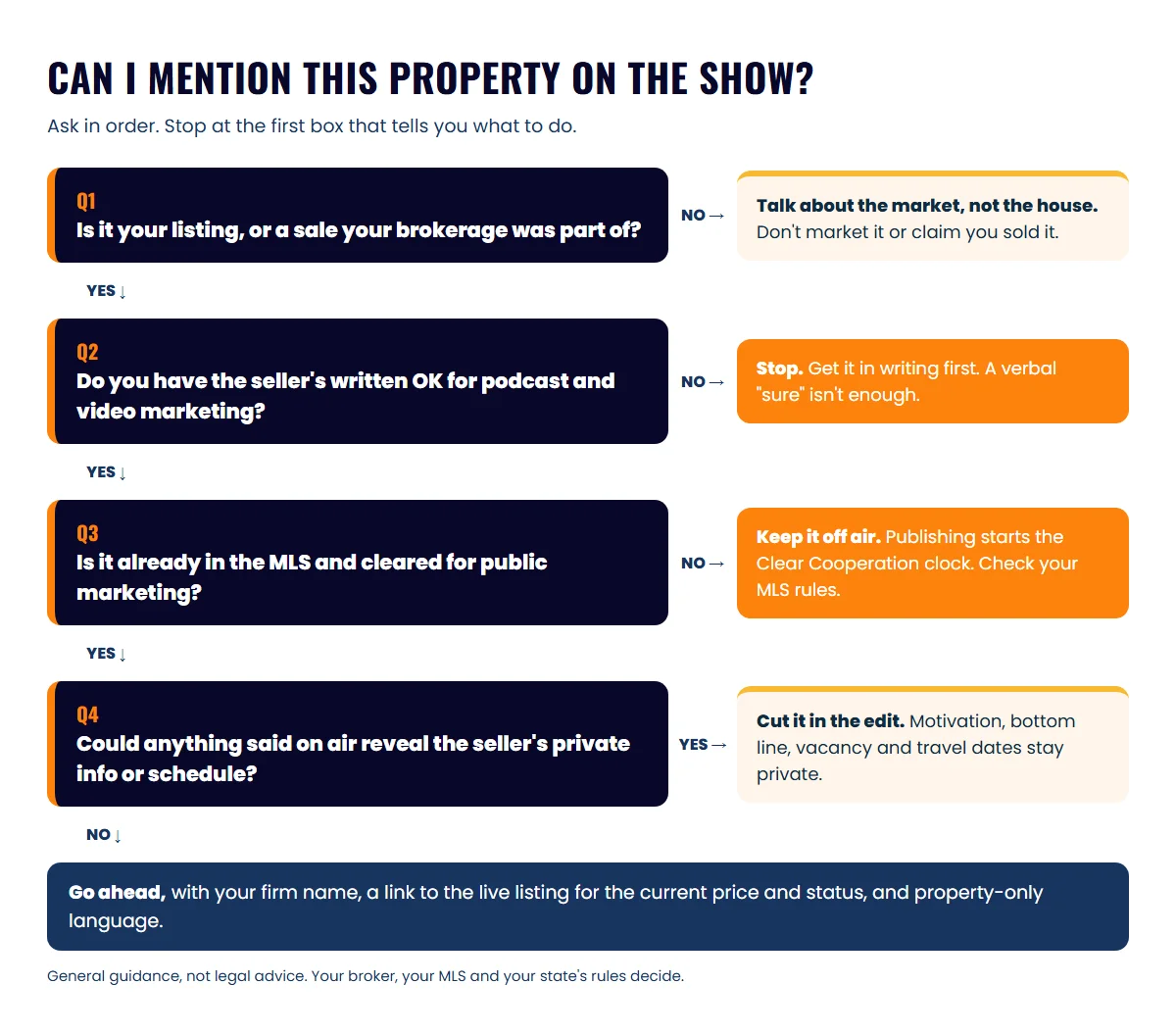
You need written permission that names podcast, video and short clips as marketing channels. A general “marketing” line in the listing agreement may cover it, but sellers rarely picture their kitchen on YouTube for years. Spell it out, and get your broker to approve the wording.
What never goes on air
Your duty to keep client information private doesn’t pause because the mic is on. Standard of Practice 1-9 bars REALTORS® from revealing a client’s confidential information, and the duty continues after the relationship ends. On a podcast, that means cutting:
- why the seller is moving (divorce, job loss, estate sale, health);
- how low they’d go, or how “motivated” they are;
- when the home is empty, or when the owners are traveling;
- the showing schedule, lockbox details, or alarm habits.
Sellers who appear as guests often volunteer this themselves. Brief them before recording, and cut it in the edit anyway. A signed podcast guest release form covers the recording rights; it doesn’t make oversharing safe.
Don’t over-polish the truth
Article 12’s “true picture” works both ways. Latent material defects aren’t confidential under the Code, so don’t call a house “perfect” on air when you know about a roof problem. Talk about real features and let the disclosures do their job.
How do you keep a listing episode accurate after it publishes?
Keep the price and status out of the audio wherever you can, and put them in show notes you can edit. An episode stays online for years. A price you said in March is wrong after the April reduction, and the audio can’t be updated.
Standard of Practice 12-8 asks REALTORS® to keep their website information current and correct it promptly. Apply the same habit to your show notes, episode pages and YouTube descriptions.
When the listing closes
Change the show notes to “sold” status only if your brokerage was the listing or selling broker. Standard of Practice 12-7 limits “sold” claims to those brokers. If the seller asked to be removed after closing, take the address out of the notes and description.
What Fair Housing rules apply to describing a listing out loud?
The same advertising rules apply to spoken words as to printed ads. HUD’s rule at 24 CFR 100.75 bans statements in advertising that show a preference based on race, color, religion, sex, disability, familial status or national origin. Section (b) says the ban applies to “all written or oral notices or statements” by someone selling or renting a dwelling.
Unscripted talk is where agents slip. “Perfect for a young family” points at familial status. “Great for empty nesters” can do the same. Describe what’s there instead: “three bedrooms on one floor,” “fenced yard,” “ten minutes to the rail station.” The Fair Housing checklist for real estate podcasts has a full list of phrases to cut, for hosts and guests.
What about a guest who pitches their own listing?
Treat a guest’s listing like your own, with one difference: the authority belongs to them. Before you record, ask the guest to confirm they have their seller’s permission for podcast marketing and that the property is cleared in their MLS. Have them name their brokerage on air, and add it to the show notes.
You’re still the publisher. If the guest says something about the seller’s motivation or who the home “suits,” cut it. A short guest prep email that says “no seller details, no pricing promises, property features only” saves you most of that edit.
Pre-publish checklist for listing episodes
Run this before any episode, video or clip that mentions a specific property goes live. If you work with a podcast production team, hand them this list. Ask any of the production companies that work with agents whether they’ll run it on every edit before you sign.
- Seller’s written consent covers podcast, video and clips.
- Property is in the MLS and cleared for public marketing, or you confirmed with your MLS that the episode is allowed.
- Your firm name is said on air and appears in the notes and video description.
- Any price on air matches the listing agreement on the publish date. Better: no price on air at all.
- Show notes link to a live listing page for current price and status.
- No seller motivation, bottom line, vacancy, travel dates or showing details anywhere in the audio or video.
- No Fair Housing problem language from you or any guest.
- Clips cut from the episode carry the same firm name and don’t freeze an old price on screen.
- A reminder is set to update notes when the price or status changes, and again at closing.
For the wider production process these checks plug into, see the real estate podcast production guide. Video episodes create more assets to keep accurate, and the video podcast guide for agents shows where clips and descriptions come from.
Next step
Before your next listing episode, send your broker the seller consent clause above for approval, and email your MLS one question: “Does a public podcast or YouTube episode count as public marketing under our rules?” Save both answers with your show files. Then add the checklist to your podcast launch checklist so every listing segment goes through it.
Frequently asked questions
Can I talk about a coming-soon listing on my podcast?
Treat it as off limits until it's in the MLS and cleared for public marketing. A public episode can count as public marketing, which can trigger your MLS's submission deadline. Ask your MLS how it handles coming-soon status.
Can I discuss a home I sold last year?
Yes, if your brokerage was the listing or selling broker and the clients agree to be named or described. Stick to what's public, like the sale price after closing, and keep negotiation details private unless the clients give written consent.
Do I need to say the listing price on air?
No, and it's often better not to. Prices change, and the episode stays online. Put the price in the show notes next to a link to the live listing, and update the notes if it changes.
Can another agent pitch their listing on my show?
Yes, but you're now helping advertise their listing. Ask them to confirm they have their seller's permission, have them name their brokerage on air and in the notes, and edit the segment for Fair Housing language like any other.
Sources
- 2026 Code of Ethics & Standards of Practice — National Association of REALTORS® (accessed October 6, 2026)
- MLS Clear Cooperation Policy — National Association of REALTORS® (accessed October 6, 2026)
- Multiple Listing Options for Sellers — National Association of REALTORS® (accessed October 6, 2026)
- 24 CFR § 100.75, Discriminatory advertisements, statements and notices — Cornell Legal Information Institute (accessed October 6, 2026)
Done-for-you podcast production
Want a podcast that brings in referrals, not just downloads?
Icons of Real Estate plans, produces and publishes business-growing podcasts for agents. You record. We handle the rest.
Launch Your Podcast
Written by
Co-Founder and Podcast Guru, Icons of Real Estate
Tomás Fonseca co-founded Icons of Real Estate in 2021 and is its Podcast Guru. He has a background in marketing, with stints at companies like Nintendo and Ardor SEO, and is one of the hosts of the Icons of Real Estate Podcast.

How we research, write, fact-check and correct articles: our editorial standards.