
On this page
Publish a real estate podcast weekly or every two weeks, on the same weekday, and choose the slower option if you edit it yourself. How often you publish matters less than whether listeners can predict it: a show that lands every second Tuesday for a year beats one that posts four episodes in March and nothing in May.
Cadence is a decision you make once and then protect. The sections below cover why consistency wins, how to choose between weekly and every two weeks, and how to plan a month so the schedule survives a busy market.
Why does a steady schedule matter more than volume?
A steady schedule matters more than volume because podcast listening is a habit, and habits run on predictability. Listeners who like your show slot it into a commute or a dog walk, and they notice when it isn’t there.
The habit is a weekly one for a large share of the audience. Edison Research’s Podcast Consumer 2025 report found 40% of Americans aged 12 and over had consumed a podcast in the last week, against 55% in the last month. Weekly listeners are the ones who come back for each episode, and they’re the ones a missed week disappoints.
The platforms say the same from the other side. Spotify for Creators warns that fans expect new episodes on a steady schedule, that late releases can hurt listener engagement, and that shows which drift become less and less regular until they disappear. Its practical advice is simple: have at least one episode scheduled for each one you release.
For an agent, there’s a second reason. Your sphere is a small audience you know personally. Past clients who hear you every other Tuesday for a year think of you as the agent with the show. Past clients who heard three episodes last spring have mostly forgotten it existed. The guide to growing a local podcast audience puts a steady schedule first for that reason.
Should you publish weekly or every two weeks?
Publish every two weeks if you edit the show yourself or you’re in your first year, and weekly if you batch-record and someone else edits. Monthly is too slow for listeners to form a habit around.
The table compares the three cadences on the things that actually decide whether you keep the schedule.
| Weekly | Every two weeks | Monthly | |
|---|---|---|---|
| Episodes a year | 52 | 26 | 12 |
| Your time if you do everything | Highest; see the weekly time budget | About half of weekly | Lowest |
| Episodes to bank before launch | 3 to 4 | 3 | 2 |
| Survives a busy spring? | Only with an editor and a backlog | Yes, with a backlog of two | Yes, but listeners drift between episodes |
| Best for | Producer-backed shows, solo market updates | Most working agents | A show that’s really a quarterly newsletter |
Icons production clients choose between weekly and bi-weekly episodes, and the done-for-you production service is built around those two cadences. That’s not an accident: both are frequent enough to hold a habit and slow enough to sustain alongside a real estate business.
If you’re unsure, start every two weeks. Moving faster later is a pleasant announcement. Moving slower later reads as the show winding down, even when it isn’t.
Which day and time should you publish?
Publish on a fixed weekday, early in the morning, and keep it for the life of the show. The exact day matters far less than keeping the same one.
Pick a day by working backwards from your recording slot. If you record on Thursdays, an episode that releases the following Tuesday gives an editor the working days in between and leaves Monday for a final check. Early morning means the episode is waiting in podcast apps before the commute, and your clip goes out at the same time.
Say the day out loud in the show: “New episodes every other Tuesday.” Put it in the show description and on your episode pages. Listeners who know the day don’t need a reminder, and guests who know the day know when to share.
How many episodes should you bank before launch?
Bank three finished episodes before launch and keep at least two in reserve after it. The bank is what lets a canceled guest, a closing week or a vacation pass without a missed release.
Most agent podcasts that stop don’t stop for lack of ideas. They stop because one busy week arrives with nothing finished, a release gets skipped, and the habit breaks on both sides. The batch-recording plan for shows that stall shows how one recording session every five or six weeks keeps a bi-weekly show two episodes ahead.
Check the bank on the first of every month. If it’s below two, your next free afternoon is a recording afternoon, not a promotion afternoon.
How do you plan a month of episodes and short posts?
Plan a month as a grid: each episode gets a release day, and each release gets two or three short posts in the days after it. Fill the grid before the month starts, then record and schedule into it.
Here is a month on an every-two-weeks schedule, as an example rather than a rule.
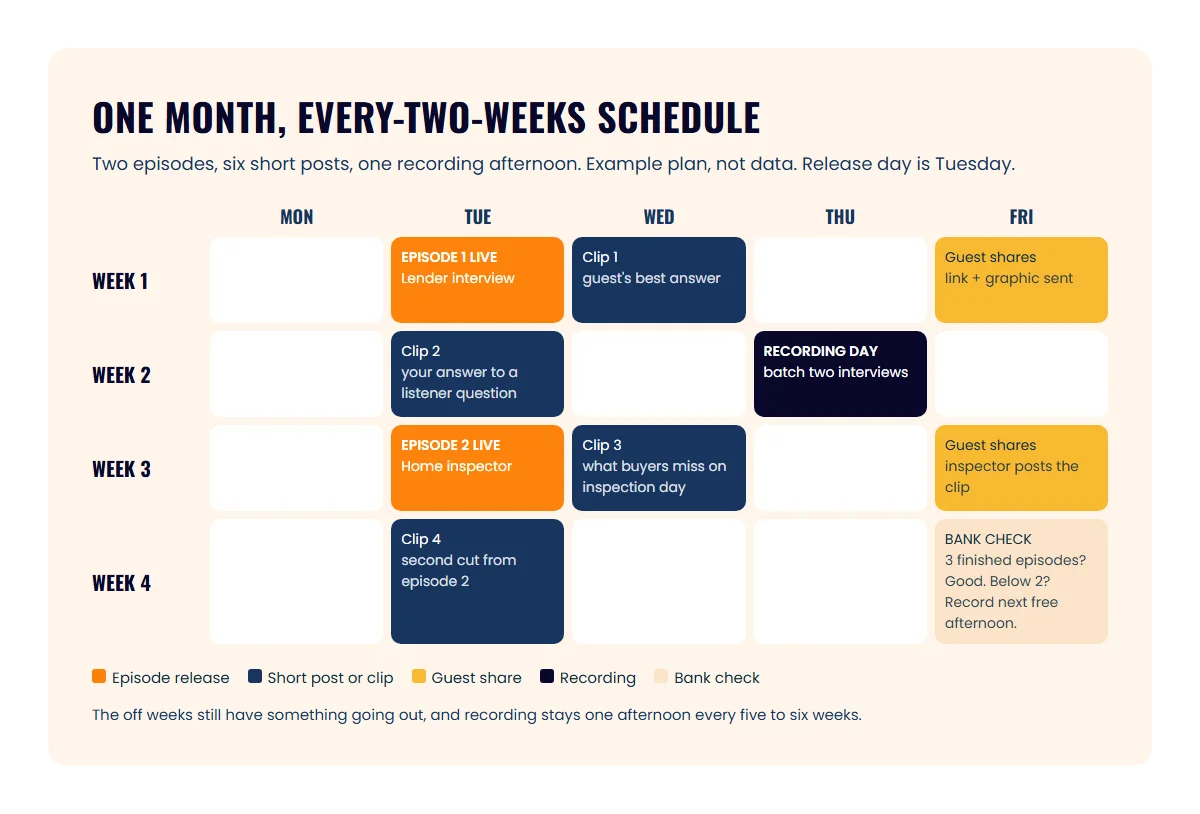
The seasonal side of this, which topics suit which months, is in the 52-week episode calendar for agents. Use the calendar to decide what each slot holds and this page to decide how many slots there are.
Hosts who publish their own show can plan and track the month in ICONS DIY, the do-it-yourself podcast workspace from ICONS: episodes publish to your own feed and you see the downloads for each one, so a bank check and a results check happen on the same page.
What should you do when you can’t keep the schedule?
When you can’t keep the schedule, announce a change before you miss a release, either a slower cadence or a dated break. The announcement protects the habit; silence breaks it.
Three options, in order of preference:
- Drop a cadence for a stated period. “Through June, new episodes every other week.” Then go back and say so.
- Run a short solo episode instead of skipping. A ten-minute market update recorded on your phone keeps the slot filled and takes an hour including notes.
- Take a planned break with a return date. Say it in the last episode and in the show description. Listeners wait for a season; they don’t wait for a show that vanished.
What you shouldn’t do is publish three episodes in one week to “catch up.” It confuses the schedule and leaves the bank empty again. If the show has already gone quiet, the steps to relaunch a stalled podcast start with the bank, not with an apology episode.
Downloads per episode are a lagging measure of all this. A show that holds its schedule for a year usually sees a slow, steady climb rather than a spike, and the guide to how many listeners a real estate podcast needs explains why a small, local, steady audience is the one that produces business.
Next step
Decide the cadence today: every two weeks unless you have an editor and a backlog. Pick the weekday, write it into your show description, and put one recording afternoon in the calendar every five weeks. Then record three episodes before you release the first.
Frequently asked questions
Is publishing twice a week worth it for an agent?
Rarely. Two episodes a week doubles the editing and booking load, and most local audiences don't listen that often. Put the extra effort into clips and guest shares from one strong episode instead.
Can I publish in seasons instead of all year?
Yes, if you announce it. A spring season and a fall season of 10 to 12 episodes each, with a stated break between, keeps the show predictable. Tell listeners the return date in the last episode.
Does a short bonus episode count toward the schedule?
It counts as a bonus, not as the episode listeners expect. Keep the main slot filled and treat a short market update or listener question as extra.
Should I change my cadence once the show grows?
Only when you've held the current one through a full busy season with episodes still in the bank. Moving from every two weeks to weekly works best with a producer or an editor on the team.
Sources
- The Podcast Consumer 2025 — Edison Research at SSRS (accessed October 9, 2026)
- How to make a podcast schedule — Spotify for Creators (accessed October 9, 2026)
Done-for-you podcast production
Want a podcast that brings in referrals, not just downloads?
Icons of Real Estate plans, produces and publishes business-growing podcasts for agents. You record. We handle the rest.
Launch Your Podcast
Written by
Co-Founder and Podcast Guru, Icons of Real Estate
Tomás Fonseca co-founded Icons of Real Estate in 2021 and is its Podcast Guru. He has a background in marketing, with stints at companies like Nintendo and Ardor SEO, and is one of the hosts of the Icons of Real Estate Podcast.

How we research, write, fact-check and correct articles: our editorial standards.