On this page
- Why do transactional touches fail to bring repeat business?
- What is the difference between a touch and a conversation?
- Which podcast conversations build relationships with past clients?
- How do you keep a past client relationship going for ten years?
- What should you ask in a yearly past client conversation?
- What should you avoid when past clients come on your show?
- How do you measure repeat business from relationships?
- Next step
Real estate agents build relationships that bring repeat business by having real conversations with past clients, not by sending more touches. A podcast makes those conversations easy to start: invite past clients on as experts in their own work, send episodes that fit their lives, and hold one real conversation a year. Over a decade, that keeps you their agent.
Most past-client plans are built around touches: a card on the home anniversary, a pie at Thanksgiving, a monthly market email. They are polite and forgettable. The agent who gets the next listing is usually the one the client has actually talked to.
Why do transactional touches fail to bring repeat business?
Transactional touches fail because the gap between moves is too long for them to carry the relationship. In NAR’s latest buyer and seller survey, published in 2025, home sellers had owned their home for a median of 11 years before selling, an all-time high. The same profile puts the median age of repeat buyers at 62.
Eleven years of postcards adds up to more than a hundred messages that ask for nothing and say nothing. By year five the client knows your name and has forgotten your voice. Then a friend mentions an agent they love, and the listing goes there.
On the plus side, past relationships carry real weight. NAR’s 2025 data, as summarised by Virginia REALTORS, shows two in three sellers (66%) either came by referral or went back to an agent they had used before. Buyers were less loyal: only 18% bought through an agent they had used in the past. Past clients will come back, but only if the relationship is still alive when they’re ready.
What is the difference between a touch and a conversation?
A touch delivers something about you, while a conversation asks something about them. A simple test: could the client reply in a sentence that says something about their life? If not, it’s a touch.
This table compares the two across the moments that matter after closing.
| Moment | Transactional touch | Relationship conversation |
|---|---|---|
| Home anniversary | Card with your logo | Call: “What did you change in year one, and what’s next?” |
| Holidays | Branded gift drop-off | Invite them to a live recording or client night |
| Market news | Monthly market email to everyone | Send one episode that fits their plans, with a note |
| Their business or hobby | Nothing | Invite them on your show to talk about it |
| Life change (job, kids, retirement) | Automated “thinking of you” email | Coffee: “How is the house working for you now?” |
Touches still have a place. They keep your name visible. But they can’t do the job alone, because a relationship only grows when the other person talks.
For more on this theme, listen to the Icons 100 episode Relationships Over Transactions. Its idea is simple: a podcast is a relationship-building tool that happens to produce content.
Which podcast conversations build relationships with past clients?
The podcast conversations that build relationships with past clients are the ones where the client is the expert. Your past clients are nurses, contractors, shop owners, coaches and gardeners. Each one knows something your listeners want to hear, and being asked is a compliment they’ll remember.
Four formats work well:
- Past client as expert. Interview them about their profession or business. A pediatric nurse on finding care near a new home. A contractor on what to fix first.
- The first-year homeowner. A buyer from last year talks through what surprised them, what they changed and what they’d do differently. Keep it about the house, not about you.
- The street or project story. A client who restored a porch, started a community garden or organised a block party tells the story.
- The live recording night. Record an episode in front of a small group of past clients, with one or two of them on the mic. The room itself is the client event.
Your guest gets a public thank-you, a link to share and a reason to talk about you. You get an hour with someone who already trusts you, plus an episode to send to others.
How do you keep a past client relationship going for ten years?
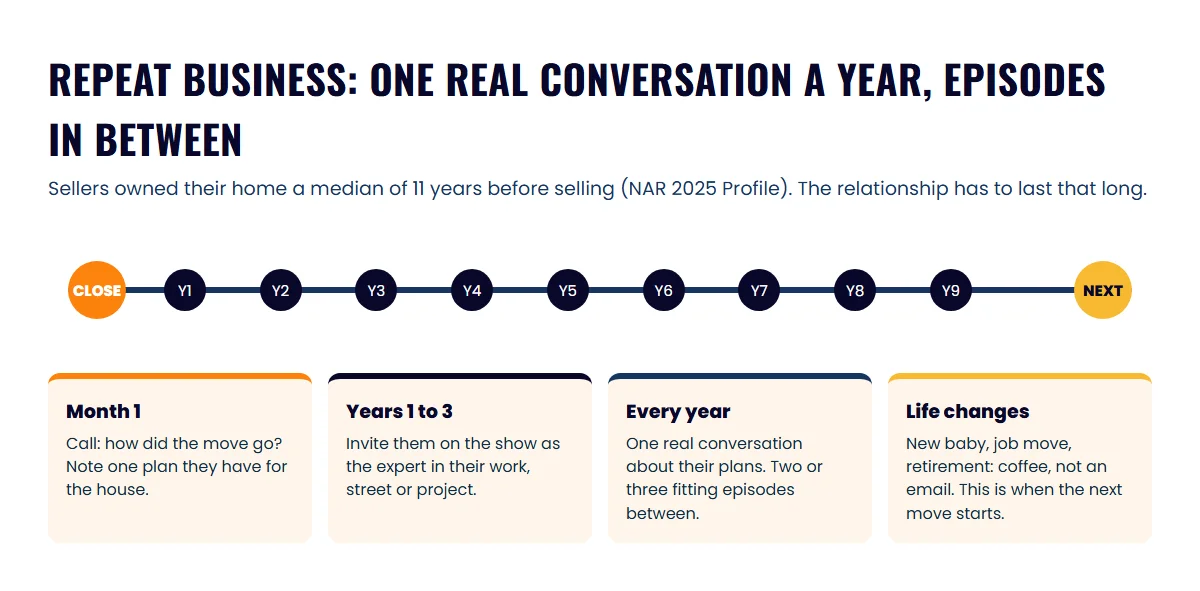
Keep a past client relationship going for ten years by planning one real conversation a year and letting episodes fill the months between. A yearly call or coffee is enough if it’s about them. The episodes keep your voice familiar without asking for anything.
A simple rhythm after closing:
- Month 1: call to ask how the move went. Write down one thing they want to do to the house.
- Months 2 to 11: send two or three episodes that fit what you wrote down, each with a short note
- Year 1 anniversary: invite them on the show, or to coffee if they’d rather not record
- Every year after: one call, one question about their plans, and a note in your CRM
- When life changes: a new baby, a job move or retirement means a coffee, not an email
Episodes work as touches between conversations because they carry your voice and your thinking. For copy-paste messages, adapt the past client and sphere episode sequence.
If your past clients are also your main referral source, the companion piece on how top-producing agents keep referrals coming shows how to tier them alongside partners and other agents.
Repeat business doesn’t only come from past clients. Guests send it too. Lisa Parenteau, host of Lifting Others As We Rise, got a $2.5M referral from one of her guests. Shae Spitz interviewed a local agent before her show launched, and five months later that agent reached out about a development. It became a 330-listing opportunity.
What should you ask in a yearly past client conversation?
Ask about their life and their home, in that order, and leave your business out of it. A yearly conversation works when the client does most of the talking. Twenty minutes is plenty, and it can happen on the phone, over coffee or as a pre-chat before a recording.
Question 4 is the one agents skip. It turns a past client into a guide to their neighborhood, and the names often become your next guests. Question 5 is the only one about real estate, and it comes last on purpose. Write the answers in your CRM the same day, so next year’s call starts where this one ended.
What should you avoid when past clients come on your show?
Avoid turning a past client episode into an ad for yourself. The moment the conversation becomes “tell everyone how great I was,” it stops building the relationship and starts using it.
A few guardrails:
- Keep testimonials separate. If they talk about working with you, it’s a testimonial, and advertising rules apply. Read the rules for past client interview episodes first.
- Get permission in writing. A podcast guest release form covers recording and reuse. Check your state’s rules on recording consent with your broker.
- Protect their privacy. No sale prices, addresses or family details unless they clearly agree.
- Talk about places, not people. Past clients aren’t trained in Fair Housing. The Fair Housing podcast checklist gives you a short brief to read them before recording.
How do you measure repeat business from relationships?
Measure repeat business by tagging every returning client and every referral with the past client relationship it came from. Without that tag, repeat business looks like luck.
Track four numbers each year:
| Measure | What it tells you |
|---|---|
| Past clients who came back to buy or sell | Direct repeat business |
| Referrals from past clients | Whether the relationship reaches their circle |
| Past clients you had a real conversation with this year | Whether you’re doing the work |
| Past clients who were on your show or at a recording | Whether the podcast is part of the relationship |
Only the third number is fully in your control. If it’s low, repeat business will follow it down a few years later. To compare referral sources across your whole business, see the referral-partner episode guide.
If you want the conversations without the production work, Icons podcast production handles editing, publishing and clips while you do the talking.
Next step
Open your closed-deal list from five years ago. Pick the three clients you’d most like to hear from, and call one this week to ask what’s changed in their home.
Frequently asked questions
How often should I contact past clients?
Aim for one real conversation a year and a light, useful touch every couple of months. Frequency matters less than whether the message is about them.
Do I need a podcast to build relationships with past clients?
No, but a podcast gives you a reason to have a long conversation that doesn't feel like a sales call. Phone calls and coffees work too; the show just makes them easier to start.
Is a past client episode the same as a testimonial?
Only if the client talks about working with you. An episode about their business or neighborhood isn't a testimonial, but check your broker's advertising rules either way.
What if a past client used another agent for their next move?
Ask them why, kindly, and listen. It's usually timing or a family connection. Keep the relationship; their next referral can still come to you.
Sources
- Top 10 Takeaways from NAR's 2025 Profile of Home Buyers and Sellers — National Association of REALTORS (accessed October 21, 2026)
- Key Takeaways from NAR's 2025 Profile of Home Buyers and Sellers — Virginia REALTORS (accessed October 21, 2026)
- Relationships Over Transactions: How Top Real Estate Agents Build Trust & Referrals | Icons 100 — YouTube (accessed October 21, 2026)
- A Business Bigger Than You - 3 Top Producers on Referrals, Reputation & Real Estate Legacy — YouTube (accessed October 21, 2026)
Done-for-you podcast production
Want a podcast that brings in referrals, not just downloads?
Icons of Real Estate plans, produces and publishes business-growing podcasts for agents. You record. We handle the rest.
Launch Your Podcast
Written by
Co-Founder and Podcast Guru, Icons of Real Estate
Tomás Fonseca co-founded Icons of Real Estate in 2021 and is its Podcast Guru. He has a background in marketing, with stints at companies like Nintendo and Ardor SEO, and is one of the hosts of the Icons of Real Estate Podcast.

How we research, write, fact-check and correct articles: our editorial standards.