On this page
- Why do top-producing agents need a system to keep referrals coming?
- Which referral sources does a top producer already have?
- How do you turn your best referrers into podcast guests?
- How do episodes keep you top of mind between conversations?
- How many referrals can a podcast add for a top producer?
- How much time does a referral-focused podcast take?
- How do you know the podcast is bringing more referrals?
- Next step
Top-producing agents get more referrals with a podcast by turning the people who already refer them into guests and listeners. Interview your best past clients, partners and out-of-market agents about their own work. Then send each episode to the people it fits. The show gives you a reason to call when you’re too busy to stay in touch.
Most agents start a podcast hoping strangers will hear it and call. A top producer has a better asset: dozens of people who have sent business before. The job is to keep them close while you’re busy closing. A podcast does that well because each episode is a real conversation, not another “just checking in” text.
Why do top-producing agents need a system to keep referrals coming?
Top-producing agents need a system because their referral base is large and their calendar is full, so the people who send business are the first ones to get neglected. Referrals also arrive on a long cycle. A client you served this year may not move again for a decade.
Recent data shows how much rides on it. NAR’s 2025 home buyer and seller survey, as summarised by Virginia REALTORS, found that 43% of buyers chose an agent someone had referred them to. Sellers leaned on relationships even more: 66% either came by referral or went back to an agent they had used before. NAR’s own summary of the 2025 profile puts the median time a seller owned their home at 11 years.
So most sellers come through a referral or a past relationship, and the gap between moves is long. Between those two facts sits the problem every busy agent knows. You mean to call, you don’t, and the referral goes to whoever called last.
Which referral sources does a top producer already have?
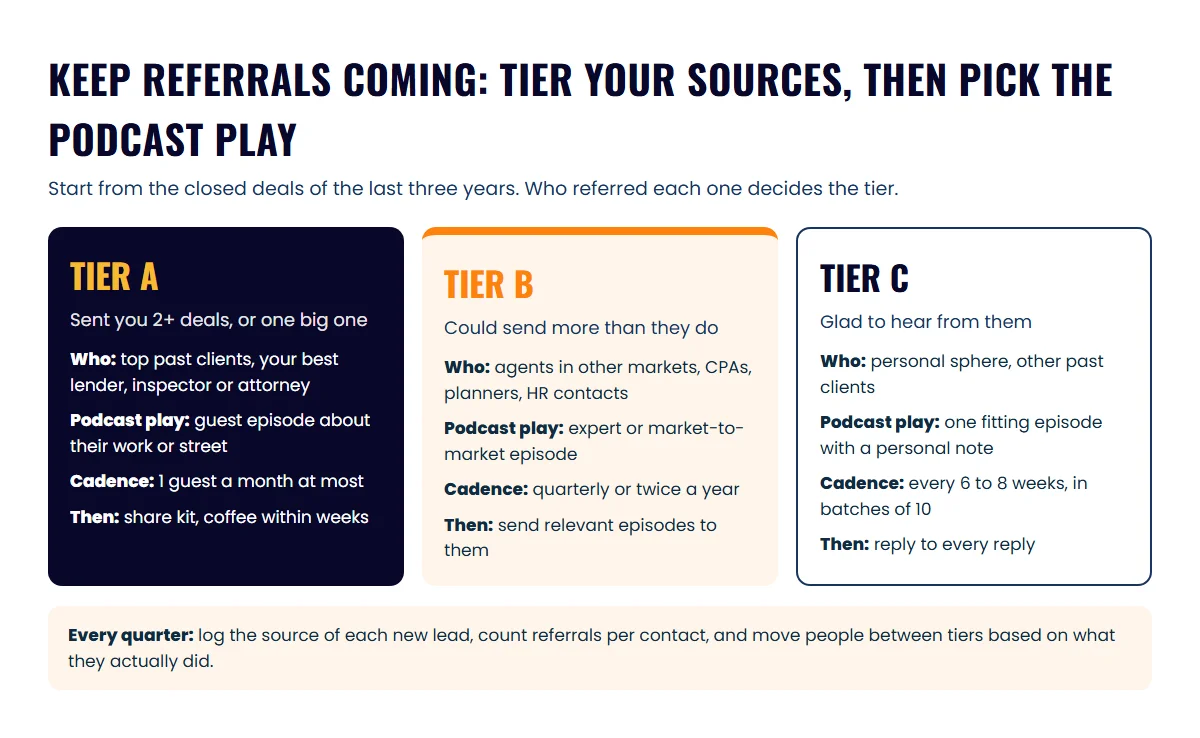
A top producer usually has five referral sources: past clients, personal sphere, service partners, agents in other markets and local centers of influence. Each one stays warm for a different reason, so each needs a different podcast play.
This table shows a starting tier for each source, the podcast play that suits it and a realistic cadence.
| Referral source | Starting tier | Podcast play | Cadence |
|---|---|---|---|
| Past clients who have referred you | A | Guest episode about their work, street or move | 1 per month at most |
| Service partners (lender, inspector, attorney) | A or B | Expert guest episode; recurring segment | 1 to 2 per quarter |
| Agents in other markets | B | Market-to-market episode; send relocation episodes | Quarterly |
| Centers of influence (CPA, financial planner, HR) | B | Expert guest episode for their clients | Twice a year |
| Personal sphere and other past clients | C | Episode sent with a personal note | Every 6 to 8 weeks |
Tier A is the short list of people who have sent you two or more deals, or one big one. Your tier B contacts could send more than they do. Everyone else you’d be glad to hear from goes in tier C.
Partner episodes have their own playbook in the referral-partner episode guide, and out-of-market agents in the agent-to-agent referral podcast format. Past clients, the biggest group, get a long-term plan in how podcast conversations earn repeat business.
How do you turn your best referrers into podcast guests?
Turn your best referrers into podcast guests by inviting them as experts in their own field, not as fans of yours. A past client who runs a bakery, coaches a youth team or restores old houses has a story your listeners want. An episode honors them in public, which is the warmest thank-you you can give.
Start with a list. Pull every closed deal from the last three years and note who referred it. Names that show up twice are your first guests.
Three rules keep these episodes from feeling like a sales pitch:
- Make them the expert. Ask about their work and their corner of town. Your expertise shows in the questions.
- Don’t ask for referrals on air. The episode is the gift. The ask, if any, comes weeks later over coffee.
- Hand them something to share. A link and two clips let their circle hear you, which is where new referrals start.
If the guest is a past client talking about their own purchase, that’s a testimonial. Read the rules for past client interview episodes before you record.
When our production clients pick their first five guests, they look for people with real influence in their market who aren’t camera-shy and are glad to join a small founding group of guests. Above all, they pick people they’re comfortable around, so the first recordings go well.
How do episodes keep you top of mind between conversations?
Episodes keep you top of mind when you send one specific episode to one specific person with a note on why it fits them. A link with no note is a newsletter. A link with “this made me think of your kitchen project” is a conversation.
Treat your episode list like a library you lend from:
- Tag every episode by who it helps: sellers, first-time buyers, investors, a neighborhood, a life event.
- Send to tier C in small batches, never as one blast. Ten personal notes beat a mass email to 500 people.
- Reply to replies. When someone answers, you’re having a real conversation, and that’s the goal.
For copy-paste sequences by lead stage, including past clients and sphere, see the follow-up sequences built from podcast episodes.
How many referrals can a podcast add for a top producer?
A podcast can add a steady stream of referral partners rather than a sudden flood of referrals. The ICONS Podcast Framework estimates that one episode a week, kept up, brings about 8 new referral partners a year and a network of 40 long-term partners by year five.
The framework’s assumptions are cautious. It assumes each partner sends just one referral over five years, converted at 20% to 50%, the range the framework cites from Icons’ real estate partners for trusted referrals. That works out to 24 to 60 conversions from the partner network alone.
This math leaves out the referrals from tier A guests who were already sending you business. For a top producer, keeping those sources warm may matter more than adding new ones.
How much time does a referral-focused podcast take?
A referral-focused podcast takes about an hour a week of your time if someone else runs production. You record the conversation; editing, publishing, clips and scheduling are handled for you. The follow-up notes are the part only you can do, and they take minutes per episode.
Here is a rough split of the work, based on a typical interview episode:
| Task | Who does it | Your time per episode |
|---|---|---|
| Picking and inviting the guest | You (from your tier list) | 10 minutes |
| Recording the conversation | You and the guest | 30 to 45 minutes |
| Editing, publishing, clips | Producer | None |
| Personal notes to tier C contacts | You | 15 minutes for 10 notes |
| Coffee with the guest | You | Optional, once a quarter |
Icons’ production page puts it plainly: “One hour a week is more than enough.” If you’d rather record and hand off the rest, Icons podcast production handles guest booking, editing, publishing and social clips.
How do you know the podcast is bringing more referrals?
You know the podcast is bringing more referrals when the source field on new leads starts naming guests and episodes. Ask every new client how they heard of you, and record the person and the episode if one comes up.
Run a short review each quarter:
- Count referrals received per tier A and B contact, before and after their episode
- List tier C contacts who replied to an episode note
- Note which episode topics got the most replies
- Move contacts between tiers based on what they actually did
- Pick next quarter’s guests from the top of the list
A CRM with custom fields makes this easier; tracking podcast leads in your CRM covers the tags and fields.
One compliance note. If a referral source is a lender, title company or other settlement-service provider, RESPA limits what can pass between you, and that includes free services and gifts. Get your broker’s sign-off before anything of value changes hands. Our referral-partner playbook has a RESPA section that lists the questions to take to them.
Next step
Pull your closed deals from the last three years, write down who referred each one and circle the names that appear twice. Invite the first one this week.
Frequently asked questions
Do I need a big audience for a podcast to bring in referrals?
No. The referrals in this plan come from the guests and from the people you send episodes to. Listener numbers help later, but a show with a small audience can still keep your best referrers close.
Will past clients feel used if I invite them on my show?
Not if the episode is about them. Ask about their work, their street or their move, never about how great you were. People like being asked for their expertise.
How many referrers should I invite in the first year?
One or two a month is plenty for a busy agent. That's 12 to 24 deep conversations a year with people who already send you business.
Can I thank referrers with gifts on the show?
Ask your broker first. Gifts to clients and agents are handled differently from anything given to lenders, title companies and other settlement-service providers, where RESPA applies.
Sources
- Key Takeaways from NAR's 2025 Profile of Home Buyers and Sellers — Virginia REALTORS (accessed October 21, 2026)
- Top 10 Takeaways from NAR's 2025 Profile of Home Buyers and Sellers — National Association of REALTORS (accessed October 21, 2026)
Done-for-you podcast production
Want a podcast that brings in referrals, not just downloads?
Icons of Real Estate plans, produces and publishes business-growing podcasts for agents. You record. We handle the rest.
Launch Your Podcast
Written by
Co-Founder and Podcast Guru, Icons of Real Estate
Tomás Fonseca co-founded Icons of Real Estate in 2021 and is its Podcast Guru. He has a background in marketing, with stints at companies like Nintendo and Ardor SEO, and is one of the hosts of the Icons of Real Estate Podcast.

How we research, write, fact-check and correct articles: our editorial standards.