On this page
- Georgia reciprocity at a glance
- Does Georgia have real estate license reciprocity?
- What states have reciprocity with Georgia’s real estate license?
- What do you need to apply for a Georgia reciprocal license?
- Do you need a Georgia broker to activate the license?
- What does Georgia require after you get a reciprocal license?
- Can you work a Georgia deal without a Georgia license?
- Can you use a Georgia real estate license in another state?
- Is a Georgia license worth it, or should you refer?
Georgia real estate license reciprocity is open to agents from every state. The Georgia Real Estate Commission (GREC) issues a reciprocal license without the Georgia exam if you passed your home state’s exam and that license is in good standing. Florida residents are the exception: they must pass a Georgia law supplement exam first.
That makes Georgia far simpler to add than a state with no reciprocity, such as Texas. You still send a specific set of documents, line up a Georgia broker if you want to work right away, and finish a postlicense course if you’re a salesperson. Below: who qualifies, what to send, what comes after, and how a Georgia license plays in other states.
Georgia reciprocity at a glance
Georgia reciprocity comes down to a short list of conditions and costs. This summary is checked against GREC’s licensing page and the Rev 02.2025 reciprocal application, 20 Nov 2026.
| Item | What GREC requires |
|---|---|
| Who qualifies | A current license from any state, earned by passing that state’s exam, in good standing |
| Georgia exam | Not required, except the supplement exam for Florida residents |
| License fee | $170.00, non-refundable, by cashier’s check or money order; license runs four years |
| Florida residents | Extra $121.00 supplement exam through PSI; can’t use the standard application |
| Criminal history report | From a law enforcement agency, no more than 60 days old |
| Certified license history | Issued within one year of the application |
| Brokers | Active status for at least three of the previous five years |
| Salespersons | 25-hour or longer postlicense course within the first year |
| Active license | A Georgia broker signs the firm affiliation section |
| Incomplete application | Returned unprocessed with a $25.00 charge |
Does Georgia have real estate license reciprocity?
Georgia has real estate license reciprocity with all states. GREC’s licensing page says the Commission “offers licensing by reciprocity to licensees from all states,” with one exception for licensed Florida residents.
Older guides, including an earlier version of this page, listed a handful of partner states such as Alabama, Arkansas and Florida. That list is misleading. Georgia doesn’t limit reciprocity to named partners. What matters is how you got your license and where you live.
To qualify, GREC’s page says you must meet three conditions:
- You’re currently licensed in another state. A license you held in the past doesn’t count.
- You got that license by passing the exam in that state. GREC’s application asks your certified history to show you passed “a state administered real estate examination.”
- The license is in good standing. GREC’s wording is “not lapsed or expired.”
Meet all three and you can get a Georgia license without taking the Georgia exam. If you live in Florida, you take one extra step, covered below.
What states have reciprocity with Georgia’s real estate license?
Every state can lead to a Georgia reciprocal license, as long as you meet GREC’s three conditions. The only carve-out is for applicants who live in Florida, not for a particular state’s license.
The table shows how GREC treats the main applicant types, based on its licensing page and the reciprocal application as of November 2026.
| Applicant | Georgia exam? | What GREC adds |
|---|---|---|
| Licensed salesperson from any state, not a Florida resident | No | 25-hour or longer postlicense course within the first year |
| Licensed broker from any state, not a Florida resident | No | Active status for at least three of the previous five years; firm paperwork if you open or qualify a firm |
| Florida resident licensed in Florida | Georgia law and practice supplement exam through PSI | Can’t use the standard reciprocal application |
| Licensee with a lapsed or expired license | Not eligible for reciprocity | Ask GREC what applies in your case |
Florida’s rule follows where you live, not where you’re licensed. GREC’s reciprocal application says any licensee “who is a resident of the State of Florida” must take the supplement exam on Georgia law and practice. The application puts that exam fee at $121.00, “in addition to the cost of the license,” and you then buy the $170.00 Georgia license at the PSI test center after you pass. Florida community association managers take the Georgia CAM exam instead.
What do you need to apply for a Georgia reciprocal license?
A Georgia reciprocal license application needs five things: the form, a certified license history, lawful presence documents, a recent criminal history report and the fee. Per the reciprocal application form, GREC returns incomplete applications unprocessed and charges $25.00, so check each item.
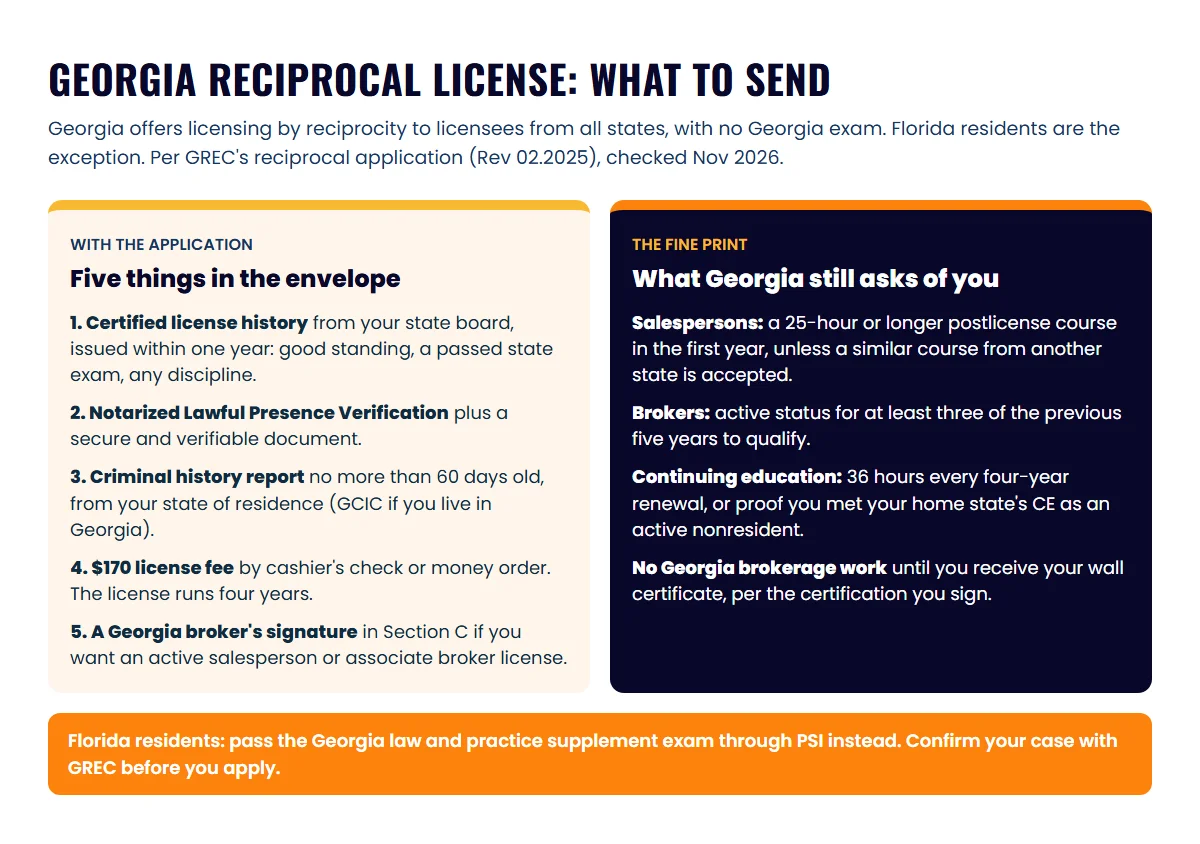
Here’s the detail behind each item, from the Rev 02.2025 application:
- Certified license history. Order it from your state’s licensing board. GREC says it is “NOT a copy of your wall certificate or pocket card.” It must show your license is in good standing, show you passed a state exam, say whether you’ve been disciplined and be issued within one year of the application.
- Lawful presence. Attach a notarized Lawful Presence Verification form and a secure and verifiable document, as described on GREC’s website.
- Criminal history report. Georgia residents attach a GCIC report. Nonresidents attach an equivalent report from their state of residence. It must be no more than 60 days old and come from a law enforcement agency. Disclose any conviction the report doesn’t show.
- Fee. A non-refundable $170.00 license fee by cashier’s check or money order, payable to the Georgia Real Estate Commission. The license is issued for four years.
- Broker paperwork, if it applies. Brokers opening a firm attach an Open a Firm application. Brokers taking over an existing firm attach a Change of Qualifying Broker form.
Mail the package to GREC at 229 Peachtree Street NE, Suite 1000, Atlanta.
How long does GREC take to issue a reciprocal license?
GREC publishes no processing time for reciprocal licenses. The application says only that once a complete application arrives, “the license will be issued,” and that one needing a background investigation will take more time.
So the speed is mostly in your hands. Send a complete package, because an incomplete one comes back unprocessed with a $25.00 charge. If you need a date, call GREC at 404-656-3916, the number on the form.
What does the criminal history report cost?
GREC doesn’t set a price for the criminal history report. The application asks for a report from a law enforcement agency, no more than 60 days old, and says a report from anyone else isn’t acceptable. Ask the agency that issues it what it charges.
Do military spouses get faster processing?
Military spouses and transitioning service members may qualify for expedited processing of a Georgia license application. Georgia Rule 520-1-.04(13), effective 1 July 2017, sets this out (text via Cornell’s Legal Information Institute). You show your status, pay the fee and meet the normal requirements. The rule speeds up processing; it doesn’t waive any requirement, so ask GREC what proof of status it accepts.
Do you need a Georgia broker to activate the license?
A Georgia salesperson or associate broker needs a Georgia broker to hold an active license. The application’s Section C says all salespersons, associate brokers and community association managers “must affiliate with a resident or non-resident broker who is licensed by the Georgia Real Estate Commission.”
The broker signs Section C before you send the application. If you don’t have a firm yet, you can ask for an inactive salesperson license instead and pay the license fee. GREC’s licensing page notes that postlicense education still applies to salespersons who go inactive.
Brokers have three options on the form: open a firm, become the qualifying broker for an existing Georgia firm, or affiliate as an associate broker. Until you receive your Georgia wall certificate, the form has you agree not to “engage in, conduct, advertise, or hold myself out” as doing brokerage work in Georgia.
What does Georgia require after you get a reciprocal license?
Georgia requires reciprocal salespersons to complete a postlicense course in the first year, and every active licensee to keep up continuing education. Brokers skip the postlicense course.
Postlicense course. Salespersons must complete “a 25-hour or longer Postlicense course within the 1st year of licensure,” per the application. If you’ve already finished a substantially similar course in another state, send proof with your application, and it may count.
Continuing education. GREC’s education requirements page sets 36 hours of approved CE in each four-year renewal period, including 3 hours on License Law. Brokers must include 18 broker-specific hours. A nonresident with an active license in another state may instead prove they met that state’s education requirements.
GREC lists two ways to prove it. Send a current pocket card showing active status with a renewal date later than your Georgia due date. Or send certificates for at least 36 hours of CE approved by your home state’s commission. Keep both licenses current, because the Georgia option depends on the home license staying active.
Can you work a Georgia deal without a Georgia license?
You can earn a referral fee on a Georgia deal without a Georgia license, but you can’t do the rest of the broker’s work there. Georgia Rule 520-1-.07(7) lets a Georgia broker share a commission with a broker licensed in another state.
The same rule (text via Cornell’s Legal Information Institute) says a Georgia broker “may pay a fee” to an out-of-state broker who refers a client. That referring broker can’t perform any other broker acts on Georgia property unless they first get a nonresident license or sign a written agreement with a Georgia broker, as allowed by O.C.G.A. Section 43-40-9.
In practice that gives you three routes:
- Refer and step back. Your broker and the Georgia broker sign a referral agreement, and the Georgia agent handles showings and negotiation.
- Work under a written agreement with a Georgia broker, if both brokers agree to set one up. Ask GREC and your broker what that agreement must cover.
- Get the reciprocal license if Georgia deals are regular, using the steps above.
The fee is paid to the licensed out-of-state broker, so a salesperson gets it through their own broker. Check the terms with your own broker before you agree to anything.
Can you use a Georgia real estate license in another state?
A Georgia real estate license doesn’t transfer to another state on its own. Each state’s commission decides what a Georgia licensee needs, and the answers range from a document check to a course and an exam.
The table compares three states using each commission’s own rule or page as of November 2026.
| State | Credit for a Georgia licensee | Still required |
|---|---|---|
| Alabama | Reciprocal salesperson or broker license if you hold a current license earned by prelicense courses and a comprehensive exam | 6 hours of reciprocal prelicense coursework, the reciprocal exam, and a license history issued within 120 days before the Alabama license |
| New Mexico | Reciprocal agreement for brokers licensed in Georgia: no prelicense education or exam | A certified copy of your Georgia license history. The same FAQ also says all applicants take the 30-hour Broker Basics class, so ask the Commission whether that applies to you. Salespersons get no reciprocity |
| Tennessee | No reciprocal license, per our Tennessee guide checked against the Tennessee Real Estate Commission in November 2026; some credit after a staff review | The steps in our Tennessee guide, linked below |
Alabama’s rule also says the home license can’t itself be a reciprocal or nonresident license. So a Georgia license you got by reciprocity won’t qualify you there. Our guide to Tennessee real estate license reciprocity covers the Tennessee steps in full. For a state with no reciprocity at all, see Texas real estate license reciprocity.
Is a Georgia license worth it, or should you refer?
A Georgia license is worth it when Georgia clients or referral partners already bring you regular business. If you get one or two Georgia deals a year, a broker-to-broker referral is usually less work than a second license, postlicense course and CE in two states.
Georgia’s process is lighter than the Texas or Tennessee routes, so the bar is lower. Still, run your own numbers. Count last year’s Georgia leads, what you earned on referrals, and what you’d have earned working them. Then add the postlicense course and the four-year renewal cycle.
The agents who get the most from a second license work a corridor, such as Chattanooga to north Georgia or the Augusta area across the South Carolina line. In a corridor, being known on both sides matters as much as the license. Guesting on podcasts outside your licensed market explains which out-of-state shows bring real business. If you’d rather start with a few interviews in the new market than build your own show, ICONS podcast guest booking handles the pitching and scheduling. Building those partner relationships on purpose is the idea behind referral-partner podcast episodes.
Rules and fees change. Check the current application on GREC’s website, and talk to your broker, before you order documents or pay anything.
Frequently asked questions
Is my Georgia reciprocal license active right away?
Only if you choose active status and a Georgia broker signs the firm affiliation section of the application. Salespersons can also ask for an inactive license and join a firm later.
Can I get a Georgia reciprocal license if my home license is inactive?
GREC's licensing page says the home license must be currently in good standing and not lapsed or expired, and the certified history must show that. If your status is unclear, ask GREC before you send the fee.
How much does a Georgia reciprocal license cost?
GREC charges a non-refundable $170.00 license fee, and Florida residents also pay $121.00 for the supplement exam. Add your home state's fee for a certified license history and whatever the law enforcement agency charges for the criminal history report.
Can I transfer my Georgia license to another state?
No license transfers automatically. Each state's commission sets its own terms for Georgia licensees, from a document check to a course and exam, so start with that state's commission page.
Do I need to live in Georgia to hold a Georgia license?
No. Nonresidents can hold a Georgia license. The application has you consent to being sued in Georgia over your Georgia work and agree to cooperate with Commission investigations.
Sources
- Obtaining a Real Estate License — Georgia Real Estate Commission (accessed November 20, 2026)
- Real Estate Reciprocal Application (Rev 02.2025) — Georgia Real Estate Commission (accessed November 20, 2026)
- Education Requirements: Real Estate — Georgia Real Estate Commission (accessed November 10, 2026)
- Ga. Comp. R. & Regs. R. 520-1-.07 Management Responsibilities of Real Estate Firms — Legal Information Institute, Cornell Law School (accessed November 20, 2026)
- Ga. Comp. R. & Regs. R. 520-1-.04 — Legal Information Institute, Cornell Law School (accessed November 20, 2026)
- Rule 790-X-1-.18 Reciprocal License Requirements — Alabama Real Estate Commission (accessed November 10, 2026)
- Real Estate Commission FAQs — New Mexico Regulation and Licensing Department (accessed November 20, 2026)
Done-for-you podcast production
Want a podcast that brings in referrals, not just downloads?
Icons of Real Estate plans, produces and publishes business-growing podcasts for agents. You record. We handle the rest.
Launch Your Podcast
Written by
Co-Founder and Podcast Guru, Icons of Real Estate
Tomás Fonseca co-founded Icons of Real Estate in 2021 and is its Podcast Guru. He has a background in marketing, with stints at companies like Nintendo and Ardor SEO, and is one of the hosts of the Icons of Real Estate Podcast.

How we research, write, fact-check and correct articles: our editorial standards.