On this page
- Does Texas have reciprocity for real estate licenses?
- What credit does Texas give an out-of-state real estate license?
- How do you get a Texas sales agent license if you’re licensed in another state?
- How does an out-of-state broker get a Texas broker license?
- Can you work a Texas deal without a Texas license?
- Can you use a Texas real estate license in another state?
- Is a second state license worth it for a Texas agent?
Texas real estate license reciprocity doesn’t exist: the Texas Real Estate Commission (TREC) says Texas has no reciprocity with any state. Agents licensed elsewhere must meet every current Texas requirement, including 180 hours of Texas courses. The one real break is the exam: an active license from an ARELLO-accredited state can waive the national portion.
That answer disappoints a lot of agents planning a move. Below: what an out-of-state license still gets you in Texas, the steps in order, how to keep earning from Texas deals before you’re licensed, and how a Texas license works in other states.
Does Texas have reciprocity for real estate licenses?
Texas has no reciprocity for real estate licenses with any state. TREC’s frequently asked questions put it in one line: “Texas does not have reciprocity with any state. To become licensed, you must satisfy all current Texas licensing requirements.”
Reciprocity, in licensing terms, means one state accepts another state’s license and lets you skip most of its own steps. Some states do that with a few partners. Texas doesn’t do it with anyone, so “is Texas a reciprocal state?” has a short answer: no.
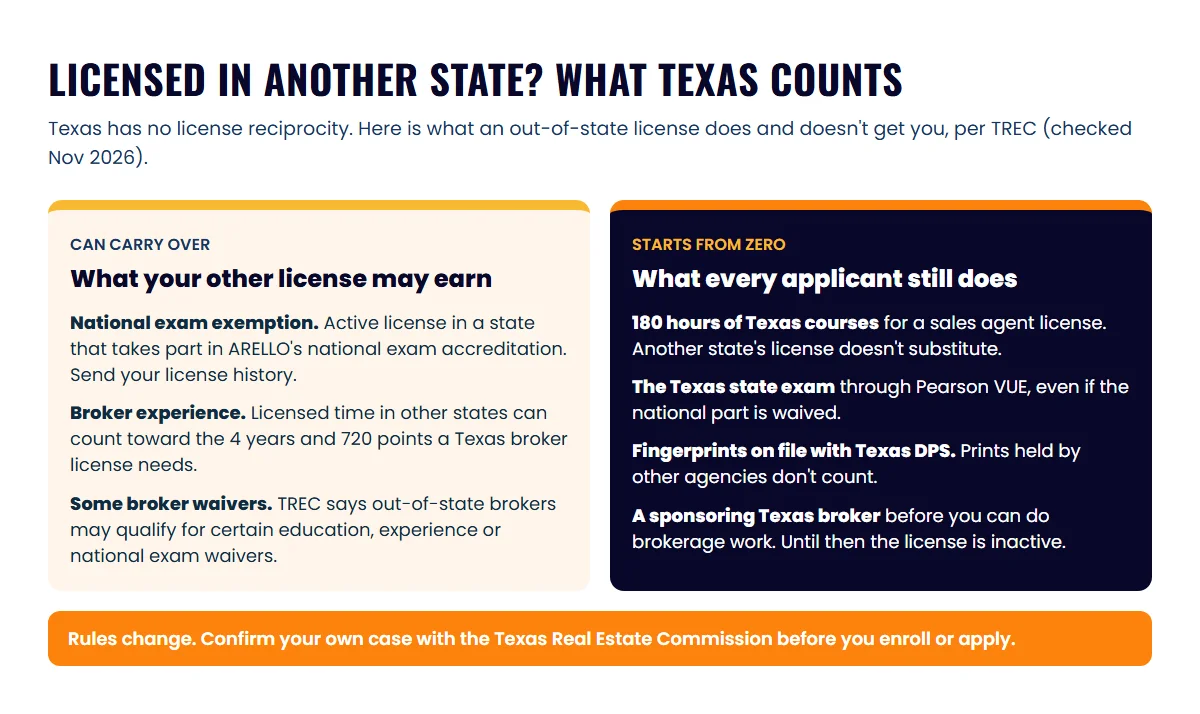
What Texas does offer is partial credit. Your other license can save you one exam section, and if you’re a broker it can count toward experience and some waivers. Everything else you do like a first-time applicant.
What credit does Texas give an out-of-state real estate license?
Texas gives an out-of-state license credit in two places: the national exam section and, for brokers, experience and certain waivers. Education for a sales agent license gets no credit at all.
TREC is blunt about education. A license in another state “or experience in real estate brokerage or any related business does not substitute for the educational requirements,” citing TREC Rule 535.63(a). The table shows how the main requirements play out for each license type, based on TREC’s pages as of November 2026.
| Requirement | Out-of-state sales agent applying in Texas | Out-of-state broker applying in Texas |
|---|---|---|
| Education | All 180 hours of Texas qualifying courses | 270 hours of qualifying courses plus 630 hours of related education, unless TREC grants a waiver |
| Experience | Not required | 4 years active in the last 5 and at least 720 experience points; out-of-state time can count |
| National exam | Exempt with an active license from an ARELLO-accredited state | TREC’s broker guide lists national exam waivers for out-of-state licensees |
| Texas state exam | Required | Required |
| Fingerprints | Must be on file with Texas DPS | Required if you don’t already have prints on file with DPS |
| License history | Send it with your application to claim the exam exemption | Required if you use out-of-state experience or held a license elsewhere in the last 5 years |
The broker column comes from TREC’s step-by-step broker license guide, published in August 2026. It says applicants who hold or recently held a license in another state “may qualify for certain education, experience, or national exam waivers,” but doesn’t list which ones. Ask TREC how your history will be treated before you sign up for 900 hours of coursework.
How do you get a Texas sales agent license if you’re licensed in another state?
An out-of-state agent gets a Texas sales agent license the same way a new applicant does, with one difference: you submit your license history and may skip the national exam. TREC’s sales agent licensing page lays out the order.
- Check eligibility. You must be a U.S. citizen or lawfully admitted alien, at least 18, and meet TREC’s standards for honesty, trustworthiness and integrity. If something in your past worries you, you can request a Fitness Determination before you apply.
- Register in TREC’s online portal. If you don’t have a TREC license number, register to get a pre-license education application number. Give it to your course provider.
- Finish 180 hours of qualifying courses. That’s six 30-hour courses: Principles of Real Estate I and II, Law of Agency, Law of Contracts, Promulgated Contract Forms, and Real Estate Finance. Don’t apply until they’re done.
- Apply online and attach your license history. Pay the fee on TREC’s current fee schedule. Application fees aren’t refundable, and you can’t edit an application once it’s submitted.
- Get fingerprinted for Texas DPS. You’ll get an email to schedule once your status moves to “In Review.” Prints on file with other agencies don’t count. If you live outside the IdentoGO service area, you can ask for a TREC-specific hard card.
- Pass the exam. Pearson runs it. You take the Texas state portion, plus the national portion unless TREC exempts you. Fail either part three times and you need more education before retesting.
- Find a sponsoring broker. TREC issues an inactive license first. It turns active once a Texas broker sponsors you through TREC’s online portal.
Watch the clock. A Texas application “expires one year from the date it is filed,” and each exam section result is good for one year. Agents who move mid-process sometimes lose months to fingerprint scheduling, so book it the day the email arrives.
How does an out-of-state broker get a Texas broker license?
An out-of-state broker gets a Texas broker license by meeting the Texas broker requirements, with possible credit for out-of-state experience and some waivers. There’s no shortcut to a Texas broker license based only on holding one elsewhere.
Under the August 2026 guide, a Texas broker applicant needs four years of active experience as a sales agent or broker in the last five years. You also need at least 720 experience points. Education adds 270 hours of qualifying courses and 630 hours of related education, including the six-hour Broker Responsibility Course. Inactive time doesn’t count toward experience.
If you’re using out-of-state experience, or you held a license in another state in the last five years, send a certificate of license history with the application. And if you’re applying on an out-of-state broker license without prints on file with DPS, you’ll be fingerprinted. After TREC approves your requirements, you take the Texas broker exam through Pearson VUE.
Can you work a Texas deal without a Texas license?
You can’t broker Texas property without a Texas license, but you can refer the client to a Texas broker and earn a referral fee. TREC’s FAQ says that when the property “is located wholly or partly in Texas,” an out-of-state broker must get a Texas license or associate with a Texas broker.
The referral route is the practical answer while your license is in progress. TREC’s FAQ says a license holder can be disciplined for paying part of a commission or fee to anyone except “a licensed Texas broker or a broker licensed in another state” (Texas Occupations Code §1101.652(b)(11)). So a Texas broker can pay your broker, and your broker pays you under your agreement.
Agents who build these referral relationships on purpose often do it by meeting agents in other markets. Interviewing agents in other markets on a podcast is one way to find the Texas agent you’d trust with a client before you need one. Check fee splits and paperwork with your broker every time.
Can you use a Texas real estate license in another state?
A Texas real estate license doesn’t transfer to another state. TREC’s answer to a Texas broker asking about out-of-state property is: “We don’t know, since you will be governed by the laws in that state.” The other state’s commission decides what credit you get.
All three states in the table below ask for a certified history of your license. TREC’s licensing forms include a “Request for Certificate of Active Licensure or Sponsorship History”; ask the other state’s commission which document it accepts before you order one.
The table compares three nearby states, using each commission’s own page as of November 2026.
| State | Credit for a Texas licensee | Still required |
|---|---|---|
| Colorado | Accepts reciprocity from all U.S. states and territories if your license has been non-expired for at least two years | State portion of the broker exam, fingerprint background check, certified license history dated within 90 days |
| Oklahoma | Nonresidents take the Oklahoma state portion; the national portion depends on your experience | License certification history from every state, IdentoGo background check, Oklahoma topic courses, an Oklahoma resident as registered agent |
| New Mexico | No reciprocity for salespeople; reciprocal agreements only with Georgia, Louisiana and Massachusetts brokers | Brokers from other states can request an education or exam waiver; salespeople get none |
Two things stand out. Colorado’s path is short for a Texas agent with two years on a license, and New Mexico gives a Texas sales agent no credit. Oklahoma also won’t issue a license of higher standing than the one you hold elsewhere, so a Texas sales agent can’t jump to an Oklahoma broker license.
Looking at the Southeast? See our guide to Tennessee real estate license reciprocity. Rules in any state can change, so treat every table here as a starting point and confirm with that state’s commission.
Is a second state license worth it for a Texas agent?
A second state license is worth it when you already have regular clients or referral partners in that state. If you only get one or two deals a year from there, referral fees usually cost you less time than courses, exams and a second set of renewals.
Run the numbers on your own business before you enroll. Count the deals you sent out of state last year, what you earned in referral fees, and what you’d have earned doing them yourself. Add the hours for education and exams, plus continuing education in two states every renewal cycle.
The agents who make dual licenses pay usually work a corridor: clients moving between two metros, or investors buying across a state line. If that’s you, being visible in the second market matters as much as the license. Guesting on podcasts outside your licensed market explains which out-of-state shows bring business and which only bring referral leads.
Whatever you decide, check the current rules with TREC before you pay for courses or file anything, since requirements and fees change. For agents who want to meet partners in a new market faster, ICONS podcast guest booking pitches and books the interviews so you only show up for the conversation. You can also start with the complete guide to podcast guesting for agents.
Frequently asked questions
Do I have to retake the whole Texas exam if I'm licensed in another state?
Not always. You still take the Texas state portion. If you hold an active license in a state that takes part in ARELLO's national exam accreditation, TREC can exempt you from the national portion once it sees your license history.
How long do I have to finish after I apply to TREC?
A Texas application expires one year from the date it's filed. Each exam section you pass is also valid for one year, so plan to finish fingerprints and both exams inside that window.
Is my Texas license active as soon as I pass the exam?
No. TREC issues an inactive license first. It becomes active once a Texas broker sponsors you, which you or the broker request through TREC's online licensing portal.
Can a Texas agent pay a referral fee to an agent in another state?
TREC's FAQ says license holders can be disciplined for paying a commission or fee to anyone other than a licensed Texas broker or a broker licensed in another state. Fees run broker to broker, so set it up through your sponsoring broker.
Sources
- Become a Real Estate Sales Agent — Texas Real Estate Commission (accessed November 10, 2026)
- Frequently Asked Questions — Texas Real Estate Commission (accessed November 10, 2026)
- Applying for a Texas Broker License: A Step-By-Step Guide — Texas Real Estate Commission (accessed November 10, 2026)
- Broker License Application Requirements — Colorado Division of Real Estate (accessed November 10, 2026)
- Application and Exam FAQs — Oklahoma Real Estate Commission (accessed November 10, 2026)
- Real Estate Commission FAQs — New Mexico Regulation and Licensing Department (accessed November 10, 2026)
Podcast guesting for agents
Get booked on real estate podcasts
The ICONS Hub connects agents with real estate podcast hosts looking for expert guests.
Guest On The Network
Written by
Co-Founder and Podcast Guru, Icons of Real Estate
Tomás Fonseca co-founded Icons of Real Estate in 2021 and is its Podcast Guru. He has a background in marketing, with stints at companies like Nintendo and Ardor SEO, and is one of the hosts of the Icons of Real Estate Podcast.

How we research, write, fact-check and correct articles: our editorial standards.