On this page
- What can a guest reuse from someone else’s podcast?
- What should you ask the host for?
- How do you mine one episode for reusable answers?
- Where does each answer go? The real estate repurposing map
- How do you turn the appearance into a blog post on your own site?
- How do you use the appearance in listing presentations and seller pages?
- How do you use a podcast appearance as social proof without overstating it?
- How do you keep one appearance working for 12 months?
- Next step
To repurpose a podcast guest appearance, first get the host’s permission and files, then pull out your five best answers with timestamps. Give each answer a home: a short clip, a blog post on your site, a Google Business Profile post, a CRM email, a listing presentation slide. Reuse them on a 12-month calendar, not just in release week.
Most agents treat a guest spot as a one-week event. They share the link, post a clip, and the episode sinks. Yet the interview is 30 to 45 minutes of you answering client questions in your own voice. Treat it like a library you pull from, and it feeds your marketing for months.
Release week has its own seven-day plan for after a podcast interview; everything here starts after that. The full system, from pitching to tracking, sits in the full podcast guesting system for agents.
What can a guest reuse from someone else’s podcast?
You can always reuse your own ideas, but the recording usually belongs to the host. That one fact shapes everything. The host recorded, edited and published the episode, so treat the audio and video files as theirs unless they say otherwise.
Here’s how the permission levels break down in practice:
| What you want to do | Permission needed? | Safe default |
|---|---|---|
| Link to the episode or share the host’s post | No | Do it freely, and tag the show |
| Embed the official player on your website | Usually no, if the show offers an embed | Use the embed code the platform or host provides |
| Quote your own words in text (blog, email, slide) | No, they’re your words | Name the show and link to the episode |
| Post clips the host made and sent you | Implied, but confirm | Ask “OK to post these on my channels?” |
| Cut your own clips from the episode | Yes | Ask in writing before you edit anything |
| Re-upload the full episode to your channel | Yes, and many hosts will say no | Embed or link instead |
| Use the show’s logo or cover art | Yes | Use the show name in text if you’re unsure |
None of this is legal advice. It’s the courteous, low-risk default. Hosts talk to each other, and a guest who re-uploads episodes without asking doesn’t get invited back.
What should you ask the host for?
Ask for the files and the permissions in one short email, ideally right after recording when goodwill is highest. Hosts are busy. A clear list gets a clear yes; a vague “can I use the episode?” gets ignored.
Save the reply. A written yes, even in an email, is the record you’ll want if anyone asks later. Hosts who need permission from their own guests use a different document, a podcast guest release form.
How do you mine one episode for reusable answers?
Listen once with a notepad and build an answer inventory: a list of your best answers, each with a timestamp, the client question it answers, and who needs to hear it. This takes about one listen plus 20 minutes. Everything else in this guide runs off that list.
- Play the episode at normal speed. You’ll miss nuance at 2x.
- Mark every answer you’d be proud to send to a client. Note the start and end time.
- Rewrite the host’s question as a client would ask it. “What’s your take on pricing strategy?” becomes “Should I price my home high and come down?”
- Tag each answer with a client stage. Seller, buyer, past client, new lead or agent referral partner.
- Flag anything that will date. Rates, inventory numbers and “this spring” references won’t age well. Use those answers early, then retire them.
- Flag anything risky. A client detail, an address, or a careless line about who a neighborhood “suits.” Don’t reuse those at all.
A good 30 to 45 minute interview usually gives you five to eight usable answers. Finding only one or two is useful feedback for your next appearance. Go in with stories ready for the questions hosts usually ask agents.
Where does each answer go? The real estate repurposing map
Send each answer to the place where someone at that client stage will meet it. A pricing answer belongs in front of sellers. A “how I work with first-time buyers” answer belongs in your new-lead follow-up. This is what makes a guest appearance work as agent marketing instead of just content.
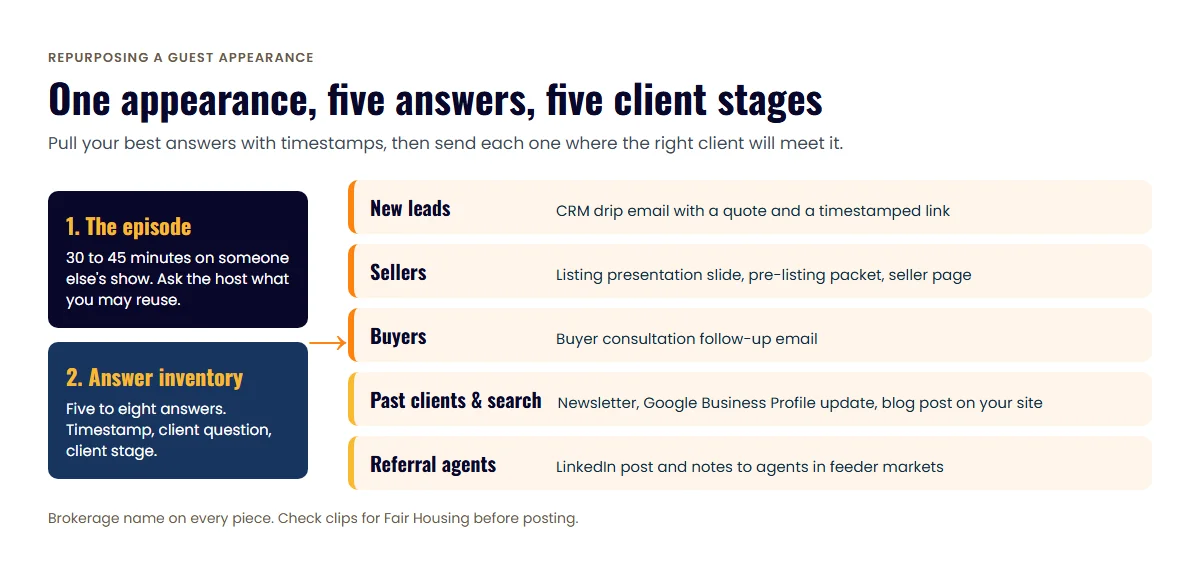
| Client stage | Where the answer goes | Format | Shelf life |
|---|---|---|---|
| New leads | Second or third email in your CRM drip | Two-sentence quote plus a timestamped link | Evergreen if the advice isn’t dated |
| Sellers | Seller page on your site, listing presentation, pre-listing packet | Embedded episode, pull quote, QR code | 12+ months |
| Buyers | Buyer consultation follow-up email | One answer, one link, one next step | 12+ months |
| Past clients and sphere | Monthly newsletter, Google Business Profile update | Short summary of one answer | One-off, then reuse a different answer |
| Search visitors | Blog post on your website or IDX site | 600 to 1,000 words expanding one answer | Years, if you update it |
| Social followers | Vertical clip, quote card, LinkedIn post | 30 to 60 second clip with captions | Days, so recycle on a schedule |
| Agent referral partners | LinkedIn, referral groups, email to agents in feeder markets | The answer that shows how you handle clients | 12+ months |
Notice where the long shelf life sits. Social clips get the attention, but they fade in days. A seller page, a drip email or a blog post keeps working for a year with no reposting. Build those first.
The video clip rules for agent shows cover length and selection. The same rules apply whether you cut the clip from your own show or from someone else’s.
How do you turn the appearance into a blog post on your own site?
Pick the one answer that matches a question local clients search for, and write a post that answers it better than you did out loud. Embed the episode in the post and point to the timestamp. Never paste the raw transcript. It reads badly, and it’s the host’s content, not yours.
A simple structure works:
- Title as the client’s question. “Should I renovate my kitchen before selling in [your city]?”
- A three-sentence direct answer at the top.
- Two or three sections that expand on what you said, with the local details you didn’t have time for on air.
- The episode embed, with a line like “I talked about this on [Show name]; my answer starts at 14:20.”
- One next step, such as a pricing conversation or your seller guide.
If your website runs on an IDX platform, put the post on that site so the reader is one click from searching homes. Keep your brokerage name and any required license details on the page, just as you would on any other ad.
How do you use the appearance in listing presentations and seller pages?
Use it as proof of how you think, placed right next to the claim it supports. “I’m great at pricing” is a claim. A QR code to two minutes of you explaining pricing on someone else’s show is evidence. Sellers trust evidence more, partly because a third party chose to put you on the air.
Three placements work well:
- The pricing or marketing slide. Add one pull quote from your answer, the show name and a QR code that opens the episode at the right timestamp.
- The pre-listing packet. Include a short “Hear how I approach [topic]” line with the link, so sellers can listen before you arrive.
- The seller page on your website. Embed the episode under a heading that matches the seller’s worry, such as “How I price homes in a shifting market.”
How do you use a podcast appearance as social proof without overstating it?
Say exactly what happened: you were a guest on a named show, on a date, talking about a topic. “As heard on [Show name]” is fine. “Featured expert” or “Top agent, as seen on” is only fine if it’s literally true. Overstating a guest spot is the fastest way to turn good social proof into an advertising problem.
If you’re a REALTOR®, Article 12 of the NAR Code of Ethics requires you to “present a true picture” in your advertising, and Standard of Practice 12-5 adds that your firm’s name has to appear on it in a way that is reasonable and readily apparent. Clips, quote cards, blog posts and slides all count as ads. State rules can add more, so run your plan past your broker.
A few practical rules:
- Don’t imply endorsement. The host interviewed you. That isn’t the same as recommending you.
- Disclose paid spots. If you paid to appear, don’t present it as an editorial invitation. The disclosure questions come up in paying for a podcast guest spot.
- Check every clip for Fair Housing. Describe homes, prices and amenities. Never describe an area by who lives there or who it’s “good for.”
- Watch co-marketing. When the host works for a mortgage or title business, get your broker’s view before any joint promotion, since RESPA can reach anything of value traded between referral sources.
- Keep it current. Drop an appearance from your “As heard on” list if the show is gone or the episode is taken down.
How do you keep one appearance working for 12 months?
Put the reuse on your calendar the day the episode goes live. Without dates, the second, third and fourth uses never happen. The table below is a simple default; swap in your own answers from the inventory.
| When | Reuse | Answer to use |
|---|---|---|
| Release week | Follow the seven-day plan in what to do after a podcast interview | Your strongest answer |
| Month 1 | Blog post with embed; listing presentation slide | Seller-focused answer |
| Month 2 | Add an answer to your CRM drip | Buyer or new-lead answer |
| Month 3 | Newsletter section and a second clip | A different answer from the inventory |
| Month 6 | New Google Business Profile update | Any evergreen answer |
| Month 9 | LinkedIn post aimed at referral agents | The “how I work” answer |
| Month 12 | Review: re-post the best clip, retire dated answers, update the blog post | Best performer |
The month 6 slot is there for a reason. Google’s help page on Business Profile posts says posts older than six months are archived unless a date range is set. An update can carry a photo, a video and a button with a link, so a fresh post every six months keeps the appearance visible on your profile.
Track which reuse starts conversations. Tag each link by where it was used (drip, presentation, blog, clip), and on every first call ask where the person first heard your name. The CRM fields for that are laid out in how to track podcast leads.
Next step
Open your most recent guest appearance today and build the answer inventory: five answers, five timestamps, five client stages. Then send the host the permission email. If you’d like more appearances to repurpose without doing the pitching yourself, the ICONS Hub guest booking plans hand the pitching and scheduling to a coordinator.
Frequently asked questions
Can I upload a podcast I was a guest on to my own YouTube channel?
Only if the host says yes in writing. Without permission, embed the host's player or link to the episode, which sends views to the show and keeps you on good terms.
How many pieces of content can one guest appearance produce?
A 30 to 45 minute interview usually holds five to eight answers worth reusing. Each answer can become a clip, a paragraph in an email and a section of a blog post, so a dozen or more pieces is realistic.
What if the host won't share clips or the video file?
Work from what you can control: your own words. Quote yourself in text, write a blog post that expands your answer, and embed or link the official episode. You don't need the file to repurpose the ideas.
How long is an old podcast appearance still useful?
As long as the advice in it is still true. Market numbers date fast, but answers about pricing strategy, preparing a home or how you work with buyers can stay useful for years.
Sources
- Create & manage posts on your Business Profile — Google Business Profile Help (accessed October 6, 2026)
- 2026 Code of Ethics & Standards of Practice — National Association of REALTORS® (accessed October 6, 2026)
Podcast guesting for agents
Get booked on real estate podcasts
The ICONS Hub connects agents with real estate podcast hosts looking for expert guests.
Guest On The Network
Written by
Co-Founder and Podcast Guru, Icons of Real Estate
Tomás Fonseca co-founded Icons of Real Estate in 2021 and is its Podcast Guru. He has a background in marketing, with stints at companies like Nintendo and Ardor SEO, and is one of the hosts of the Icons of Real Estate Podcast.

How we research, write, fact-check and correct articles: our editorial standards.