On this page
- How long should you wait to follow up on a podcast pitch?
- What does the full follow-up cadence look like?
- Template 1: the bump (day 7)
- Template 2: the new angle (day 17 to 21)
- Template 3: when the host says “not right now”
- Template 4: when the host says yes but never books a date
- Template 5: the 90-day re-pitch
- How should you read a host’s reply?
- What should a follow-up never include?
- How do you follow up through a contact form or a DM?
- How do you keep track of follow-ups without missing one?
- Next step
A podcast pitch follow-up email is a short reply in the same thread that brings your pitch back to the top of a host’s inbox. Send the first one about 7 days after your pitch. Send a second, with a new topic, 10 to 14 days later. If neither gets a reply, stop and re-pitch in about 90 days.
That’s the whole rule. What follows is a dated cadence, five templates for the stalls agents actually hit, and a table for reading host replies. Follow-up is one step in a bigger loop; the podcast guesting system for agents covers the rest, from picking an angle to tracking leads.
How long should you wait to follow up on a podcast pitch?
Wait about 7 days after the pitch before you send your first follow-up. A week gives a host time to work through a normal inbox, record an episode and come back to guest requests, which many hosts handle in one batch. Following up after two or three days reads as impatient. Waiting a month means your pitch is buried under a few hundred newer emails.
Two cases call for a shorter gap:
- You tied the pitch to a date. If you pitched a topic about a local event, a school-year move or a rate change that’s in the news, follow up after 3 or 4 days. The topic expires, so say so.
- The host told you when they book. Some shows say “we book guests on the first of the month.” Follow up just after that date, not on your own schedule.
Silence after a pitch rarely means no. Usually the email landed on a recording day and slid down the inbox, and a short nudge is often what gets the reply.
What does the full follow-up cadence look like?
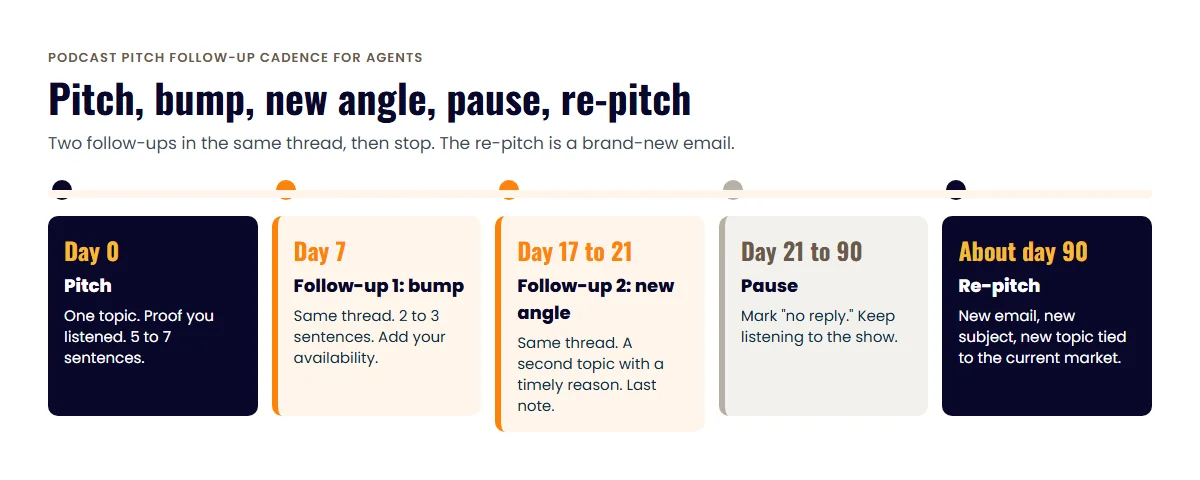
The cadence is four touches over about three months: the pitch, a short bump, a new angle, and a fresh re-pitch. Each one has a different job. Repeating the same message four times is what gets agents filtered as spam.
| Touch | When | Channel | Job | Length |
|---|---|---|---|---|
| Pitch | Day 0 | Email (or the show’s guest form) | Offer one topic, prove you listened | 5 to 7 sentences |
| Follow-up 1: the bump | Day 7 | Reply in the same thread | Bring the pitch back to the top | 2 to 3 sentences |
| Follow-up 2: the new angle | Day 17 to 21 | Reply in the same thread | Offer a second topic with a timely reason | 3 to 5 sentences |
| Pause | Day 21 to 90 | None | Mark “no reply” in your tracker, keep listening | None |
| Re-pitch | Around day 90 | New email, new subject line | Pitch a fresh topic tied to the current market | 5 to 7 sentences |
Two follow-ups is the ceiling. A third nudge in a row tells the host you’ll be hard to work with, and hosts talk to other hosts.
Template 1: the bump (day 7)
The bump is a two-line reply that adds one useful detail and asks nothing new. Reply in the same thread so the host sees your original pitch right below it. Don’t re-paste the pitch, and don’t open with “just checking in” and nothing else.
The one new detail, your availability, removes a step for the host. That small thing makes replying easier than ignoring you.
Template 2: the new angle (day 17 to 21)
The second follow-up offers a different topic, because the first one may simply not fit the show. Give a timely reason for the new idea in one sentence. Then make it clear this is your last note, which takes pressure off the host and often prompts a reply.
Pick the second topic from a different audience than the first. Pitched a seller topic? Offer a buyer or relocation one. If you’re short on ideas, pull from this bank of 50 podcast guest topics sorted by audience.
Template 3: when the host says “not right now”
A “not right now” is a real answer and a good one. Thank the host, ask one question that lets you come back at the right time, and stop. The goal is permission to follow up later, on their schedule.
Then do exactly what you said. If the host names a month, set a reminder for the first week of it and reply in the same thread so they see the history. If they name a topic, pitch that topic, even if it’s not your favorite. A host who asked for something is far more likely to book it.
Template 4: when the host says yes but never books a date
A “yes” with no recording date is the most common stall in podcast booking. The host meant it, then got busy. Follow up 5 to 7 days after the yes with specific times, so booking takes the host one click or one word.
If the show sends a booking link for a recording slot, use it the same day. If a week passes after Template 4 with no reply, send one more line in the thread: “Still keen to do this whenever your schedule opens up.” Then wait for the host. A yes doesn’t expire as fast as a cold pitch does.
Have your podcast one-sheet ready before you send this. A host who says yes will often ask for your bio and headshot in the next email, and a fast answer keeps the booking warm.
Template 5: the 90-day re-pitch
The re-pitch is a new email, with a new subject line and a new topic, sent to a host who never replied. Treat it as a first pitch. Don’t mention that they ignored you, and don’t reply in the old thread, which would put your two unanswered follow-ups right under it.
The “recent episode” line matters most here. It proves you’re still listening three months later, which is rare. If you quote a market number in the pitch, name the source (your local MLS report or association data) and use the latest figure.
How should you read a host’s reply?
Every host reply tells you what to send next. Use this table so you answer fast and don’t over-follow-up a warm lead or under-follow-up a lukewarm one.
| What the host says | What it usually means | What you send | When |
|---|---|---|---|
| Nothing | Busy, buried, or not a fit | Template 1, then Template 2 | Day 7, then day 17 to 21 |
| “Not right now” or “we’re booked” | Open door, wrong timing | Template 3 | Within a day |
| “Not a fit for our audience” | The topic, or you, don’t match the listeners | A one-line thank-you. No counter-pitch | Within a day |
| “Yes, let’s do it” | Booked in principle | Thank-you, then Template 4 if no date follows | Same day, then 5 to 7 days |
| “Send me more info” | Interested but checking you out | One-sheet link, two sample questions, availability | Same day |
| “We charge guests” or “sponsored spots only” | It’s a paid placement, which is advertising | Ask your broker before replying | Before any money changes hands |
| An unsubscribe or “please stop” | A firm no | Nothing. Remove them from your list | Immediately |
The “not a fit” reply deserves respect. Counter-pitching it turns a polite no into an annoyed one. Say thanks, and if you guest on a related show later, the host may remember you as the agent who took no gracefully.
What should a follow-up never include?
A follow-up should never add pressure, guilt or extra work for the host. Most failed follow-ups break one of these rules:
- No guilt lines. Skip “I haven’t heard back” and “I’m sure you’re busy, but.” Both read as complaints.
- No attachments. A PDF from a stranger can land in spam or look risky. Link to your one-sheet instead.
- No new subject line on follow-ups 1 and 2. A new subject starts a new thread and hides your original pitch.
- No listing promotion. Don’t mention a property you’re selling. A host wants a guest, not an ad, and on-air listing talk raises its own rules.
- No neighborhood descriptions about people. If your angle is local, describe homes, commute times and amenities, never who lives there. Fair housing applies to how you pitch, not just to what you say on air.
- No missing brokerage name. Keep your firm name in your signature on every email. If you’re a REALTOR®, Standard of Practice 12-5 requires disclosing your firm’s name when you advertise real estate services in any medium (NAR Code of Ethics). Ask your broker whether a pitch email counts as advertising under your state’s rules; adding the name costs nothing.
- No length creep. If a follow-up is longer than your pitch, cut it. Under 80 words is a good target.
How do you follow up through a contact form or a DM?
Use the same cadence, but shorten everything and point back to your original message. Many shows take guest requests only through a form on their website, and some hosts are easier to reach on Instagram or LinkedIn than by email. Others find guests through booking platforms such as PodMatch.
- Contact form. You can’t reply in a thread, so open your follow-up with the date you sent the first request and your topic in five words. Paste your one-sheet link. Keep it under 60 words, because forms often cut long messages.
- DM. One message, two sentences, no links unless the platform shows previews well: “Hi [name], I sent a guest idea for [show] on [date] about [topic]. Happy to send it here if that’s easier.”
- Mixed channels. A DM counts as one of your two follow-ups. Don’t send a bump by email and a bump by DM in the same week.
If the show is a local one, such as a chamber of commerce podcast or a city business show, you may already share contacts with the host. A warm introduction from a mutual contact beats any follow-up template, and finding local podcasts to guest on through your chamber, lender partners and past clients is how you get one.
How do you keep track of follow-ups without missing one?
Log every pitch in a simple tracker and let your email app remind you. Follow-ups fail far more often because the agent forgot than because the template was weak.
Tracker columns
| Column | Example entry |
|---|---|
| Show and host | Riverside Business Hour, host first name |
| Contact channel | Email, from the show’s website |
| Topic pitched | Selling a long-held family home |
| Pitch date | 2026-03-03 |
| Follow-up 1 date | 2026-03-10 |
| Follow-up 2 date and new topic | 2026-03-23, spring market for buyers |
| Status | No reply / not now (check back in June) / yes, no date / booked / not a fit |
| Re-pitch date | 2026-06-02 |
The status column is the one that drives your week. Sort by it every Monday and send whatever is due.
Reminders in Gmail
If you use Gmail, snooze each pitch in your Sent folder so it comes back at the right time. Gmail’s snooze sends the email back to the top of your inbox at the time you pick (Gmail Help). Snooze the pitch for 7 days. When it reappears with no reply, send Template 1 and snooze again.
Gmail also lets you schedule an email to send later, up to 100 scheduled emails at a time (Gmail Help). Use that to send a pitch at a good hour, not for follow-ups. A scheduled follow-up still goes out if the host replies in the meantime, and “just checking in” sent after a yes looks careless.
If you’d rather not run this cadence yourself, a dedicated coordinator on the paid ICONS Hub plans handles the pitching, scheduling and follow-up for you. Plan details are on the podcast guesting page.
Next step
Open your sent folder and find every podcast pitch from the last month. Put each one in a tracker row, mark its status, and send whatever is due today: a bump, a new angle, or a Template 3 reply. Once you land the booking and record, the seven-day plan for after a podcast interview turns the episode into referrals.
Frequently asked questions
Is it rude to follow up on a podcast pitch?
No. Hosts get a lot of email and pitches get buried by accident, so one short, polite nudge a week later is normal. Sending five is what feels rude.
Should I call the host instead of emailing again?
Only if the host is a local business owner you already know, or the show lists a phone number for guest requests. Otherwise stay in the channel the host chose, which is usually email.
Can I follow up on social media if email gets no reply?
One short message is fine if the host is active there. Point back to your email instead of re-sending the whole pitch, and count it as one of your two follow-ups, not an extra one.
What if the host replies months later?
Answer within a day and treat it as a fresh yes. Re-check that your topic is still current, update any market numbers you planned to use, and offer recording times right away.
Sources
- Snooze emails until later — Gmail Help (accessed October 6, 2026)
- Schedule emails to send — Gmail Help (accessed October 6, 2026)
- 2026 Code of Ethics & Standards of Practice — National Association of REALTORS® (accessed October 6, 2026)
Podcast guesting for agents
Get booked on real estate podcasts
The ICONS Hub connects agents with real estate podcast hosts looking for expert guests.
Guest On The Network
Written by
Co-Founder and Podcast Guru, Icons of Real Estate
Tomás Fonseca co-founded Icons of Real Estate in 2021 and is its Podcast Guru. He has a background in marketing, with stints at companies like Nintendo and Ardor SEO, and is one of the hosts of the Icons of Real Estate Podcast.

How we research, write, fact-check and correct articles: our editorial standards.