On this page
- What is a podcast one-sheet?
- What should a real estate agent put on a one-sheet?
- Copy-paste one-sheet template
- What do good agent one-sheets look like?
- Which numbers can you put on your one-sheet?
- How should you design and send your one-sheet?
- What mistakes get one-sheets ignored?
- Should you write it yourself or have it built?
- Next step
A podcast one-sheet for a real estate agent is a single page that sells you as an interview guest. It shows your headshot, a one-sentence angle, a short bio, three talk topics, five sample questions, proof you can document, a listener link and your brokerage name. Hosts use it to decide whether to book you and to write your intro.
A one-sheet isn’t a listing flyer, a résumé or a brochure for your brokerage. Its only job is getting a busy host to say yes in under a minute.
You’ll find a copy-paste template, three filled-in agent examples with notes, and the advertising checks generic templates leave out. The one-sheet is one piece of a bigger podcast guesting system for agents, which covers choosing shows and tracking the leads that come back.
What is a podcast one-sheet?
A podcast one-sheet is a one-page summary of you as a guest: who you are, what you can talk about, and why a show’s listeners will care. Some people call it a guest sheet or a speaker sheet. The format is the same.
Three documents get mixed up here, so here’s how they differ:
| Document | What it is | Who reads it | Length |
|---|---|---|---|
| Guest one-sheet | Your pitch on a page: angle, topics, questions, proof, links | Podcast hosts and producers deciding whether to book you | One page |
| Guest bio | A short paragraph about you, in the third person | The host, who reads it aloud or pastes it into show notes | 50 to 150 words |
| Media kit | A longer pack, usually for a show or brand, with audience data and rates | Sponsors and advertisers | Several pages |
Your bio sits inside your one-sheet. Stuck on the bio? These podcast guest bio examples for agents give short and long versions for different niches. Most agents don’t need a media kit at all unless they host a show and sell sponsorships.
What should a real estate agent put on a one-sheet?
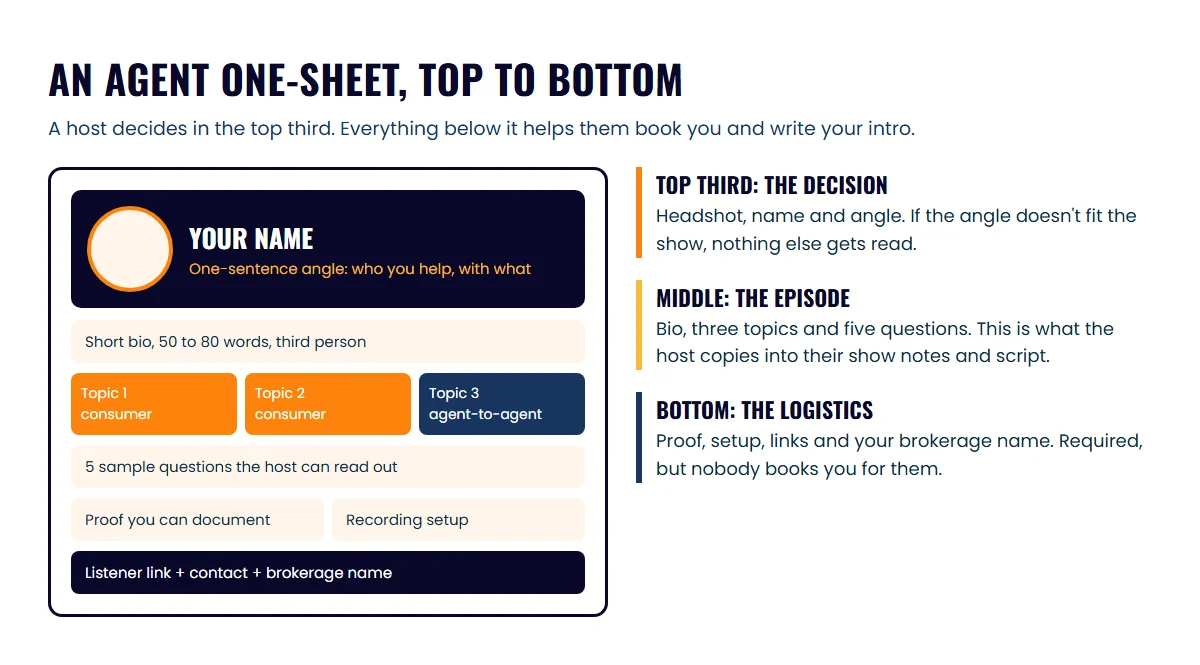
Put eight blocks on the page, in this order: headshot, name and angle, bio, three topics, five sample questions, proof, recording setup, and a footer with your listener link, contact and brokerage name. The order matters more than the design.
The top third: the decision
Hosts skim. If your top third doesn’t match their show, they stop reading.
- Headshot. Use the same recent photo that’s on your website and portal profiles. Consistency helps the host recognize you on the call.
- Name and title. “[Your Name], REALTOR®” is enough. Skip the five designations.
- Angle. One sentence that says who you help and with what. “I help first-time buyers in [City] buy with less than 5% down” beats “Top-producing agent passionate about real estate.”
The middle: the episode
This is the part the host actually uses. Make it easy to copy and paste.
- Bio. 50 to 80 words, third person. Lead with what you help people do, then your market and experience.
- Three topics. Each gets a punchy title and a one-line promise of what listeners will learn. Make two of them consumer topics and one agent-to-agent topic, so the same sheet works for a local business show and an industry show.
- Five sample questions. Write them the way the host would say them out loud. Busy hosts love a guest who hands them the episode.
Short on angles? Borrow from these 50 guest topic ideas sorted by audience.
The bottom: the logistics
- Proof. Past podcast appearances, classes you teach, articles, local speaking. Only list what you can document.
- Recording setup. One line: “USB mic, webcam, quiet office, available on Zoom or Riverside.” Hosts worry about audio quality, so settle it up front.
- Listener link. A page built for that show’s listeners, such as a free guide or a market report. Don’t send them to your homepage.
- Contact and brokerage name. Email, phone and your brokerage name as your broker requires.
Copy-paste one-sheet template
A copy-paste one-sheet template only needs the text. Fill in the brackets, then drop it into any design tool.
What do good agent one-sheets look like?
Good agent one-sheets lead with a niche a host can picture and list proof a host can check. The three examples here are illustrative, not real clients. Read the note under each one, because the reasoning carries over to your own sheet.
Why it works. She has no sales volume to show, so she doesn’t fake it. Her past career is the proof, and the homebuyer class is something a host can verify. The angle is about the buyers’ job, not a protected class, so it’s safe under Fair Housing rules. The third topic makes her bookable on agent shows, where a rookie with a clear niche is a good story.
Why it works. The angle is a decision every homeowner faces, which fits local business, home improvement and personal finance shows. The production number is a placeholder he fills in only from a report he can show his broker. Notice the sample question uses round, clearly hypothetical numbers. That gives the host a vivid opener without claiming a market statistic.
Why it works. Relocation, career and personal finance shows reach people who are about to move, and few agents pitch them. The topics describe areas by commute and routine, not by who lives there. That’s the line to hold. The Fair Housing Act prohibits discrimination based on race, color, national origin, religion, sex, familial status and disability, per HUD’s Fair Housing Act overview. So “best neighborhoods for young families” or anything that steers people by who lives in an area doesn’t belong on your sheet or on air. Talk about the homes, the commute and the amenities instead.
Which numbers can you put on your one-sheet?
Put only numbers you can document and that belong to you personally. A one-sheet is marketing, and truth-in-advertising rules apply to it the same way they apply to a listing ad.
If you’re a REALTOR®, Article 12 of the NAR Code of Ethics requires you to “present a true picture in their advertising, marketing, and other representations.” Standard of Practice 12-5 adds that you can’t advertise real estate services in any medium without disclosing your firm’s name “in a reasonable and readily apparent manner.” Both are in the 2026 NAR Code of Ethics. Your state and brokerage may have more rules, so check with your broker before the sheet goes out.
| Claim | Safe to list? | How to do it right |
|---|---|---|
| Your personal closed sales or volume | Yes, if documented | Name the period and source, such as “2025, per MLS.” Keep the report on file |
| Team volume | Only labelled as team | Write “our team closed…”, never present it as yours alone |
| “Top 1%” or “#1 agent” | Risky | Only with the ranking source and year. If you can’t name the source, cut it |
| Awards and designations | Yes | Use the exact award name and year |
| Podcast and speaking appearances | Yes | Show name, episode title and date, so a host can check |
| Client results (“sold in 3 days”) | Ask your broker | Get client permission and broker approval first |
| Brokerage name | Required in most cases | Put it in the footer, at a readable size |
How should you design and send your one-sheet?
Keep the design simple, export it as a PDF, and also publish it as a page on your website. Then link to it in your pitch instead of attaching it, because attachments from strangers often get filtered or ignored.
Design rules that keep it readable
- Letter size, portrait. One page. If it spills onto two, cut words, don’t shrink the font.
- Two brand colors, one font family. Use your personal brand colors, not a busy template.
- Body text no smaller than 10 point. Many hosts open it on a phone.
- White space around each block. Skimmers need clear edges between sections.
- Clickable links in the PDF. Test every link after export.
Template tools like Canva are fine for this. Search for a “one sheet” or “media kit” layout, swap in your blocks in the order above, and delete anything decorative that pushes your angle down the page.
File name and delivery
- File name:
firstname-lastname-podcast-one-sheet.pdf. It’s searchable in the host’s downloads folder. - Web page:
yourwebsite.com/podcastwith the same content plus your headshot as a downloadable file. Hosts often need the photo for episode art. - In the pitch: one line near the end. “My one-sheet, with topics and sample questions, is here: [link].”
- After a no reply: resend the link in your follow-up, with the topic that best fits their latest episode. The follow-up cadence for podcast pitches shows when to send it.
Give each show its own listener link
Use one listener page per show, or tag the same page with a different tracking code per show. Then a lead that comes in from an episode can be traced back to it. Set up the podcast lead source tags in your CRM before the first episode airs.
What mistakes get one-sheets ignored?
Most one-sheets fail because they’re about the agent, not the listener. Watch for these:
| Mistake | Why hosts skip it | Fix |
|---|---|---|
| Vague angle (“passionate about real estate”) | Every agent says it | Name who you help and with what |
| Listings or a market report on the page | Reads like an ad, not a guest | Move them to your listener page |
| Only consumer topics, or only agent topics | Fits half the shows you pitch | Two consumer topics, one agent topic |
| No sample questions | Host has to do the prep work | Write five, in the host’s voice |
| Old headshot | Host doesn’t recognize you on the call | Use a photo from the last two years |
| Unverifiable stats | Looks inflated, raises compliance risk | Cut or source them |
| No brokerage name | Likely breaks advertising rules | Put it in the footer |
| Neighborhood topics framed by who lives there | Fair Housing risk on air and in print | Frame areas by homes, commute and amenities |
Should you write it yourself or have it built?
Write it yourself if you have a clear angle and an hour to spare. The template above gets you most of the way. Have it built if you’d rather spend that hour on pitching, or if you plan to guest often enough that a booking team will be pitching for you anyway.
Our Icons Concierge and Momentum guesting plans include a speaker media kit with an optimized profile and a one-sheet, and a coordinator handles the pitching. You can see how that works on the podcast guesting service page. Either way, you should approve every line before it goes out under your name.
Next step
Fill in the template today, even roughly. Then pick the five shows on your list that fit your angle best, and put the one-sheet link in your first pitch. No list yet? Start with podcasts in your own market, because those listeners can hire you directly.
Frequently asked questions
Is a podcast one-sheet the same as a media kit?
Not quite. A guest one-sheet is one page about you as an interview guest. A media kit is usually a longer pack, often for a show selling sponsorships, with audience data and ad rates.
Should I make one-sheets for each show?
Keep one master sheet. For a show that matters, swap the angle line and reorder the topics so the best fit comes first. That takes ten minutes, not a redesign.
Can a new agent with no sales history have a one-sheet?
Yes. Lead with what you know well, such as a previous career, a niche or your local roots, and use proof you can document, like a class you teach or a past appearance. Don't pad it with team numbers that aren't yours.
Can I use a free template tool to design it?
Yes. Any design tool that exports a clean PDF works. Pick a simple layout, use your brand colors, and check that the text is still readable when the page is viewed on a phone.
Sources
- 2026 Code of Ethics & Standards of Practice — National Association of REALTORS® (accessed October 6, 2026)
- Housing Discrimination Under the Fair Housing Act — U.S. Department of Housing and Urban Development (accessed October 6, 2026)
Podcast guesting for agents
Get booked on real estate podcasts
The ICONS Hub connects agents with real estate podcast hosts looking for expert guests.
Guest On The Network
Written by
Co-Founder and Podcast Guru, Icons of Real Estate
Tomás Fonseca co-founded Icons of Real Estate in 2021 and is its Podcast Guru. He has a background in marketing, with stints at companies like Nintendo and Ardor SEO, and is one of the hosts of the Icons of Real Estate Podcast.

How we research, write, fact-check and correct articles: our editorial standards.