
On this page
- What makes a podcast topic easy for a host to say yes to?
- How do you match a topic to the show’s audience?
- Which 10 topics work on first-time buyer shows?
- Which 10 topics work on seller and move-up shows?
- 8 topics for investor audiences
- 7 topics for relocation and newcomer audiences
- 7 topics for local business and community shows
- 8 topics for agent-to-agent shows
- Which topics should you handle with care?
- How do you turn a topic from this list into a pitch?
- Next step
The best podcast guest topics for realtors come from the show’s audience, not your résumé. Pick the listener first (first-time buyers, sellers, investors, people relocating, local business owners or other agents), then offer one specific problem you solve for them, a clear takeaway and a deal story that proves it. The 50 angles that follow are grouped the same way.
Each topic is written the way you’d put it in a pitch, with a note on what you’d cover and what proof you need to say it. Steal the angle, swap in your market and your stories. If you’re new to guesting, the podcast guesting system for real estate agents covers the full process from one-sheet to lead tracking.
What makes a podcast topic easy for a host to say yes to?
A host says yes to a topic that clearly fits their listeners and promises them something specific. “Real estate tips from a Denver agent” is a job title. “Why Denver first-time buyers lose bidding wars on condos, and the two contract terms that fix it” is a topic.
Every pitchable topic has four parts:
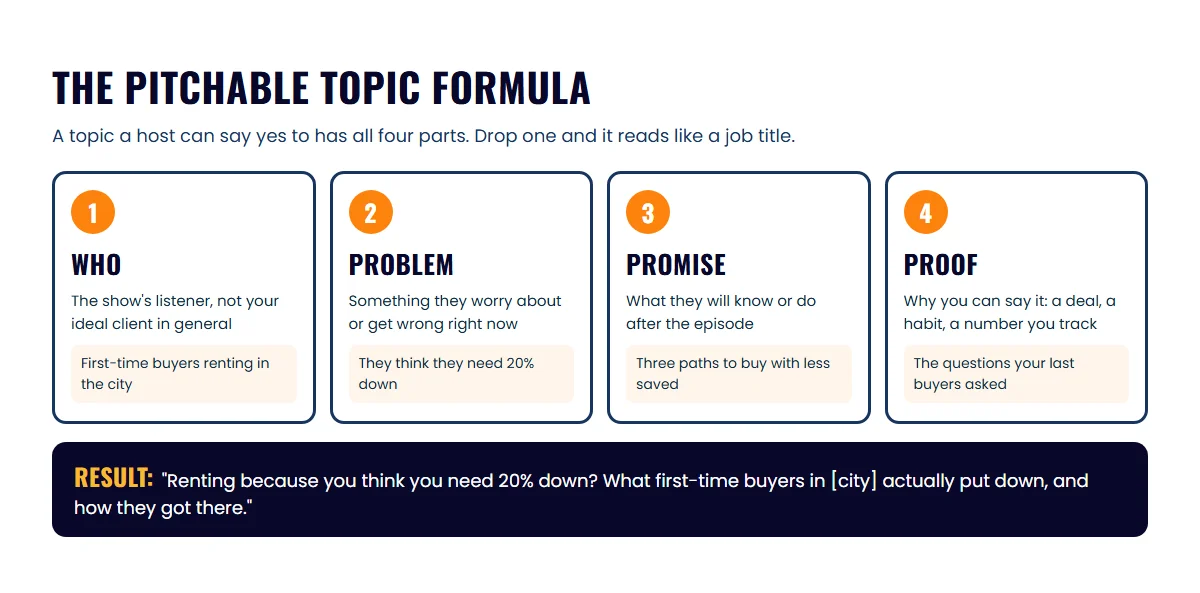
Here’s how that changes the topics agents usually send:
| Weak topic | What’s missing | Pitchable version |
|---|---|---|
| “The current housing market” | Who and promise | “What sellers in [county] are getting wrong about price this season, from my last 10 listing appointments” |
| “Tips for first-time buyers” | Problem and proof | “The three surprises that almost sank my first-time buyers’ deals this year, and how we caught them” |
| “Real estate investing” | Who and problem | “How a W-2 earner can tell if a small rental in [city] pays before they make an offer” |
| “My story as an agent” | Promise | “I left teaching for real estate at 41. What the first two years cost me, and what I’d do differently” |
How do you match a topic to the show’s audience?
Match by asking what the show’s listeners are trying to decide right now. Your expertise only matters where it meets that decision. Use this table to pick the lane before you pick the topic:
| Show audience | What listeners want | Your topic lane | Where it can lead |
|---|---|---|---|
| Renters, young professionals, personal finance | Can I afford to buy, and how? | First-time buyer process and money | Buyer consults in your market |
| Homeowners, retirees, parents of grown kids | When and how to sell or downsize | Selling, pricing, prep, timing | Listing appointments |
| Investors, landlords, side-income shows | Will this property make money? | Numbers, local rules, finding deals | Investor buyers, repeat clients |
| People moving, military, remote workers | What’s it like to move there? | Relocation process and the local area | Out-of-area buyers, agent referrals |
| Local business, city, community shows | What’s happening in our town? | Local housing as part of local life | Your sphere and farm area |
| Agents and brokerage shows | How do top agents run their business? | Systems, niches, lessons learned | Agent-to-agent referrals |
Most agents should spend most of their pitches on the first five rows, because those listeners can hire you. Agent shows build referral relationships, which pay slower. Shows outside real estate entirely are often the easiest bookings; here’s how to find non-real-estate podcasts that want agent guests.
Which 10 topics work on first-time buyer shows?
First-time buyer topics work best on personal finance, career and young-professional shows, where listeners want buying to feel possible and less confusing. Lead with the fear, then the fix.
- “Do you really need 20% down? What first-time buyers I work with actually do.” Cover the loan types you see your buyers use, at a general level, and send detailed loan questions to a lender. Proof: your own buyer stories.
- “Rent vs buy in [city]: the math nobody shows you.” Walk through a labelled example with round numbers, not a promise. Proof: a real comparison you’ve done for a client, anonymized.
- “The first 30 days after your offer is accepted, step by step.” Inspection, appraisal, final walkthrough. Proof: your own checklist.
- “Three surprises that almost sank my buyers’ first deals.” Short stories with a lesson each. Proof: the deals themselves, with names left out.
- “How to read an inspection report without panicking.” What’s a big deal, what’s normal, what to ask for. Proof: the questions buyers ask you most.
- “What a buyer’s agent agreement is, and what to ask before you sign one.” Keep it to process and questions, not what anyone should pay. Proof: how you explain it at your own consults.
- “Condo, townhouse or starter home: which first purchase fits your next five years?” Proof: the trade-offs your past buyers weighed.
- “Buying a home with a partner or friend you’re not married to.” Cover the questions to settle before the offer, and send title and legal questions to an attorney. Proof: deals you’ve worked on.
- “The money you need besides the down payment.” Closing costs, reserves, moving, the first repair. Proof: a labelled example budget.
- “How to win an offer when you can’t offer the most money.” Terms, timing, a clean offer, a good pre-approval. Proof: an offer that won without the top price.
Which 10 topics work on seller and move-up shows?
Seller topics work on homeowner, retirement, parenting and local shows, because those hosts reach people who already own. Sellers want to know what to fix, what it’s worth and when to move.
- “What to fix and what to leave before you sell.” Proof: before-and-after decisions from your listings.
- “Why homes sit: the three pricing mistakes I see at listing appointments.” Proof: your own appointments, with no client details.
- “Selling the family home after 25 years: the emotional side nobody plans for.” Proof: stories from long-time owners you’ve helped.
- “Buy first or sell first? How move-up families handle the gap.” Cover the options at a general level and send financing details to a lender. Proof: how your clients solved it.
- “Downsizing math: what selling the big house really frees up.” Use a clearly labelled example with round numbers. Proof: your process with downsizing clients.
- “Pre-listing inspections: worth it or not?” Give your honest opinion and when it changes. Proof: listings where it helped or didn’t.
- “How to read your first offer, beyond the price.” Contingencies, closing date, concessions. Proof: a multiple-offer story.
- “Staging on a budget: what buyers notice in the first 30 seconds.” Proof: your own showing feedback.
- “Selling an inherited house: the first five steps.” Keep to the real estate side and send probate and tax questions to an attorney or CPA. Proof: estates you’ve listed.
- “What happens between ‘accepted offer’ and ‘closed’ for sellers.” Proof: your timeline handout.
8 topics for investor audiences
Investor shows want numbers, local rules and how deals get found. They’ll test you, so pick a topic you can back with your own transactions.
- “How to run a quick rent check on a property in [city] before you make an offer.” Proof: your own method and the sources you use.
- “Small multifamily in a mid-size market: what’s different from big-city investing.” Proof: duplex and fourplex deals you’ve closed.
- “The local rules out-of-town investors miss.” Permits, rental registration, short-term rental limits in your area. Point listeners to the city’s own pages. Proof: a deal where a rule changed the plan.
- “How agents find off-market deals, and why most of them aren’t deals.” Proof: your pipeline habits.
- “House hacking as a first purchase: what it’s actually like.” Proof: clients who did it, or your own experience.
- “Building an investor-friendly team: agent, lender, inspector, property manager.” Name roles, not paid partners. Proof: the team you work with.
- “Flips that lost money: three mistakes I watched happen.” Proof: anonymized stories.
- “What to ask a listing agent when you’re buying a rental.” Leases, deposits, repair history. Proof: your own question list.
Tax-driven topics such as 1031 exchanges or depreciation belong to CPAs. You can explain how the real estate side works and tell listeners to talk to their tax advisor.
7 topics for relocation and newcomer audiences
Relocation, military, remote-work and career shows reach people who need an agent they’ve never met. Talk about the place and the process, and keep it about homes and amenities.
- “Buying a home in a city you’ve never lived in: how to do it from 1,000 miles away.” Proof: remote buyers you’ve worked with.
- “Your first 90 days in [city]: what newcomers wish they’d known.” Commute, seasons, utilities, home maintenance. Proof: questions your relocating clients ask.
- “Rent first or buy right away when you move?” Proof: clients who did each.
- “Video tours, virtual walkthroughs and buying sight unseen: what can go wrong.” Proof: your remote-showing process.
- “Moving for a new job: how to time the sale, the move and the start date.” Proof: a relocation timeline you’ve run.
- “Comparing areas when you don’t know the city: commute, price, lot size, property taxes.” Proof: the comparison sheet you give clients.
- “How to pick an agent in a city where you know nobody.” An honest, non-salesy version builds trust. Proof: what you’d check yourself.
7 topics for local business and community shows
City, local business and community shows want topics their whole town can use, not just people moving this month. These episodes reach your sphere and farm area, and finding local podcasts to guest on takes a slightly different search than finding industry shows.
- “What’s being built in [town], and what it means for homeowners.” Stick to public projects and records. Proof: the planning documents you follow.
- “Property taxes in [county]: how reassessment works and how to appeal.” Explain the process and point to the assessor’s office. Proof: questions your clients ask.
- “Why local businesses and local real estate rise and fall together.” Proof: your own referral network.
- “Starting a business from home: zoning and HOA questions to ask before you buy.” Proof: buyers who needed a home office or workshop.
- “How [town]‘s housing has changed since you moved here.” Talk about homes, styles and prices, never who lives where. Proof: your years in the market.
- “Home maintenance by season for [region].” Proof: the reminders you send past clients.
- “The real estate side of aging in place.” Single-level homes, modifications, when to move. Proof: clients who faced the choice.
8 topics for agent-to-agent shows
Agent shows reward specific systems and honest numbers from your own business. Listeners won’t hire you, but they can refer you, so pick topics that show how you treat a client.
- “How I built a niche around [client type], and what I turned down.” Proof: your business mix.
- “My follow-up system for past clients, step by step.” Proof: the actual cadence and tools.
- “How I explain buyer agreements and compensation at the first meeting.” Clear it with your broker first, and read up on what you can say about commissions on air after the NAR settlement. Proof: your consult script.
- “What I learned from a deal that fell apart.” Proof: the deal, anonymized.
- “Running a referral business across state lines.” Referral agreements, handoffs, staying in touch. Proof: referrals you’ve sent and received.
- “Content that brought me clients versus content that just got likes.” Proof: your own source tracking.
- “Year one again: what I’d do differently as a new agent.” Proof: your first year.
- “How I prepare sellers for a tough inspection report.” Proof: a listing where it saved the deal.
Which topics should you handle with care?
Some topics are fine to pitch but easy to say wrong on air. An episode stays online for years, and it’s advertising for you and your brokerage. Check these with your broker before you record:
| Topic | Why it’s risky | Safer framing |
|---|---|---|
| “Best neighborhoods for families” or “safe areas” | Can describe areas by who lives there. The Fair Housing Act protects race, color, national origin, religion, sex, familial status and disability (HUD) | Talk about homes, lot sizes, commutes and amenities, and send people to public sources for schools and crime data |
| Commissions and what buyers pay | Policies and broker rules vary, and on-air promises stick | Explain the process and the questions to ask. Let your broker review the script |
| A lender, title or other partner as co-guest | Referral payments between settlement service providers are restricted under RESPA (CFPB, 12 CFR 1024.14) | Go on as separate experts, don’t trade referrals for airtime, and ask your broker’s compliance contact |
| Market forecasts | Predictions age badly and can read as advice | Describe what you’re seeing in your own deals this season |
| Tax, legal, loan details | Outside your license | Explain the real estate side and name the professional to call |
For a fuller pre-recording review, run the episode through a Fair Housing checklist for podcast episodes; your broker has the final word.
How do you turn a topic from this list into a pitch?
Turn a topic into a pitch by rewriting it for one show’s listeners and attaching a proof line. Five steps:
- Listen to two episodes. Note what the host asks every guest and what listeners seem to be dealing with.
- Pick one topic from the matching audience section. Choose the one you have the best story for.
- Rewrite the topic line with the show’s words. Use the listener the host talks to, such as “new parents” or “W-2 investors”.
- Add three bullet points. These are the things you’d cover. Hosts often use them as their question list.
- Add one backup topic from a different section. Keep a third angle ready for your podcast pitch follow-up email.
Put your two best topics on your one-sheet too, so the host sees them in two places. The podcast one-sheet template for realtors has a slot for exactly that.
Next step
Pick two topics from the audience you most want to reach, write the four parts for each, and pitch five shows this week. If you’d rather have someone match your topics to shows and send the pitches, the ICONS Hub’s podcast guesting plans include a booking team that builds your one-sheet and pitches for you.
Frequently asked questions
How many topics should I put in a podcast pitch?
One lead topic and one backup. More than that makes the host do the choosing, and most won't. Keep a third angle ready for your follow-up email.
Can I pitch the same topic to several shows?
Yes, as long as the shows have different audiences. Rewrite the listener and the promise for each show so the pitch doesn't read like a form letter.
Should I talk about the housing market forecast on a podcast?
Only as what you see in your own transactions right now. Predictions age badly in an episode that stays online for years, and they can read as advice your broker never approved.
Sources
- Housing Discrimination Under the Fair Housing Act — U.S. Department of Housing and Urban Development (accessed October 6, 2026)
- § 1024.14 Prohibition against kickbacks and unearned fees — Consumer Financial Protection Bureau (accessed October 6, 2026)
Podcast guesting for agents
Get booked on real estate podcasts
The ICONS Hub connects agents with real estate podcast hosts looking for expert guests.
Guest On The Network
Written by
Co-Founder and Podcast Guru, Icons of Real Estate
Tomás Fonseca co-founded Icons of Real Estate in 2021 and is its Podcast Guru. He has a background in marketing, with stints at companies like Nintendo and Ardor SEO, and is one of the hosts of the Icons of Real Estate Podcast.

How we research, write, fact-check and correct articles: our editorial standards.