On this page
- What is a podcast guest release form?
- Why does a real estate podcast need more than a generic release?
- What should a podcast guest release include?
- Podcast guest release form template
- Which riders do real estate episodes need?
- Do you need the guest’s consent to record?
- How do you collect releases without slowing down booking?
- What can’t a release protect you from?
- Next step
A podcast guest release form, sometimes called a podcast interview release, is a short signed agreement that lets you record, edit and publish a guest’s voice, image and words. Real estate shows need more than a generic template. Add riders for past clients, lenders and title partners, home tours and minors, then have your broker approve the final wording.
Below you’ll find a base release you can copy, four riders built for real estate episodes, the line to read on tape before you hit record, and a simple way to collect signatures without slowing down booking. The release belongs in pre-production, one stage of how a real estate podcast gets produced.
What is a podcast guest release form?
A podcast guest release form is a one-page document in which the guest grants you the right to use the recording of their appearance. It answers four questions in writing: what you can do with the recording, where you can publish it, for how long, and what the guest can and can’t ask you to change later.
It is not a contract for payment, a non-disclosure agreement or a promise of results. Most agent shows don’t pay guests, and the form should say so plainly. That way nobody remembers the deal differently six months from now.
Treat the release as the paperwork side of the booking. You confirm the date, send the questions and send the release in the same email.
Why does a real estate podcast need more than a generic release?
A generic release covers the guest’s voice and face. Real estate episodes put more on the record than that. Here’s what a template from a podcast platform usually misses:
- Clients and deal details. A past client telling the story of their sale may mention price, timing, a divorce or a job loss. You need their written OK for each detail, not just their voice.
- Settlement-service partners. A lender, title or escrow guest creates a RESPA question if anything of value changes hands in exchange for referrals. The release is a good place to state that nothing does.
- Property and people at home tours. Filming in a listing records the owner’s property, their belongings and sometimes their kids. The guest you interview may not be the person who can consent for any of that.
- Your brokerage. The finished episode is advertising for your real estate services. Your broker may require their own wording, a firm-name disclosure or a review before release. Here’s how to ask your broker to approve the show.
- Local businesses. When the owner of a coffee shop or a moving company comes on, their business name and logo appear too. A staff member may not have the authority to approve that.
What should a podcast guest release include?
A podcast guest release should include ten clauses, from the grant of rights and likeness permission to editing, takedowns and a dated signature. The table shows what each clause does and why it matters for an agent’s show.
| Clause | What it says | Why an agent needs it |
|---|---|---|
| Grant of rights | Guest lets you record, edit and publish the appearance | The core permission. Without it you’re publishing someone else’s words on a hope. |
| Name, voice and likeness | You can use their name, image, voice and bio in the episode and in promotion | Covers thumbnails, quote cards and show notes, not just the audio. |
| Editing | You can cut, shorten and reorder for length and clarity | Lets you remove a Fair Housing slip or an off-topic tangent without asking. |
| Formats and channels | Audio, video, transcripts, clips and social posts, in any medium | Agents repurpose heavily. Short clips are often where the leads come from. |
| Duration | No end date, worldwide | Your back catalog should stay live. A guest shouldn’t be able to pull a two-year-old episode on a whim. |
| No payment | Guest won’t be paid, and you won’t be paid for the booking | Clears up expectations and supports your RESPA position with partners. |
| Guest’s own content | Guest owns their ideas and can share the episode | Makes the form feel fair and encourages them to promote it. |
| Guest promises | Guest won’t share others’ private information and has the right to say what they say | Puts responsibility on the guest for their own statements. |
| Takedown request | How a guest can ask for an edit or removal, and that you decide | Gives an unhappy guest a clear path instead of a public complaint. |
| Signature and date | Printed name, signature, date, email | Proof of who agreed and when. Electronic signatures are fine for most shows. |
Podcast guest release form template
Copy this into a document or your e-signature tool, then replace every item in square brackets. Keep the language plain. Guests sign faster when they understand what they’re signing.
Once the form is signed, send the guest your questions. The interview question generator can draft a starting list you then tailor to the guest.
Which riders do real estate episodes need?
A rider is a short add-on section that sits under the base release. Use one for each situation that applies to the episode. Most episodes need none; client stories, partner interviews and home tours usually need at least one.
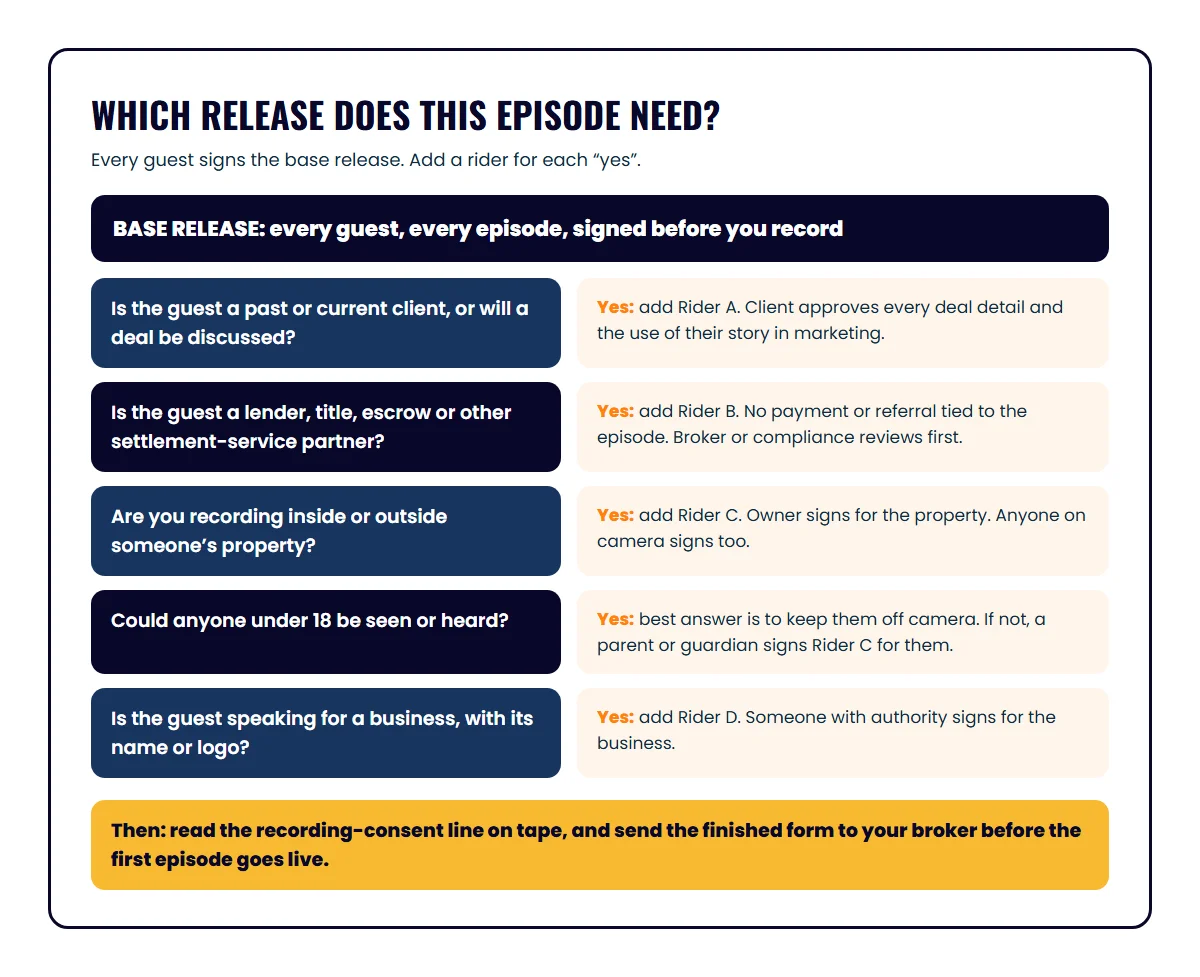
Rider A: past or current clients
Client episodes are some of the most persuasive you’ll make, and the most sensitive. The rider makes the client approve the specific details before they’re aired.
Keep it to details the client chose. If a client says “we sold because of the divorce” on tape, cut it unless they confirm in writing they want it in.
Rider B: lenders, title, escrow and other settlement-service partners
Partner episodes are a strong format, and the referral-partner episode guide covers how to run them. The rider records that the episode isn’t a disguised payment for referrals.
Don’t use this rider to paper over a deal that is really co-marketing. If a lender offers to pay for the show, the studio or the ads, stop. That’s a sponsorship conversation for your broker, and it happens before anyone hits record.
Rider C: home tours, property owners and minors
When you record at a property, the person who owns it consents for the property, and each person on camera consents for themselves. A seller sitting in for the interview can sign both; a tenant can’t consent for the owner.
The simplest rule for kids is to keep them out of frame. Schedule the shoot while they’re out, and do a quick room check for names on bedroom doors, school uniforms and family photos. If a child does appear, the parent or guardian signs, and you blur or cut on request without arguing. Ask your attorney how your state treats consent by minors.
A home tour also raises Fair Housing points. Describe the property and its features, not who should live there or who lives nearby. Your edit is the second chance to catch it.
Rider D: local business guests
Local business owners make good guests for a community-focused show, and they bring their own audience. The rider confirms the person signing can approve the use of the business name and logo.
Once the episode is live, send the business owner a ready-made sharing pack. The guest share kit shows what to put in it.
Do you need the guest’s consent to record?
Yes, get every guest’s consent to record, every time, even where the law only requires one party’s consent. Under federal law, recording is generally allowed when one party to the conversation consents. The text of 18 U.S.C. § 2511(2)(d) says it isn’t unlawful when the person recording is a party or one party has given prior consent. Several states go further. The Digital Media Law Project’s guide to recording phone calls and conversations lists states that require every party’s consent, including California, Florida and Pennsylvania.
Remote interviews often cross state lines, so don’t try to work out whose law applies. Get consent from everyone, in writing and on tape.
Keep that 15 seconds in your raw file and cut it from the published episode. If a second person walks into the guest’s room, pause and get their OK too.
How do you collect releases without slowing down booking?
Make the release part of the booking confirmation, not a separate chore. Here’s a process that takes about two minutes per guest:
- Build the form once. Load the base release and riders into an e-signature tool as a template, with your broker’s approved wording.
- Send it with the calendar invite. The confirmation email includes the date, the recording link, three to five questions and the release. State that you record once it’s signed.
- Tick the riders. Before sending, pick the riders that apply. Use the decision chart above.
- Chase it 48 hours out. If it isn’t signed two days before the session, send one reminder. If it still isn’t signed on the day, read the consent line and get the signature before you publish.
- Store it with the episode. Save the signed PDF in the same folder as the raw files, named with the episode number and guest name. You’ll want it if a takedown request arrives in two years.
- Log takedown requests. Note the date, the request and what you did. Treat each one fairly and fast.
New to booking? This workflow slots into the outreach plan for a show’s first ten guests. If a production company books guests for you, ask who sends and stores releases; it’s a good question when you compare real estate podcast production companies.
What can’t a release protect you from?
A podcast guest release covers permission to publish, but it doesn’t make the content itself safe. A signed form won’t fix:
- Defamatory or false claims. If a guest says something untrue about a named person or business, cut it.
- Fair Housing problems. Statements that describe an area by its residents, or suggest who a home is “right for”, don’t belong in your episode, whoever says them. Cut and re-record if needed.
- Missing brokerage disclosure. Your intro, outro or show notes still need the wording your broker requires.
- Music, images and clips you don’t own. A guest can’t grant rights to a song playing in the background or a photo they found online.
- Undisclosed sponsorships. If anyone pays for a segment, the episode needs to say so clearly.
Do a compliance listen before every release. On a video episode, that includes the background; setting up a clean video podcast background saves you from fixing it in the edit.
Next step
Copy the base release and riders into your e-signature tool today. Send it to your broker with a note asking for any required wording, then make it a fixed attachment on every booking confirmation. Once that’s done, you’ll never hold a finished episode you can’t publish.
Frequently asked questions
Is a verbal OK on the recording enough instead of a signed release?
It's better than nothing, but it's weak. A recorded yes proves consent to record; it rarely spells out clips, ads, revocation or business names. Get the signature and the on-tape line.
Do I need a release if the guest is my friend or a family member?
Yes. Friends become ex-friends and family members change their minds. The form costs you two minutes and protects the episode you spent hours making.
Can a guest sign the release after we record?
They can, but don't plan on it. If they refuse later, you can't publish. Make the signed form a condition of the calendar invite.
Should I use my brokerage's form instead of this one?
If your brokerage has one, use it or merge the riders below into it. Your broker's form already reflects their policies and their lawyer's preferences.
Sources
- 18 U.S. Code § 2511 - Interception and disclosure of wire, oral, or electronic communications prohibited — Cornell Law School LII (accessed October 6, 2026)
- Recording Phone Calls and Conversations — Digital Media Law Project (accessed October 6, 2026)
Done-for-you podcast production
Want a podcast that brings in referrals, not just downloads?
Icons of Real Estate plans, produces and publishes business-growing podcasts for agents. You record. We handle the rest.
Launch Your Podcast
Written by
Co-Founder and Podcast Guru, Icons of Real Estate
Tomás Fonseca co-founded Icons of Real Estate in 2021 and is its Podcast Guru. He has a background in marketing, with stints at companies like Nintendo and Ardor SEO, and is one of the hosts of the Icons of Real Estate Podcast.

How we research, write, fact-check and correct articles: our editorial standards.