On this page
- What are a realtor’s four podcast production options?
- What is one hour of your time worth?
- Which route is cheapest at your hourly value?
- Is DIY plus AI tools a real middle path?
- Should a realtor hire a podcast editor or a full producer?
- What does the time-cost math miss?
- How do you test the decision in 60 days?
- Next step
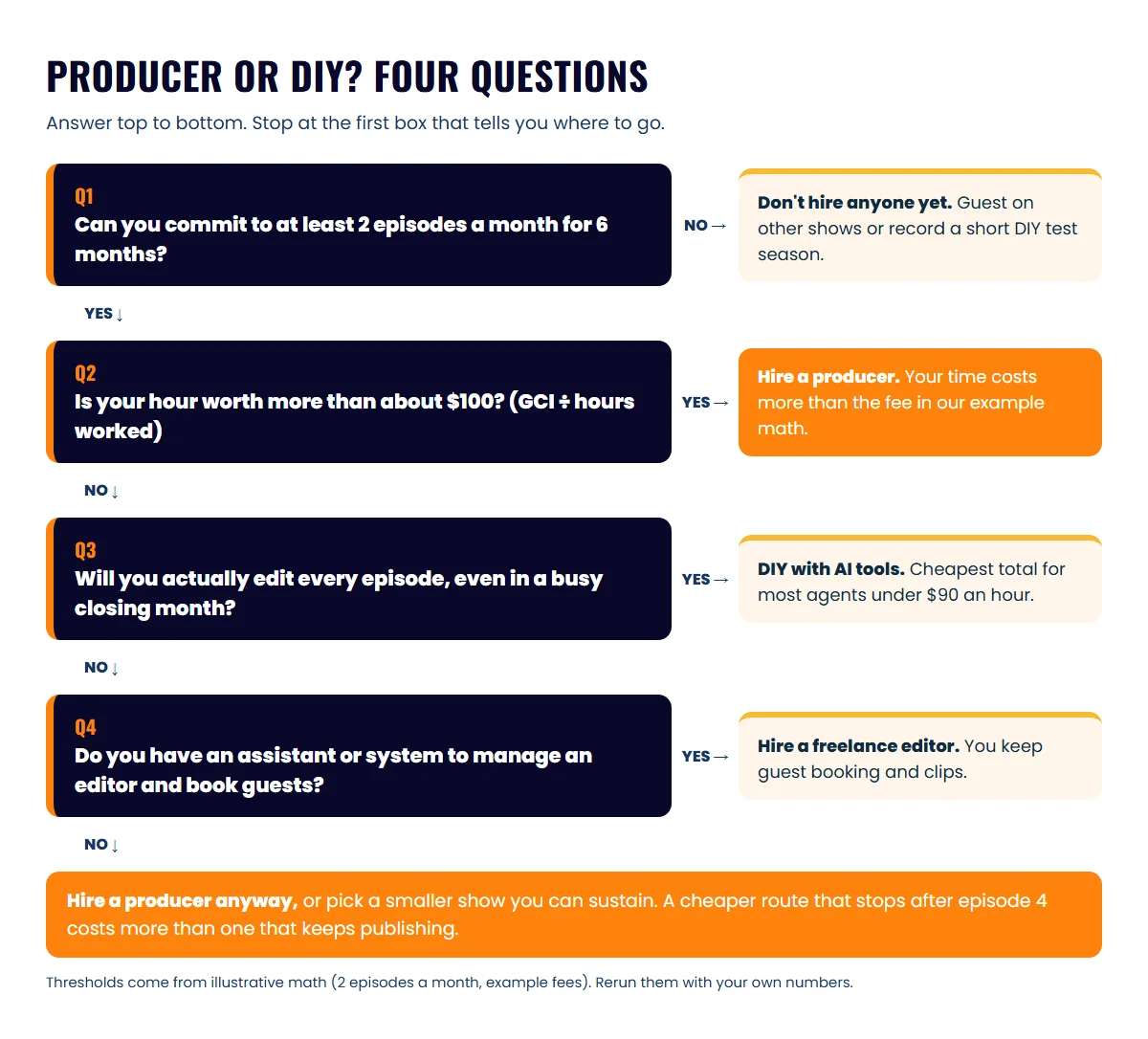
In our example math, a realtor should hire a podcast producer once your hour is worth about $100 and the show releases at least two episodes a month. Below that, do it yourself with AI editing tools, or pay a freelance editor. Multiply your hourly value by each route’s hours, add the fee, and pick the lowest total.
Every number below is an example you can swap for your own. What each route actually involves, step by step, is mapped in the real estate podcast production workflow.
What are a realtor’s four podcast production options?
Real estate agents have four realistic podcast production routes, not two: DIY, DIY plus AI tools, a freelance editor, or a producer. The old “DIY or hire” question skips the middle ground that AI editing tools and freelancers now fill.
| Route | Who does the editing | Who books guests and makes clips | Your hours per episode (our estimate) |
|---|---|---|---|
| DIY | You, in a standard editor | You | About 6 |
| DIY plus AI tools | You, with AI doing the first pass | You, with AI suggesting clips | About 4 |
| Freelance editor | A hired editor | Usually you | About 2.5 |
| Producer (done-for-you) | A production team | Usually the team, depending on package | About 1 |
The hour figures are planning estimates, not survey data. They match the estimates used in real estate podcast cost and ROI, and they’re in line with what agents told NAR years ago. In a 2019 NAR feature on agent podcasts, one host said his 30-minute shows took about 40 minutes to an hour to edit and finalize. Another said each show took about three to four hours from script to syndication. Add video and short clips, which most agents want now, and the hours climb.
Time your own first three episodes. Your real numbers beat ours. A task-by-task weekly time breakdown for an agent podcast helps you log them.
What is one hour of your time worth?
Your hourly value is your gross commission income divided by the hours you actually worked. It’s a rough figure, but it’s the right one, because every hour you spend editing is an hour not spent on a listing appointment or a call to your sphere.
- Take last year’s GCI. Use what you kept after splits if your split is large.
- Estimate the hours you worked. For example, a 25-hour week across 48 weeks is 1,200 hours.
- Divide GCI by hours.
| Example GCI | Hours worked | Hourly value |
|---|---|---|
| $60,000 | 1,200 | $50 |
| $120,000 | 1,200 | $100 |
| $180,000 | 1,200 | $150 |
| $300,000 | 1,200 | $250 |
These rows are examples, not benchmarks. Plug in your own figures before you trust any result below.
Which route is cheapest at your hourly value?
The cheapest route is the one with the lowest total: the cash fee plus your hours multiplied by your hourly value. Here is that math for a show releasing two episodes a month.
Total monthly cost (cash plus your hours at your hourly value):
| Your hourly value | DIY | DIY plus AI | Freelance editor | Producer |
|---|---|---|---|---|
| $50 | $600 | $424 | $550 | $721 |
| $100 | $1,200 | $824 | $800 | $821 |
| $150 | $1,800 | $1,224 | $1,050 | $921 |
| $250 | $3,000 | $2,024 | $1,550 | $1,121 |
The bold cell is the lowest total in each row. Three things stand out.
- Plain DIY never wins. Once AI tools cost about the price of a lunch, editing everything by hand loses at every hourly value in this example.
- At $100 an hour, three routes are within $24 of each other. In this example that’s a tie. When the math ties, decide on the factors in the next sections, not on the spreadsheet.
- Above $150 an hour, the producer wins clearly, and in this example the gap widens as your hour gets more valuable.
Where are the crossover points?
A crossover is the hourly value where paying more cash for fewer hours starts to make sense. Divide the extra fee by the hours it saves.
| Switch | Extra cash per month | Hours saved | Crossover |
|---|---|---|---|
| DIY plus AI to freelance editor | $276 | 3 | About $92 an hour |
| DIY plus AI to producer | $597 | 6 | About $100 an hour |
| Freelance editor to producer | $321 | 3 | About $107 an hour |
If your hourly value sits below about $92, DIY with AI tools is the best value in this example. Above about $107, a producer is. In between, it’s close, and the next sections should decide it. The cost and ROI guide linked above reaches slightly different crossovers because it models 12 months and video editing rates, which shows how much the answer moves with your assumptions. Run yours through the podcast cost calculator.
Is DIY plus AI tools a real middle path?
DIY plus AI tools is a real middle path for agents who will reliably sit down and edit. AI editors now handle the slowest mechanical work, which is why we estimate the route at about 4 hours an episode instead of 6. For the recording, review and hosting side, the free ICONS DIY Podcast workspace puts ICONS Live, Review and hosting under one sign-in.
What AI tools do well
- Filler words and silences. Descript’s paid plans list “Remove Filler Words” for cutting “um,” “ah” and repeated words, and Riverside lists removal of silences and filler words.
- Audio cleanup. Descript lists Studio Sound for improving voice quality on imperfect recordings.
- Transcripts and text-based editing. You edit the episode by deleting words in a transcript instead of scrubbing a timeline.
- Clip and show-note drafts. Riverside lists “Magic clips & show notes,” and Descript lists clip creation and an AI co-editor called Underlord.
What AI tools don’t do
- Book and brief guests. That’s often an hour or more per episode, and no editor touches it.
- Run the compliance listen. A guest’s offhand Fair Housing slip about a neighborhood, or a missing brokerage line, needs a human ear. Check your disclosure wording with your broker.
- Fix local detail. AI won’t know that a street name was mispronounced or which school boundary comment should come out.
- Keep you consistent. The tool is ready every week. You might not be.
That last point is the real risk of this route. A DIY-plus-AI show costs the least only while it keeps publishing.
Should a realtor hire a podcast editor or a full producer?
A realtor should hire a podcast editor if the bottleneck is editing, and a full producer if the bottleneck is everything around the recording. The two jobs are easy to confuse, and agents often pay for the wrong one.
A podcast editor cleans up and assembles recordings you send them. A podcast producer runs the show: planning, guest coordination, editing, publishing, clips and the release schedule. The editor saves you post-production hours. The producer also saves you the booking, publishing and repurposing hours, which is why the time gap between them is bigger than it looks.
| Your situation | Better fit |
|---|---|
| You enjoy booking guests and posting clips, but hate editing | Freelance editor |
| You have an assistant who can manage files and deadlines | Freelance editor |
| Guest booking is what keeps slipping | Producer |
| You’ve missed release dates because of closings | Producer |
| You want a video show with clips and an episode article each week | Producer, or an editor plus a lot of your own time |
Going the producer route? Score competing quotes with the production company comparison worksheet, and check the weekly deliverables against what a done-for-you podcast includes.
What does the time-cost math miss?
The math treats every hour the same and assumes the show keeps running. Neither is quite true, so weigh four other factors before you decide.
- Consistency. A route you abandon after five episodes costs more than any row in the table, because you paid for a show that stopped building trust. Be honest about your worst month, not your average one.
- What you do with freed hours. Saved time only has value if it goes into prospecting, follow-up or client work. If those hours drift into email, the cheaper cash route was the better deal.
- Skill and quality. A first-time editor makes a rougher episode than a practiced one. That matters less for a sphere newsletter audience and more if you want to win over strangers on YouTube.
- Cash flow. A producer is a fixed monthly cost. If your income is lumpy, look at contract terms and cancellation notice before you sign.
Also check what your brokerage already offers. Some have studios or marketing staff who can help, which changes your numbers before you pay anyone.
Signs you’ve outgrown DIY
- You’ve pushed an episode’s release date twice in a quarter
- Recorded episodes are sitting unedited
- You skip clips and show notes to get the episode out
- Guest booking takes longer than the recording
- You avoid listing appointments on your editing day
Two or more of these, and the cheap route is no longer cheap.
How do you test the decision in 60 days?
Run a short, measured trial instead of guessing. Sixty days covers four episodes at a two-a-month pace, which is enough to see your real hours.
- Weeks 1 to 2: Record two episodes and produce them yourself with an AI editing tool. Log every minute, including guest booking and clip posting.
- Weeks 3 to 4: Publish both. Note what you skipped to get them out.
- Weeks 5 to 8: Produce two more episodes the same way, or hand them to a freelance editor if the first month ran over.
- Day 60: Multiply your logged hours by your hourly value. Add the cash you spent. Compare that total with producer quotes.
If you’d rather test the full done-for-you model, Icons of Real Estate’s production service starts at $497 one time for the Launchpad and from $621 a month for Ongoing Production, with roughly an hour a week of your time, by Icons’ own description. Whoever you hire, make sure the show, the RSS feed and the back catalog stay in your name. To turn any of these fees into a deal count, use the closings needed to cover a podcast budget.
Next step
Work out your hourly value today. Then log your hours on your next two episodes, whatever route you’re on now. With those two numbers, the grid above gives you an answer in five minutes, and it will be your answer, not ours.
Frequently asked questions
Is a podcast producer worth it for a new agent?
Usually not in year one. If your hour is worth less than about $90, a DIY show with AI editing tools costs less in total, and you learn what your show needs before paying someone to run it.
Can I switch from DIY to a producer later?
Yes. Make sure the podcast host account and RSS feed are in your name from day one, so a producer can take over the show without starting a new feed.
Should my assistant edit the podcast?
Only if editing replaces lower-value work in their week. An assistant's hour pulled away from transaction coordination or follow-up still costs your business money.
Sources
- Sharing Real Estate Knowledge Through Podcasts — National Association of Realtors (accessed October 6, 2026)
- Pricing — Descript (accessed October 6, 2026)
- Plans & Pricing — Riverside (accessed October 6, 2026)
Done-for-you podcast production
Want a podcast that brings in referrals, not just downloads?
Icons of Real Estate plans, produces and publishes business-growing podcasts for agents. You record. We handle the rest.
Launch Your Podcast
Written by
Co-Founder and Podcast Guru, Icons of Real Estate
Tomás Fonseca co-founded Icons of Real Estate in 2021 and is its Podcast Guru. He has a background in marketing, with stints at companies like Nintendo and Ardor SEO, and is one of the hosts of the Icons of Real Estate Podcast.

How we research, write, fact-check and correct articles: our editorial standards.