On this page
- What is a local market update podcast?
- Which numbers belong in a market update?
- What is the segment plan for a 12-minute market update?
- Market update script template
- What does a finished market update look like?
- How do you turn one market update into clips?
- How do you record a market update video without a studio?
- What should you never say in a market update?
- Should you use an AI avatar for market updates?
- How often should you publish a market update?
- Next step
A local market update podcast for realtors is a recurring episode where you explain what your market did last month and what it means for buyers and sellers. Use a fixed 12-minute plan: three local numbers, one local story, a buyer half, a seller half and one call to action. Record it on video and cut four clips.
Below are the timings, a fill-in script, a worked example and the clip map. Editing and publishing around it follow the same production workflow as any agent podcast. If you want something to alternate with the monthly update, choose from these episode formats that suit agent shows.
What is a local market update podcast?
A local market update is a solo episode, usually monthly, in which an agent turns local housing data into plain advice. It isn’t a news recap. Anyone can read a headline about mortgage rates. Your job is to say what last month meant for someone selling a three-bedroom on the north side of your town.
That’s also why it works as lead generation. Homeowners who aren’t ready to move still want to know what their house might be worth. A steady monthly update makes you the person they think of when the answer starts to matter.
Most search results for this topic sell AI-generated avatar videos. You don’t need one. You need a repeatable structure, three good numbers and the nerve to give an opinion.
Which numbers belong in a market update?
Pick three numbers per episode, and make one of them the number that changed the most. Ten statistics in a row sound like a spreadsheet read aloud. Three numbers, each explained, sound like an expert.
Pull them from your MLS or your local Realtor association’s monthly report. National figures, such as NAR’s monthly Existing-Home Sales report, are useful context for one sentence. They don’t describe your town, so don’t build the episode on them.
| Metric | What it tells the listener | How to say it plainly |
|---|---|---|
| Median sale price | Where prices sit for a typical home | “Half the homes that sold went for more than this, half for less.” |
| Months’ supply | Whether it’s a buyer’s or seller’s market | “If nothing new listed, it would take this long to sell everything on the market.” |
| Days on market | How fast homes sell | “A typical home went under contract in about this many days.” |
| Sale-to-list price ratio | How much room there is to negotiate | “Sellers got about this share of their asking price.” |
| New listings | Whether choice is growing for buyers | “This many homes came on the market, up or down from last month.” |
| Active inventory | How much buyers can pick from today | “This is how many homes you could tour this weekend.” |
NAR defines months’ supply as the number of months it would take to sell all current inventory at the current sales pace. That’s a definition worth repeating on air, because few homeowners know it.
Three rules for using numbers on air
- Name the area, the month and the source every time. “Single-family homes in [TOWN], September, from our MLS” is one sentence and it protects you.
- Compare to something. A number alone means little. Compare to last month or the same month last year.
- Round for the ear. Say “about 31 days,” not “30.7 days.” Put the exact figures in the show notes.
What is the segment plan for a 12-minute market update?
The plan below has six segments and fits in about 12 minutes. Keep the order the same every month so you can prepare in under an hour and listeners know what’s coming.
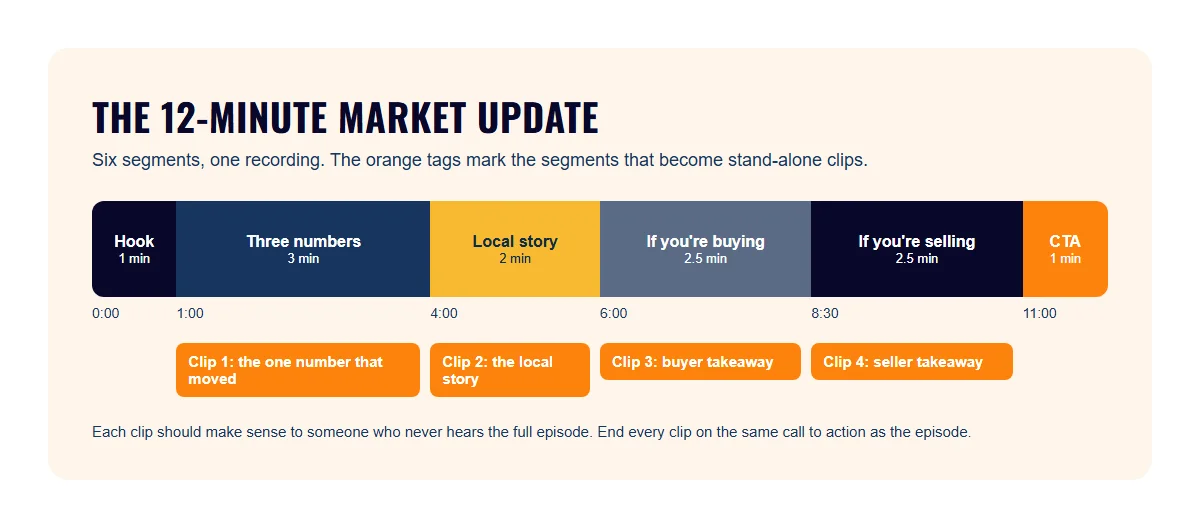
| Segment | Time | What you do | Prep needed |
|---|---|---|---|
| 1. Hook | 0:00 to 1:00 | State the one thing that changed and who it matters to | One sentence, written out |
| 2. Three numbers | 1:00 to 4:00 | Each number, compared and translated | Your three numbers and last month’s |
| 3. Local story | 4:00 to 6:00 | One local development, business, road project or event and what it means for housing | A link or note in the show notes |
| 4. If you’re buying | 6:00 to 8:30 | What the numbers mean for buyers right now | Two pieces of advice |
| 5. If you’re selling | 8:30 to 11:00 | What the numbers mean for sellers right now | Two pieces of advice |
| 6. Call to action | 11:00 to 12:00 | One specific next step | One offer, written out |
The local story is what separates you from a data feed. It could be a new grocery store opening, a road project, a zoning vote on new homes or a seasonal event. Keep it factual and about places and plans, not about the people who live there.
Market update script template
Copy this script and replace every bracketed item. Read the hook and the call to action word for word. Talk through the middle from the bullets so you sound like yourself.
Two tips on the call to action. Offer one thing, not three. And make it something useful, like a street-level price report, rather than “call me if you’re thinking of moving.”
What does a finished market update look like?
A finished market update follows the template line by line, with real local numbers in every bracket. The version below uses a made-up market, and every number is invented for illustration.
How do you turn one market update into clips?
Plan the clips before you record, then cut them from segments 2 to 5. Each clip should make sense to someone who never hears the full episode, so open each segment with a complete thought, not “And another thing.”
| Clip | Cut from | Length to aim for | Where to post |
|---|---|---|---|
| The number that moved | Segment 2 | 30 to 60 seconds | YouTube Shorts, Reels, a short in your newsletter |
| The local story | Segment 3 | 45 to 90 seconds | Facebook, Reels, Shorts |
| Buyer takeaway | Segment 4 | 30 to 60 seconds | Shorts, Reels, email to buyer leads |
| Seller takeaway | Segment 5 | 30 to 60 seconds | Shorts, Reels, email to your past clients and sphere |
YouTube now allows Shorts up to three minutes long, so you can post a whole segment if it holds up. Shorter usually works better for a number and a takeaway. Add captions to every clip so it still works when someone scrolls past with the sound off.
End each clip with the same call to action as the full episode. One offer, repeated across five pieces of content, is easier to track than five different ones. Turning a full video episode into a month of posts is its own system, set out in the video podcast playbook for agents.
How do you record a market update video without a studio?
A phone or webcam, a clip-on or USB microphone and a window are enough. Viewers forgive simple video. They don’t forgive bad sound.
- Prepare on the same day each month. Pull your numbers the day your MLS or association publishes them. NAR’s national report comes out mid-month, so recording soon after it lets you add one line of national context.
- Write only the hook and CTA. Put your three numbers and four pieces of advice on one card or a notes app beside the camera.
- Face a window, not a lamp. Natural light from the front is the cheapest upgrade there is.
- Record segment by segment. If you stumble, restart that segment. Clean breaks between segments also make the clips easier to cut.
- Show one simple graphic per number. A large figure on screen, with the area and month, beats a busy chart.
- Publish the full episode first, then the clips over the next two weeks. Spreading them out keeps you visible without recording more.
What should you never say in a market update?
Keep every sentence about homes, prices, timing and places, never about the kind of people who live somewhere. Fair Housing problems in market content usually come from loose descriptions, not from the numbers.
- No describing who lives in an area. Phrases like “great for young families” or “a safe neighborhood” can read as steering. NAR’s guidance on steering, crime and schools says to stay objective and factual and to avoid subjective commentary, personal opinions and hearsay. Point people to official data sources instead.
- No numbers you can’t source. If you can’t say where a figure came from, cut it. Mixing areas or time periods is the most common accuracy slip.
- No promises about where prices are going. You can share your read of the trend. Label it as your opinion and don’t guarantee anything.
- No unapproved listing talk. Featuring your own listings or recent sales brings in seller consent and MLS rules; read the rules for talking about listings on a podcast first.
- Required disclosures. Most brokerages require your brokerage name in advertising, and a market update video counts. Ask your broker for the exact wording before episode one.
Until the habits stick, check each script against a Fair Housing checklist for podcast hosts before you record.
Should you use an AI avatar for market updates?
You shouldn’t use an AI avatar for market updates. Avatar tools save you 15 minutes and cost you the whole point. People hire the agent they feel they know. A video of a synthetic presenter reading numbers anyone could download builds no trust in you.
AI is useful behind the camera. Use it to draft show notes, suggest a headline or turn your transcript into a newsletter blurb. Then check every number against your source before anything goes out.
How often should you publish a market update?
Once a month is the right pace for most agents. Markets rarely change enough in a week to fill a useful episode, and a monthly slot is easy to keep for a year.
Market updates also pair well with other formats. Many agents alternate them with guest interviews, such as the Main Street spotlights on a hyperlocal real estate podcast. Your market update can also travel. Hosts of local and relocation shows often want a guest who can explain a market in five minutes.
If recording is the only part you want to do, hand off editing, clips and publishing. Icons of Real Estate offers production for agent podcasts, and you can weigh it against other podcast production companies for agents.
Next step
Pick a recording day this month, pull your three numbers and fill in the script above. Record it once, cut the four clips, and do it again next month with the same structure. By the third episode, preparation should take well under an hour.
Frequently asked questions
How long should a real estate market update video be?
About 10 to 12 minutes for the full episode is enough for three numbers, a local story and advice for both sides. The clips you cut from it should each be under a minute or two.
Where do I get local market data for my update?
Use your MLS reports or your local Realtor association's monthly statistics, since those cover your actual area. National reports such as NAR's Existing-Home Sales are useful context but should never replace local numbers.
Can I do a market update with no listings or sales of my own?
Yes. The numbers come from the market, not your own deals. Just be clear about the source, and don't imply sales were yours unless they were.
Should I read the script word for word?
Read the hook and the call to action word for word, and talk the middle from bullet points. Fully read scripts tend to sound flat on camera.
Sources
- Existing-Home Sales — National Association of REALTORS (accessed October 6, 2026)
- FAQs on Steering, Crime and Schools — National Association of REALTORS (accessed October 6, 2026)
- Upload YouTube Shorts — YouTube Help (accessed October 6, 2026)
Done-for-you podcast production
Want a podcast that brings in referrals, not just downloads?
Icons of Real Estate plans, produces and publishes business-growing podcasts for agents. You record. We handle the rest.
Launch Your Podcast
Written by
Co-Founder and Podcast Guru, Icons of Real Estate
Tomás Fonseca co-founded Icons of Real Estate in 2021 and is its Podcast Guru. He has a background in marketing, with stints at companies like Nintendo and Ardor SEO, and is one of the hosts of the Icons of Real Estate Podcast.

How we research, write, fact-check and correct articles: our editorial standards.