On this page
- Why do real estate agents quit YouTube?
- Why is a booked guest harder to skip than a video idea?
- Which guests keep a real estate YouTube channel going?
- How do you set up a podcast schedule that keeps YouTube fed?
- How long should you give YouTube before you judge it?
- What if you already quit your real estate YouTube channel?
- Should you edit the YouTube videos yourself?
- Next step
Real estate agents quit YouTube because every solo video starts from a blank page, editing eats their evenings, and views stay low for months. To stay consistent, run the channel like a podcast: book a guest each week, record two to three weeks before you publish, and let one interview feed both YouTube and podcast apps.
A booked guest is an appointment you keep. A video idea in your notes app is not. That difference is most of this article.
Why do real estate agents quit YouTube?
Real estate agents quit YouTube for the same few reasons, and none of them is laziness. Each one is a design flaw in how the channel was set up. Fix the design and the habit gets easier.
The table lists the five most common reasons and what an interview schedule changes.
| Reason agents quit | What it feels like | What an interview schedule changes |
|---|---|---|
| Blank-page ideas | “What do I film this week?” | The guest and their expertise are the topic |
| Talking alone to a lens | Ten takes of a two-minute market update | A conversation, where the guest carries half |
| Editing load | Evenings lost to a timeline | One long video, edited once, cut into clips |
| No deadline | Filming slides behind every showing | A person expects you at 10 am Tuesday |
| Slow, low views | 40 views after three months | You also gain a relationship from every episode |
That last row matters most. A solo video with 40 views has given you almost nothing. An interview with 40 views still gave you an hour with a lender, an inspector or a top agent in another market, and a reason to send them the finished episode.
If being on camera is the real block, read how camera-shy realtors podcast without loving the camera.
Why is a booked guest harder to skip than a video idea?
A booked guest is harder to skip because cancelling means letting a real person down, while skipping a video only lets yourself down. Agents are good at keeping appointments. They do it all day. So make YouTube an appointment.
Three things happen when the channel runs on guests:
- Prep drops to 15 minutes. You need five questions and the guest’s background, not a script. The interview question generator gets you a first draft.
- The content is better. A mortgage lender explaining rate buydowns is more useful to a buyer than your summary of it.
- The schedule fills itself. Once guests are booked a month out, you’re no longer deciding each week whether to film.
Which guests keep a real estate YouTube channel going?
The guests who keep a real estate YouTube channel going are the professionals your clients already ask you about. They have real answers, they’re easy to book locally, and most of them want the exposure as much as you want the episode.
Rotate through these so the channel never runs dry. Each row is a guest type, an episode that tends to stay useful, and why they say yes.
| Guest type | Episode idea that lasts | Why they agree |
|---|---|---|
| Mortgage lender | What pre-approval really checks | Buyers are their customers too |
| Home inspector | What gets flagged in older homes | They rarely get to explain their work |
| Stager or designer | Getting a home ready on a small budget | Before-and-after stories sell their service |
| Contractor | What to fix before listing, and what to skip | Sellers are their next jobs |
| Past client | What I wish I’d known before buying | They like you, and it’s flattering to be asked |
| Agent in another market | Moving to their city from yours | Referrals can flow both ways |
Before any lender or co-marketing episode, check your brokerage’s rules on joint promotion. Then book the next six guests in one sitting. That one hour of outreach sets your schedule for two months.
How do you set up a podcast schedule that keeps YouTube fed?
A podcast schedule keeps YouTube fed by separating three dates: when you book a guest, when you record, and when the video goes live. The gap between them is your safety margin.
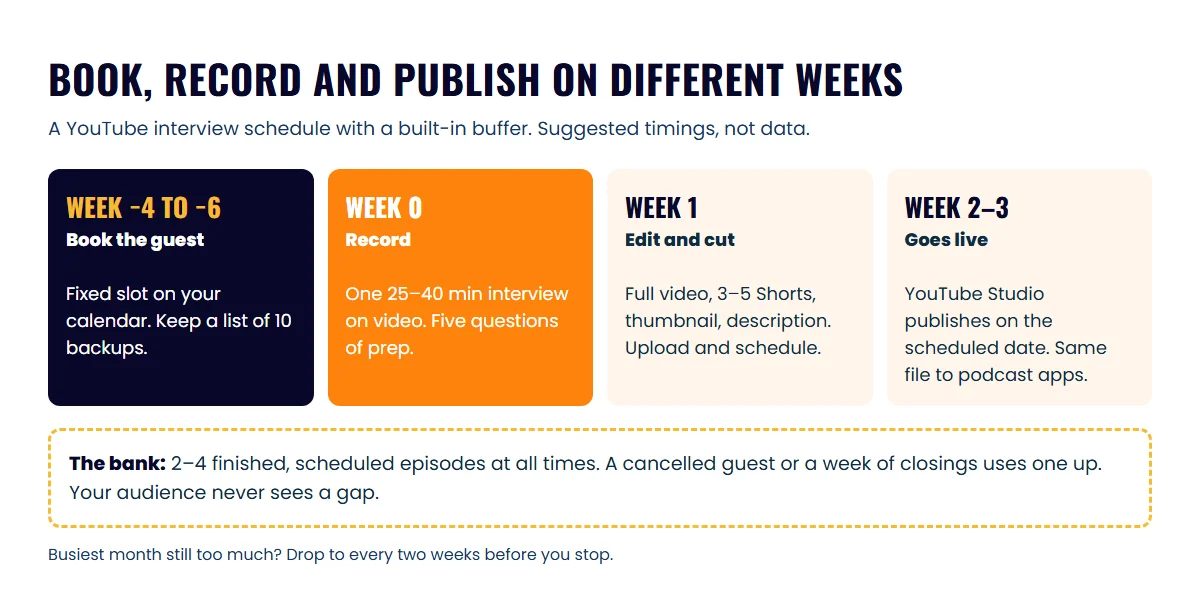
Set it up in this order:
- Choose a cadence you can keep in your busiest month. Weekly if you have help with editing, every two weeks if you don’t.
- Fix one recording slot. Same day and time each week, protected like a listing appointment.
- Book guests four to six weeks ahead. Keep a list of ten possible guests so a cancellation never leaves a gap.
- Publish two to three weeks after you record. In YouTube Studio you can upload a video and schedule the date, time and time zone it goes public, so publishing doesn’t need you on the day.
- Start with a bank. The ICONS Podcast Framework advises releasing at least three episodes on day one and having 10 ready by launch. A bank turns a missed recording into a non-event.
- Cut clips from every episode. Shorts and Reels point back to the full interview, which is where viewers decide whether they like you.
The same recording goes to podcast apps, so you’re building two channels for the work of one. For the case for running both, see podcast vs YouTube channel for real estate agents.
How long should you give YouTube before you judge it?
Give YouTube at least three months of unbroken publishing before you judge it on views, and judge it on conversations and referrals from the start. Early view counts on a local channel are small, and that’s normal.
YouTube’s own help page on how YouTube search works says search ranks videos on three elements: relevance, engagement and quality. Nothing in that list rewards posting every day. A focused interview that answers a real local question can keep being found long after the week it went up.
The audience is there too. YouTube says it had more than 1 billion monthly active viewers of podcast content as of January 2025. You only need a few hundred of them in your market.
Track these each month instead of chasing subscribers:
- Episodes published on schedule
- Guests recorded, and guests who shared their episode
- Calls, DMs and emails that mention a video
- Referrals or introductions from guests
For the lead side, see how real estate agents get leads from YouTube.
What if you already quit your real estate YouTube channel?
If you already quit your real estate YouTube channel, restart it as an interview show instead of deleting it. Old videos still count as proof that you’ve been around, and the subscribers you have will see the new episodes.
A restart checklist:
- Keep the channel and old videos. Hide only anything outdated or off-brand.
- Update the banner and description to say what the show is and how often it posts.
- Record a 60-second trailer. Explain the new format and how often it posts.
- Bank three or four episodes before you announce anything. That buffer is what keeps a restart alive.
- Tell your sphere. Send one email: “I’m back, and here’s who I’m talking to.”
If the show was a podcast that also stalled, the relaunch checklist for a stalled real estate podcast covers the feed and the trailer in more detail. For the channel setup itself, use the guide to starting a real estate YouTube channel around an interview show.
Should you edit the YouTube videos yourself?
You should edit the videos yourself only if you have the hours every week, including your busiest week. Editing is the task that kills most agent channels, because it’s slow, it’s lonely and nobody is waiting for it.
Count the hours honestly with the weekly time budget for a real estate podcast. If the number doesn’t fit your worst month, hand it off. With our done-for-you podcast production, every episode goes out to YouTube, Spotify, Apple and the other major platforms, and your part is the recording.
For the bigger picture of how one interview becomes a video show, see the pillar on real estate video podcasts.
Next step
Book your first three guests before you film anything else. Once three people expect you on three dates, the channel has a schedule. If consistency is a problem across all your content, not just YouTube, read how busy real estate agents stay consistent with content.
Frequently asked questions
How many videos before a real estate YouTube channel works?
There's no fixed number. Judge the first three months on whether you published every cycle and booked guests, then judge on calls and referrals that mention a video.
Should I upload my podcast to YouTube as audio only?
Video is better. A static image with audio gives YouTube little to show in clips and Shorts, and viewers expect to see faces in an interview.
Can I post Shorts instead of long videos?
Shorts are good trailers but poor homes for an answer. Cut them from the long interview and point each one back to it, so the long video does the persuading.
Sources
- Schedule video publish time — YouTube Help (accessed October 21, 2026)
- How YouTube search works — YouTube Help (accessed October 21, 2026)
- 1 billion monthly podcast users on YouTube — YouTube Official Blog (accessed October 21, 2026)
Done-for-you podcast production
Want a podcast that brings in referrals, not just downloads?
Icons of Real Estate plans, produces and publishes business-growing podcasts for agents. You record. We handle the rest.
Launch Your Podcast
Written by
Co-Founder and Podcast Guru, Icons of Real Estate
Tomás Fonseca co-founded Icons of Real Estate in 2021 and is its Podcast Guru. He has a background in marketing, with stints at companies like Nintendo and Ardor SEO, and is one of the hosts of the Icons of Real Estate Podcast.

How we research, write, fact-check and correct articles: our editorial standards.