One viral video can’t build a real estate business by itself. A viral clip can bring a burst of views, followers and a handful of real messages. It can’t choose who watches, earn the trust a home sale needs, or repeat on demand. The real estate business comes from what catches the spike: a full episode, an offer and follow-up.
I’m not against viral clips. Every agent who posts video hopes for one. But I’ve watched agents treat a big week of views as a strategy, then spend months trying to recreate it. Here’s an honest look at what the spike gives you, what it doesn’t, and what to have in place so a lucky clip turns into clients.
What can a viral video do for a real estate agent?
Going viral gives a real estate agent attention at a scale that’s hard to buy cheaply. For a few days, far more people see your face and hear your voice than your normal posts reach. That has real uses:
- New followers. Some viewers stay, and a share of them will see your next posts.
- A proven topic. If a clip about closing costs or bidding wars took off, people want that subject. Make more on it.
- Inbound messages. A few viewers will DM you with real questions. Some are buyers or sellers.
- Familiarity. A friend’s referral lands easier when the person says “wait, I’ve seen your videos.”
- Agent referrals. Viewers in other states can become referrals you send to agents you trust there.
That’s a good week. It isn’t a business yet.
What can’t a viral clip do?
A viral clip can’t do the slow work that turns a stranger into a client: building trust, staying in touch and being findable when the person is ready to move. The table sets out each limit and what to do about it.
| What a viral clip can’t do | Why | What to do instead |
|---|---|---|
| Choose who watches | The feed picks viewers by interest, not by zip code | Make local follow-up clips on the same topic |
| Repeat on demand | Past hits aren’t a direct ranking factor | Build a steady weekly base that doesn’t depend on luck |
| Earn trust for a big decision | Sixty seconds is a first impression | Send viewers to a full episode where they hear you think |
| Follow up with anyone | Views don’t come with names | Capture contacts through your profile link and DMs |
| Last | The feed moves on once people stop sharing | Keep the clip as one piece of a library, not the plan |
The repeat problem is the one that catches agents out. TikTok has said that “neither follower count nor whether the account has had previous high-performing videos are direct factors” in what it recommends (TikTok Newsroom). Your next video starts from scratch, judged on whether people watch it to the end.
Why do most viral views come from outside your market?
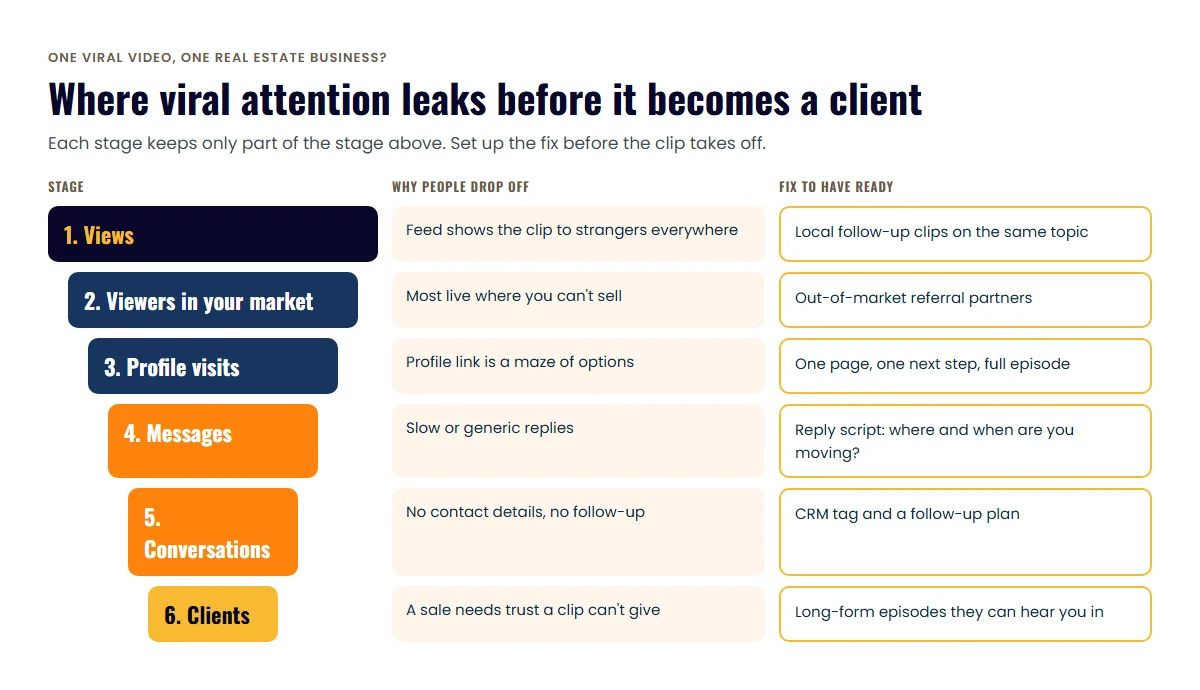
Most viral views come from outside your market because short-form feeds recommend clips by interest, and your interest group is national. Instagram says that for Reels, “the majority of what you see is from accounts you don’t follow” (Instagram Ranking Explained). When a clip spreads, it spreads to strangers everywhere.
For a creator selling a course, that’s fine. For an agent who sells homes in one county, most of those views can never become a client. Real estate is local, and the people who hire you mostly come through relationships. Two in three sellers (66%) in NAR’s 2025 buyer and seller survey went with an agent they were referred to or had used before (Virginia REALTORS summary of the NAR data).
So the useful question after a spike isn’t “how many views?” Ask how many of the people who reached out live where you work.
Can one viral video still turn into real deals?
One viral video can turn into real deals when the agent has a system that catches the attention. The clip opens the door. Your profile, your longer content and your follow-up decide whether anyone walks through.
It does happen. An episode on the ICONS of Real Estate YouTube channel tells the story of an agent whose accidental viral TikTok grew into a business. Stories like that are worth hearing for how the agent handled what came after the clip, not for the clip itself.
Those out-of-market leads are where many agents leave money on the table. If you already know agents in other cities, an agent-to-agent referral podcast gives you a reason to stay in touch with them.
What should be ready before a clip takes off?
The things that turn a spike into clients have to exist before the spike, because you won’t have time to build them during it. Use this checklist:
- Landing spot: your profile link goes to one page with one clear next step, not a list of ten links
- Way back to the episode: the clip came from a full episode, and the caption or a pinned comment says where to find it
- On YouTube Shorts: a related video link points the Short to the full episode on your channel
- Reply script: a short DM answer that asks where they live and when they plan to move
- CRM tag: one tag for the clip, so you can follow up and later count what it produced
- Follow-up plan: an email or text sequence for anyone who shares contact details (our guide to using podcast episodes in lead follow-up has one)
- Referral partners: the agents you’d send out-of-market leads to
- Advertising rules: your profile shows your brokerage the way your state and broker require, so check with your broker before a post brings a flood of attention
Should you chase virality or build a long-form base?
You should build a long-form base and treat virality as a bonus. Chasing virality means making lots of standalone clips and hoping the feed picks one. Building a base means recording a regular long conversation, then cutting clips from it.
The second approach wins for an established agent for three reasons. Every clip has somewhere to send people. Every recording also builds a relationship with a guest, which is how most referral business starts. And the base keeps working on weeks when nothing goes viral, which is most weeks. We compare the two formats goal by goal in long-form podcast vs short-form video, and explain why hosting conversations beats chasing followers.
For picking which moments to clip, read which podcast clips get agents DMs. The video podcast pillar for agents covers recording so the clips look good. Agents who appear as guests on ICONS shows can use ICONS Social, which writes a pack of posts from the episode in their own words and publishes them after they approve. If you’d rather not run the show yourself, ICONS podcast production takes the recording and handles the editing, publishing and social clips.
Next step
Look at your last ten short videos. For each one, ask: if this had gone viral, where would a viewer have gone next? If the answer is “nowhere,” fix the landing spot first. Then record a long conversation worth sending people to.
If YouTube is where you want that base to live, our guide to starting a real estate YouTube channel shows how an interview show can carry the whole channel. It also solves the question every agent with a camera eventually asks: what do I film this week? With a guest booked, the answer is already on your calendar, and the clips come out of a conversation you were going to have anyway.
Frequently asked questions
How many views count as viral for a real estate agent?
There's no official number. For a local agent, a useful test is whether a clip reached far more people than your follower count and pulled in messages from strangers. Raw views matter less than how many of those viewers live where you sell.
Should I delete a viral video that brought the wrong audience?
Usually not. Out-of-market viewers can still become agent-to-agent referrals, and the clip proves the topic works. Make a local follow-up on the same subject instead.
Can I pay to make a real estate video go viral?
Paid promotion can buy views, but bought reach isn't the same as a clip people share on their own. If you boost a post, target your own area so the money reaches people who could actually hire you.
Sources
- How TikTok recommends videos #ForYou — TikTok Newsroom (accessed October 21, 2026)
- Instagram Ranking Explained — Instagram (accessed October 21, 2026)
- Key Takeaways from NAR's 2025 Profile of Home Buyers and Sellers — Virginia REALTORS (accessed October 21, 2026)
- Add a related video to your Shorts — YouTube Help (accessed October 21, 2026)
- Real Estate Marketing Secrets: How One Accidental Viral TikTok Built a 75-Deal-a-Year Business — Icons of Real Estate (YouTube) (accessed October 21, 2026)
Done-for-you podcast production
Want a podcast that brings in referrals, not just downloads?
Icons of Real Estate plans, produces and publishes business-growing podcasts for agents. You record. We handle the rest.
Launch Your Podcast
Written by
Co-Founder and Podcast Guru, Icons of Real Estate
Tomás Fonseca co-founded Icons of Real Estate in 2021 and is its Podcast Guru. He has a background in marketing, with stints at companies like Nintendo and Ardor SEO, and is one of the hosts of the Icons of Real Estate Podcast.

How we research, write, fact-check and correct articles: our editorial standards.