On this page
- What is each format actually good at?
- Which goal does each format serve?
- Can short-form video alone bring in listings?
- Why does a long-form podcast build relationships that clips can’t?
- How do you get both from one recording?
- What mistakes do agents make when they mix long and short formats?
- How should a busy agent split time between the two?
- Next step
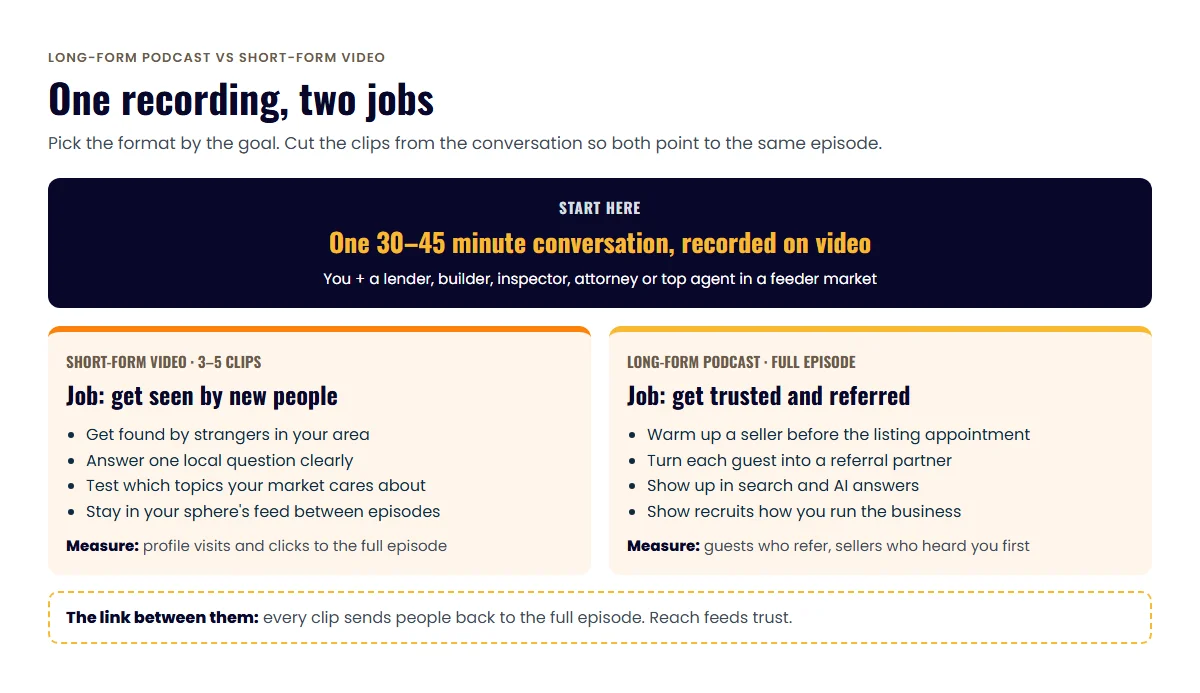
A long-form podcast and short-form video serve different goals for realtors. Short-form video wins reach, so strangers in your market find you. A long-form podcast wins trust and relationships: a prospect hears how you think for half an hour, and each guest can become a referral partner. Most agents need both, cut from one recording.
The mistake I see most often is treating the two as rivals and picking one by platform. Plenty of agents ask me whether they should be on TikTok or start a podcast. Ask a different question instead. What do you need this quarter: more people who know your name, or more people who trust you enough to call?
What is each format actually good at?
Short-form video is a vertical clip, usually under a minute, built to be found by people who don’t know you yet. Instagram says that for Reels, “the majority of what you see is from accounts you don’t follow” (Instagram Ranking Explained). YouTube Shorts can now run up to three minutes (YouTube Help), but the job is the same: a quick first impression in a stranger’s feed.
A long-form podcast is a full conversation, often 20 to 45 minutes, that people choose to sit with. YouTube reported more than 1 billion monthly active viewers of podcast content in January 2025, and over 400 million hours a month of podcasts watched on living-room devices (YouTube Official Blog). Those viewers are leaning back, not scrolling past.
In plain terms:
- Short-form video gets you seen. It tests ideas fast, reaches people outside your sphere and keeps your face in the feed.
- Long-form podcast gets you known. It shows judgment, gives a prospect a long sample of working with you and creates a real hour with a guest.
Which goal does each format serve?
Each agent goal has a format that does most of the work. The table matches eight common goals to the better format and the reason.
| Your goal | Better format | Why |
|---|---|---|
| Get found by strangers in your area | Short-form video | Feeds push clips to people who don’t follow you |
| Warm up a seller before a listing appointment | Long-form podcast | Twenty minutes of you explaining your thinking beats a 30-second clip |
| Build referral partners (lenders, builders, attorneys) | Long-form podcast | The guest spends real time with you, and you both have a reason to follow up |
| Stay in front of your sphere every week | Both | A clip in their feed, the full episode in your newsletter |
| Answer one local question clearly | Short-form video | One question, one answer, under a minute |
| Show up in search and AI answers | Long-form podcast | Chapters, transcripts and an episode article give search engines text to index |
| Recruit agents to your team | Long-form podcast | Recruits want to hear how you run the business, at length |
| Test which topics your market cares about | Short-form video | Cheap to make, fast feedback on what lands |
Notice the pattern. Short-form wins wherever the goal is attention from new people. Long-form wins wherever the goal is a decision that involves trust, and in real estate most of the money sits there.
Can short-form video alone bring in listings?
Short-form video alone rarely brings listings to an established agent, because sellers mostly hire someone they were referred to or have used before. Two in three sellers (66%) in NAR’s 2025 survey of recent movers picked an agent who came by referral or who had served them before. On the buy side, 43% hired a referred agent (Virginia REALTORS summary of the NAR data).
That doesn’t make clips useless. A clip can be the first touch that makes a referral feel familiar (“oh, I’ve seen her videos”). But the clip is rarely the reason someone hands you a house. When it does take off, read what a viral clip can and can’t do for your business before you plan around it.
Why does a long-form podcast build relationships that clips can’t?
A long-form podcast builds relationships because every episode starts with a real conversation between you and a guest. You invite a lender, a builder, an estate attorney or a top agent in a feeder market. They give you 30 to 45 minutes. You prepare, you listen and you make them look good.
A clip can’t do that. Nobody becomes your referral partner because you posted a Reel. Plenty of people will after you’ve spent an hour together and sent them a finished episode they’re proud to share. That is the core of hosting conversations instead of chasing followers, and it is why the guest list matters more than the view count. Our guide to real estate podcast episodes with referral partners covers who to invite.
The listener side works the same way. A seller who has heard you talk through pricing for 20 minutes walks into the listing appointment already halfway decided.
How do you get both from one recording?
You get both by recording one long conversation on video and cutting the clips from it. One session gives you the episode for trust and the clips for reach, with no extra filming days.
- Record the full conversation on video, horizontal (16:9), with each person on a separate track if your tool allows it. Our video podcast setup for real estate agents covers cameras, tracks and layout.
- Publish the full episode to YouTube and the audio apps under one title that names the local question it answers.
- Cut three to five clips, each holding one complete answer, story or strong opinion. Our notes on podcast clips that get agents DMs help you choose.
- Point every clip back to the full episode, in the caption, a pinned comment or a linked video where the platform allows it.
- Send the full episode, not a clip, to the guest, to your sphere and to any seller you’re meeting this month.
If you’re unsure whether you need video at all, the video vs audio decision worksheet walks through the trade-offs. Short-form depends on having video to cut from; the relationship side does not.
What mistakes do agents make when they mix long and short formats?
Agents who mix long and short formats usually go wrong by judging each one with the other’s yardstick. Here are the four I see most:
- Judging the podcast by views. An episode with 80 plays can still win a listing if one of those plays was a seller you sent it to. Count guests who refer and sellers who listened, not plays.
- Judging clips by DMs alone. Clips mostly earn familiarity. Their job is to send people to the episode and make your name ring a bell later.
- Clipping the intro. The first minutes of an interview are small talk. The best clip moments sit in the middle, where the guest gets specific.
- Clips with no way back. If nobody can find the full conversation from the clip, the reach never turns into trust.
How should a busy agent split time between the two?
A busy agent should put the hour into the long conversation and let the clips fall out of it. For an established solo agent who lives on referrals, I’d spend almost no time making standalone short-form content. Clip what you already recorded.
Here’s a simple rule by situation:
- Your business runs on referrals and past clients: long-form first. Clips are distribution.
- You’re entering a new area or niche and nobody knows you: lean harder on short-form for a quarter, but still cut from conversations so the content has substance.
- You have no time to edit: don’t drop the conversation, drop the editing. Hand it off.
That last point is where most agents stall. ICONS podcast production is built for it: you record, and the team handles editing and publishing and turns each episode into reels, carousels and thumbnails. One hour a week of recording is more than enough.
If you want to see what a weekly show could be worth before committing, run your own numbers in the podcast ROI calculator. For where YouTube viewers turn into leads, see the YouTube lead setup for realtors.
Next step
Write down the one goal that matters most for your business in the next 90 days. If it’s “more strangers know my name,” cut more clips. If it’s “more listings, more referral partners,” book your next guest and record the long conversation first. The clips will come with it.
Frequently asked questions
How long should a real estate podcast episode be?
Long enough to finish one real conversation. For most agent interview shows that lands between 20 and 45 minutes. Cut dead air and repetition, but don't trim a good guest to hit a target length.
How many clips should I cut from one episode?
Three to five is a sensible range for a 30-minute interview. Each clip should hold one complete answer, story or opinion that makes sense without the rest of the episode.
Is audio-only still worth it if short-form video is where the reach is?
Yes, if your goal is trust and relationships. The guest relationship and the listener's half hour with you work the same in audio. You just won't have video to cut clips from.
Sources
- Instagram Ranking Explained — Instagram (accessed October 21, 2026)
- Understand three-minute YouTube Shorts — YouTube Help (accessed October 21, 2026)
- 1 billion monthly podcast users on YouTube — YouTube Official Blog (accessed October 21, 2026)
- Key Takeaways from NAR's 2025 Profile of Home Buyers and Sellers — Virginia REALTORS (accessed October 21, 2026)
Done-for-you podcast production
Want a podcast that brings in referrals, not just downloads?
Icons of Real Estate plans, produces and publishes business-growing podcasts for agents. You record. We handle the rest.
Launch Your Podcast
Written by
Co-Founder and Podcast Guru, Icons of Real Estate
Tomás Fonseca co-founded Icons of Real Estate in 2021 and is its Podcast Guru. He has a background in marketing, with stints at companies like Nintendo and Ardor SEO, and is one of the hosts of the Icons of Real Estate Podcast.

How we research, write, fact-check and correct articles: our editorial standards.