On this page
- What do you need to record a client video testimonial on a phone?
- Where and when should you film it?
- What questions should you ask in a real estate video testimonial?
- How do you get consent to record and publish the video?
- How long should a real estate video testimonial be, and how do you edit it?
- Where should you use the finished video testimonial?
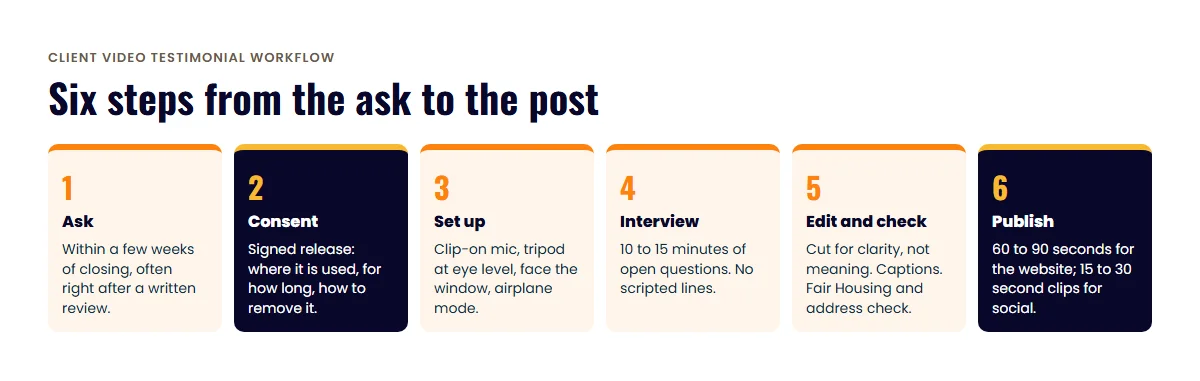
To record a video testimonial from a real estate client, use a phone on a tripod, a clip-on microphone and soft window light. Get written consent first. Then ask open questions about their situation and the moments that mattered. Record ten to fifteen minutes and cut a 60 to 90 second video plus short clips.
That’s the short version. We produce podcasts for agents, and the same rule from the studio applies here: sound first, light second, camera third. Below is the setup, the questions, the paperwork and the edit. If video is new to you, our overview of real estate video podcasts shows how a single recording turns into many pieces of content.
What do you need to record a client video testimonial on a phone?
A client video testimonial needs four things: a recent phone, a clip-on (lavalier) microphone, a small tripod and a window. Viewers forgive a soft picture long before they forgive thin, echoing audio, so the microphone matters more than the camera.
Here is the kit in priority order:
- Clip-on microphone. A wired or wireless lavalier that plugs into your phone. Clip it mid-chest on the client’s shirt, about a hand’s width below the chin.
- Tripod with a phone clamp. Set the lens at the client’s eye level. Handheld footage looks nervous.
- Light. Seat the client facing a window, not with it behind them. Turn off overhead lights if they cast shadows under the eyes.
- Phone settings. Use the rear camera, not the selfie camera. Lock focus and exposure by pressing and holding on the client’s face. Turn on airplane mode so a call can’t ruin a take.
You don’t need a ring light or a cinema camera. If you already have podcast gear, the same rules apply, and our guide to podcast equipment for real estate agents covers microphones in more depth. For posture, framing and eye-level camera tips, see how to look and sound good on a video podcast.
Where and when should you film it?
Film the testimonial within a few weeks of closing, in a quiet room with soft furnishings. Carpets, curtains and a sofa absorb echo; a bare kitchen with stone counters does not. Your office meeting room is often the easiest choice, or a brokerage podcast studio if your office has one.
Timing matters as much as place. Clients remember the details most clearly in the first weeks after the move, and they’re still grateful. Ask when you send your written review request (see how to ask clients for a Google or Zillow review). A client who has just written a kind review is usually the easiest person to ask for video.
If the client has moved out of town, record remotely. In ICONS Live, the free ICONS browser studio, a guest joins from a link and each person is recorded separately, with a 48 kHz WAV and MP4 file per speaker. Separate files make it easier to cut your voice out of the final testimonial.
What questions should you ask in a real estate video testimonial?
Ask questions that pull out a story, not praise. A good testimonial sounds like a client explaining what happened; a weak one sounds like an advert. Interview the client, stay off camera, and ask them to answer in full sentences that repeat the question (“When we started looking, we…”) so each answer stands alone in the edit.
These eight questions work for buyers and sellers:
- What was going on in your life when you decided to move?
- What worried you most before you started?
- How did you end up working with me?
- What happened that you didn’t expect?
- Was there a moment when you thought it might fall through? What happened next?
- What did I do that another agent might not have?
- How did you feel on closing day?
- What would you tell a friend who’s about to buy or sell?
Questions 4 and 5 usually produce the best footage, because the client tells a story with tension in it. Don’t feed them lines or ask them to “say something about my negotiation skills”. Federal guidance is plain on the point: in the FTC’s answers on the Endorsement Guides, an endorsement must reflect the honest opinion of the endorser. Scripted lines also sound scripted.
How do you get consent to record and publish the video?
Get written consent before you press record, in a short release the client signs. A spoken “sure, that’s fine” isn’t enough to rely on when the video ends up in ads two years later.
The release should cover:
- Permission to record and to publish the video, their name and their likeness
- Where you’ll use it: website, social media, listing presentations, paid ads
- How long you’ll use it, and how they can ask you to take it down
- Whether you’ll show their first name only, or full name and town
- Any gift or benefit they receive, and that it doesn’t depend on what they say
- Your brokerage name, if your broker requires it on client agreements
Our podcast guest release form includes a client version you can adapt. Recording and privacy rules vary by state, and many brokerages have their own testimonial policy. Run your release past your broker before the first shoot.
If you give the client a thank-you gift, FTC guidance says to disclose benefits viewers wouldn’t expect. The FAQ also suggests disclosure when customers were told in advance they might be featured in an ad. A one-line caption is enough.
How long should a real estate video testimonial be, and how do you edit it?
A finished video testimonial should run 60 to 90 seconds for your website and listing presentations, with 15 to 30 second clips for social media. Record far more than you need; the length comes from the edit.
A practical cut plan from one recording:
| Piece | Length | Built from | Where it goes |
|---|---|---|---|
| Main testimonial | 60 to 90 seconds | Situation, the tense moment, the outcome | Website, listing presentation, Google Business Profile |
| Story clip | 20 to 30 seconds | Question 4 or 5 | Instagram, Facebook, LinkedIn |
| Quote clip | 10 to 15 seconds | Question 8 | Stories, email signature link |
| Full conversation | 10 to 15 minutes | Lightly trimmed | Podcast bonus episode or YouTube, with consent |
Edit for clarity, never for meaning. The FTC’s Endorsement Guides, at 16 CFR 255.1, say an endorsement may not be presented out of context or reworded so as to distort the endorser’s views. Cutting pauses and “ums” is fine. Splicing half a sentence onto another answer to make a new claim is not. Our explainer on the FTC fake review rule for real estate agents covers the rest of the federal testimonial rules.
Add captions to every clip, since many people watch with the sound off. Then check the transcript for Fair Housing problems. Clients sometimes say a neighborhood is “safe” or “great for families” or describe who lives there. Paste the captions into the free fair housing word checker and cut anything it flags before you publish.
Where should you use the finished video testimonial?
Use the main video where prospects decide whether to call you: your website’s about page, your listing presentation and your Google Business Profile. Use the short clips on social media, in your email newsletter and in follow-up emails after a first meeting.
A few practical notes:
- Pin one testimonial to the top of your social profiles and refresh it every few months.
- Match the story to the audience. Use seller stories in listing presentations and buyer stories in buyer consultations.
- Keep the address private. Blur house numbers and street signs.
- Treat a podcast episode as the long version. A client who enjoys being filmed may be a good guest for a past client interview episode.
Agents who appear as guests on ICONS podcasts get ICONS Social, which turns each episode into posts in their own words. Those posts sit well next to client testimonials on your feeds. ICONS is also building a free review and video-testimonial collector, coming soon. Among its planned features: a post-close survey, a video clip of about 60 seconds recorded through the ICONS recording stack, and embeddable widgets that show collected reviews. It won’t write or edit testimonials on a client’s behalf.
Frequently asked questions
Should I film the testimonial in the client's new home?
Only if they offer, and keep the address out of the frame: no house numbers, street signs or mail on the counter. A quiet room in your office works just as well and is easier to control.
Can I give the client a gift for recording a video?
You can, as long as the gift doesn't depend on what they say. FTC guidance says to disclose a benefit viewers wouldn't expect, so add a short line such as 'Client received a thank-you gift' to the post.
Can I write the testimonial and have the client read it?
No. A testimonial must reflect the client's honest opinion and experience. Scripted praise also looks stiff on camera, which defeats the point of using video.
What if the client later wants the video removed?
Take it down. Say in your release how removal requests work, and check in once a year with clients whose videos you still use.
Sources
- FTC's Endorsement Guides: What People Are Asking, Federal Trade Commission (accessed October 21, 2026)
- 16 CFR 255.1, General considerations (Guides Concerning the Use of Endorsements and Testimonials), Cornell LII (accessed October 21, 2026)
- Consumer Reviews and Testimonials Rule: Questions and Answers, Federal Trade Commission (accessed October 21, 2026)
Done-for-you podcast production
Want a podcast that brings in referrals, not just downloads?
Icons of Real Estate plans, produces and publishes business-growing podcasts for agents. You record. We handle the rest.
Launch Your Podcast
Written by
Co-Founder and Podcast Guru, Icons of Real Estate
Tomás Fonseca co-founded Icons of Real Estate in 2021 and is its Podcast Guru. He has a background in marketing, with stints at companies like Nintendo and Ardor SEO, and is one of the hosts of the Icons of Real Estate Podcast.

How we research, write, fact-check and correct articles: our editorial standards.