On this page
- Does your brokerage need a podcast studio?
- What equipment goes in a brokerage podcast studio?
- How much does it cost to build a podcast studio?
- How should you lay out the studio room?
- What booking rules should agents follow?
- Who owns the files recorded in a shared studio?
- Can a lender or vendor pay for the studio?
- What goes on the studio reset checklist?
- Next step
A brokerage podcast studio equipment list starts with two XLR dynamic microphones on boom arms, a four-input recorder, closed-back headphones for every seat, two cameras, two or three soft lights and acoustic panels in a small carpeted room. Add a written booking policy and a reset checklist, or the shared gear drifts out of shape fast.
Broker-owners, office managers and team leaders deciding on a shared recording room are the readers here. A solo agent recording at home needs far less, as the podcast equipment list for agents shows. Who hosts the firm’s show, who approves it and how it recruits are covered in running a brokerage or team podcast. This page sticks to the room.
A note on prices: gear prices move constantly and the official product pages we checked don’t list them. Every dollar range below is our estimate for a category of product, not a quote.
Does your brokerage need a podcast studio?
A brokerage needs a podcast studio when people come to the office to record, often enough to keep a room busy. Most agent shows are recorded remotely, and a remote show needs a good mic and a quiet room, not a studio.
Use this four-part test before you buy anything:
- Demand. Can you count about four in-person recordings a month already scheduled or committed? Count the brokerage show plus any agent shows with local guests.
- A room. Is there a room you can dedicate, or at least book reliably, that isn’t glass-walled?
- An owner. Can you name one staff member who will run orientation, check gear weekly and fix problems? If you can’t name that person, don’t build.
- Budget for the room, not just the gear. Are you willing to spend on rugs and panels before cameras?
Four yeses means build. Fewer than four means start with a studio-in-a-case: Tier 1 below, stored in a rolling case and set up in a conference room. If bookings hold for a quarter, upgrade. If they don’t, the gear goes home with agents for their own remote shows and nothing is wasted.
Renting a local studio or hiring a crew per session is the other option. The video podcast cost breakdown for realtors compares building, renting and hiring.
What equipment goes in a brokerage podcast studio?
Brokerage podcast studio equipment comes in three tiers: a portable interview kit, a two-seat video studio, and a multi-seat studio with three or four cameras. Each tier keeps the gear from the one before it.
The table below shows what each tier adds and who it suits.
| Tier | Who it’s for | Core gear | What it can record |
|---|---|---|---|
| 1. Studio in a case | Offices testing demand; conference-room setups | 2 hybrid USB/XLR dynamic mics, boom arms, 4-input recorder, 2 closed-back headphones, phone mounts, portable panels | In-person audio for two; remote interviews from one seat |
| 2. Two-seat video studio | A brokerage show plus a few agent shows | Tier 1 plus 2 cameras, 3 soft lights, fixed panels, rug, monitor for the host | Two-person video interviews with a close shot of each speaker |
| 3. Multi-seat studio | Large offices with several weekly shows or panels | 4 mics, 3 to 4 cameras, a video switcher or multi-camera recorder, 4+ lights, full room treatment | Panels of three or four, wide and close shots, live streams |
Why a four-input recorder is the heart of the room
A dedicated podcast recorder is the one item shared studios get the most from, because it puts each mic on its own track with no laptop involved. As one example, Zoom’s PodTrak P4next specifications list four XLR mic inputs, four headphone outputs with their own volume controls, up to 11 simultaneous recording tracks in 48 kHz/24-bit WAV to a microSD card, a USB-C audio interface mode, and power from two AA batteries or USB. That covers a two-seat studio with room to grow, and it runs fine with no computer at all.
Separate headphone volumes matter more than they sound. In a shared room, every guest wants a different level, and one shared headphone feed starts arguments.
Why hybrid mics suit a shared room
Pick microphones with both USB and XLR outputs. Shure’s MV7+ product page describes “dual USB-C and XLR outputs,” and other makers sell similar hybrid dynamic mics. In a brokerage, that means the same mic plugs into the recorder for an in-person episode and straight into an agent’s laptop for a remote one. One set of mics serves both uses.
Choose dynamic mics, not condensers. Condensers hear the hallway, the HVAC and the copier. Whether a third camera earns its place depends on your edit; the video podcast production workflow for agents covers that call.
Master equipment checklist
Tick each item as you buy it. Quantities are for a two-seat Tier 2 studio.
- Dynamic microphones with XLR, USB as well ideally (2)
- Boom arms that clamp to the table, plus a spare clamp (2)
- Podcast recorder or audio interface with at least 4 inputs (1)
- Spare microSD cards, labelled, and a card reader (2 cards)
- Closed-back headphones for host, guest and spare (3)
- XLR cables, plus 2 spares in a labelled bag (4)
- Cameras with mains power adapters, so no battery swaps mid-episode (2)
- Tripods or desk mounts that hold each camera at eye height (2)
- Soft key lights plus 1 background light, all at the same color temperature (2 + 1)
- Acoustic panels and 1 large rug (8 to 12 panels)
- A door seal or draft stopper
- Small round or angled table and 2 quiet chairs with no squeak or swivel click
- Surge-protected power strip and cable covers for the floor
- “Recording: do not knock” sign or light outside the door
- Laminated quick-start card on the wall
- Lockable cabinet for mics, cards and headphones
How much does it cost to build a podcast studio?
By our illustrative estimates, a brokerage podcast studio costs roughly $1,100 to $3,000 for a portable kit, $3,000 to $9,000 for a two-seat video room, and $8,000 to $24,000 or more for a multi-seat studio. These are our estimates for each gear category, not market data or quotes.
The table breaks the estimate down by category so you can price your own list.
| Category (our estimates) | Tier 1: Studio in a case | Tier 2: Two-seat video | Tier 3: Multi-seat |
|---|---|---|---|
| Mics and boom arms | $300 to $700 | $300 to $1,000 | $600 to $2,000 |
| Recorder or interface | $200 to $400 | $200 to $600 | $500 to $1,500 |
| Headphones | $100 to $300 | $150 to $450 | $200 to $600 |
| Cameras and mounts | $0 to $200 (agents’ phones) | $1,000 to $3,000 | $3,000 to $8,000 incl. switcher |
| Lights | $100 to $300 | $300 to $900 | $800 to $2,500 |
| Room treatment | $200 to $600 | $500 to $1,500 | $1,500 to $5,000 |
| Furniture, cables, signs, storage | $200 to $500 | $500 to $1,500 | $1,500 to $4,000 |
| Estimated total | About $1,100 to $3,000 | About $3,000 to $9,000 | About $8,000 to $24,000+ |
Three costs don’t show up on a gear receipt. Construction (new walls, a solid door, ventilation changes) can exceed the gear budget, so get a contractor quote if walls move. Staff time to run orientation and resets is real. And editing is the biggest ongoing cost of all, because a studio records episodes but doesn’t finish them.
How should you lay out the studio room?
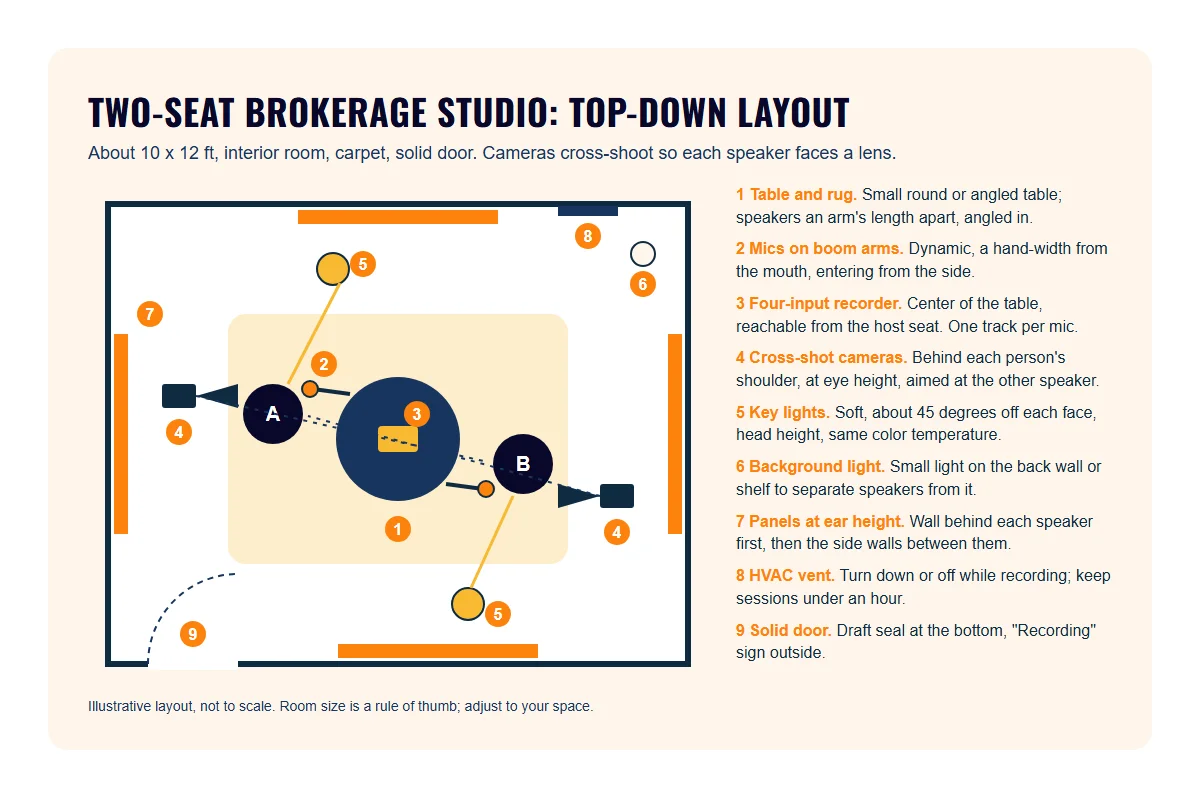
Lay out a podcast studio with the two speakers facing each other at a slight angle across a small table, each camera behind the other person’s shoulder, and soft lights angled in from the side.
Pick the right room first
The best brokerage studio is usually the smallest interior room with carpet and a solid door. Walk the office with these questions:
- Glass? Glass walls reflect sound and show the hallway on camera. Avoid them, or cover them with heavy curtains.
- Neighbours? Stay away from the kitchen, elevator, copier, front desk and bathrooms.
- Air? Find the HVAC vent. You’ll want to switch it off or reduce it during recording, so pick a room that doesn’t overheat in 45 minutes.
- Size? Around 10 by 12 feet is a comfortable rule of thumb for two seats and cameras. Bigger rooms need more treatment.
- Power? You need outlets near the table and behind each camera position, so no cables cross the walkway.
Set the table and the mics
Seat the two speakers about an arm’s length apart, angled toward each other rather than straight across. Mount each mic on a boom arm clamped to the table, a hand-width from the speaker’s mouth, coming in from the side so it doesn’t block the face on camera. Put the recorder in the middle of the table, reachable from the host’s seat.
Treat the walls behind each speaker
Hang panels at ear height on the wall behind each speaker and on the side walls between them. Those are the first surfaces each voice hits. Put a large rug under the table and chairs. A bookshelf filled unevenly makes a good camera background and breaks up echo at the same time.
Light from the side
Place a soft key light about 45 degrees off each speaker’s face, at head height. Add one small light pointed at the background wall to separate the speakers from it. Keep every light at the same color temperature, so both faces match in the edit.
What booking rules should agents follow?
Brokerage studio booking rules should cover who can book, how long a slot is, cancellations, guests, files and the reset, written on one page and agreed before the first booking.
Use a shared room calendar in whatever tool the office already uses, so availability is visible to everyone. Then adapt this policy.
For the release itself, this podcast guest release form template includes riders for client stories, settlement-service partners and business guests. Have your broker review both documents.
Who owns the files recorded in a shared studio?
Files recorded in a brokerage studio belong to whoever the written policy says owns them, so decide before the first booking. The brokerage owns the gear, but that doesn’t automatically settle who owns an agent’s show.
A simple split works for most offices:
| Recording | Who keeps the files | Who backs them up |
|---|---|---|
| The brokerage show | The brokerage | The studio owner or the show’s producer |
| An agent’s own show | The agent | The agent, the same day |
| A team show | The team, per its written agreement | The team’s producer |
Agents who change firms will ask what happens to episodes they recorded in your studio. Put the answer in writing now. The agent’s side of that move is covered in what a personal brand and podcast take with you when switching brokerages.
A studio also doesn’t solve editing. Raw files from a great room still need cutting, mixing, publishing and clips. Some brokerages leave that to each agent. Others standardise it, for example with an outside podcast editing and publishing service such as Icons, whose model is “You record. We handle everything else.”
Can a lender or vendor pay for the studio?
A lender, title company or similar settlement-service vendor paying for a brokerage studio can raise RESPA questions, so get your broker or compliance counsel involved before you accept anything.
The CFPB’s Regulation X kickback rule, 12 CFR 1024.14, bars giving or accepting a fee, a kickback or anything else of value in return for referring settlement-service business. Its definition of a thing of value includes “services of all types at special or free rates” and “sales or rentals at special prices or rates.” Free gear, discounted rent on a studio, or a sponsor paying the build cost can all fall into that conversation.
That doesn’t mean a lender can never appear on a show recorded there. It means the money and the arrangement need review before anyone signs. Common questions your broker will ask:
- Who pays for what, and is the amount tied to fair market value for what the vendor gets?
- Is any payment linked, formally or informally, to referrals?
- How will the vendor’s name appear on air, on artwork and in the room?
Your broker and compliance contact make the final call. If the money would come from the brokerage itself, the cost-sharing models between a firm and its agents spell out who owns what under each.
What goes on the studio reset checklist?
A studio reset checklist is a short list each agent completes before leaving, so the next booking starts with working gear. Laminate it and mount it by the door.
Before recording
- Phone on Do Not Disturb; “Recording” sign on the door
- HVAC set to low or off for the session
- Recorder on, fresh card space checked, each mic on its own track
- Headphones plugged in; each person sets their own level
- Cameras on mains power, framed at eye level, recording settings checked
- Lights on and matching; nothing personal or confidential in frame
- Guest release signed
- 10-second test recorded and played back
After recording
- Files copied to your own storage and checked to open
- Recorder and cameras off; batteries charging if used
- Mics and boom arms back in their marked positions
- Headphones and cables back in the cabinet, cables coiled
- Chairs and table back on their floor marks
- Lights off, HVAC back to normal, sign removed
- Any problem reported to the studio owner
Floor tape marks for the table, chairs and tripods save more time than any other trick. The next agent sits down and the framing is already right.
Next step
Run the four-part test with your managing broker this week. If you pass, buy the Tier 1 kit, set it up in your best conference room, and publish the booking policy before you announce the studio. Track bookings for one quarter, then decide whether a dedicated Tier 2 room is worth the build.
Frequently asked questions
Can agents use the studio for remote interviews too?
Yes. Plug a hybrid USB and XLR mic into the agent's laptop, wear closed-back headphones and record on a platform that saves separate tracks. The treated room makes the host sound better even when the guest is remote.
How big should a podcast studio room be?
For two seats with cameras, a room around 10 by 12 feet is a comfortable rule of thumb. Smaller works for audio only. Larger rooms need more treatment, so bigger is not better.
Does a brokerage studio help with recruiting?
Only if agents use it and the brokerage show comes out of it. A studio nobody books is office decor. Track bookings and recordings each month, and show candidates real episodes, not the room.
Should the brokerage hire a producer to run the studio?
Not at first. Name an existing staff member as studio owner for setup, orientation and weekly checks. Hire or outsource editing once several shows record there every month.
Sources
- PodTrak P4next specifications — Zoom Corporation (accessed October 6, 2026)
- MV7+ Podcast Microphone — Shure USA (accessed October 6, 2026)
- 12 CFR 1024.14 Prohibition against kickbacks and unearned fees — Consumer Financial Protection Bureau (accessed October 6, 2026)
Done-for-you podcast production
Want a podcast that brings in referrals, not just downloads?
Icons of Real Estate plans, produces and publishes business-growing podcasts for agents. You record. We handle the rest.
Launch Your Podcast
Written by
Co-Founder and Podcast Guru, Icons of Real Estate
Tomás Fonseca co-founded Icons of Real Estate in 2021 and is its Podcast Guru. He has a background in marketing, with stints at companies like Nintendo and Ardor SEO, and is one of the hosts of the Icons of Real Estate Podcast.
How we research, write, fact-check and correct articles: our editorial standards.