On this page
- When should a real estate agent ask for a review?
- How do you get your Google review link and QR code?
- How do you request a Zillow review?
- What should you say when you ask a client for a review?
- What are you not allowed to do when asking for reviews?
- Should you reply to every review?
- How do reviews fit with the rest of your marketing?
Real estate agents should ask every client for a Google review and a Zillow review within a few days of closing. Send a short text with your direct review link, say what the review helps with, and follow up once. Never offer anything in exchange for a review, and never ask only the clients you think are happy.
That’s the whole method. Simple, not easy. The rest of this page is the detail: timing, the words, where to find each link, and the rules each platform publishes. For the wider picture of how reviews fit your brand, start with the personal branding playbook for real estate agents. Our older post on real estate agent reviews for your business covers general reputation tips.
When should a real estate agent ask for a review?
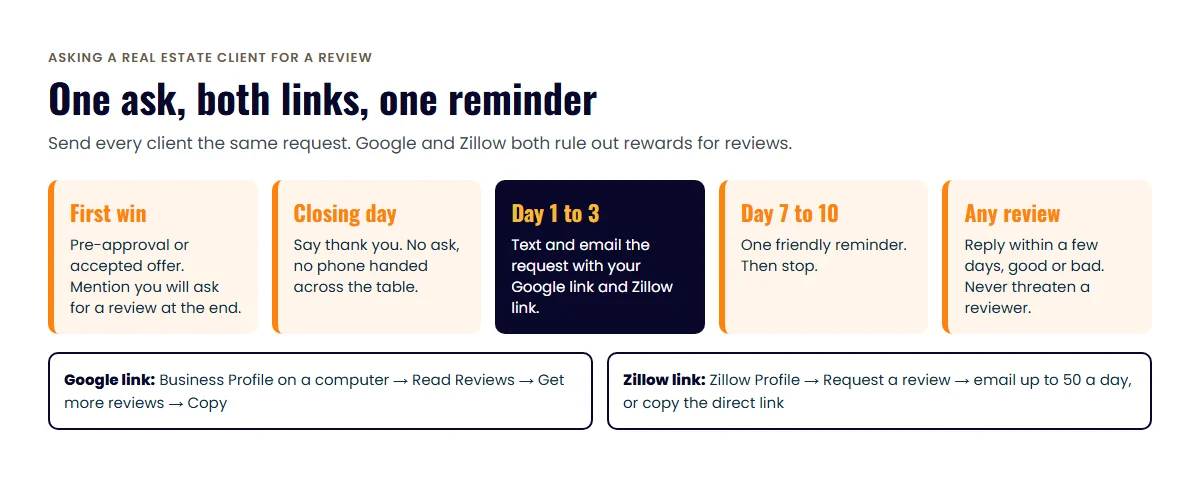
A real estate agent should ask for a review in the first week after closing, while the keys are still new. Zillow’s agent guide, How to Request Client Reviews, suggests asking at mutual acceptance or within three days after closing. It also suggests asking earlier, at a first win such as a pre-approval.
The table shows a simple timing plan that works for most transactions.
| Moment | What to do | Channel |
|---|---|---|
| First win (pre-approval, accepted offer) | Mention that you’ll ask for a review at the end | In person or phone |
| Closing day | Thank them. Don’t ask yet; they’re busy | In person |
| Day 1 to 3 after closing | Send the review request with both links | Text, then email |
| Day 7 to 10 | One friendly reminder if nothing came in | Text |
| Past clients (older closings) | Call first, then send the link | Phone, then text |
Stop after one reminder. Really. A third nudge feels like pressure, and pressure is one of the things Google’s policy warns against.
How do you get your Google review link and QR code?
Google gives you a review link and QR code from your Business Profile. Per Google’s help page, Create a Google link or QR code to request reviews, the steps are:
- Sign in to your Business Profile on a computer. Google says review QR codes can’t be generated on mobile.
- Select Read Reviews, then Get more reviews.
- Select Copy to copy the link, or right-click the QR code and save the image.
- Save the link in your phone’s text shortcuts so you can paste it in two taps.
Google suggests putting the link in thank-you emails and the QR code on printed material. For an agent, that means your closing card, your email signature and the last page of your listing presentation. If you want a branded QR code for a printed piece, the free real estate QR code generator will turn the link into one.
How do you request a Zillow review?
Zillow review requests start from your Zillow profile: sign in, open your profile and select Request a review. Zillow’s agent guide describes two ways to send it:
- Email from Zillow. Enter up to 50 client email addresses a day. Each client gets an email from Zillow with a link to your review form, and you can track the status under “Sent requests”.
- Direct link. Copy the URL to your review form and send it yourself. Requests sent this way don’t show in “Sent requests”.
Zillow’s guide also says to give clients clear instructions if they don’t have a Zillow account. Tell them up front that they’ll need to sign in, because a client who hits an unexpected login screen halfway through a kind review will often close the tab and never come back to it. Warn them.
What should you say when you ask a client for a review?
Say thank you, name one specific thing you did together, and give the link with a clear, honest request. Keep it short. Three lines is plenty. Here are three versions you can adapt.
Note the word “honest” in every version. It’s deliberate. It is the line that keeps your ask on the right side of every platform policy below. Two platforms, one difference: Zillow’s agent guide says you may guide clients toward a topic, such as your neighborhood knowledge, as long as you ask only for accurate information. Google’s policy says businesses shouldn’t request that specific content be included. So keep the Google ask open, and save topic suggestions for Zillow.
What are you not allowed to do when asking for reviews?
The platform rules come down to four things: no rewards, no cherry-picking, no insiders and no pressure. The table shows what Google’s Maps user contributed content policy and Zillow’s Real Estate Professional Rating and Review Policy say about each.
| Practice | Zillow | |
|---|---|---|
| Gift card, discount or free service for a review | Not allowed: incentives for reviews count as fake engagement | Reviews from people offered compensation may be withheld; agents agree not to solicit reviews for compensation |
| Asking only clients you think are happy (review gating) | Not allowed: businesses can’t “selectively solicit positive reviews” | Not named; the FTC calls it misleading if it substantially skews your reviews |
| Reviews from family | Conflict of interest (personal affiliations) | May be withheld |
| Reviews from your own team or brokerage staff | Conflict of interest (current or former employment) | May be withheld, even if the employee was a real client |
| Asking someone you never worked with | Not allowed (must reflect a genuine experience) | Not allowed (needs a true interaction) |
| Handing over your phone at the closing table | Policy says don’t require or pressure reviews on your premises | Not named; avoid it |
Review gating deserves its own warning. Some review tools send a survey first and only pass happy clients on to Google. Google’s policy rules that out. The FTC goes further in its answers on the Endorsement Guides: asking only customers likely to be happy is misleading when it substantially skews the reviews. The federal rule behind this is covered in our guide to the FTC fake review rule for real estate agents.
A closing gift is still fine. Just keep it separate. Give it because they were your client, before or regardless of any review, and never mention reviews in the same breath.
Should you reply to every review?
Yes, reply to every review, good or bad, within a few days. Zillow’s guide recommends thanking every reviewer and answering negative reviews quickly and professionally, without criticizing the client.
For a bad review, keep the reply short: thank them, state the facts once without client details, and offer to talk offline. Never threaten a reviewer or accuse them in public. The FTC rule bans using unfounded legal threats or intimidation to get a review taken down. On Zillow, if a review you think is false passes moderation, the only on-platform recourse is a clarification comment under it. Report a review only when no real transaction happened.
How do reviews fit with the rest of your marketing?
Written reviews prove you’re good to work with. Video testimonials and podcast conversations show it. A client who has just written a review is often the easiest person to ask for a short video. Our guide on how to record a video testimonial from a real estate client walks through the phone setup and questions.
Agents who appear as guests on ICONS podcasts get ICONS Social, which turns the episode into posts in their own words. That gives prospects something to watch once your reviews have earned their attention.
ICONS is also building a free review and video-testimonial collector, coming soon. Its planned features are a post-close survey sent to your client and a video clip of about 60 seconds. It will also have embeddable widgets showing collected reviews, and links that send the client on to your Google and Zillow review pages. It will not post to Google or Zillow for you, because those platforms don’t allow it. And it won’t filter out unhappy clients, for the gating reasons above.
Frequently asked questions
Can I give a client a closing gift and ask for a review?
Give the gift because they were your client, not in exchange for a review. Google's policy treats free or discounted goods offered for reviews as fake engagement, and Zillow may withhold reviews from anyone offered compensation.
Can my spouse or my team members review me?
On Zillow, reviews from family members and from employees of the same company can be withheld, even when the employee was a real client. On Google, current or former employment counts as a conflict of interest.
How many Zillow reviews should an agent have?
Zillow's own agent guide suggests at least five recent reviews on your profile. Recency matters as much as the total, so ask after every closing.
Can I ask clients to mention my neighborhood expertise?
Zillow's agent guide says you can guide clients toward topics as long as you ask only for accurate, honest information. Google's policy says businesses shouldn't request that specific content be included, so keep Google asks open.
Sources
- Maps user contributed content policy: fake engagement and conflict of interest, Google (accessed October 21, 2026)
- Create a Google link or QR code to request reviews, Google Business Profile Help (accessed October 21, 2026)
- Real Estate Professional Rating and Review Policy, Zillow (accessed October 21, 2026)
- How to Request Client Reviews, Zillow for Agents (accessed October 21, 2026)
- FTC's Endorsement Guides: What People Are Asking, Federal Trade Commission (accessed October 21, 2026)
Done-for-you podcast production
Want a podcast that brings in referrals, not just downloads?
Icons of Real Estate plans, produces and publishes business-growing podcasts for agents. You record. We handle the rest.
Launch Your Podcast
Written by
Co-Founder and Podcast Guru, Icons of Real Estate
Tomás Fonseca co-founded Icons of Real Estate in 2021 and is its Podcast Guru. He has a background in marketing, with stints at companies like Nintendo and Ardor SEO, and is one of the hosts of the Icons of Real Estate Podcast.

How we research, write, fact-check and correct articles: our editorial standards.