On this page
- What is the FTC fake review rule?
- What does the FTC rule ban, section by section?
- Can real estate agents give gifts or incentives for reviews?
- Can family, team members or your broker review you?
- Is it legal to ask only happy clients for reviews?
- What about bad reviews, your own website and social media followers?
- Does the rule cover video testimonials and podcast episodes?
- What happens if an agent breaks the rule?
- FTC review rule checklist for agents
The FTC fake review rule, formally the Trade Regulation Rule on the Use of Consumer Reviews and Testimonials (16 CFR Part 465), has been in force since October 21, 2024. For real estate agents, it bans fake reviews and testimonials, paying for positive reviews, undisclosed reviews from team members and close family, and intimidating clients into removing bad reviews.
What is the FTC fake review rule?
The FTC fake review rule is a federal regulation that makes specific review and testimonial tricks unlawful and lets courts fine businesses for knowing violations. The FTC announced the final rule on August 14, 2024 after a 5-0 vote.
Two definitions in section 465.1 decide what it covers:
- Consumer review: a consumer’s evaluation of a product, service or business. A star rating with no text counts.
- Consumer testimonial: an advertising message people are likely to believe reflects a customer’s opinions or experience. A client quote on your listing presentation, a video on your website and a past-client story in an ad all qualify.
So the rule reaches your Google and Zillow reviews and the testimonials you use in your own marketing.
What does the FTC rule ban, section by section?
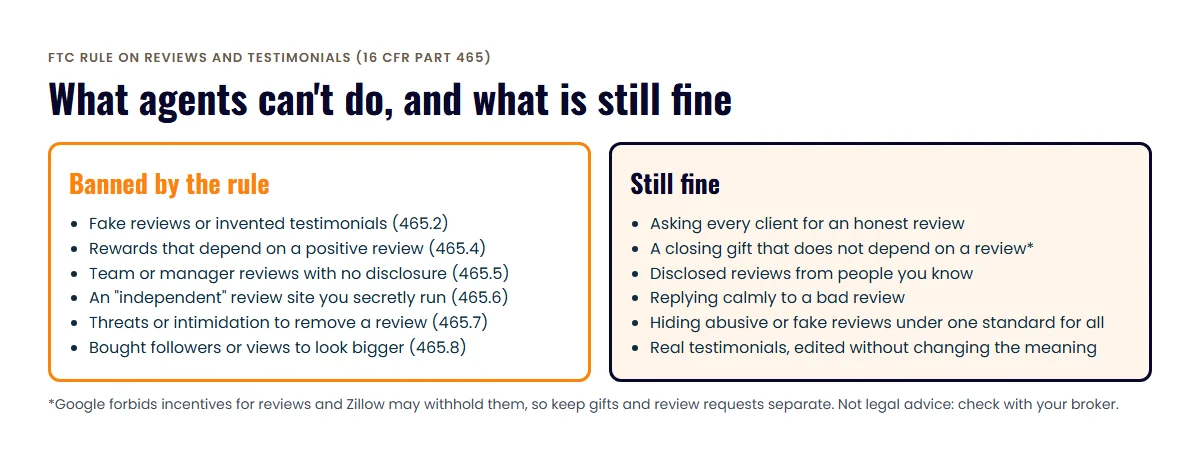
The FTC rule bans six kinds of review and testimonial practice, each in its own section of Part 465. The table shows each one with the version of it most likely to come up in a real estate business.
| Section | What it bans | Agent example |
|---|---|---|
| 465.2 Fake reviews and testimonials | Writing, buying or spreading reviews or testimonials from people who don’t exist, didn’t use your service, or whose experience is misrepresented | An assistant posts five-star reviews under made-up names; a testimonial invented for a listing presentation |
| 465.4 Buying positive or negative reviews | Compensation or incentives conditioned, expressly or by implication, on a review saying something positive or negative | “Leave me a five-star review and I’ll send a $50 gift card” |
| 465.5 Insider reviews and testimonials | Reviews or testimonials from officers, managers, employees or agents without a clear disclosure of the relationship | A team member reviews the team lead with no mention that they work for her |
| 465.6 Company-controlled review sites | Presenting a website you control as independent reviews | A “Best Agents in Town” site that ranks only you, without saying it’s yours |
| 465.7 Review suppression | Unfounded legal threats, physical threats, intimidation or false public accusations to stop or remove a review; hiding negative reviews while implying you show them all | Threatening a past client with a lawsuit over an honest one-star review |
| 465.8 Fake social media indicators | Buying or selling fake followers or views to misrepresent influence for a commercial purpose | Buying 10,000 Instagram followers before a listing launch |
| 465.1 and 465.9 | Definitions and severability | n/a |
Section 465.3 is reserved and holds no rule. Several sections apply when you “knew or should have known” a review was fake. Ignoring obvious warning signs is not a defense under that standard.
Can real estate agents give gifts or incentives for reviews?
Real estate agents can give incentives under the FTC rule only if the reward doesn’t depend on what the review says. The FTC’s rule Q&A states that the rule does not prohibit incentives for reviews, as long as no particular sentiment is required, expressly or by implication.
That’s the federal floor, not the whole picture. Google’s review policy forbids incentives for reviews outright, and Zillow may withhold reviews from anyone offered compensation. Our guide on how to ask clients for a Google or Zillow review quotes both policies. In practice, keep closing gifts and review requests completely separate.
Can family, team members or your broker review you?
Family, team members and managers can review you under the FTC rule only with a clear and conspicuous disclosure of the relationship. Platform policies go further, so in practice these reviews rarely belong on Google or Zillow.
The rule sets out three points that matter for agents:
- Officers and managers. A team lead, broker-owner or managing broker who writes a review of the business must disclose the relationship (465.5(a)).
- Employees and agents. A business can’t spread a testimonial from its own staff or agents without disclosure, if it knew or should have known about the relationship (465.5(b)).
- Relatives. An officer or manager can’t ask their spouse, parent, child or sibling, or ask staff, to post reviews without disclosures (465.5(c)).
A general request sent to every client is exempt from the insider sections. If your cousin bought through you and gets the same request as everyone else, the rule doesn’t treat that as soliciting a relative. The Q&A adds a warning, though: even disclosed family and employee reviews may still break the FTC Act if they materially raise your average rating.
Is it legal to ask only happy clients for reviews?
Nothing in the FTC rule itself specifically bans asking only happy clients, but the FTC says the practice can still be illegal. Its Endorsement Guides FAQ says asking only customers you expect to be happy is misleading if it substantially skews the favorability of your reviews.
This practice is called review gating. A survey goes out first, and only clients who score you highly get the Google link. Google’s policy forbids it separately. Send every client the same request with the same links.
What about bad reviews, your own website and social media followers?
Bad reviews can be answered but not suppressed. Under section 465.7 you may not use unfounded legal threats, intimidation or false public accusations to stop or remove a review. You also can’t hide negative reviews on your own site while implying you show them all.
Hiding a review is allowed when you apply the same standard to every review, whatever its rating. Grounds the rule lists include personal information, harassing or abusive content, discriminatory content, reviews you reasonably believe are fake, and reviews unrelated to your services.
Two other areas to check:
- Your website. A testimonials page is fine. A “top agents” directory you secretly run is not (465.6).
- Follower counts. Buying followers or views to look bigger is covered by 465.8 when you knew or should have known they were fake.
Does the rule cover video testimonials and podcast episodes?
Video testimonials and client podcast episodes are covered by the FTC rule, because its testimonial definition includes verbal messages and depictions of a person’s likeness. A client video on your website, a past client story in a podcast episode and a quote card on Instagram are all testimonials.
That matters most for disclosures. Section 465.1 says a clear and conspicuous disclosure must use the same means as the claim. If a client praises you out loud in a video, the disclosure should be heard in the video too, not hidden in a caption. Online, a disclosure isn’t clear and conspicuous if the viewer has to click or hover to find it.
Two practical rules for agents who publish video:
- If a team member, relative or paid partner appears as a “client”, say so in the video itself.
- If you gave the client a gift that viewers wouldn’t expect, say that in the caption and, ideally, on screen.
Video and audio are where most agents now build their brand, as the personal branding playbook for real estate agents explains. For a full client episode, the past client interview episode guide includes on-air disclosure lines.
What happens if an agent breaks the rule?
An agent who knowingly breaks the rule can face civil penalties in court, on top of the FTC Act’s general ban on deceptive practices. The FTC’s 2025 inflation adjustment set the maximum civil penalty for these violations at $53,088 per violation.
Platform consequences come faster. Zillow says it may terminate an Agent Profile that enables fraudulent reviews, and Google removes reviews that break its policy. Your broker and state licensing board may also treat fake reviews as misleading advertising. For other rules that touch agent marketing, see real estate podcast compliance.
FTC review rule checklist for agents
Work through this checklist with your broker once, then repeat it whenever you change how you ask for reviews or testimonials.
- Every review and testimonial comes from a real client describing their real experience
- No one on your team writes reviews or testimonials for you or for clients
- Review requests go to every client, including the ones you suspect are unhappy
- No gift, discount or referral fee depends on a review, or on its rating
- Team members, family and managers disclose their relationship if they ever review you
- You reply to bad reviews calmly and never threaten a reviewer
- Testimonials on your website aren’t filtered to hide negative ones while implying you show all
- You don’t buy followers, views or likes
- Edited testimonials keep the client’s meaning (see how to record a video testimonial from a real estate client)
- Your broker has signed off on your review and testimonial process
For agents who guest on ICONS podcasts, ICONS Social checks each post it drafts from an episode for fair-housing and disclosure problems, and nothing goes out until you approve it. ICONS is also building a free review and video-testimonial collector, coming soon. Its launch plan deliberately leaves out filtering unhappy clients from public display and writing testimonials for clients.
Frequently asked questions
Does the FTC rule apply to small businesses like a solo agent?
Nothing in the FTC's Q&A carves out small businesses, and one of its examples is a small business whose manager asks employees to get reviews from relatives. Treat the rule as applying to you.
Are AI-written reviews banned?
Reviews attributed to people who don't exist or who had no experience with you are banned however they're written. The FTC's announcement names AI-generated fake reviews as an example.
Can I post testimonials from my old brokerage on my new website?
The rule doesn't address moving brokerages. The testimonials must still be real and accurately reflect the client's experience, and your new broker may have its own rules, so ask them first.
Does the rule cover Zillow and Google reviews?
Yes. A consumer review on any platform counts, including star ratings with no text. Google and Zillow also apply their own, stricter policies on top.
Sources
- Federal Trade Commission Announces Final Rule Banning Fake Reviews and Testimonials, FTC press release, August 14, 2024 (accessed October 21, 2026)
- Consumer Reviews and Testimonials Rule: Questions and Answers, Federal Trade Commission (accessed October 21, 2026)
- 16 CFR Part 465, Use of Consumer Reviews and Testimonials, Cornell LII (accessed October 21, 2026)
- FTC's Endorsement Guides: What People Are Asking, Federal Trade Commission (accessed October 21, 2026)
- FTC Publishes Inflation-Adjusted Civil Penalty Amounts for 2025, Federal Trade Commission (accessed October 21, 2026)
Done-for-you podcast production
Want a podcast that brings in referrals, not just downloads?
Icons of Real Estate plans, produces and publishes business-growing podcasts for agents. You record. We handle the rest.
Launch Your Podcast
Written by
Co-Founder and Podcast Guru, Icons of Real Estate
Tomás Fonseca co-founded Icons of Real Estate in 2021 and is its Podcast Guru. He has a background in marketing, with stints at companies like Nintendo and Ardor SEO, and is one of the hosts of the Icons of Real Estate Podcast.

How we research, write, fact-check and correct articles: our editorial standards.