On this page
- Why do busy agents fall off with content?
- What is the one-appointment content system?
- How much content does one recorded conversation give you?
- How do you stay consistent with content in a busy season?
- What should you hand off, and what has to stay yours?
- How do you know your content habit is working?
- Next step
Busy real estate agents stay consistent with content by shrinking the job to one fixed appointment a week: a recorded conversation with a guest. Clips, posts, a newsletter and an article are cut from that one recording, ideally by someone else, and a small bank of finished episodes covers the weeks when closings take over.
That’s the whole system. The rest of this guide shows how to set it up, what to cut from each recording, and what to do when spring hits and your calendar fills up.
Why do busy agents fall off with content?
Busy agents fall off with content because it’s the only task in the business with no client waiting on it. A buyer calls, an inspection moves, and the post you meant to film slides to tomorrow. Then it slides again.
The deeper problem is that most content plans ask one person to do five jobs: think of the idea, write it, perform it on camera, edit it and publish it. Each post starts from a blank page. That works in a slow month and breaks in a busy one.
The table shows the usual reasons agents stop and the structural fix for each.
| Why agents stop | What it looks like | The fix |
|---|---|---|
| No idea ready | Staring at your phone at 9 pm | The guest brings the topic |
| Every post starts from zero | Five separate filming sessions a week | One recording feeds the whole week |
| Editing eats evenings | Clips half-finished in your camera roll | Someone else edits and cuts |
| No deadline | “I’ll post when I have time” | A guest booked on your calendar |
| One bad week ends the habit | Two weeks of silence, then quitting | An episode bank and a fallback cadence |
If you’ve been posting for months with nothing to show for it, the problem may be the content itself, not the schedule. Our diagnostic for real estate content that isn’t getting leads covers that side.
What is the one-appointment content system?
The one-appointment content system replaces daily content tasks with a single weekly recording block that you treat like a listing appointment. You show up, talk with a guest for 25 to 40 minutes, and leave. Everything else happens downstream.
Here’s how to set it up:
- Pick one recording slot. Same day, same time, every week. Tuesday at 10 am works for many agents because it dodges weekend showings.
- Book guests four to six weeks ahead. Lenders, inspectors, local business owners, past clients and agents in other markets. A booked guest is a deadline you won’t skip, because skipping means cancelling on a person.
- Record the conversation on video. Even if you call it a podcast, video gives you clips for social media and a long version for YouTube.
- Hand the file off the same day. Editing, clips, captions and the article are someone else’s job, or a fixed block later in the week if you do it yourself.
- Schedule everything at once. Most platforms let you queue posts. YouTube Studio lets you set the date, time and time zone a video goes live, so one upload session can cover the week.
If you want the deeper version of this for a podcast specifically, including cadence choices, read how often a real estate podcast should publish.
How much content does one recorded conversation give you?
One recorded conversation gives most agents a full week of content across every channel. The ICONS Podcast Framework counts seven or more pieces from one episode. In practice the cut list looks like this.
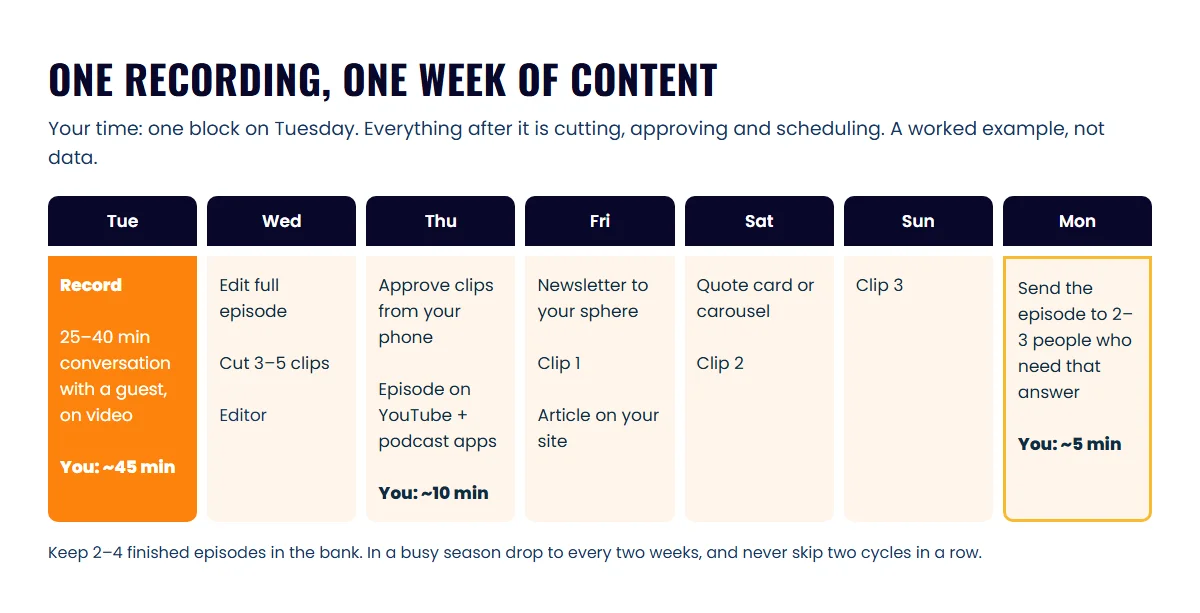
- Full episode. It goes up on YouTube and in podcast apps.
- Clips. Cut three to five short clips of 30 to 60 seconds, each built around one useful answer.
- Quote card. Make one graphic or carousel with the guest’s best line.
- Newsletter. Write two sentences to your sphere on what you learned, plus the episode link.
- Article. Publish a page on your website built around the main question the episode answers.
- Personal follow-up. Send the episode to two or three people who need that exact answer.
That last item is where content turns into business. A seller who’s worried about the inspection hears your inspector guest explain it, and they hear you asking the right questions. For the full cut list with more formats, use the podcast repurposing checklist.
How do you stay consistent with content in a busy season?
You stay consistent with content in a busy season by building a buffer before it arrives and by stepping your cadence down instead of stopping. Consistency fails on the week you skip with nothing in reserve, not on the week you’re busy.
Three rules handle almost every crunch:
- Keep an episode bank. The ICONS Podcast Framework advises having 10 episodes ready by launch day. After launch, aim to stay two to four episodes ahead. Record extra in slow weeks, like late November or mid-January.
- Step down, don’t stop. If weekly breaks, go to every two weeks. A slower rhythm keeps the habit alive. Silence is what ends it.
- Never skip two cycles in a row. One missed week is a blip. Two is how a habit ends.
Most shows never get far enough to need these rules. An Amplifi Media analysis from 2021 found that 44% of all podcasts have three or fewer episodes, and only 36% reach ten or more. Simply still being there in month six puts you ahead of most of the people who started at the same time.
We go deeper on where shows stall, episode by episode, in why podcasts fail by episode 6. If YouTube is the channel that keeps dying on you, see why real estate agents quit YouTube and how to stay consistent.
What should you hand off, and what has to stay yours?
Keep the parts only you can do, the conversation and the relationship, and hand off everything that happens to the file afterwards. Editing and posting are where busy agents lose their evenings, and they’re the easiest jobs to delegate.
This split shows what to keep and what to give away.
| Task | Keep or hand off | Why |
|---|---|---|
| Choosing and inviting guests | Keep (with help on scheduling) | The guest list is your referral network |
| Recording the conversation | Keep | Your voice and judgment are the product |
| Following up with the guest | Keep | The relationship is the real return |
| Editing audio and video | Hand off | Hours of work, no business judgment needed |
| Cutting clips and captions | Hand off | Repeatable with a clear brief |
| Writing the newsletter and article | Hand off, then approve | You check facts and tone in minutes |
| Scheduling and posting | Hand off | Pure admin |
If you’d rather keep everything in-house, the weekly time budget for a real estate podcast shows how many hours each task really takes. If you’d rather hand it off, our done-for-you podcast production is built around that split: you record, and the team handles everything else.
How do you know your content habit is working?
You know your content habit is working when you can count conversations and referrals from it, not just views. Track four numbers in a simple sheet every month:
- Weeks published in a row. The habit itself. Aim for 12 before you judge anything else.
- Guests recorded. Each one is a new relationship, even if the episode gets 40 plays.
- Replies, DMs and calls that mention an episode. The early sign that people are listening.
- Business from guests or listeners. Referrals, listings and introductions you can trace back.
The first two prove you’re consistent. The last two show whether the content is doing its job. For how these numbers fit into a wider plan from content to closed deal, see how real estate agents turn content into leads.
Next step
Put one recurring recording block on your calendar this week, then invite three guests for the next month. Once those are booked, you have a schedule that doesn’t depend on willpower.
If you’re wondering what happens to all those recordings in two years, read why podcast episodes outlast social media posts, and how to make sure yours do.
Frequently asked questions
How often should a busy agent post on social media?
Post as often as your one weekly recording can feed, which for most agents means three to five short posts a week cut from the episode. Steady and repeatable matters more than daily.
Is batching content worth it for real estate agents?
Yes, if you batch the recording, not just the posting. Two or three conversations recorded in one block can cover a month, and the editing can happen without you.
What if I hate being on camera?
A conversation is easier than talking to a lens alone, because the guest carries half of it. Start with audio plus a simple webcam frame and build from there.
Sources
- Why there really aren't 2 million podcasts — RAIN News (Steve Goldstein, Amplifi Media) (accessed October 21, 2026)
- Schedule video publish time — YouTube Help (accessed October 21, 2026)
Done-for-you podcast production
Want a podcast that brings in referrals, not just downloads?
Icons of Real Estate plans, produces and publishes business-growing podcasts for agents. You record. We handle the rest.
Launch Your Podcast
Written by
Co-Founder and Podcast Guru, Icons of Real Estate
Tomás Fonseca co-founded Icons of Real Estate in 2021 and is its Podcast Guru. He has a background in marketing, with stints at companies like Nintendo and Ardor SEO, and is one of the hosts of the Icons of Real Estate Podcast.

How we research, write, fact-check and correct articles: our editorial standards.