On this page
- What is evergreen content for a real estate agent?
- Do podcast episodes really outlast social media posts?
- Which podcast topics stay evergreen for agents?
- How do people find an old podcast episode?
- How do you make a podcast episode evergreen?
- How do you turn old episodes into a library clients use?
- Where do social media posts fit around evergreen episodes?
- Next step
Evergreen content for real estate agents is anything that answers a question clients will still ask in two years. Podcast episodes can outlast social media posts by years, because feeds favor what was just posted while search and direct links keep surfacing a useful episode. That only works if the topic doesn’t expire and the episode is easy to find.
Most podcast marketing skips that second half. An episode isn’t evergreen just because it’s long or recorded. Below is what makes the difference, and how to build your back catalog so it keeps working.
What is evergreen content for a real estate agent?
Evergreen content for a real estate agent is a piece that stays accurate and useful long after it’s published. “What does a home inspector look for?” is evergreen. “Rates moved this week” is not.
A quick test for any topic. It’s evergreen if you can answer yes to all three:
- Will a client ask this again next year? Questions about process, costs, choosing professionals and preparing a home come up with every deal.
- Is the answer stable? Rules of thumb and how-to answers change slowly. Prices, rates and inventory change monthly.
- Would you send it to someone a year from now? If you’d happily text it to a new buyer next spring, it’s evergreen.
Most of what agents post fails this test, and that’s fine. Market updates, new listings and event posts do a job this week. The mistake is spending all your effort on content that expires and none on answers that don’t. Use your recording time for the lasting questions, and keep the news for short posts.
Do podcast episodes really outlast social media posts?
Podcast episodes can outlast social media posts, but only when they’re built to. A social post fades by design, while a podcast episode fades by neglect.
Social feeds lean on recency. Instagram’s own explanation of how its ranking works says Feed signals include when a post was shared. A great post from last March is rarely seen today unless someone goes looking for it.
Podcasts aren’t automatically better. Backlinko’s analysis of 3.6 billion articles, last updated in 2021, measured shares and links that arrive more than 30 days after publishing. It found podcasts were 4.28x less likely to be evergreen than list posts. The same study found that heavy engagement on Twitter rarely led to long-term shares and links either.
The honest reading: format doesn’t make content last. Topic and findability do. A podcast episode simply gives you more to work with, because it’s long enough to answer a question properly and it can live in search, on your website and in your follow-up emails.
This table compares the three places your content usually lives.
| Content | How people find it after week one | What keeps it working |
|---|---|---|
| Social media post | Rarely, unless saved or shared | Little; reach is front-loaded |
| Podcast episode in apps | Subscribers scrolling back, show search | A clear, searchable episode title |
| Episode on YouTube | YouTube and Google search | A title and description that match the question |
| Episode article on your website | Google search, links you send | Updates, internal links, an embedded player |
Which podcast topics stay evergreen for agents?
The podcast topics that stay evergreen for agents are the questions clients ask at every stage of a deal. Interview the professionals who answer them. Save the time-stamped news for short posts.
| Evergreen episode topics | Dated topics (keep for short posts) |
|---|---|
| What an inspector looks for in older homes | This month’s sales numbers |
| How a lender pre-approval really works | This week’s rate move |
| Staging on a small budget, with a local stager | A new listing just hit the market |
| What a past client wishes they’d known | Holiday open-house hours |
| How to choose a contractor after closing | A local event this weekend |
A series of these turns into a library you send before the first meeting. That’s the idea behind buyer education episodes: one evergreen answer per episode, sent at the moment a client needs it.
How do people find an old podcast episode?
People find an old podcast episode in three ways: search, your website, and you sending it to them. Podcast apps on their own don’t do much for the back catalog.
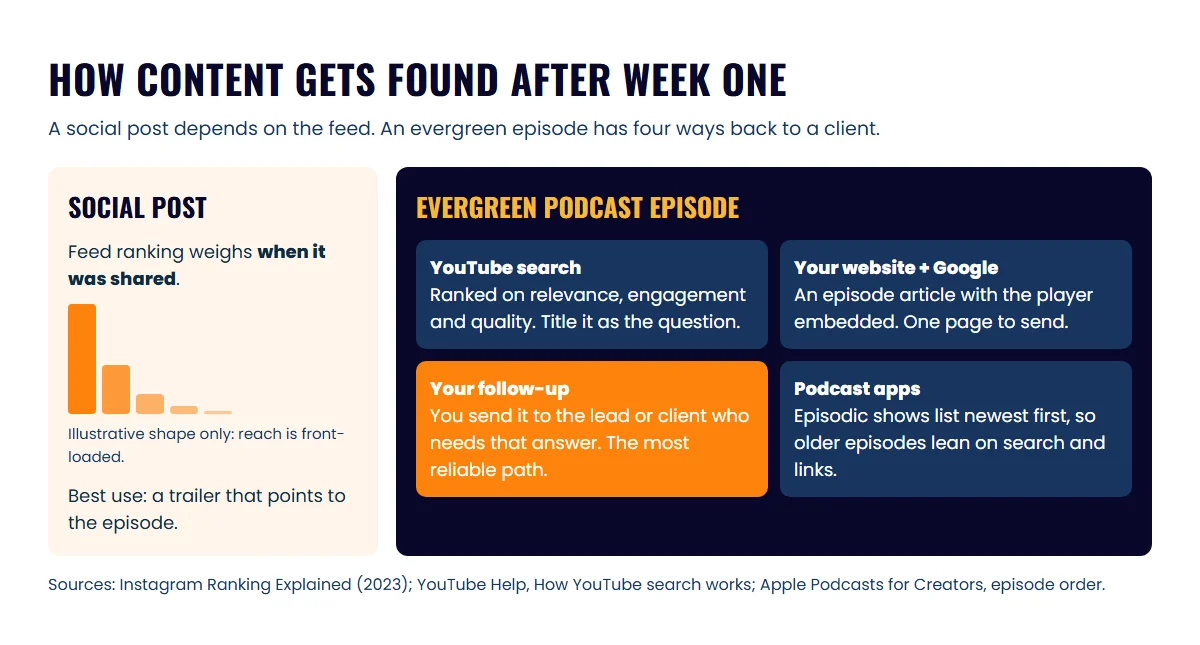
- Search. YouTube says its search ranks videos on relevance, engagement and quality. A clearly titled interview that answers a common question can keep showing up.
- Your website. An article built around the episode can be found on Google, and it gives you one page to send. Our guide shows how to embed the episode player on your own website.
- Direct follow-up. You send the episode to a lead or client who needs that answer. This is the most reliable path, and it’s covered in using podcast episodes in lead follow-up.
- Podcast apps. Apple says episodic shows are listed newest first. Listeners who find your show usually start at the top, so older episodes in apps depend on search and links.
How do you make a podcast episode evergreen?
You make a podcast episode evergreen by choosing a lasting question, keeping dates out of the recording, and giving the episode a home that search engines and people can reach. Run this checklist on every episode:
- Title it as the question. “What inspectors flag in older homes” beats “Episode 42 with Dave.”
- Keep time stamps out of the talk. Avoid “this week” and “this spring” in the main answer.
- Put dated news in the intro or a separate short. Then the core episode still works next year.
- Publish it on YouTube with a full description. Use the words a client would type.
- Write a website article for it. Answer the question in the first paragraph and embed the episode.
- Add it to a follow-up sequence. Decide which client stage it belongs to.
- Review the catalog once a year. Update show notes where facts changed.
If you want this done for every episode, our podcast production service includes episode articles on your site along with the editing and publishing.
How do you turn old episodes into a library clients use?
You turn old episodes into a library by grouping them by the moment a client needs them, then putting that list where clients already look. A back catalog nobody can browse is just an archive.
Most agents only need three groups to start:
| Client stage | Episodes to file there | Where to put the list |
|---|---|---|
| Thinking about buying | Lender, first-time buyer mistakes, how offers work | Your buyer consultation email |
| Getting ready to sell | Stager, contractor, pricing, what inspectors find | Your listing presentation and pre-listing packet |
| After closing | Insurance, contractors, local services | Your closing gift note and annual check-in |
Build one page on your website for each group, with a sentence on each episode and the player embedded. Then link those pages from your email signature and your follow-up templates.
Once a year, go through the list. Remove anything that’s now wrong, and record a fresh version of your most-sent episodes. A five-year-old episode with a guest who has since retired can still work, but a new one with the same question usually works better.
Where do social media posts fit around evergreen episodes?
Social media posts fit around evergreen episodes as trailers. A clip or quote card gets attention this week, then points people to the full answer that will still be there next year.
Cut two to four clips from each episode and link each one back. Our guide to podcast clips for real estate agents covers which moments draw replies. Agents who appear on an ICONS podcast can use ICONS Social, which drafts posts from the episode for them to approve. For non-podcast post ideas, our older list of social media ideas for real estate agents still works as a starting point.
Social posts aren’t wasted effort. They just shouldn’t be the only place your best answers live.
Next step
Pick the three questions you answer most often on calls and book a guest for each. Those three episodes will be your first evergreen library. To keep recording them through busy months, see how busy real estate agents stay consistent with content, and for the bigger plan, how real estate agents turn content into leads.
Frequently asked questions
How long does a social media post last?
There's no single number, and platforms don't publish one. Feeds rank posts partly on when they were shared, so most reach comes early. Treat a post as a short-term trailer.
Should I delete old podcast episodes?
Only if the information is now wrong or off-brand. Otherwise update the show notes, add a line at the top of the article that says what changed, and keep the episode live.
Is a market update ever evergreen?
Not the numbers. The skill behind it can be: an episode on how to read a local market report stays useful long after the figures in it are out of date.
Sources
- We Analyzed 3.6 Billion Articles. Here's What We Learned About Evergreen Content — Backlinko (accessed October 21, 2026)
- Instagram Ranking Explained — Instagram (Adam Mosseri) (accessed October 21, 2026)
- How YouTube search works — YouTube Help (accessed October 21, 2026)
- How to set the order of podcast episodes — Apple Podcasts for Creators (accessed October 21, 2026)
Done-for-you podcast production
Want a podcast that brings in referrals, not just downloads?
Icons of Real Estate plans, produces and publishes business-growing podcasts for agents. You record. We handle the rest.
Launch Your Podcast
Written by
Co-Founder and Podcast Guru, Icons of Real Estate
Tomás Fonseca co-founded Icons of Real Estate in 2021 and is its Podcast Guru. He has a background in marketing, with stints at companies like Nintendo and Ardor SEO, and is one of the hosts of the Icons of Real Estate Podcast.

How we research, write, fact-check and correct articles: our editorial standards.